The Top 100 started as a hobby; a fan adoring his musical heroes and paying tribute by making portraits of them. The hobby became obsession and the project went from the boy’s room into the art world. But I'm still that fan, it's about them in the end, their music, and not about me.
Photography provides our culture with ongoing snippets of reality. The instantaneous nature of these snippets are not being questioned because, after all, they are photographs. The camera is a machine and it objectively records reality accurately. It records reality unbiased and we ignore, or forget, the subjectivity of the photographer, who, by selecting which instant to share, already interpreted reality for us. Painting, contrary to this, is not instantaneous, and will not be considered as objective reality. The subjectivity of a painting is an automatic integral aspect in our reading of it, how we interpret what we see. In the same manner objectivity is an aspect of how we see a photograph. While painting from a photograph, which is what I do with these Top 100 portraits, the two different realities overlap, or rather the second (painting) is superimposed on the first Photography.) Certain aspects of instantaneous reality, taken for granted in a photograph, can look rather out of place in a painting. A photo of a figure in mid-motion, for example, could look awkwardly out of balance in a painting. Our mind simply recognizes the continuous motion in the photo but fails to so in a painting. The instantaneous moment is extended in the painting and the figure looks hopelessly unbalanced. You can easily tell the difference between a portrait painting from a photograph from a painting using a live model, a sitter. A big smile in the face is a first and easy giveaway. A big smile can be captured by a camera because its instantaneity, those photographed in fact, often do smile. While painting the smile it can not succeed in capturing the emotion, expression, of the instant. When looking at a painting of a person with a big smile, you will see certain wrinkles, individual teeth, but not a happy joyful expression. When I occupy this place between the instantaneous and the extended, I consider all these aspects of representation. I will remove evidence of the instance, and try to capture a person in an extended viewing, to show a broader view of a person's character as if this person were viewed over time. In the case of my Top 100 paintings this constitutes the viewing of many different photos, or videos.
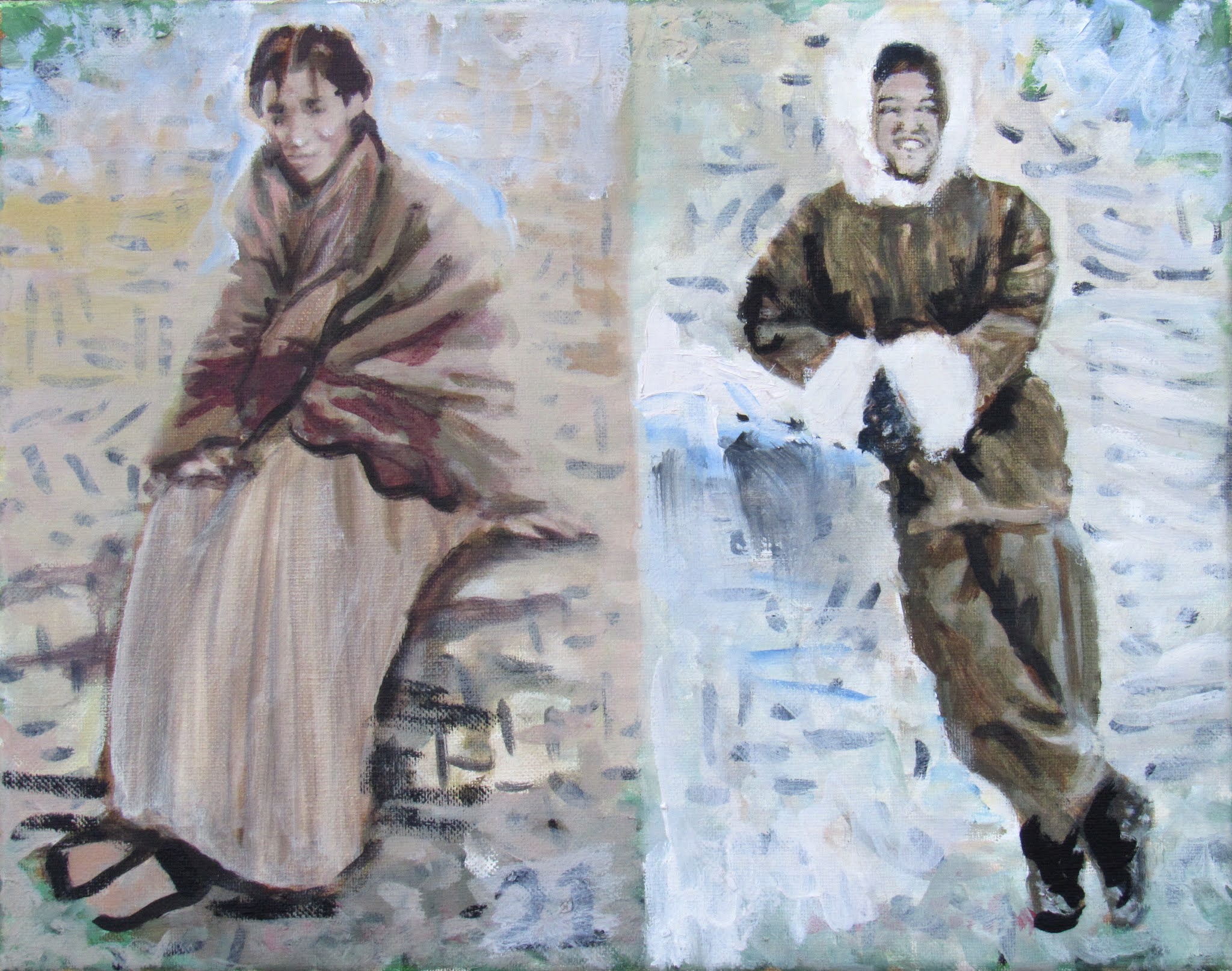
Alaci Tulaugak;Nellie Nungak/Mary Sivarapik
Lately, I've become interested in reversing this relationship. To paint precisely those things that make a photograph a photograph, aspects of reality that are the unique property of photography. I paint the broad smile, the mid-motion depiction of a figure in motion, the out-of-focus face, or background, the disproportionate view that results from an odd vantage point (like being real close to a person for example.) In a video I recorded last week, I hold a record sleeve of a randomly selected disc. The person depicted on that cover seems up-side down, but she isn't. It's just that she is laying down on the ground and the photographer hovers over her with a (his) camera. In a painting, I thought, the image of the woman would look for sure up-side down. While I was recording the video I was in the process of painting certain Canadian Inuits from Nunavut that are part of the Top 100 2022. The video, shown below the second Inuit painting, became about that record sleeve, rather than about the current painting I was working on at that moment.
Two singers from Canada: Inuit Games and Songs
Even though the record, A Stereo Visit to Italian Movies, is not at all a part of the Top 100 2022 list, far from it, I had to paint it as if it were. I was reinforced doing so because of another random pick from my record shelves. This was a record of the Argentinian singer Ramona Galarza, the cover of which shows a background upside down as trees are reflected in the body of water directly behind Galarza. The painting then is a double portrait of the model featured on the Italian movie record together with Ramona Galarza, as she appears on the cover of the self titled record. At this moment I feel this painting is part of the current Top 100 series but I'm not 100% yet on this issue. This is the painting in question (below.)
A double
portrait of the percussionists Max Roach and Joe Chambers, both members of
Roach's M'Boom ensemble whom are listed in this this years top 100 list.In one single painting such as this one, as a
microcosm, the whole series of 100 paintings, of all series of a hundred
paintings play out. In it, as the subject matter, is the music. It all starts
with the music. The music carries that feeling of being carried away into a
different state of being, a more timeless and more real sense of being. When
hearing the Max Roach M'Boom group for the first time you feel as if you are
there, as part of the ensemble, as part of history, as part of a world that is
different from the world you encounter when you balance your checkbook or bring
your car into the shop for an oil change. The moment you hear the ensemble for
the first time the checkbook and car oil are forgotten, they don't exist at
that moment in time. It is a little different when you listen to it for a
second time and a little more different the third time. You start to
distinguish individual details and chance, surprise, and spontaneity cease to
exist.
Now the M'Boom recording is not as transformative an
experience than hearing, for the first time, the unpretential and spontaneous
song a mother gets into when washing her child in the middle of the New Guinean
jungle (as recorded by Charles Duvelle in the 1970s) but in a way it's the same
sensation be it less removed from my own experience. I have no memory of my
mother singing to me and I have no memory of being washed but I do remember
seeing jazz concerts. The first shockingly new jazz concert I saw was when I
was in my early 20s and saw Han Bennink perform with Mischa Mengelberg. Jazz,
perhaps more than other Western type of music, is transformative because it is
often improvised and spontaneous. I too have unforgettable experiences of
jamming with other musicians right around that time too. These feelings I seek
to duplicate in painting now. Painting did become a substitute for music.
Painting allows me to transport my being to a different reality, the reality of
color and form and creativity. Honestly, as I'm painting this painting representing M'Boom, that delayed
conscious state isn't there. Most of the time, making the painting is work. The shift in conscousness is there only in moments, moments of
spontenaity and creativity that often occur after lengthy spells of plain work.
Alaci Tulaugak, Paul Hodge/Marvin Green, Nellie
Nungak
From: Inuit Throat and Harp Songs: Eskimo Women's Music of
Povungnituk recorded in 1979 by Paul Hodge and Marvin Green. The katajjait of
Povungnituk in Quebec has characteristics that distinguish them from those of
Nunavut (see Nicole Beaudry for example) in that their songs are strictly imitations of the
sounds of nature. In Sound of the Wind the sounds of wind blowing through
the cracks of an igloo are imitated. Different too is a variation of katajjait
that is performed by four women as opposed to the customary two (female)
performers standing close to one another.
Laura Boulton, a socialite from Ohio (b. 1899, Conneaut,
died in 1980), had a 50-year long career in ethnomusicology that started with a
trip to Africa in 1929. She recorded more than 30,000 songs travelling
throughout the world. She saw herself as a song catcher, doing the noble work
of preserving the music of vanishing cultures, that she, like most other early
ethnomusicologists, considered primitive. Her legacy, despite the colonial
attitude, is the preservation of musical traditions now extinct. She was not
only an early practitioner in the world of ethnomusicology, she did so as a
woman. (Not many women recorded in the field in the early years. One notable
exception is Frances Densmore, whose known for her work with Native American tribes
is well known. Densmore started much earlier than Boulton and is also less
colonial in her attitudes.) I've painted Laura Boulton four times now, three
tracks from the LP African Music recorded in the 1930s made it into the 2021
list. The fourth track in the top 100 (at #2) is the Girl's Game from
the LP The Eskimos of Hudson Bay and Alaska in the 1940s during the
Second World War. She considered the Eskimo recordings "the most primitive
in her collection" and therefore "unusually interesting." I've written
about this painting earlier as it was the first painting I created for the current
series of 100. I'm reproducing the painting here again because I've altered it
quite a bit. I have all paintings in the series hanging on my studio wall and
every time I see something in an older painting I don't like I fix it. The
individual paintings aren't considered finished until the whole series is
finished and exhibited. I did not change the figures much in the painting but
adapted the rest to fit an evolved concept for the series as a whole.
Baker Lake Eskimo/Laura Boulton
The Folkways LP African Music [1957] was
recorded in the 1930s and originally released as a set of six 78 rpm records on
Victor in 1939. The recordings were made mostly in the French Sudan (now Mali)
and also includes recordings from Cameroon, Nigeria, and Benin. The three tracks
in the Top are War Song by Malinke people recorded in Bamako, Mali, a
track with short outtakes from different songs sang by Tuaregs recorded in
Timbuktu also in Mali, and Orphan's Wail by a Bakwiri singer from southern
Cameroon. The painting up top illustrates the Tuareg recordings, a track that
includes a lullaby, a herding song, and a marriage song. I used a photo taken
in Timbuktu, from the record sleeve for the Tuareg singer. It is the only photo
of the four that was not taken by Boulton as she also appears herself in the same
photo. That image of Boulton I had already used for the image illustrating the Bakwari
singer on Orphan's Wail. Boulton doesn't name the singer but she did
photograph him in the process of recording.
Bakwari singer/Laura Boulton
The third track then from African Music is the
War Song performed by Malinke people on harps and drums. The image of the
Malinke harpist was again taken by Boulton during the recording. It's one of
most fascinating drum rhythms I've ever heard.
There are two children's game songs included on the LP The
Eskimos of Hudson Bay and Alaska. [Folkways, 1955, recorded by Laura Boulton]
One is called Girl's Game and the illustration for it I did about a year ago at
the beginning of the Top 100 2020 nicknamed The COVID series. Girl's Game is number 5 on
the list. Here's the illustration for the second one found that is fifth from the bottom of that list now that the COVID series nears it's completion: Children's Game. The recording is of two six year old girls holding hands while echoing each
others lines, rhythms, breathing and panting. Soon they will be able to
perform a proper katajjaq. The image I used this time is not a photo by Boulton
but a contemporary image owned by Alamy Stock Photos.
A few days prior to the drawing of the Inuit Children I did a
portrait the Uzbek Afghani singer Mijan who's Afghan Old Song is at number 94.
The song was recorded in 1965 and functions as a stand in for the Uzbek song by
this singer that was recorded in 1967 and found on
Musiques Clasiques et populaires d'Afghanistan. [Musee de l'homme, Paris, 1976, recorded by Bernard Dupagne]
The two songs are nearly identical. Mijan was 20 in 1967 and
after a performance at Radio Kabul some years later she became a well known
singer, now renamed Sabza Gul. I recorded a video showing the process of making this drawing. The full drawing took about two hours to complete, one of the quicker ones from the COVID series (most drawings were stretched out over several days.) The video is less than half an hour.
Simultaneous to producing the two drawings above I also
continued work on the next series: The Top 100 2021, the double portrait
series. On the heels of a double portrait illustrating a recording found on the
Russian made Voyage en URRS series comes yet another one from the same collection. As I
did with the previous one I had to stretch the perimeters of who I could pick.
The recorder is not listed and the singer elusive. I stated just two weeks ago
that I have not been able to find an image of any of the many musicians from
the collection that have been in a Top 100. But now I just may have identified
D. Kosterdine, whose Morceau de Khe has been a long favorite of mine. I'm not
totally sure but I think that Delsjumjaku Demnimeevic Kosterkin, who appears on
the cover, and inside on the CD, of Siberié 1:
Chants chamaniques et narratifs de l'Arctique Siberién, is the
same person as the aforementioned D. Kosterdine. Both are Nganasan shamans. There
is at least a decade between the recordings made by Henri Lecomte and the
Russian recordings but Lecomte encountered a older shaman so that doesn't rule
out that the two are one and the same individual. Lecomte then is paired with
Kosterkine in this painting. Lecomte took the photo that became the cover of Siberié 1 that I used.
Tuurnagaaluk (6009) and Eunice Kunuk Arreak (6010)
Number 87 of the Top 100 2020 is track from the CD Canada: Inuit Games and Songs on the UNESCO label. The track is labelled Two Katajjait and it, as the title implies, consists of two recordings of a katajjaq, the Inuit style of throat singing in the form of a game. Both recordings are short and are from two different locations with different singers, recorded by different musicologists in the mid-1970s. The first one, recorded by Nicole Beaudy, features Elijah Pudloo Mageeta and Teemegeak Pitaulassie. This was recorded at Cape Dorset. The second one was recorded by Denise Harvey and is a duet by Maggie Grey and Jessie Tomassie at Payne Bay. There have been so many recordings of katajjait in the Top 100 and so few of the singers have been photographed for the albums (or at all on-line for that matter) that I have been forced in being creative when it comes to selecting individuals to illustrate the songs. For this one I stumbled on a very interesting article from the Library Archives Canada Blog titled Inuit: Disc Numbers and Surname Project that chars the history of attempts by the Canadian government to maintain a inventory of the Inuit people. I had never heard that Inuits were given numbers that then were printed on a small plaque (disc) that they had to carry with them at all times. The practice was abandoned in the 1970s. The images I drew in this work are from two photos that were taken directly after one another and did appear in that article.
While working on the Inuit drawing I also worked on a painting for the Top 100 2021 simultaneously (as I have been doing the past months). Depicted are the Swiss/French photographer Barbara Brandli and one of her subjects who appeared on the cover of the album Music of the Venezuelan Yekuana Indians. [Folkways, 1975] Brandli (1932-2011) is a world renown photographer who, after a successful career as a photographer of the Parisian society, went on to live in Venezuela. She is best known for her work with the Yanomami Indians. The song illustrated is calledEdanaka hani amöde and makes the list for the third successive year.
Numbers 64 and 65 of the Top 100 2012 happen to belong to the same
series of recording and come from the same album: Songs of the Inuit
Iglulik. Both songs were recorded by Jean-Jacques Nattiez in 1977. That
the songs appear next to one another in the list is a coincidence; I do
not place the songs into the list as I fancy, the songs appear by virtue
of a number system. Both the Huangahaaq (#65) and the Nirdliruyartak
(#64) happened to end up with the exact same number of points. Both
Huangahaaq and Nirdliruyartak are a form of throat singing games but
different from katajjait (a song style). Compared to the dozens of
katajjait recordings that have featured in recent top 100s they were
also recorded further north from the Hudson Bay area most katajjait
originated from. Number 64 was recorded in Pond Inlet and 65 in Iglulik.
Both locations are close to one another and well inside the Arctic
Circle. The Inuit: Iglulik cd is well documented. It comes with a 55
page booklet with numerous illustrations, all photographs by
Jean-Jacques Nattiez. The photo of Annie Kappianak (together with Rose
Iquallijuk) that appears in the booklet is the only throat game song
illustrated though and is of the performer of number 65 be it with a
different partner than on the recording. Kappianak teams up with Jeanne
Amainuk on a Huangahaaq game. The song "is not based on a text but on
the juxtaposition of syllables or words, connected more for their
sonorous qualities than for telling a story." "The game consists of
making the partner lose [his] seriousness, using diverse modulations of
the word hang. The women pull wry faces."
Iglulik Inuit, Jean-Jacques Nattiez
The nirdliruyartak is similar to the katajjait of Northern Quebec. The
nirdliruyartak is a complex game of alternating high and low sounds and
is difficult to learn. The sounds are made while both inhaling and
exhaling. The high sequence of sounds is called nirdliruyartak, which
means goose cry, and is the name of the game. The image I used for this
song does not appear in the cd booklet but appears in Inuit Throat-Games
and Siberian Throat Singing: A Comparative, Historical, and
Semiological Approach by Jean-Jacquez Nattiez. [University of Montreal,
1999] The women in the photo by Nattiez are not identified by name but
are Iglulik.
I made a second painting directly after I finished the first. The
painting represents the provisional number 2 in the Top 100 2021. Like
the first one, the location is again Nunavut, Canada. This time further
north in Kinngait on Baffin Island. The painting represents the track
"Three Katajjait," first on the Unesco record "Canada: Inuit Games and
Songs." A Katajjaq (singular form) is a game song performed by two woman
who stand close together. They mimic each other's sounds until one
starts laughing, she is the loser. The three katajjait were performed by
five different performers and again I do not know if the (nameless)
woman on the left in the painting is either on of the five. I do now
that it comes from a performance of a katajjaq and the the photograph I
used was taken at around the same time (1974) the recording was made.
The photo was taken by Nicole Beaudry, who also recorded the "Three
Katajjait." The woman on the right is Nicole Beaudry, be it from a much
more recent photograph of her. There's a lot of laughter on both the
numbers 1 and 2 recordings during their respective performances. Beaudry
herself suggests that this is because the music of both recordings are
games and not considered music by the Inuit themselves. I argue that it
is music, and the laughter an expression of the joy felt when two souls
merge.
The contrast of the two men depicted in the above image is stark. The
intentional juxtaposition of object and subject in these series of
paintings (The Top 100 2021) is especially pronounced in illustrations
of older recordings. Anthropology has evolved from the colonialist
attitude of the 19th and early 20th centuries to the immersive
contextual discipline it is today. The term ethnomusicology was not in
use yet in 1949 when Adolphus Peter Enkin recorded "The mourning 'call'
of Melville and Bathurst Islands. The photo credit of aboriginal
rock-painter on the left that I used is Mount Ford. I assume this refers
to Charles Mountford, the leader of the 1948 expedition to Australia's
Northern Territory (where both mentioned islands are situated.) Enkin,
an Anglican clergyman, was at odds with his then boss Mountford. Enkin
was a champion in the fight against prejudice and racism, and was an
outspoken advocate for equal rights for indigenous Australians. A.P.
Enkin to his credit, broke through the divide that considered indigenous
peoples as primitive and as savage. Extended contact and communication
will accomplish a better understanding, I assume. Still the
object-subject relation is clearly visible. Starting in the late1960s it
becomes standard practice for anthropologists and ethnologists to not
only extend contact with their subject but to live with them, often for
many years, to understand the cultures they research. The drawing below,
belonging to the Top 100 2020, illustrates the music of the Hamar in
Southern Ethiopia. Husband and wife team of anthropologists Ivo Strecker
and Jean Lydall, and their two two young children, went to live with
the Hamar in the 1970s.
I just watched (part of) a movie by Rosie Strecker, who was the daughter
of Strecker and Lydall and lived with the Hamar for several years since
she was 4 months old. The movie documents her return to Ethiopia many
years later. The story is heartwarming and strengthens my belief in the
goodness of humanity. Object and subject collapses in this movie as it
does in the best of modern anthropology, and ethnomusicology.
The Yamana, or Yaghan people were the southernmost inhabitants of the earth. They are often grouped with the Selk'nam people as well other groups that lived in Terra del Fuego in the south of both Argentina and Chile, but they are a distinct other group with their own unique language. I've written a lot about the Selk'nam before as I have been intrigued by their remarkable traditions of body painting and the cosmogenesis it enacts. I reproduced two photographs of Selk'nam people, taken by Martin Gusinde in the early 1920s, in my art appreciation textbook You are an Artist. It was also Martin Gusinde who was the first to record the Selk'nam as well as their neighbors to the south the Yamana. Canto Yamana, at #58 in the Top 100 2020, is a recording from 1923 of a shaman. When Gusinde writes about the music of the Yamana he talks about boatmen songs. The singing of the Yamana, according to the early anthropologist Erich von Hornbostel, is the most primitive of the world, using only two notes.
Baker Lake Eskimo and Laura Bolton
While the drawings for the Top 100 2020 continue to be made until all 100 are done, I started the Top 100 for the year 2021 already. The Top 100 2021 exhibition is scheduled for next summer in Dublin, Ohio and I felt like starting early. I also didn't paint much for a while and now with my studio in working order it is really nice to be out of the house. (A lot of activities, such as my job, are still being done from home.) I had a plan. The concept for the new 100 paintings was to paint double portraits, featuring the musician on one side of the canvas, and the one who recorded it on the other. I figure the juxtaposition is an interesting one. I have now one done and a second one started. I'm still not 100% sure how to tackle certain aspects, like text, in the painting. I experimented here but may change the markings later. The 1 in the top right corner means it's number 1 in the Top 100 2021. This may change because the making of the list for this year is in progress. I am certain, however, that Girl's Game, sung by Agnutnak and Matee, two-fifteen year old Inuit women from Baker Lake, Canada, will be part of the list when it is final. The song was recorded by Laura Bolton in 1974 at Baker Lake and appeared on the Folkways album The Eskimos of Hudson Bay and Alaska. The photograph I used to paint the young woman was taken by Bolton and was included in the liner notes for the record. The song was also listed last year. When I painted an image for the Top 100 2020 I used the same photo. I did include the rest of the family then.
Much of the the Top 100 2020 comes from regions barely affected by the global COVID-19 epidemic. More than a month after I painted the previous Inuit entry, the numbers for Nunavut (the Canadian Inuit Province) remain at zero. The katajjait vocal style features two women singing/breathing into each other's mouths so their voices resonate. Needless to say that COVID-19 would easily spread in the process. Nunavut is the location with most recordings in this top 100 followed by the Solomon Islands. I just read in the news today that the Solomon Islands recorded their first case of COVID-19. Maria and I both work in public spaces in a city where the virus is spreading rapidly. I thought it would be wise to get ourselves tested which we did today: the results came back negative. The song illustrated is a Qiarpaa, a variation of the katajjaq genre that really are considered games rather than music. This particular example from the collection Canada: Jeux Vocaux Des Inuit was performed by Issumartarjuak and Watuak and recorded by Roman Pelinski at Eskimo Bay.
Eskimo Family, Baker Lake
11 x 14 inches, watercolor, pencil, spray paint on paper, 2020
Many tunes in this year's list end with laughter, not because the music is particularly funny but that it evokes exaltation. Indeed this year's top 100 is the happiest of all 36 editions thus far. In the case of katajjait laughter is actually the true end of a song much like in a staring contest. It simply ends when one breaks into laughter. The other individual is then the winner of the game. Jean-Jaques Nattiez, one of the foremost authorities on the subject, is hesitant to call the Inuit katajjait tradition music as he regards the activity as games. The Inuit themselves do not consider these games music either. To me though, these games are key in my lifelong search into the essence and origin of music. The laughter and the game are both biological feats of humanity (which also extends much further into the animal kingdom) while music and art can be considered a cultural heritage. Music is played (as opposed to work) for the sake of happiness (and elation, exhilaration, etc.) Games, for a great part, is the property of children. In games children act out the stimulation of perceived reality, often the behaviors of adults. Games can also be nonsensical, games for games sake, for fun and laughter. The laughter at the end of songs in this top 100 isn't limited to katajjait only but it is limited to the format of two performers only, and only when the duet is of women or children. There are plenty of children's duets in the list. The one I found on The Eskimos of Hudson Bay and Alaska [Folkways, 1955] is truly amazing. Heard are two 15-year old girls who whisper words into a kettle-resonater placed on the ground. The rhythmic breathing then contributes to a feedback loop that only gets interrupted when one starts to laugh. We have names too, rare for field recordings that old; one girl is called Angutnak and the other Matee. The recording was made by Laura Boulton at Baker Lake, Hudson Bay, in what is today Nunavut, an enormous semi-autonomous region in Canada. The photograph that I used as source for this drawing was also taken by Laura Boulton at Baker Lake. Perhaps one of the children of the Inuit family depicted in it is either Angutnak or Matee, I wouldn't know. There are currently no cases of COVID-19 in Nunavut.
A contemporary analogy of the elation evoked by duet singing can also be found in popular music. A good example of this is a duet I recently saw on YouTube by Bonnie Raitt and John Prine performing Angel From Montgomery. The laughs exchanged by the two at the end of the song speak pure happiness. Think also of the laughs exchanged between Kenny Rogers and Dolly Parton in their many duets. Yes, both of these I watched because of the passing of yet another pop icon. Besides Prine and Rogers the list also includes Little Richard, David Olney, Millie Small, Betty Wright, Manu Dibango, and Bob Andy, to name just a few. Some died, like Manu Dibango, whose best known song Soul Makossa once scored high in a previous top 100, from the Coronavirus. I saw Manu Dibango perform live maybe fifteen years ago or so.
Nellie Echalook and Rebecca Natialuk
11 x 14 inches, mixed media on paper, 2020
As long as the stay-at-home order stays in place, I'll keep doing these meticulous drawings for the Top 100 2020. I'll go by my preliminary list starting at no. 1 which I did last week. This is then the no. 3 thus far; a recording made by Nicole Beaudry at Cape Corset, Baffin Land in 1974. The recording is the first track from the CD Canada: Chants et Jeux des Inuit [Musiques & Musiciens du Monde, Unesco Collection, 1991; first appeared as an LP in 1976]. The track is labeled Trois Katajjait de la Terre du Baffin and alternatively Trois Jeux de Gorge, Katajjaq. The one track has three recordings made on different occasions by four singers (each recording is a duet, as Katajjait are typically performed by two singers.) The performers are: Elijah Pudloo Mageeta, Quanak Martha Meekeega; Napache Samaejuk Pootoogook, and Napache Etidloie Toonoo. I have not been able to find any photographs of any of the performers on the CD but was delighted to find an image of two performers who in a previous year were listed, Nellie Echalook and Rebecca Natialuk. I did not have this image available to me when I made a painting illustrating their katajjaq. At this point there are already ten different katajjait listed in my top 100 list, several from the CD mentioned above.
Group of Inuit Women
14 x 11 inches, oil on canvas, 2019
The Qiarpa (chorus) this painting represents was recorded at Eskimo Point by Ramon Pelinski in 1980. It can be found on the cd Canada: Jeux Vocaux des Inuit (Inuit de Caribou, Netsilik et Igloolik (Disques Ocora, 1989). The performers on most of the 90(!) tracks on the cd are credited by name but not this particular track. The chorus of the heading appears to be a class of young students being instructed on the traditional singing styles of the Inuit, demonstrating just how much the indigenous culture is alive in contemporary times. The painting shows half of a group of female throat singing (kattajaq) singers who were invited to perform in Strasbourg, France for the occasion of an exhibition of Inuit sculpture in 1984. A video of the performance is embedded on a site selling the cd.
The track Katajjait on "Hamma"
features three examples of katajjait, traditional game songs of the Inuit. The
word "hamma" is a syllable of the Inuktitut language, the songs
represented have no words but play on the sound of hamma. The songs appear on Canada: Inuit Games and Songs on UNESCO.
The performers, in order of appearance: Elijah Pudloo Mageeta, Tamegeak
Pitaulassie, Marie Apaqaq, Soria Eyituk, and Napache Semaejuk Pootoogook.
Recorded in Baffin Land at Cape Dorset and Sanikiluaq between 1973 and 1975 by
Nicole Beaudry and Claude Charron. Katajjait are secular song but were banned by encroaching Christianity for a hundred years. Many cultural traditions Inuit have disappeared and exist only in museums and literature but katajjaq vocal games somehow survived and are now practiced widely in Nunavut, the semi-autonomous state under Inuit rule in Northern Canada.