Showing posts with label San. Show all posts

Monday, November 7, 2022

Of Cromagnon man and Kalahari healers

Marjorie Shostak and Nisa
In May of last year I wrote how Margaret de Wys successfully sought the help of an Ecuadorian shaman to heal and recover from breast cancer. It's a romantic idea that healers from indigenous communities have a certain knowledge lacking in the industrialized world. There's some truth in it (it seems to me) that traditional healers know things about the properties of obscure plants and the often mysterious workings of the human body, that are unknown to the western scientific world. But let's not forget that the science of the western world has advanced to such a degree that healing of diseases, especially those of the industrial world, such as cancer, has a very good success rate, perhaps as good, or better, than traditional methods. The American anthropologist Marjorie Shostak, a decade before de Wys, and on different continent, was not as lucky. Shostak sought the help from her friend Nisa, a !Kung San woman from Botswana. Nisa, in 1970, had been the subject of a book by Shostak: Nisa, the Life and Words of a !Kung Woman. [Harvard University Press, 1981] The book gained importance and became a standard of anthropological literature. Sound recordings made during her three year stay among the !Kung appeared on two discs by the Folkways label. The record Instrumental Music of the Kalahari San appeared in 1982. Like last year the tune Sitengena with one man's voice is listed in the top 100. Read here about the recording.
Cromagnon: Austin Grasmere; Brian Elliot; Sal Salgado
The two colors behind Shostak and Nisa are olive green and olive brown, hardly to be called random. The first time I used the Random Color Generator at randomwordgenerator.com a month ago I these three colors behind three members of the 60s garage band Cromagnon. I didn't write down the names of colors then but they do come up with wonderful (but not truly random) colors. I learned about this obscure band from New York City when I was looking into the ESP label that is the home of many free jazz musicians I'm interested in. ESP refers to the language and not psychology. It was founded in 1963 to showcase esperanto-based music, but after its only second release, a disc by Albert Ayler (Spritual Unity, 1965) the label focused on free jazz and other experimental music. The song Caledonia from the album Orgasm of 1969 (later reissued as Cave Rock) is a real tour de force heavy metal song with bagpipes prominently heard with fuzz guitar, bass and drum. Taped sound effects also feature on the recording. More music from ESP will feature in this year's 100 as well as another recording of the !Kung San of the Kalahari Desert in Botswana.


Saturday, November 6, 2021

New Paintings

John Cage/David Skidmore (Third Coast Percussion)
I took some time deliberating what image to use for John Cage's portrait and who to pair him with. I had access to photos of Cage not readily available on line, and listened to some suggestions of a friend who's a big fan of everything Cage. For the Cage portrait I opted for the same photo as author Kay Larsen used for the cover of Where the Heart Beats: John Cage, Zen Buddhism, and the Inner Life of Artists. She obviously chose the image, a reversal of traditional portraiture, with great purpose. And I chose to adopt this purpose: We, the audience, have the same vantage point as Cage has, we are looking at the same shade of orange as he does. We are invited to see the world as Cage does as it were. For the pairing I opted for the most obvious: the performer of The Works for Percussion 2, the work in the top 100 list. The performers are Third Coast Percussion, a Grammy winning ensemble from Chicago. Of the four members Davis Skidmore, the most prolific in composing materials for the group. The other members are Sean Collins, Robert Dillon, and Peter Martin. Once I selected the two images I planned the painting process in great detail. In good Cagean fashion I had the computer select at random the four customary base colors I have been starting most paintings with lately. 

Budai Ilona/Péter Éri

Kék ibolya, ha leszakajtanálak is a lyrical song fromthe album Hungarian Folk Music [Hungaraton, 1964.] No performer or recorder are listed on the album but the location is: Great Plain. The liner notes tell us that the song belongs to the traditional style. The notes further reark that the old songs are hardly remembered. Perhaps because of this important LP the song Kék ibolya, ha leszakajtanálak (which translates as Blue Violet, if I picked You) is remembered as recordings of it are plentiful on YouTube. Thirteen years after the release of the LP by the communist government, the ethnographer Péter Éri recorded it for an album called Élö Népzene II, in a series called Living Hungarian Folk Music. The singer on this album is the well known Hungarian singer Budai Lilona. The vocal version of Kék ibolya on Hungarian Folk Music is followed by short instrumental versions of it, first on a zither, then on a hurdy gurdy.
Eddie Kirkland/John Lee Hooker

Tsitano Muburunyara/Ton van der Lee

Nanang Marin, Dumagat representative/David Blair Stiffler


Friday, April 9, 2021

Of Violent People and of Friendly People

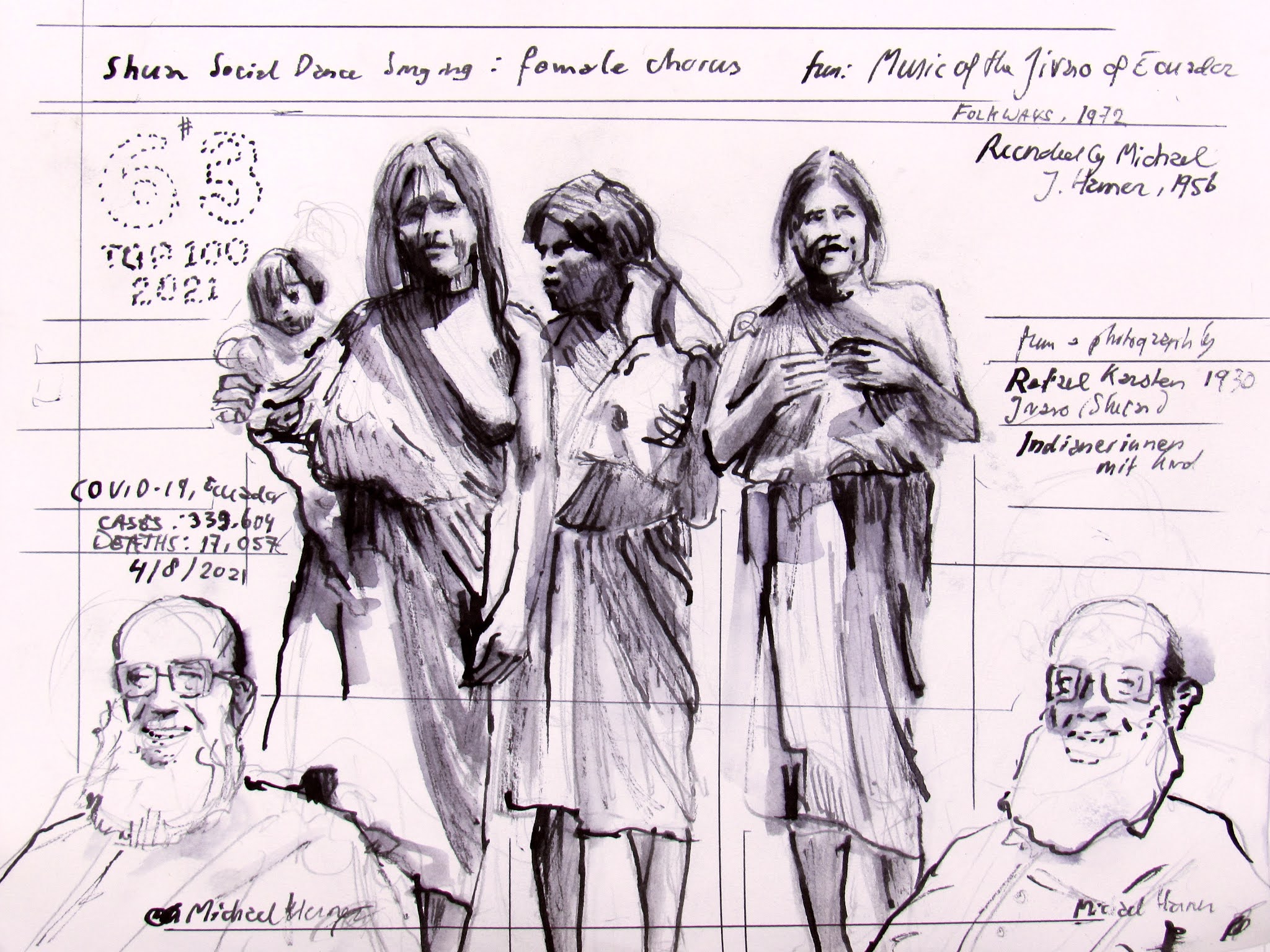
Indianerinnen mit kind (Shuar)/Michael J. Harner

 The Shuar, generally better known by their previous name Jivaro, were one of the most violent tribes written about in the anthropological history. They were head hunters, the source of the once collectable shrunken heads. (Earlier I wrote about the practice of infanticide among the Shuar.) The Jivaro warriors were feared throughout the region by their enemies but also by their own women. While the status of women throughout the world is usually not anywhere near the status of equality, the Jivaro women were worse off. Beatings were common. Only later in life, when widowed, or when they were children they could live in relative freedom. The suicide rate of Shuar women were among the highest in the world. Yet, their songs are among the sweetest and happiest I've encountered. Michael J. Harner recorded several dance songs and lullabies that are included on the Folkways LP 'Music of the Jivaro of Ecuador' along with war songs and other songs by men. Shaman's songs were recorded too. One freedom Shuar women enjoyed was to become a shaman. Not many neighboring tribes had female shamans. Harner was the first to study the Shuar in depth in the 1950s, earlier records are anecdotal, biased, or tainted by biased interpreters from neighboring tribes. Rafael Karsten, in the 1930s was the first anthropologist to attempt a study of the then called Jivaro, but later had to admit to Harner that all his information came from a translator belonging to a tribe not friendly to the Shuar. Harner tracked this individual down for his research and corrected Karsten's otherwise useful data. The photograph I used for this image was taken by Karsten in 1930. Harner, later in his career, became known for his research and books on (neo)shamanism and other spiritual new age practices. Shuar Social Dance Song (2): Female Chorus in #63 in the Top 100 2020.
Marjorie Shostak/!Kun San man
The historical contrast between the Shuar of Ecuador and the !Kung San of Botswana couldn't be greater. The Shuar had a violent death rate among men under 25 at a staggering 42%, the highest number ever recorded in the world, the number !Kung San men in contrast, is less than 0.5%. San women are considered equal. Marjorie Shostak, seen on the left, spend many years with the San people. She recorded the 'Sitenga with one man's voice' in Botswana in 1970. It's at #5 in the Top 100 2021. The song, by /Tilkay (also known as "Jimmy" from /Xai/Xai, itself was not illustrated in the liner notes to the album so I used another image from these notes. The man on the right was photographed by Shostak and is labeled: "A !Kung San man reclining." The ! and / symbols used in the text are vocal sounds, the ! represents the click sound made famous by Miriam Makeba in "The Click Song." One more thing: the object/subject differentiation disappears even further compared to the last painting I wrote about a few days back. The only photo I could find of a 'sitengena' being played was this very image of Marjorie Shostak.

Wednesday, March 10, 2021

Moving Along


Jofirsti Lungisa playing a musical bow 
 

The Top 100 2020 contains a larger than usual number of repeats from the year before and again a great number of tunes from 2020 will be repeated again in 2021. There's plenty of different music I play but those recordings that make up the playlist from which I compile my thoughts on the origin of music is getting more established as time goes on. And so do my thoughts. The playlist is front and center of my music appreciation path. At some point when I have enough time and ambition I am going to collect and edit my writings on this subject as they appeared in this blog and other places and compile them into a cohesive paper forming a theory on the origin of music, of art, and creativity. The theory is a meditation on all the big questions concerning the origin and nature of being using insights from hundreds of others. The theory itself is far too big and broad for one person to research. The theory that is forming in my hand circumnavigates materials handily available on line and is not depending on independent research at all but rather on the implications of the sounds on the playlist. And empathy. I haven't posted much recently but have continued the work towards completing the illustrations for the Top 100 2020. The nine works shown here are all from this year and are done on 11 x 14 drawing paper. Ink is the most common material used throughout but a number of other media have also been used. Represented are numbers 45 through 53:

  • 45: Jofirsti Lungisa – Nandel'ekhaye
  • 46: San, Tin Can Bow Solo
  • 47: Yeyi "Hut Song" by thirteen young girls and children from Cameroon
  • 48: Norma Tanega – You're Dead
  • 49: Ya'ak Keodaeng and Ya'Seu Keodaeng – Teum singing
  • 50: Sun Ra and His Akestra featuring June Tyson – Space is the Place
  • 51: Nellie Echalook and Rebecca Natialuk – Katajjait
  • 52: Grande danse, ahidus by a mixed chorus of Ben aissa Berbers
  • 53: Bell'ilba (lullaby) by a Kel ansar Tuareg mother
!Kung San playing a hunting bow

Baka gathering

Norma Tanega
 
Bamboo on the Mountains (cover), Frank Porschin

Sun Ra, preparation sketch for stencil

Sun Ra, stencilprint (A/P)

Nellie Echalook and Rebecca Natialuk

Berber Family

Tuareg mother and child, Bernard Lortat-Jacob