Showing posts with label John Cage. Show all posts

Sunday, October 23, 2022

Modern Classical Music

György Ligeti, Antoinette Vischer
Continuum is a work composed by György Ligeti in 1968. The work was written for harpsichord solo and dedicated to the harpsichordist Antoinette Vischer. A version from 1970, transcribed for barrel organ by Pierre Charial, was the version to enter the top 100 list this year but an older version (1968) recorded by Vischer herself later on scored the majority of points. From what I understand (from comments on YouTube) is that the piece is incredibly difficult to play. In the early 1960s Vischer had commissioned John Cage to compose a work for harpsichord but Cage was hesitant until, in 1967, he saw an opportunity for the harpsichord while on a Visiting Associate-ship at the University of Illinois' Computer Music program led by Lejaren Hiller. The two created a complex composition for seven harpsichords and 52 magnetic tape players called HPSCHD. The premiere at the University of Illinois in 1969 featured Vischer, David Tudor, and Philip Corner, among the seven harpsichordists. The composition is a work to experience, not suited for recording, even though a recording of it made it onto a disc produced by Nonesuch in 1969. I bought that LP this year but the track did not make it onto the 2022 top-100 list. Another work by John Cage did, also from an LP I bought this year, MagnifiCathy: The Many Voices of Cathy Berberian. [1971, Wergo] A Flower and The Wonderful Widow of Eighteen Springs are two compositions by John Cage for voice and closed piano. Bruno Canino plays (taps onto) the closed piano behind Berberian's voice.
John Cage, Cathy Berberian
The great influx of modern classical music was not perpetuated by those two records that I just discussed but rather by a big Iannis Xenakis haul at a local thrift store. One afternoon in the Spring I found no less than five discs by Iannis Xenakis. I bought all five, and all five are really great. One of the five, also a Nonesuch LP (1968), is shared with a contemporary of Xenakis, the Polish composer Krzysztof Penderecki. His Cappriccio for Violin and Orchestra on side B of the shared record comes into the Top 100 2022 as well as Xenakis' Akrata found on side A. Both works, the whole LP, was performed by the Buffalo Philharmonic Orchestra Led by Lukas Foss, the famous German-American pianist, composer, and conductor.
Lukas Foss, Krzysztof Penderecki
Iannis Xenakis is represented five times in the list, and is the highest ranking individual this year. Two further (after Akrata) recordings come from an LP on the Candide label, and were recorded by the Ars Nova Ensemble led by Marius Constant, who also founded the ensemble specializing in contemporary music and especially that of Xenakis. The LP is simply called Iannis Xenakis, the recordings are from 1967, and the top 100 titles are Syrmos for 18 strings and Polytope for 4 Orchestras scattered throughout the Audience. A different Polytope and Polla ta Dhina for Children's Chorus and Orchestra (from Album 2—Music Today series, EMI) are the other Xenakis recordings in the list.
Marius Constant, Iannis Xenakis


Sunday, April 17, 2022

Miniatures (Top 100 2022)

Allen Ravenstine, Pere Ubu

David Thomas, Pere Ubu

After a little break for a while I'm ready to start the next series of 100, the Top 100 2022. While it was clear for a while already I would stay close to the double portrait concept used in 2021, I am going to make some changes in the process. Looking back on the Top 100 2021, I found that the juxtaposition, or contrast of object and subject was hardly ever as black and white as I had imagined. In stead of focusing on the differences between the people portrayed, I'm now treating them as equal. There's always a relationship between two people (or more) involved in the making of a recording and this relationship is usually much more egalitarian, at least today, as the colonialist attitude of the earlier 20th century I took as a vanishing point last year. Even within early ethnomusicological recordings I found that the relationship between object and subject was often based on equality, certainly not as dismissive as it is portrayed in contemporary criticism. 

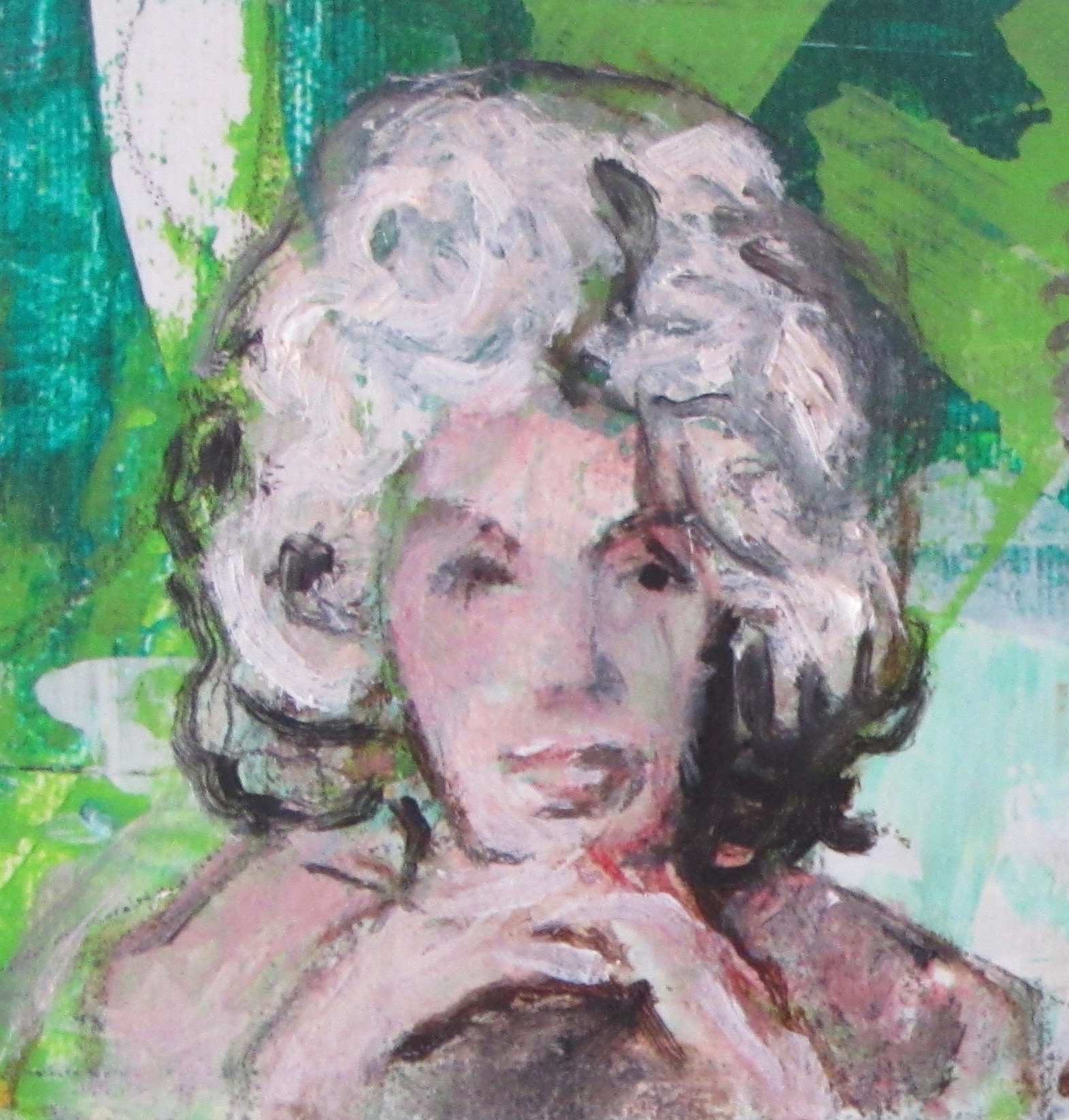
I've started collecting the images of the people who will feature in the top 100. It's a mix of familiar faces (to me) and new ones. To become familiar with the musicians, musicologists, and producers of the recordings in the list I thought I would paint a bunch of miniatures onto a canvas. As I did with the two larger recent canvases I am planning to paint 100 miniatures on it. I organized the canvas in such a way that all 100 portraits have a 4x4 inch square available to them. I neatly gridded out the canvas. I will present the images on here in series of 10 at a time. I have now 45 done. Here's the painting thus far. Below it I'll zoom in on the individual people with a little commentary to go with it.

100 Faces of the Top 100 2022, in progress, 24x36 inches
The first images I'll zoom into are all related to the band The Ex. Several of their songs already secured a spot in the 2022 list even though that list is nowhere near completion. The first one to enter was the song Eoleyo, written by the famous Ethiopian composer and percussionist Mulatu Astatke. Eoleyo is not a famous Astatke song, it was only released locally on cassette tape, but the audience at a concert in Addis Ababa burst out in ecstatic approval. The vocal at the concert are by Katharina Borneveld, who is usually the drummer for The Ex. For the occasion Han Bennink, the most famous of Dutch drummers, sat in. Terrie Ex (Terrie Hessels) is the only one from the six portraits below whom I painted before. He produced the record Ilital: New Ethiopian Dance Music, from which Gue by Tirudel Zenebe is listed high in the Top 100. Another famous Ethiopian musician, the saxophonist Getatchew Mekuria, did a whole tour with The Ex. She Ilelle, in the Top 100, was performed on one of those occasions (Groningen.) Andy Moor is the third Ex member I painted. Here are all six:
Tirudel Zenebe

Getatchew Mekuria

Han Bennink

Andy Moor

Katharina Bornefeld

Terrie Ex
The final two images illustrate two songs in one by Cathy Berberian. Her album magnifiCathy I had on tape in the 90s and was thrilled to find a copy on vinyl in a second hand record store in Nijmegen, the Netherlands. Both songs, A Flower and The Wonderful Widow of Eighteen Springs, by the composer John Cage.
A Flower (1950) has no words, just sounds, while the text of The Wonderful Widow of Eighteen Springs (1942) is based on a passage in James Joyce's Finnegan's Wake. The musical score to accompany both songs was written for closed piano (the lid closed so that the piano becomes a percussion instrument.)
John Cage

Cathy Berberian


Saturday, November 6, 2021

New Paintings

John Cage/David Skidmore (Third Coast Percussion)
I took some time deliberating what image to use for John Cage's portrait and who to pair him with. I had access to photos of Cage not readily available on line, and listened to some suggestions of a friend who's a big fan of everything Cage. For the Cage portrait I opted for the same photo as author Kay Larsen used for the cover of Where the Heart Beats: John Cage, Zen Buddhism, and the Inner Life of Artists. She obviously chose the image, a reversal of traditional portraiture, with great purpose. And I chose to adopt this purpose: We, the audience, have the same vantage point as Cage has, we are looking at the same shade of orange as he does. We are invited to see the world as Cage does as it were. For the pairing I opted for the most obvious: the performer of The Works for Percussion 2, the work in the top 100 list. The performers are Third Coast Percussion, a Grammy winning ensemble from Chicago. Of the four members Davis Skidmore, the most prolific in composing materials for the group. The other members are Sean Collins, Robert Dillon, and Peter Martin. Once I selected the two images I planned the painting process in great detail. In good Cagean fashion I had the computer select at random the four customary base colors I have been starting most paintings with lately. 

Budai Ilona/Péter Éri

Kék ibolya, ha leszakajtanálak is a lyrical song fromthe album Hungarian Folk Music [Hungaraton, 1964.] No performer or recorder are listed on the album but the location is: Great Plain. The liner notes tell us that the song belongs to the traditional style. The notes further reark that the old songs are hardly remembered. Perhaps because of this important LP the song Kék ibolya, ha leszakajtanálak (which translates as Blue Violet, if I picked You) is remembered as recordings of it are plentiful on YouTube. Thirteen years after the release of the LP by the communist government, the ethnographer Péter Éri recorded it for an album called Élö Népzene II, in a series called Living Hungarian Folk Music. The singer on this album is the well known Hungarian singer Budai Lilona. The vocal version of Kék ibolya on Hungarian Folk Music is followed by short instrumental versions of it, first on a zither, then on a hurdy gurdy.
Eddie Kirkland/John Lee Hooker

Tsitano Muburunyara/Ton van der Lee

Nanang Marin, Dumagat representative/David Blair Stiffler


Tuesday, April 16, 2013

33 ⅓

Yoko Ono
11" x 8.5", 2013
watercolor on paper

John Cage
11" x 8.5", 2013
watercolor, pen on paper
33 ⅓ is the title of a composition by John Cage. It's not a composition in the traditional sense of composition, it's in fact more of a conceptual art piece than it is a musical composition. In it are 12 turntables that are to be played simultaneously. The composition involves audience participation. The audience is the performer of the piece. 33 ⅓ refers to the speed in which records are to be played on the turntables, the turntables are set to 33 ⅓ rpm. In 2012, the 100th anniversary of John Cage's birth, I was one of the performers in an installation of the piece at the Bob Rauschenberg Gallery at Edison State College in Fort Myers. The piece is right up my alley: As the source material for the composition "guest curators" were invited to submit 10 records of their choice, a sort of top 10 of their favorite records. These guest curators included David Byrne, Lee Ranaldo, Yoko Ono, Mike Kelley, Iggy Pop, Pauline Oliveros, Meredith Monk, John Baldessari, Vito Acconci, Joan la Barbara, James Rosenquist, Matthew Barney, William Wegman, Ed Ruscha, Richie Ramone, Brian Ferry, Blixa Bargeld, and Jack White, indeed a who's who of art art and music. David Byrne's selection consisted of all spoken word recordings, while Yoko Ono selected only records involving herself, her late husband John Lennon, and her son Sean Ono Lennon. I had a blast browsing through the records of these luminaries and playing out my heart's content. When it was all said and done, the turntables silenced, the piece finished (for the day), I made a top 10 of the records I played that night. Air Male by Yoko Ono and the Plastic One Band was the number one on my list.