Showing posts with label 'Are'are. Show all posts

Monday, November 15, 2021

For Boxer (and for Lil' BUB)

Kimya Dawson/Aesop Rock
 

Kimya Dawson is known for a string of lo-fi homemade albums released after the Moldy Peaches broke up. For Boxer comes from Knock Knock, Who? from 2004. The song is a heart-rending account of the death of her dear cat. I only found out later the song was about a cat and not a friend. Together with her often-collaborator Aesop Rock she also recorded an ode to Lil' BUB, a celebrity cat known for her unique physical appearance. 


Hugo Zemp/Il'aresi (or Aresi)

Aaresi and Il'aresi appear several times in the 1994 ethnographic documentary film 'Are'are Music by Hugo Zemp. Footage from the film was recorded mostly in 1974 and 1975 in Malaita, the largest of the Solomon Islands, the performers in the film belong the the 'Are'are ethnic group. The song illustrated here is an example of the Aamamata genre of funerary songs performed as a duo. The two singers are also seen in the film as part of a trio performing bamboo stamping tubes as well as part of a larger group of women performing several kiro ni karusi songs, which are water games. I finally found an image of Zemp that fits in between him as a young man and and old man (I think I might have used every image of Hugo Zemp available on Google Image. The photo I used was taken by Marianne Zemp.)


Wednesday, August 11, 2021

Play in the water

A strange thing happened while painting this watercolor of a water game by six 'Are'are women from Malaita in the Solomon Islands. The scene I painted, a still from the movie 'Are'are Music, kept animating in front of my eyes. The whole scene played out continuously as if I were there. I felt a sense of empathy as I could identify with the performers. Not as being one of them but more like an onlooker. There's a voyeuristic element to the scene as it seems such a private gathering. Hugo Zemp, who filmed the scene, must have felt it too, even though the filming and recording of sound and the performance itself must have been carefully planned. The high vantage point enhances this sensation. You are looking at the performance from a perch quite a bit higher than the surface of the water. It helped that the performers are somewhat familiar, especially Aaresi, and Il'eresi as they were recorded by Zemp on various occasions and who are multiple times in this Top 100 and who I've painted already several times. Aaresi is in the center while Il'eresi is on the right. About the music: The sounds are similar to the traditional drums used by the 'Are'are and some rhythms played also mimic traditional drum rhythms. But there are no drums used, only hand clapping, on and beneath the water surface. Water drum games are not unique to the 'Are'are. Many water games, drum rhythms, have been recorded among the people of the Central African rain forests. Water drums by the Baka people, for example, was the first time an ethnographic recording ended up high in a Top 100 list. This was in 2004. The COVID0-19 series are now nearly completed and no active cases of the pandemic are recorded in the Solomon Islands. The total amount of cases during the one and a half year of COVID is a mere 20. Nobody died.


Friday, June 11, 2021

'Are'are and Mitsogo

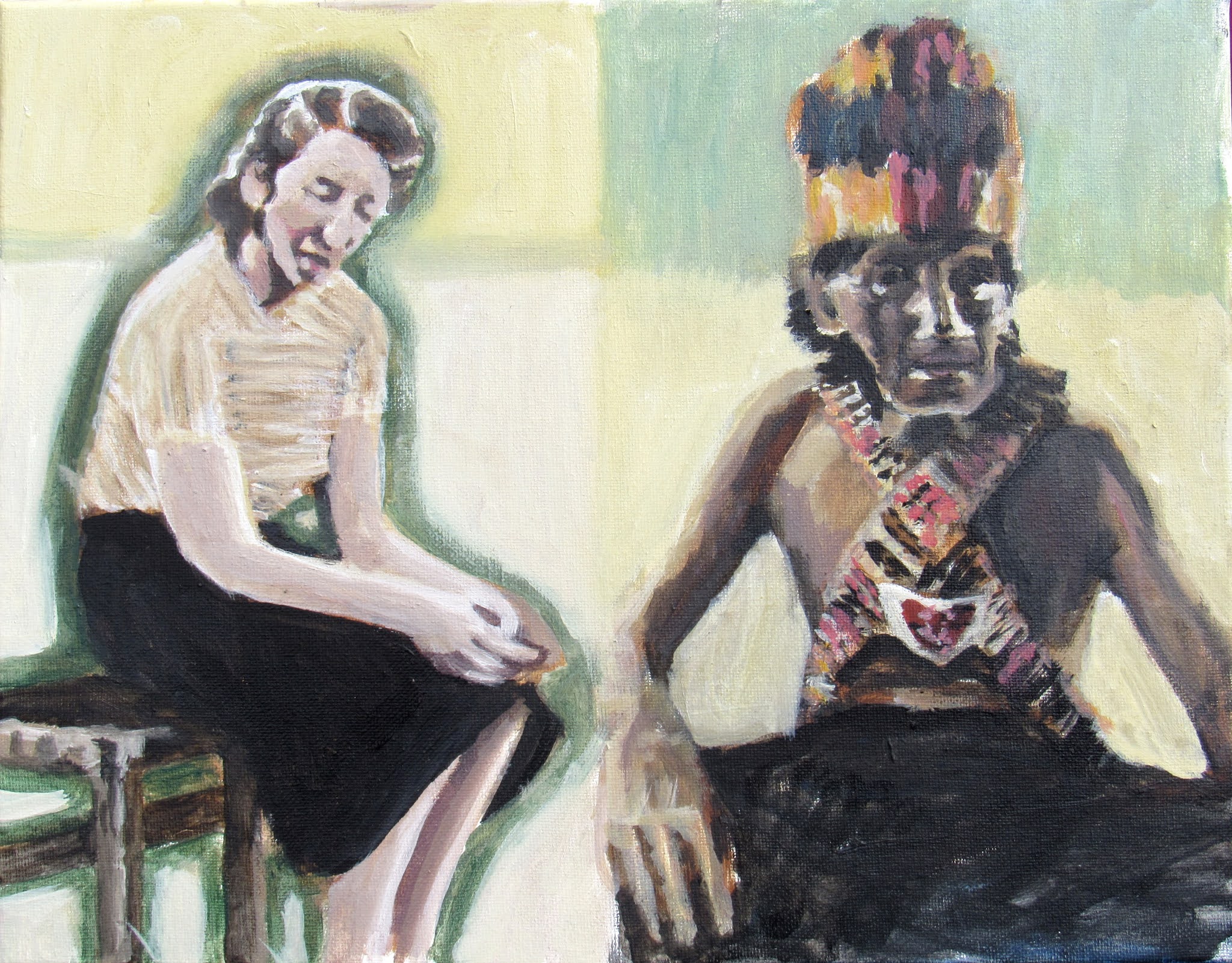
Hugo Zemp/Sisiwa, oil on canvas, 11x14 inches.


Ya Mwei masks/Pierre Sallee, 11x14 inches, ink on paper

The otherworldly sounds heard on Voice of the Genie Ya Mwei (mother of the inundations) come from two performers who ingested irritant leaves causing a swelling of the throat. While performing the secret male-only rite they also wear Ya Mwei costumes establishing a total transformation from man to spirit. Pierre Sallee recorded the sounds of a night of rituals by the Mitsogo people of Gabon in 1968. 

Top: Aamamata: Lament by Oko'ohimana sung by Sisiwa and Nonohanapata. Outake from the film 'Are'are recorded in Malaita, Solomon Islands in 1974 and 1975 by Hugo Zemp. For the film Hugo Zemp made a special effort to employ Sisiwa who was the only singer who knew the old lullabies and funeral lamentations. Zemp had made sound recordings of Sisiwa when he visited the Solomon Islands in 1969 to capture the music of the 'Are'are for the Ocora record label.

Thursday, May 6, 2021

Hugo Zemp: Les Voix du Monde

Aaresi and Il'aresi, ink on paper, 11x14 inches, 2021
The is the second painting within a brief period featuring the singers Aaresi and Il'aresi. The duo appears several times in the 1994 ethnographic documentary film 'Are'are Music by Hugo Zemp. Footage from the film was recorded mostly in  1974 and 1975 at Malaita, the largest of the Solomon Islands, the performers in the film belong the the 'Are'are ethnic group. The song illustrated here is an example of the Nuuha iisisu genre (love songs/complaints). The song illustrated less than a month ago is from the Aamamata genre of funerary songs. The two singers are also seen in the film as part of a trio performing bamboo stamping tubes as well as part of a larger group of women performing several kiro ni karusi songs, which are water games. The splashing of water provides the rhythm. Aaresi and Il'aresi are in the top 20 of individual performers in the Top 100 2020, a count that I tabulate each year. This is the first year individual performers recorded in an ethnographic context have made this particular list. I have never tabulated a list of recorders but would I have done this Hugo Zemp would, without a doubt, have topped this list in 2020. Not only was Zemp responsible for all six recordings made within the Solomon Islands in the Top 100 this year, he is also the main curator of the 3cd-set Les voix du monde: une anthologie des expressions vocales that was released in 1996 and is with great distance the winner of the albums contest that year. Directly after Aaresi and Il'aresi at number 74 comes a recording of a type of pan flute that is called au waa that features in the same 'Are'Are Music film. Au waa consists of seven bundled (bamboo) pan flutes. The performer now is Noni'ikeni. He sings a melody that is the same melody he produces on the flutes, much in the same manner as jazz musician Rahsaan Roland Kirk is known to have played.
Noni'ikeni, 14x11 inches, 2021
The sources for both ink paintings on paper were screen shots that I took while re-watching the film 'Are're Music. A synopsis of the film, with outtakes of all the major highlights can be seen here on YouTube. I have been painting simultaneously on the top 100s from 2020 and 2021 working on one of each of the series at the same time. The painting for the Top 100 2021 I worked on while drawing the 'Are'are illustrates the song, a lullaby, Hejde Lilibe, recorded by Zoltan Kallos in 1965. The same song was also featured in the Top 100 2020 and, just two months ago, I illustrated the same song. So for the version for this year (all paintings are now on canvas) I decided I would use the very same images as I had used in March. (It's really the only image of the singer Anna Balint that is available on line.) The track is listed as Hungarian Lullaby (cancion de cuna hungara) on the collection La voz humana en la musica by Carlos Reynoso (2021.) Upon my further reading up on the work of Kallos, I realized the recording was not made in Hungary, as I had assumed, but rather by ethnic Hungarians in Romania. (Not that it makes any difference but I had to, again, update my archive to reflect this error in the data I maintain.)
Zoltan Kollas and Anna Balint, oil on canvas, 2021


Monday, April 19, 2021

'Are'are and Shuara

The collection The Human Voice in Music compiled by Carlos Reynoso starts with a shamanic song of the Ecuadorian Shuara (familiar name: Jivaro). "For  those who wish to form an idea that is not biased by the temptation of  exoticism or by anachronistic particularistic yearnings, the collection  begins here." These are Reynoso's words (via Google Translate) which I (should) take to heart. Right away, within the first song of the collection, my integrity is being challenged. While having certain thoughts on the beginnings and essence of music, there are a number of factors at play I remain ignorant about. Reynoso must be serious about fighting misconceptions. Now the Shuar (Jivaro), is a good place to start because if there's one culture that has been misrepresented throughout western literature it must be the Amazonian Shuar. According to Reynoso the Shuara Shamanic Song exists in the grey area between speech and singing. The recorded performance is a manifestation of an altered state of consciousness that is patterned in such a way that it should be considered music. [Reynoso] Isabel Aretz and Felipe Ramon y Rivera, who I assume are responsible for recording this gem, characterize this incantation as a song. If the shaman heard on the recording is male or female isn't mentioned. In last year's top 100 I assumed that this was a recording of a woman but now I have my doubts. It shouldn't matter. Most shamans are men but in some cultures (including the Shuar) sometimes women become shaman, then there are other cultures, particularly in East Asia where most shamans are women. Listening to the song I assumed I heard a woman's voice but listening to other shamans recorded, both Shuar and from other cultures, it is not uncommon, even characteristic, for a (male) shaman to use a falsetto voice. I realized the shaman recorded by Aretz and Ramon y Rivera could be a man after watching a video of Dan Ramon, a Shuar shaman who was recently recorded by a site called Amazon Explorer. I decided to use a still from this video for the illustration of the Shuar Shaman Song. He is pictured on the right while Isabel Aretz is on the left. Aretz (1909-2005) was an Argentine Venezuelan composer and ethnomusicologist. The song was number 15 in 2020 and now, in the Top 100 2021, resides at number 4, for the time being.
No doubt exist as to the gender of the performers of the song "Aamamata na Kaukaurara" that is number 67 of the Top 100 2020. The performers Aaresi and Il'eresi were recorded by Hugo Zemp in 1977 in the Solomon Islands. Aamamata is a genre of song used for funerals. Kaukaurara is the composer of the song. The title thus translates as Funeral Lament by Kaukaurara. Another  song by the same two women appears on Zemp's Musique 'Are'are. The image above comes from a still from that film. The 'Are'are are a cultural group from the largest Island in the Solomon archipelago which is Malaita.


Thursday, June 4, 2020

'Are'are

Nonohanapata (l.) and Sisiwa (r.)
11 x 14 inches, various materials on paper, 2020
Last year I had chosen an photo taken by Hugo Zemp to illustrate the song Koleo, from the album Iles Salomon: Musique de Guadalcanal (Ocora/Radio France, 1970.) The photo was not taken in Guadalcanal but instead on the neighboring island Malaita, both belonging to the Solomon Islands in Melanesia. The image is a still from the documentary Musique 'Are'are (Hugo Zemp, Musee de l'Homme, 1993.) The section of the film the image appears in is during a performance of "aamamata," a funerary duet style song, a lament. The "koleo" of Guadalcanal belongs to the same tradition but is of a different group, island, and language. Koleo reappears in this year's top 100 and I was going to use the same image to start another painting. Starting another painting usually requires—and this is part of the longevity of the whole top 100 project—revisiting the music, additional research, and the selection of an image. During the research I found I was able to view the full documentary (2.5 hours) on line, and I settled in for the marathon. As a result many of the performers in the film ended up in a top 10 and several may make it into the final list of 100 songs for 2020. Nonohanapata and Sisiwa could very well be one of those in which case the image produced for Koleo should then shift to the funeral lament "aamamata" (called Lament by Mahasiwa.) 
The "Are'are, at the time of shooting the film in 1970s, were Christians, and the traditional music hardly performed any more. Age old traditions are vanishing throughout the world. Notable in the film by Zemp is that in the panflute ensembles he recorded some musicians were wearing blue jeans and t-shirts while others were stark naked.