Showing posts with label Solomon Islands. Show all posts

Thursday, June 24, 2021

Lomax and another Zemp


From the cover of Fataleka and Baegu Music/Hugo Zemp

Top 100 2021, #19 (provisional): Fataleka divinatory songs: Uunu. Fataleka Music, Uunu song form, Divinatory songs, performed by men's choir seated in two rows facing each other.

From: Solomon Islands, Fataleka and Baegu Music from Malaita, recorded by Hugo Zemp in 1970. Unesco Collection of Traditional Music, CD released by Smithsonian, originally released on LP on Phillips, 1973. Images in the painting: The flute player comes from the cover of the CD. An image of an uunu performance appears on the LP version but no indidual from this tiny image could be singled out so I opted for the musician shown on the cd cover. For the Hugo Zemp image I resorted to a photo that appeared in the study guide companion to the movie "Are'are Music and Shaping Bamboo by Hugo Zemp. The photo was taken by Ada Zemp-Partinkus on Malailta Island in 1975.

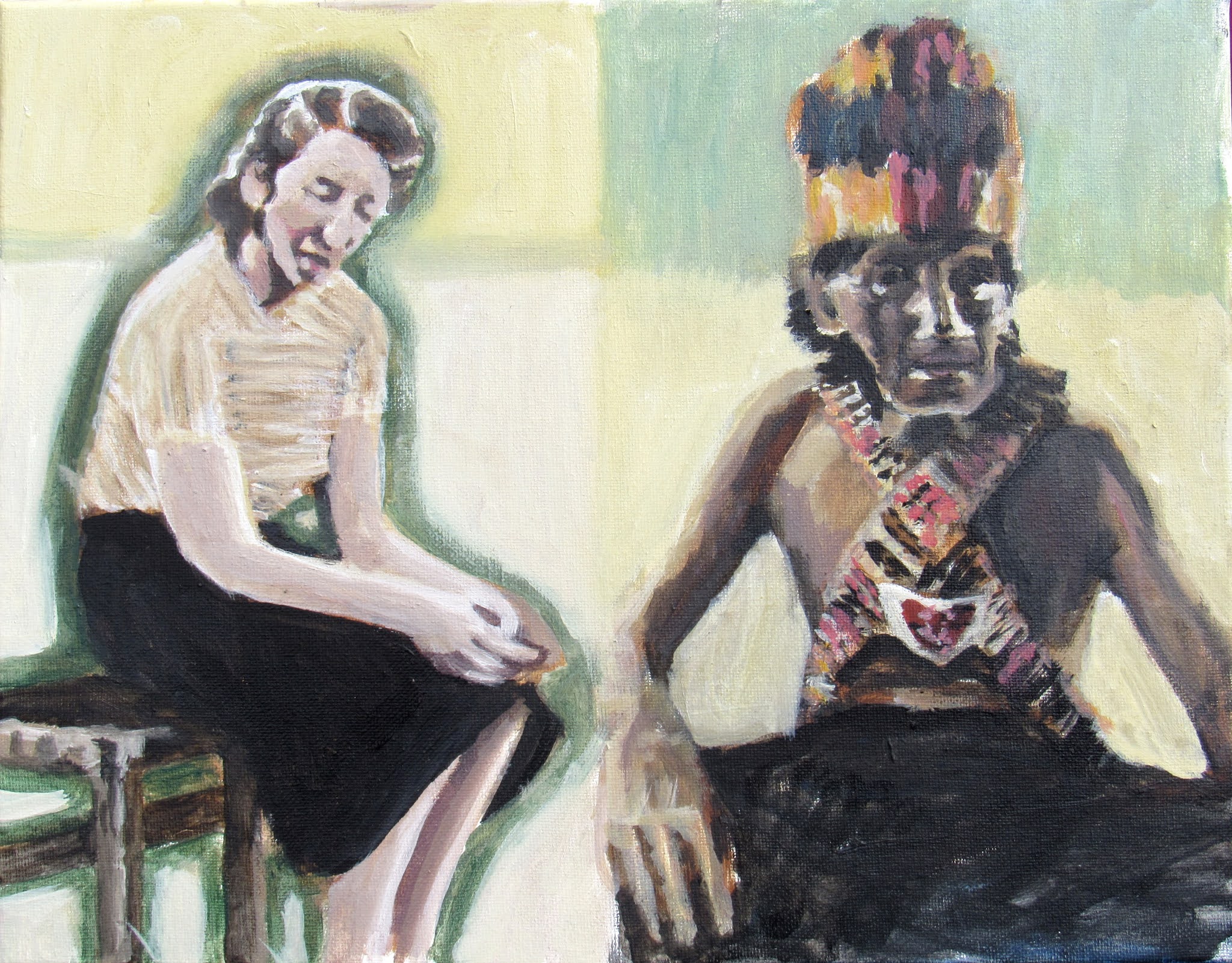
Alan Lomax

Top 100 2020, #86: Smasalom sung by a woman from the Pyuma tribe, Southwestern Formosa (Taiwan).

From The Columbia World Library of Folk and Primitive Music, Vol. XI: Japan, The Ryukyus, Formosa and Korea. Collected and edited by Genjiro Masu for the Japanese Music Institute of Tokyo. Series collected and edited by Alan Lomax (Columbia LP ca. 1955).

Note: when I first became interested in field recordings in the 1990s, Alan Lomax was the chief musicologist I turned to. Numerous songs from his extensive catalogue have been featured in past top 100s. Most of these are recordings of traditional music from the United States but Alan Lomax did field work in many other locations in the world. He is also the man behind the Columbia World Library series from the 1950s, a series of LP's that continue to be a main resource of music for the Top 100. The notes provided with each album are usually richly illustrated but the Smasalom song did not come with an image, and an image of Genjiro Masu I could not find.

Wednesday, May 19, 2021

La Flute de Pan

Hugo Zemp, Sabine Seso, oil on canvas, 11x14 inches, 2021
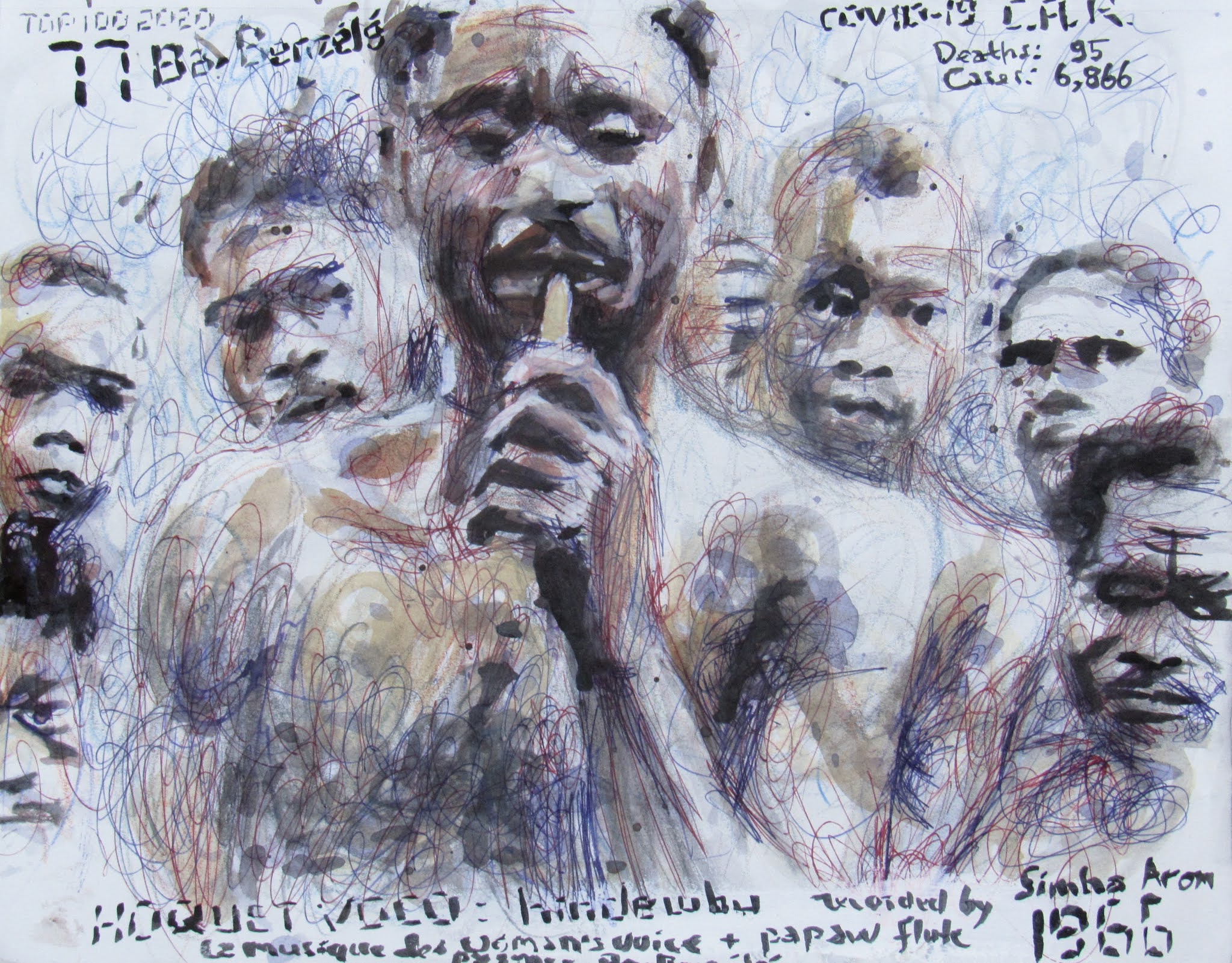
Just a few weeks ago I wrote about a technique that involves simultaneously creating vocal sounds and playing a flute. I was discussing then the track Au waa recorded by Hugo Zemp in the Solomon Islands in the 1970s. In this painting you see Hugo Zemp himself playing one of those flutes made from bamboo stalks. The portrait of Zemp here though is to accompany the track Koleo sung by a woman from Guadalcanal, one of the Solomon Islands. There are no pan flutes heard on the recording. The name of the woman singing is not listed in the liner notes and the one portrayed above is either Sabina Seso or Sylvia Saghorekao, singers who were recorded by Zemp during the same sessions on the island as Koleo currently residing at number 16 in the Top 100 2021. The image of Seso (I assume it's her) was taken by Zemp and I had used it recently to illustrate Ratsi rope sung by Seso and Saghorekao. Koleo is a type of funerary singing. The vocalizing flute technique like that of the au waa of the Solomon Islands is practiced in different parts of the world. The hindewhu of the Ba-Benzele pygmies of Central Africa is very similar to the au waa. The tune Hindewhu in the top 100 was recorded by Arom Simha in 1966 and appears on the album La musique de la pygmées Ba-Benzélé. The flute is made from the stem of a pawpaw. The image I used for this drawing is a photograph taken by Simha that appeared in the liner notes to that album. There too, in the liner notes for the album, it is illustrating this vocalizing flute technique which is called (by Hugo Zemp, when he used it in the collection Les voix du monde) hocketting. The performer on the recording is a woman though, and it may sound familiar to you because Herbie Hancock used a sample of it in the intro of his famous Watermelon Man from the album Headhunter. Or you you may have heard on Madonna's Sanctuary from Bedtime Stories. She credits Hancock for the sample but fails to identify the true source. When listening to the recording you would think it's an improvised ditty. It couldn't be farther from the truth as the very same melody appears on different Baka pygmie recordings using different names. The very same melody, note for note, is included in Louis Sarno's Bayaka CD recorded 20 years after Simha recorded Hindewhu in 1966.

Ba-Benzelle group (Hindewhu), 11x14 inches, ink, 2021

Thursday, May 6, 2021

Hugo Zemp: Les Voix du Monde

Aaresi and Il'aresi, ink on paper, 11x14 inches, 2021
The is the second painting within a brief period featuring the singers Aaresi and Il'aresi. The duo appears several times in the 1994 ethnographic documentary film 'Are'are Music by Hugo Zemp. Footage from the film was recorded mostly in  1974 and 1975 at Malaita, the largest of the Solomon Islands, the performers in the film belong the the 'Are'are ethnic group. The song illustrated here is an example of the Nuuha iisisu genre (love songs/complaints). The song illustrated less than a month ago is from the Aamamata genre of funerary songs. The two singers are also seen in the film as part of a trio performing bamboo stamping tubes as well as part of a larger group of women performing several kiro ni karusi songs, which are water games. The splashing of water provides the rhythm. Aaresi and Il'aresi are in the top 20 of individual performers in the Top 100 2020, a count that I tabulate each year. This is the first year individual performers recorded in an ethnographic context have made this particular list. I have never tabulated a list of recorders but would I have done this Hugo Zemp would, without a doubt, have topped this list in 2020. Not only was Zemp responsible for all six recordings made within the Solomon Islands in the Top 100 this year, he is also the main curator of the 3cd-set Les voix du monde: une anthologie des expressions vocales that was released in 1996 and is with great distance the winner of the albums contest that year. Directly after Aaresi and Il'aresi at number 74 comes a recording of a type of pan flute that is called au waa that features in the same 'Are'Are Music film. Au waa consists of seven bundled (bamboo) pan flutes. The performer now is Noni'ikeni. He sings a melody that is the same melody he produces on the flutes, much in the same manner as jazz musician Rahsaan Roland Kirk is known to have played.
Noni'ikeni, 14x11 inches, 2021
The sources for both ink paintings on paper were screen shots that I took while re-watching the film 'Are're Music. A synopsis of the film, with outtakes of all the major highlights can be seen here on YouTube. I have been painting simultaneously on the top 100s from 2020 and 2021 working on one of each of the series at the same time. The painting for the Top 100 2021 I worked on while drawing the 'Are'are illustrates the song, a lullaby, Hejde Lilibe, recorded by Zoltan Kallos in 1965. The same song was also featured in the Top 100 2020 and, just two months ago, I illustrated the same song. So for the version for this year (all paintings are now on canvas) I decided I would use the very same images as I had used in March. (It's really the only image of the singer Anna Balint that is available on line.) The track is listed as Hungarian Lullaby (cancion de cuna hungara) on the collection La voz humana en la musica by Carlos Reynoso (2021.) Upon my further reading up on the work of Kallos, I realized the recording was not made in Hungary, as I had assumed, but rather by ethnic Hungarians in Romania. (Not that it makes any difference but I had to, again, update my archive to reflect this error in the data I maintain.)
Zoltan Kollas and Anna Balint, oil on canvas, 2021


Monday, April 19, 2021

'Are'are and Shuara

The collection The Human Voice in Music compiled by Carlos Reynoso starts with a shamanic song of the Ecuadorian Shuara (familiar name: Jivaro). "For  those who wish to form an idea that is not biased by the temptation of  exoticism or by anachronistic particularistic yearnings, the collection  begins here." These are Reynoso's words (via Google Translate) which I (should) take to heart. Right away, within the first song of the collection, my integrity is being challenged. While having certain thoughts on the beginnings and essence of music, there are a number of factors at play I remain ignorant about. Reynoso must be serious about fighting misconceptions. Now the Shuar (Jivaro), is a good place to start because if there's one culture that has been misrepresented throughout western literature it must be the Amazonian Shuar. According to Reynoso the Shuara Shamanic Song exists in the grey area between speech and singing. The recorded performance is a manifestation of an altered state of consciousness that is patterned in such a way that it should be considered music. [Reynoso] Isabel Aretz and Felipe Ramon y Rivera, who I assume are responsible for recording this gem, characterize this incantation as a song. If the shaman heard on the recording is male or female isn't mentioned. In last year's top 100 I assumed that this was a recording of a woman but now I have my doubts. It shouldn't matter. Most shamans are men but in some cultures (including the Shuar) sometimes women become shaman, then there are other cultures, particularly in East Asia where most shamans are women. Listening to the song I assumed I heard a woman's voice but listening to other shamans recorded, both Shuar and from other cultures, it is not uncommon, even characteristic, for a (male) shaman to use a falsetto voice. I realized the shaman recorded by Aretz and Ramon y Rivera could be a man after watching a video of Dan Ramon, a Shuar shaman who was recently recorded by a site called Amazon Explorer. I decided to use a still from this video for the illustration of the Shuar Shaman Song. He is pictured on the right while Isabel Aretz is on the left. Aretz (1909-2005) was an Argentine Venezuelan composer and ethnomusicologist. The song was number 15 in 2020 and now, in the Top 100 2021, resides at number 4, for the time being.
No doubt exist as to the gender of the performers of the song "Aamamata na Kaukaurara" that is number 67 of the Top 100 2020. The performers Aaresi and Il'eresi were recorded by Hugo Zemp in 1977 in the Solomon Islands. Aamamata is a genre of song used for funerals. Kaukaurara is the composer of the song. The title thus translates as Funeral Lament by Kaukaurara. Another  song by the same two women appears on Zemp's Musique 'Are'are. The image above comes from a still from that film. The 'Are'are are a cultural group from the largest Island in the Solomon archipelago which is Malaita.


Monday, April 5, 2021

Number 4 and number 62

Sylvia Saghorekao and Sabina Seso
As many entries in the Top 100 are repeats from previous years, my familiarity with these recordings grow. The focus of the latest paintings and drawings is on the academic work of the musicologists and anthropologists who recorded in the field. I did, however, not include an image of Hugo Zemp here as I already painted him several times and already gained quite a bit of contextual information on the years Hugo Zemp spent in the Solomon Islands. What is new this year is that I now know the names of the performers and I found an image to go with it. This is from a photograph by Zemp included in the liner notes for Polyphonies des Îles Salomon (Guadalcanal et Savo) from 1978, the original appearance of the recording. The recording is called Ratsi Rope, rope is a repertoire of feminine songs and the word 'ratsi' means beginning. There are however no words to the song. The vocal sounds are an imitation of sounds in nature. Ratsi Rope is number 62 from the Top 100 2020.
Deben Bhattacharya and Tangkhul Great Story Teller
Number 4 from 2021 was also part of the Top 100 2020. I decided to use the same source image as I did last year. I could not find a photograph by Bhattacharya appropriate to illustrate his recording of the Tangkhul song. Deben Bhattacharya is a legendary ethnomusicologist from an old Bengali Brahmin family. (I've painted him before as well, the last time was in 2017 and somehow I painted his shirt then as orange as I did this time using a black and white photo from Wikipedia.) While Bhattacharya is of the highest social order in India, the indigenous tribal Tangkhul have lesser esteem in Indian society. The 2021 series of double portraits investigates issues like these. The juxtaposition of object and subject, and how this relationship evolved throughout the history of music recording. The further collapse the distinction in this painting I reversed the backgrounds from the two respective source photographs. The Tangkhul Great Story Teller now sits in the recording studio while Bhattacharya takes his place in from of the story teller's dwelling.

Saturday, August 22, 2020

Chant funebre de femmes

 Hugo Zemp, 14x11 inches, various materials on paper, 2020

Top 100 2020, #23 Chant funebre de femmes, Koleo from Iles Salomon: Musique de Guadalcanal. [Ocora, 1994] Recorded by Hugo Zemp, 1990.

Monday, July 22, 2019

Hugo Zemp (cont.)

Aamamata, funerary chant
14 x 11 inches, oil on canvas, 2014
I left the previous post on Hugo Zemp with a question that I now have the answer to: Indeed panpipes are in the repertoire of traditional Solomon Islanders music. However...this is not because Hugo Zemp imported the flutes from South America but the islanders themselves invented their own pan flute and they make it out of bamboo. And I learned that the Koleo (funerary chant) that I so treasure and is at #3 in the Top 100, is a rather recent development, a synthesis of the previous weaping tradition at a funeral and the vocal imitation of bamboo panpipes. The photograph that was the source for the above painting features in a lengthy paper on bamboo flutes by Hugo Zemp. He probably took the picture. Depicted are two women performing the funerary chant Aamamata, a different recording than the Koleo that is featured on Iles Salomon: Musique de Guadalcanal (Ocora/Radio France, 1970.) Hugo Zemp now is becoming the most important ethnomusicologist in this year's top 100 as he is the producer of Les voix du monde, une anthologie des expressions vocale, a three cd-set compiling all these recordings I have been collecting (and mimicking in my own compilation The Origins of Music.) All the stuff I've been gathering over many years I suddenly find in one instant compiled on these three cds. The collection is all I have been listening to.

Saturday, July 13, 2019

Hugo Zemp

Hugo Zemp playing a pan flute watched by a young woman
14 x 11 inches, oil and spray paint on canvas, 2019
Most recordings (sixty-nine to be precise) in the Top 100 2018/2019 were not recorded in a studio but in the "field" by folklorists, (ethno)musicologists, hobbyists, and institutions. Not always do I, in these pages, dwell on those individuals who travel the world to record music from the most remote places in often challenging even dangerous conditions. From the sixty-nine recordings the majority were made by ethnomusicologists from France and the US. Over the next few weeks I'll single out a few of these individuals whom I will provide with a short bio and of course paint. First up is Hugo Zemp, who is represented twice in the top 10 with recordings made in Guadalcanal in the Solomon Islands. Both tracks come from the LP Iles Salomon: Music del Guadalcanal. Professor Zemp was born in Basle, Switzerland in 1937 and has recorded, written, and filmed on the subject of ethnic music. As a Swiss national (working in France) he is naturally interested in yodeling, a subject he also found in various places beside Switzerland. On the image above Zemp is seen playing a pan flute in the Solomon Islands. He must have transported that thing all the way from South America! The young woman (who may well be the individual heard on Aate: Dance le femmes) looks bewildered. I wonder if Zemp left the pan flute behind and if so, did the flutes end up in the repertoire of Solomon Islands traditional music?

The following is the full list of credits for the field recordings, they're in order of the Top 100. A few names will sound familiar (Bartok) but most are pretty obscure.
Charles Duvelle; Hugo Zemp (2); Jean-Jacquez Nattiez (2); Anne-Maria and Pierre Pétrequin (2); Béla Bartók; Ramon Pelinski (3); OPOS; Enrique Pinilla (2); David Fenshawe (2); Megan Biesele; Jaap Kunst; Dept. of Anthropology, Government of India; Theodore Levin (3); Henry Lecomte (7); Francisco Carreño and Miguel Cardona; W. Coppens; Charles Brooks (2); David Blair Stiffler (3); Leo A. Verwilghen (2); Steven Field (2); Denise Harvey; Frank Proschan; Albert Cort Haddon; Albert Lord; Michel Vuylsteke; Andrei Golovnev; unknown (7); F. Conti; Vietnamese Institute of Musicology (2); Andre Didier; Howard Keva Kaufman; Hugh Tracey; Carol Jenkins; Georges Luneau; A.P. Elkin; Dave Dargie; Anne Chapman; Stephen Jay; Gilbert Rouget and André Didier; Brigitta Hauser-Schaublin; Jenny de Vera; Center for Andean Ethnomusicology.