 |
| Janis Ian/Nina Simone |
Showing posts with label Nina Simone. Show all posts
Showing posts with label Nina Simone. Show all posts
Friday, February 3, 2023
Positive Body Image


Monday, November 22, 2021
Four Women (and four men as well)
 |
| Lisle Atkinson/Nina Simone |
 |
| Bearded man from the Oenpelli Mission/Douglass Baglin |
 |
| Jo Johnson/Niki Elliott (Huggy Bear) |
 |
| Sherine Fatima Balti/David Lewiston |
Sunday, August 15, 2021
Black is a color


 |
| Nina Simone/Emile Latimer |
Friday, November 20, 2020
Two New Ink Drawings
 |
| Topoke line dance, 11 x 14, ink on paper, 2020 |
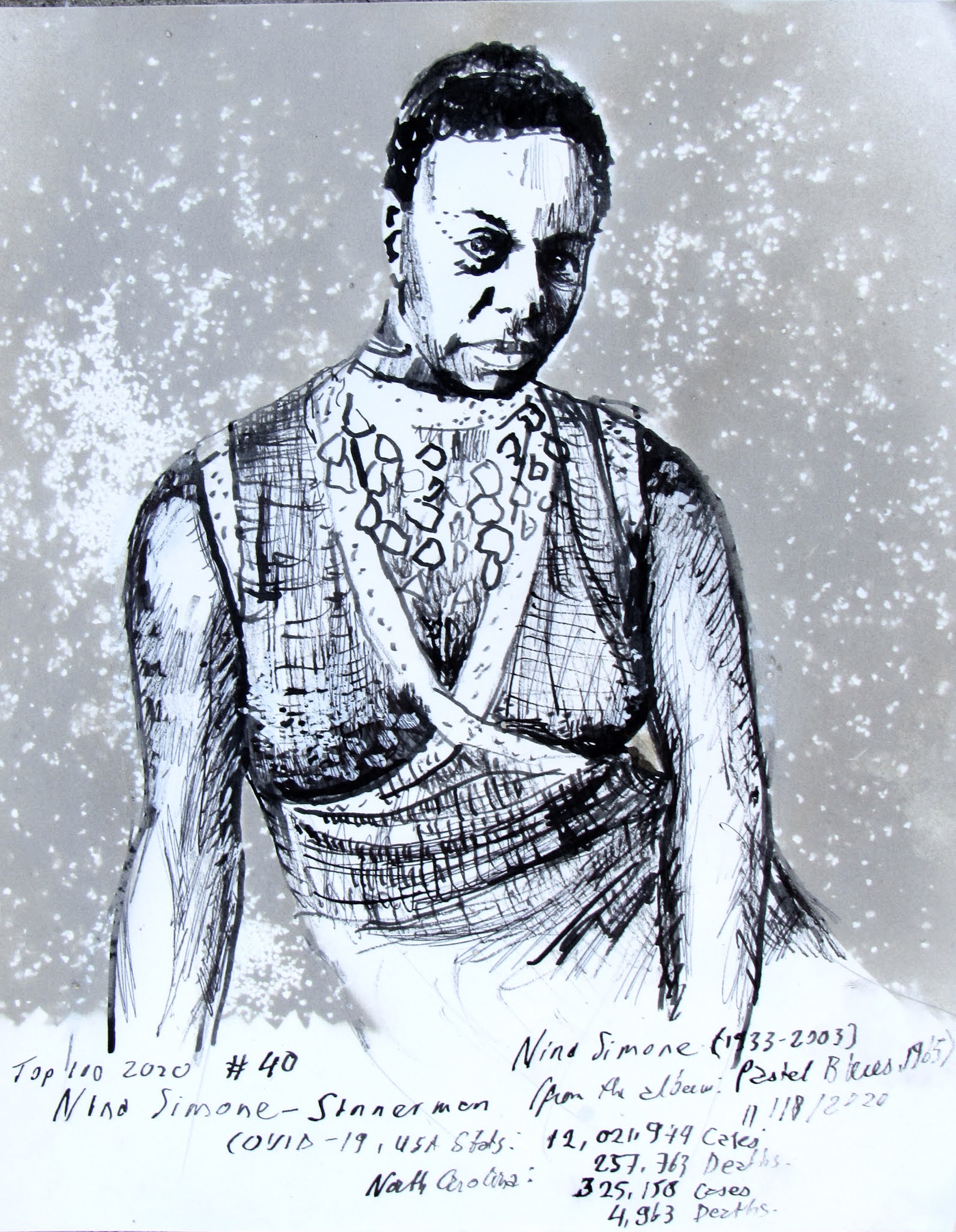 |
| Nina Simone, 14 x 11, ink on paper, 2020 |
Thursday, April 30, 2020
Black is the Color...
 |
| Nina Simone 14 x 11 inches, various materials on paper, 2020 |
I'm starting to loose my mind here. Getting carried away copying a photograph: The one Wikipedia uses on their page dedicated to Nina Simone. Their photos are typically high resolution, with warts and all. The more precise you get the more glaring the mistakes. Just a sixteenth of an inch error on the placement of an eye for example changes the whole feel of a drawing and brings out the subjectivity of any drawing more clearly. So here's the first American song in the Top 100 2020 now presiding at number 9. Black is the Color of My True Love's Hair is a traditional ballad of Scottish origin and did become a sort of anthem for Nina Simone. She recorded the song numerous times and this year's version comes from Nina Simone at Town Hall. [Colpix, 1959] Even though the American presence in the Top 100 is steadily diminishing (due to a focus on field recordings of the world's indigenous people) during the last years of compiling these lists, the United States still easily provides the most entries per country. The US is on top of the statistics of the COVID-19 too, easily, with about a quarter of all cases reported, about the same amount as recordings in the Top 100 in recent years. Now the US is a huge country with an enormous population, so their numbers per capita are not that different from other countries in the industrialized world. North Carolina, the place of birth of Nina Simone, for example, compares with say Serbia. What I would like to note in the context of Nina Simone here is the disproportionate illness and death rate among African-American citizens. No politics here today from my keyboard. The epidemic is bad enough.
Saturday, January 7, 2017
Self-portrait-a-day
 |
| Self Portrait as Cat Power: Moon Pix Blue ballpoint on paper, 12x9 inches, 2017 |
As one of many New Year's resolutions I decided I would do a self portrait a day. Towards the end of last year I had already started doing the morning pages, stream of consciousness writing geared toward freeing creativity. I found at a thrift store the book The Artist Way by Julia Cameron, a best selling new age self help guide book for blocked artists. Due to an intense teaching schedule I had only made few works in the autumn of 2016. I had nothing to loose. It was a good thing, I'm still doing these three pages each morning in a note book that I had dedicated as a dream journal a few months earlier. The self portraits seem a logic extension to the morning pages. What better way to get back into producing work again than to draw self portraits? Next week I start teaching a drawing class in college and I intend to make the students do a self-portrait-a-day, preferably in the morning. As a teacher to this class I decided I would be a student at the same time, expose myself to the same rigorous regime as I put the students through. I get a fresh start myself in a way. Start over. New year, new beginning. The portraits very quickly turned into a Top 100 extension (as so much of my work does): draw myself as the musicians from the Top 100 appear on their records. I've done it before, some 12 years ago—I was still a handsome fella then—but now as an old man.
 |
| Ghana/Self oil on paper, 24x18" 2004 |
Anyway... the first one, as it was the first one in 2004, in this context is a Cat Power impersonation. The image I started with is the cover of the Moon Pix album. I've used it several times before for Cat Power portraits, it's lovely image. The artist who created the image is Roe Etheridge. The image is reproduced in a book that features some of my own works as well. You Should've Heard Just What I Seen was published in 2013. Yesterday I wrote a new artist statement for a job application. It's basically an update from the statement at the header of this page. Here it is in full:
"The Top 100 is an ongoing series of one hundred portrait paintings of musicians and accompanying writings every year since 1989. The simple and straight forward concept of the Top 100 has stayed the same throughout almost 30 years of painting. The premise is the shallow vantage point of a music fan at his insignificant home looking out onto a world of cultural importance. While the context has shifted from a hobby to an activity within contemporary art, the essence has stayed the same. The format is a hermetic system in which everything is open and free to experiment, surprise, failure and excellence, open too to different styles and techniques, emotional expression and introversion. The format is both that of a personal diary and of an impersonal archive charting the music an individual encounters throughout a lifetime. The Top 100 is a testament of a life lived in the margins of notoriety and a historical record of the world of music and the scene of the avant garde. Shameless crushes and adorations of musical heroes provide an intimate yet recognizable account of oneʼs humble existence within an unattainable world bigger than ours. That the paintings of musicians are now shown at the same venues as their objects of desire play in, and the painted portraits appear on the sleeves of the sound recordings they illustrate, does not alter the relationship between object and subject. The artist responsible is still that fan. Itʼs all about them, the others."
I might as well forward some other self portraits I did in the past few days. Nothing to be too proud of, perhaps even a bit embarrassing, but here they are regardless. A note about the Amalia Mendoza one is that I think she's one of the great singers of the 20th century but unfortunately the context of her recordings make it less universally so: Mariachi. There's nothing wrong with mariachi but the Mendoza records (I have four of them) could certainly do without. If I had the time, expertise, and equipment, I would reissue all her records without the mariachi. She would sing unaccompanied or, in some cases, just by an acoustic guitar or piano. Her voice does not need all these happy trumpets. The best self portrait perhaps, thus far, is the one where I substitute Nina Simone's face for my own. The image is from her first record Little Girl Blue.
 |
| Self Portrait as Amalia Mendoza: Los Exitos Blue ballpoint on paper, 12x9 inches, 2017 |
 |
| Self Portrait as Nina Simone: Little Girl Blue Blue ballpoint on paper, 12x9 inches, 2017 |
Tuesday, July 19, 2016
Another Stencil
 |
| Nina Simone 12 x 9 inches, stencil print, 2016 |
The stencil assignment continues to be a part of Art Appreciation at FSW. As I am teaching yet another section this Summer, 26 students created a stencil print in an edition of ten. They trade, one with me, nine with fellow students, and they keep an artist proof in their sketchbook. For the occasion I create a stencil in an edition of the class size +10. The subject of my print should be relevant to the young students as well as my Top 100. This semester I chose Nina Simone (1933-2003). While none of the students had ever heard of Nina Simone, the biographical movie Nina, that was just released, as well as her relevance in the civil rights movement, much discussed these days in the light of the Black Lives Matter movement, I found a teachable opportunity in choosing her. Recently I purchased my 10th and 11th Nina Simone records, about a third of her discography, mostly from thrift stores. As far as I can tell there are no bad Nina Simone records out there. If anyone is interested in owning a copy of the print (edition 37), I sell off the remaining 10 prints for $50 each, just respond to this post and we'll make arrangements.
Wednesday, June 8, 2016
Nina Simone!
 |
| Nina Simone oil on canvas, 20 x 16 inches, 2016 |
To Be Young, Gifted and Black is a song written by Nina Simone with Weldon Irvine in memory of the author, and friend of Simone, Lorraine Hansberry (A Raisin in the Sun). It was just released as a single in October of 1969 when Simone performed it live at the Philharmonic Hall in New York. The concert in front of a white audience (which Simone does not fail to mention in her introduction to To Be Young, Gifted and Black) was recorded and released on the album Black Gold of 1970. I found the album together with 'Nuff Said of 1968, at the local Goodwill Outlet Center—the last place items exist before being crunched in a giant garbage machine. The album existed on a shelf, or in a box, in someone's house for 46 years, hardly ever played, before being rescued from its destruction. And now it has a new life, and a painting dedicated to it. "Her picture is painted in my memory without a color of despair, and no matter where I go she is always there." (added lyrics to Black is the Color of My True Love's Hair.)
For those of you who ever visited the Koreshan State Park in Estero might recognize the background as being the generator building interior.
Monday, May 28, 2012

Wednesday, August 18, 2010
Nina Simone (2)

Nina Simone
14" x 8"
oil on wood, 2010
It's finished, the second Simone painting of the year. It's a strange one. I sort of like the top part, the bottom part too, but together... It's just strange. Thus comes the second writing of the year about Nina Simone... But I'm at a loss, confused, confused by the painting, confused by my previous post (on Simone's diary), confused by her nakedness (I'd so vowed not to paint nudes anymore!) For inspiration on what to write I looked at comments made by viewers on YouTube. I viewed some videos of my favorite Simone songs and read hundreds of comments. Most of these comments, as one could expect, are not worth being published... I take that back: everything is worthy, as a matter of fact I'd wish some people would comment on mine. anything, even a :) or a :(, better yet an xoxo, or an lol. The painting... Clearly more about me than about Nina Simone. The writing too then, should be an exercise in auto-psycho-analysis 101, doing the patient part as well as the therapist's... But confusion prevails; the comments—no matter how sincerely—from my fellow-Nina-Simone-YouTube-watchers didn't help, and my own typed words lead to no particular conclusion...
Saturday, August 14, 2010
Nina Simone

Nina Simone
20" x 6"
oil behind plexiglass, 2010
Nina Simone has been in and out of my top 100 lists since the beginning in 1983. I own ten LPs, two CDs, and eight singles with her recordings, and this year year a whole score of her songs have been listed in various top 10 lists. Through gossip columns of music magazines I've been aware of her troubled mind, the difficult circumstances of her life, and her eccentric character, but what I knew of her was anecdotal at best. An article by Joe Hagan in The 2010 Music Issue of the Believer I've read recently, is different from the scandalous fodder usually associated with Simone, as it is a humanistic character sketch based on a newly discovered 'secret' diary of hers. The ten-page article deals with Simone's private and public life, and her sexual and racial identity. Simone herself is quoted at length through her lyrics and texts, passages from her diary are reproduced and used as illustrations, and a newly published song is tucked on a CD inside the magazine. It's a cover of an Alice Cooper song called I Never Cry, and illustrates an epitaph at the closing of the article, that was also on the last page of Simone's diary: "I learned that my pain, no matter how great, is a private matter (my hell is my own) and I must not tell it to any one else—there are no people who can help me."
Subscribe to:
Posts (Atom)