The Top 100 started as a hobby; a fan adoring his musical heroes and paying tribute by making portraits of them. The hobby became obsession and the project went from the boy’s room into the art world. But I'm still that fan, it's about them in the end, their music, and not about me.
Showing posts with label Aboriginal. Show all posts
Sunday, April 20, 2025
11 Paintings from 2025
More and more I tend to only paint from those photographs that in which I find some human truth, figures who appear to carry the weight of the world. Empathy is a matter of fact. Often I return to the same photographs that then become more than mere photographs; spirit visions from another world. The woman who graces the cover of Aboriginal Music of Australia, probably photographed by Alice Moyle who recorded the record around 1970, is not included on the CD re-release of the album now named: Australia: Aboriginal Music. I painted the image before in 2019, illustrating the same song, a type of Wu-unka song sung by Utekn and Yaimuk in the Wik-ngatara language in northern Queensland. The woman in the photograph could well be either Utekn or Yaimuk, since most other tracks on the record are sung by males. The photograph used for the above painting comes from the booklet to the LP Indian Music of the Upper Amazon from 1954 on the Folkways label. The painting accompanies a Campa Mourning Ceremony recorded by Harold Courlander in Peru, but the image is captioned "Conibo dancers at animal sacrifice ceremony." I assume, the photograph was taken by Courlander. Here I separated two female dancers from a larger group, without whom the image become more magical. Both Campa (or Ashaninka) and the Conibo live in the Amazon basin in Peru.David Toop (b. 1949) is an English musician (once a member of the Flying Lizards), author (contributor of The Wire, f.e.), and ethnomusicologist who recorded extensively among the Yanomamo in Ecuador.
Monday, November 22, 2021
Four Women (and four men as well)
![]() |
| Lisle Atkinson/Nina Simone |
![]() |
| Bearded man from the Oenpelli Mission/Douglass Baglin |
![]() |
| Jo Johnson/Niki Elliott (Huggy Bear) |
![]() |
| Sherine Fatima Balti/David Lewiston |
Friday, May 28, 2021
Cantos de pilon (worksongs)
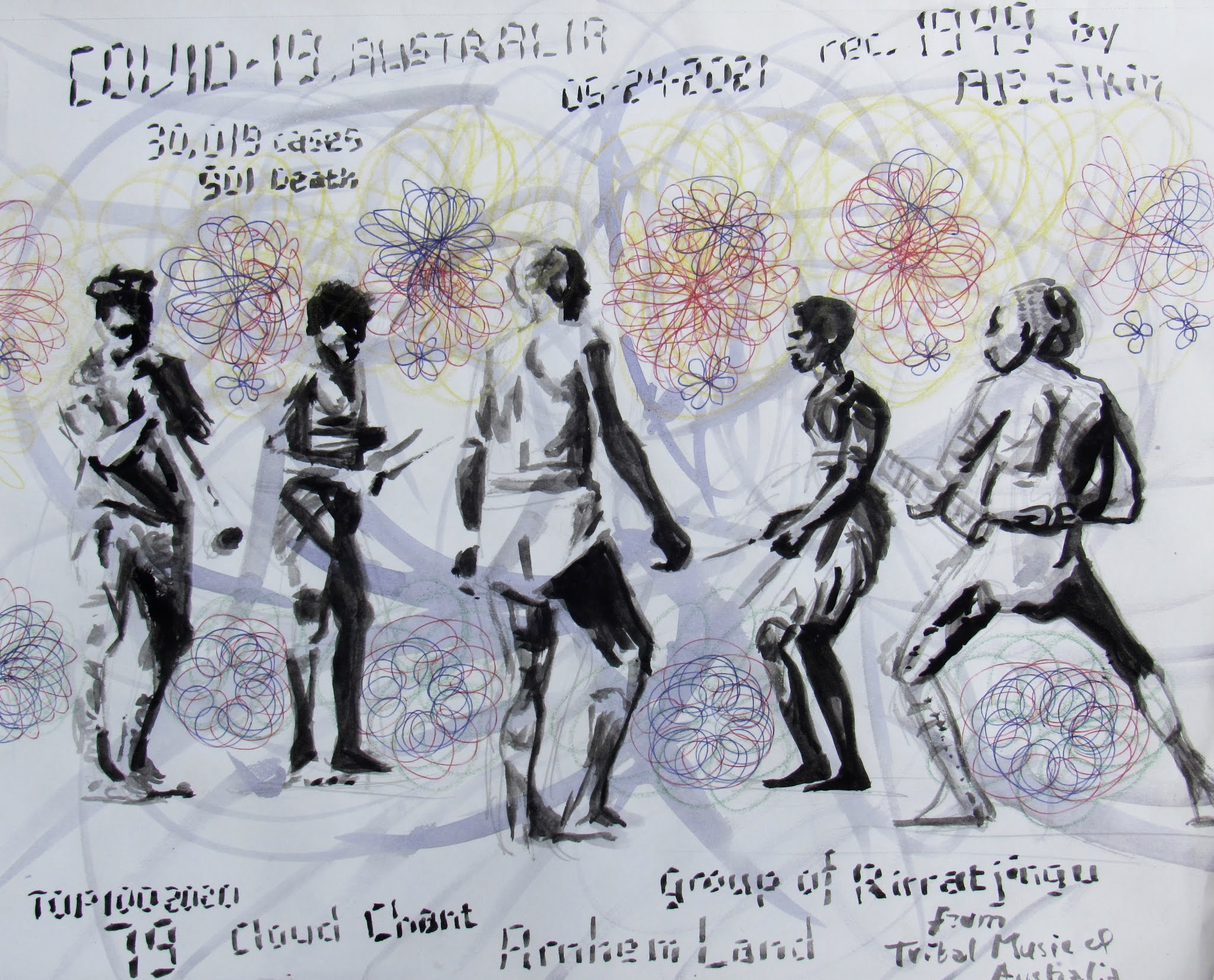
Canto Para Pilar Maiz has been in my top 100 twice before. Both in 2013 and in 2018 I used the image that illustrates the song in the liner of the album The Columbia World Library of Folk and Primitive Music, Volume 9: Venezuelan Folk and Aboriginal Music. Now I used the image as an insert (upper left corner.) In 2018 I knew more about the song and the image as I did in 2013 and now in 2021 the picture concerning the song and image becomes clearer again but also more confusing. I am not exactly sure anymore how to interpret the data provided in the liner notes with the Columbia record (of whom Alan Lomax is the final editor) as there are certain errors in the text. I am not sure if the image provided with the song is indeed Ana Caraballo (or Asuncion Caraballo—who is listed as a collaborator—for that matter.) I'm not sure anymore if the performers of the song are correctly identified. There seems to be some confusion about names involved, of the singers, the recorders, and individuals mentioned in the lyrics. On line I found another song (called Cantos de Pilon, undated but more recent than the 1949 date of Canto Para Pilar Maiz) that has almost identical lyrics (even though the lyrics of Canto Para Pilar Maiz were improvised, according to Juan Liscana, who is credited as writer of the liner notes together with Alan Lomax.) In the lyrics of Cantos de Pilon the taparo tree from Canto Para Pilar Maiz is substituted for a lime tree, and the name Alfred Caraballo, the dedicatee of Canto Para Pilar Maiz, is substituted for Asuncion(!?) One thing is certain: Canto Para Pilar Maiz is a work song. The rhythm of the song follows the rhythm of the pestle beating down on the corn inside a mortar. The job and song are typically performed by two women. The main image in the drawing comes from a photo used in a review of Cantos de Pilon. The source of the information: Luis Felipe Ramón y Rivera, an important figure in the history of Venezuelan music, and folklore.More paintings and drawings have been finished for the Top 100 2020 and 2021. The above image is to illustrate number 79 in the Top 100 2020: Cloud Chant from the album Tribal Music of Australia from 1949 that features recordings by A.P. Enkin. I would have dwelt a bit more on this one were it not that I recently talked about him in the context of a mourning song from the same album. The image is taken from the liner notes in the album. I realized I never forwarded the impression I made of the cover of the album that I used for number 71 on the same list: Djedbang-Ari.Traveling northwest from Australia you may encounter the island of Java in Indonesia, which is another location on the world map that has seen a good many anthropological and ethnomusicological projects undertaken throughout the twentieth century. From a 1950 album, again on Folkways, comes Udan Iris, a love song by a Sundanese woman coming in at number 81 in the Top 100 2020. The music on the album was recorded by Raden Suwanto and Harold Courlander. The portrait above is of Courlander, whose main focus was on African and Haitian music. Courlander (1908-1996) today, is mostly remembered for a lawsuit in which he charged Alex Haley, the author of Roots, of plagiarism. Several anecdotes that appear in Roots were taken from Courtlanders adventure novel Africa, so he claimed. I find no evidence of Courlander actually traveling to Indonesia so I must assume the recording was made by Suwanto. That Courlander was given credit was probably because he was the main editor for the Ethnic Folkways Library label, a name devised by himself. Folkways itself was the project of Moses Asch. A great number of top 100 entries come from the Ethnic Folkways Library. And so does the next work discussed: It's from the Folkways album An Introduction to the music of Viet Nam. Geographically located about the same distance from Java as Java is from Arnhem Land in Australia, be it on a more northerly track. The 1965 album is a compilation by Stephen Addiss of historic recordings made by the famous Vietnamese composer and folklorist Pham Duy (1921-2013). The track in the Top 100 2021 is Ho Ru Con, which is a lullaby of ancient origin recorded in the north of Vietnam. "Ho" in the title stands for "work song." I have not come across the qualification of a lullaby as a work song before.The image on the left, next to the portrait of Pham Duy, comes from the cover of the album mentioned the song appears on. The woman may or may not represent the singer of the lullaby. Seeing the painting now reproduced I find the face of the woman too narrow. I will go out later today to my studio to fix it. (This is not the first time it happens—what I need to fix, or hone rather, are my observation skills.) The country of Vietnam (in the 1960 still spelled as Viet Nam) also appears in the Top 100 2020. At number 72 in that list is a recording taken from the other main source of the music in the Top 100 2020, which is Les voix du monde, une anthologie des expressions vocales, a 3-cd set compiled by Hugo Zemp. Xi is yet another Vietnamese work song. This one sung by two boys is about the joys and troubles of daily life. The boys belong to the Nung An tribal people of again northern Vietnam and were recorded by Patrick Kersale in 1993.
Wednesday, March 31, 2021
Objects and subjects
I made a second painting directly after I finished the first. The
painting represents the provisional number 2 in the Top 100 2021. Like
the first one, the location is again Nunavut, Canada. This time further
north in Kinngait on Baffin Island. The painting represents the track
"Three Katajjait," first on the Unesco record "Canada: Inuit Games and
Songs." A Katajjaq (singular form) is a game song performed by two woman
who stand close together. They mimic each other's sounds until one
starts laughing, she is the loser. The three katajjait were performed by
five different performers and again I do not know if the (nameless)
woman on the left in the painting is either on of the five. I do now
that it comes from a performance of a katajjaq and the the photograph I
used was taken at around the same time (1974) the recording was made.
The photo was taken by Nicole Beaudry, who also recorded the "Three
Katajjait." The woman on the right is Nicole Beaudry, be it from a much
more recent photograph of her. There's a lot of laughter on both the
numbers 1 and 2 recordings during their respective performances. Beaudry
herself suggests that this is because the music of both recordings are
games and not considered music by the Inuit themselves. I argue that it
is music, and the laughter an expression of the joy felt when two souls
merge. The contrast of the two men depicted in the above image is stark. The
intentional juxtaposition of object and subject in these series of
paintings (The Top 100 2021) is especially pronounced in illustrations
of older recordings. Anthropology has evolved from the colonialist
attitude of the 19th and early 20th centuries to the immersive
contextual discipline it is today. The term ethnomusicology was not in
use yet in 1949 when Adolphus Peter Enkin recorded "The mourning 'call'
of Melville and Bathurst Islands. The photo credit of aboriginal
rock-painter on the left that I used is Mount Ford. I assume this refers
to Charles Mountford, the leader of the 1948 expedition to Australia's
Northern Territory (where both mentioned islands are situated.) Enkin,
an Anglican clergyman, was at odds with his then boss Mountford. Enkin
was a champion in the fight against prejudice and racism, and was an
outspoken advocate for equal rights for indigenous Australians. A.P.
Enkin to his credit, broke through the divide that considered indigenous
peoples as primitive and as savage. Extended contact and communication
will accomplish a better understanding, I assume. Still the
object-subject relation is clearly visible. Starting in the late1960s it
becomes standard practice for anthropologists and ethnologists to not
only extend contact with their subject but to live with them, often for
many years, to understand the cultures they research. The drawing below,
belonging to the Top 100 2020, illustrates the music of the Hamar in
Southern Ethiopia. Husband and wife team of anthropologists Ivo Strecker
and Jean Lydall, and their two two young children, went to live with
the Hamar in the 1970s.I just watched (part of) a movie by Rosie Strecker, who was the daughter
of Strecker and Lydall and lived with the Hamar for several years since
she was 4 months old. The movie documents her return to Ethiopia many
years later. The story is heartwarming and strengthens my belief in the
goodness of humanity. Object and subject collapses in this movie as it
does in the best of modern anthropology, and ethnomusicology.
Monday, December 2, 2019
Torres Strait Expedition
![]() |
Malo
Ceremonial Dance
14 x 11 inches, oil and spray paint on
canvas, 2019
|
The Cambridge Anthropological Expedition (also called Torres Strait
Expedition) was led by Alfred Cort Haddon in 1898. The objective was to record
the customs and sounds of the indigenous Australian (aboriginal) peoples.
Haddon was well aware that his work would be important because aboriginal life
would soon be overwhelmed by encroaching civilization and zealous missionaries.
The yearlong expedition yielded many papers, artifacts, and sound recordings
now mostly housed in the British Museum. The wax cylinders, on which the music
and other sounds were recorded, are now part of the BBC Sound Archive, all
available to anyone interested in listening (and downloading) these valuable
early recordings. The masked dancer in the painting is featured in one of
several films Haddon recorded during his stay in the Torres Strait Islands.
Sunday, December 1, 2019
Weaving
![]() |
| From the cover of Aboriginal Music from Australia 14 x 11 inches, oil on canvas, 2019 |
Continuing the playing card format using the mirroring in two directions/diagonal symmetry (see previous post) I now added the element of weaving. Not using a linear axis of symmetry the arms of the figure continue as if they embrace its own mirrored image. The image of an Aboriginal preparing food I used comes from the LP Aboriginal Music from Australia on the Phillips label. The source of the music this image represents is a cd however, a reissue on UNESCO's Collection of Traditional Music now named: Australia: Aboriginal Music. The cd has the texts and music of the original LP but not the photographs. I can not identify the images on the LP cover. I'm not certain about the gender either but the breast shown seems to indicate a woman. There is only one track sung by women on the record but it does not necessarily mean that a photo on the cover illustrates a song on the record. The song is a type of Wu-unka song sung by Utekn and Yaimuk in the Wik-ngatara language in northern Queensland. The song was recorded in 1966 by Alice M. Moyle, who I assume was also responsible for the photograph on the sleeve.
Subscribe to:
Posts (Atom)