Showing posts with label Shuar. Show all posts

Friday, August 2, 2024

A name!

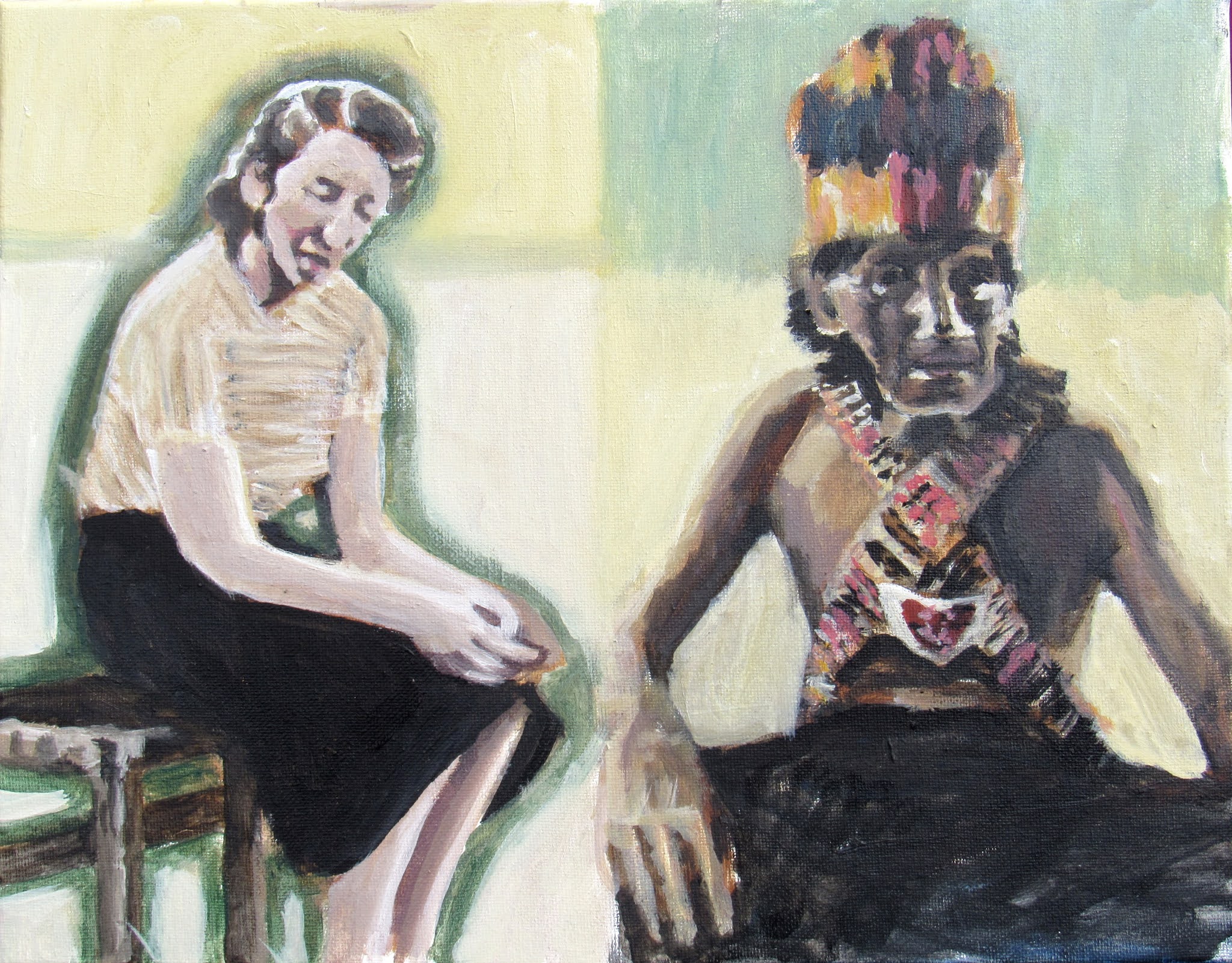
Wambustrik, mourning. 20x10 inches, oil, 2024.
"Méditation de Wambustrik sur la tombe de son fils, mort il y a peu de temps." [Caption of photo 7 by Pierre Allard and Philippe Luzuy, Visages de Bronze. Ides et Calendes Neuchatel, 1960] There's a name, finally, to one of the figures portrayed in Visages de Bronze. When I last painted him, almost two years ago, he was just a "Shuar man." The book has been the main source of illustrating those songs that were recorded by Allard and Luzuy during the same expedition in 1960, and that appeared on Jivaro: Indiens Shuar, Cayapa, Otavalo. I do not know if Wambustrik is heard on the recordings, but there is a certain synchronicity between photos and sounds.
 

Thursday, May 18, 2023

Do Souls Multiply?

Rosalia Martinez/Shuar woman (after Luzuy)

Every twentieth or thirtieth painting or so I feel like I'm painting someone I know other than the one who is actually being painted. It happened in this painting while working on the portrait of Rosalia Martinez; all the way down the start of the process I felt like I was painting someone who once was a student in a drawing class of mine. The Shuar woman on the right does not feel like anyone I know but last year, when painting another Shuar woman, also photographed by Philippe Luzuy and published in Visages de Bronze, she continued to have the spirit of the neighbor of a friend. This then leads me to a novel conclusion that there are about 400 thousand different souls in the world. It is also a novel explanation for a mystery that I have been wondering about: If reincarnation is real, how is it possible then that there are so many more people alive today then there were, say, a thousand years ago. In other words: Do souls multiply?

All kidding aside; Rosalia Martinez wrote the commentary on the CD Les voix du monde, une anthologie des expressions vocales for a recording by Philippe Luzuy called "ujaj", a track that was listed in a top 100 numerous times. As it was before, I had to be inventive to find appropriate images. Last year I ended up painting Jean Rouch together with that Shuar woman who looked like the neighbor. Jean Rouch, as it turned out, had harassed women and would have faced consequences today in the years since the me-too movement. Philippe Luzuy had extensively worked for Jean Rouch. An option I had this year was to paint Paul Morand, who wrote the introduction to Visages de Bronze, but I quickly realized that Morand had even a worse civil record than Rouch did. Paul Morand was a Nazi collaborator during the second world war. I never have been able to find a photo of Luzuy himself yet.


Sunday, November 20, 2022

The color of a frog

Shuar man, woman (after Pierre Allard, Visages de bronze)
Like last year, a number of recording from the LP Jivaro: Indiens Shuar, Cayapa, Otavalo are listed in the Top 100. I still have not been able to find a photo of Philippe Luzuy, who recorded the music on the LP, or Pierre Allard, the photographer who was with him in 1960. And, as I did last year, I used images from the book Visages de bronze [1960] with photographs by Pierre Allard and text by Luzuy. The two portraits here represent a social dance song sung by a man and a woman. I had already commented before on social and gender relations in Shuar communities, and the recording here illustrates further the discrepancy between the written account of archaeologists concerning the separation of genders and their photographs and musical recordings. For a second painting illustrating the Shuar I used the image of Simone Dreyfus-Roche, listed as the editor on the sleeve. In another gender reversal of norms, it is Dreyfus-Roche who is the authority and well known anthropologist. Luzuy, I assume, is working under her guidance. Simone Dreyfus is known for her work and recordings done in the Amazon regions of Brazil. She recorded the Capoeira among others in the mid-1950s.
Capoeira indian with Simone Dreyfus
I did not use the random color selector for the Dreyfus painting. The Shuar painting was the last of a series of works with random colors. I do like the generator though, it makes me use colors I would have never thought of using. Here's an anecdote about random colors from about twenty years ago: While my boss at a museum job was at a meeting I sat down behind his desk. I don't remember if I put my feet on his desk or not, but I did make myself comfortable. With one hand I was playing with pencil sharpener in the shape of a frog and with the other a book of color samples. Then my boss unexpectedly came back early, catching me and asking what the hell I was doing. I told him I was looking up the color of the frog. And when I actually matched the color, its name was "frog green." I chose golden colors for my painting illustrating Kulali singers from Papua New Guinea because I had done the same thing for the Top 100 2018.
Ulahi and Eyo:bo
Ulahi was still a repected and active singer among the Kulali of the Bosavi Rain Forest when Steven Feld revisted them some 25 years later in 1991. Now she was wearing western style clothing and make-up but she hardly looked much older then in 1977 when Feld took the photo I used above. This time Feld took the famed Grateful Dead drummer Mickey Hart with him. Hart produced a follow up CD with brand new recordings. [Voices of the Rainforest, 1991, Smithsonian] Ulahi is now credited for her performances as modern day pop singers would be credited—Her name comes first.


Thursday, August 26, 2021

Gentlemen in the Jungle

Michael J. Harner playing a shaman's drum/Shuar woman preparing beer

My purchases this year of the LP Music of the Jívaro of Ecuador as an mp3 file and the book Visages the Bronze, and free downloads of the LP Jívaro and a pdf of The Jívaro: People of the Sacred Waterfalls all contributed to an enormous amount of recordings by the Shuar people (as the Jivaro are currently referred to) in the Top 100 but other sources were accessed as well. I've read current academic papers on Shuar culture as well as some early anthropological studies done in the 1930s. The four titles listed above are by the ethnologists Philippe Luzuy and anthropologist Michael J. Harner. I've painted Michael J. Harner here to illustrate the song Social Dance Singing (female chorus) that he recorded in 1972 together with an image of a woman preparing mash for manioc beer that Harner also took in 1972 and appears in the liner notes of Music of the Jívaro of Ecuador. [Folkways, 1973] The image of the woman photographed by Harner would also be appropriate for the song Chant de la bière de mais but for the Luzuy recording of it I used an image of the Finnish anthropologist Rafael Karsten paired with an image from a photo that he took during his frequent stays with Ecuadorian Indians in the early 1930. 
Shuar man (after a photo by Karsten)/Rafael Karsten
Karsten's book Head-hunters of the Western Amazonas was the first serious academic study of the Shuar. The Jivaro, as they were then called, had an almost mythical status in the Western imagination. So much had been fantasized and speculated since their famous shrunken heads became a fad for collectors in the late 19th century, yet none had studied their actual culture until Karsten spent time with them. Karsten's observations however, as one might expect given the early date, are far from objective.

The song Chant de la bière de mais (recorded in 1960 by Luzuy) curiously enough is identical to another social dance song from Harner's 1972 recordings on Music of the Jívaro of Ecuador. Harner's recording is not just the same song as the one Luzuy recorded twelve years earlier but it's identical note for note, as identical as a Beethoven piano sonata recorded by two different pianists at different times. Beethoven's music was written down but the Shuar songs are passed on from one singer to another. Stranger yet, even more starteling, is the fact that the singer recorded by Luzuy is a man while the singer recorded by Harner is a woman. Michael Harner, as well as others who have studied the Shuar, observed strict gender roles. (I wrote about the mysogyny of Shuar culture earlier, you can read it here.) Cultures like the Shuar may be much more flexible as anthropologists would be able to observe. (Here's the link to all my recent musings on the recordings of the Shuar.) 

Matthew W. Stirling/Shuar woman (after a photo by Stirling)
Philippe Luzuy recorded five tracks listed in this Top 100 and I still have not been able to find an image he appears on. For the fifth recording then, which is called Chant sur l'oiseau Toucan, I continued to chronicle the history of Shuar anthropology. A few years after Karsten, still in the 1930s, the American Matthew W. Stirling, produced a study of much greater integrity. Historical and Ethnographical Material on the Jivaro Indians has the flaw that Stirling relied on a certain translator who was biased, coming from a rivalling tribe. Harner, who used Stirling's book as a guidebook, tracked the informant down thirty years later and was able to set the record straight on some of Stirling's conclusions. In the painting here Stirling is seen carrying a gun (I think this may be a first for me!) in the Ecuadorian jungle. Next to him is an image of a Shuar individual he had photographed. 

Note: The photograph I used to portray Matthew Stirling, also features his wife, and long time collaborator, Marion Stirling. It felt really really weird to edit out Marion Stirling and instead, replace her by a Shuar woman, the object of their studies. In reality Stirling is much taller than the (unnamed) Shuar woman. 

Monday, June 7, 2021

"Jivaro" (Updated developments)


Jean Rouch/Jivaro woman, oil on canvas, 11x14 inches, 2021

I received my copy of Visages de Bronze in the mail the other day. The "Faces of Bronze" on the back cover made me hope the text would be in English as well as French. No such luck, it's French only. There's only a little bit of text though, so little that between my limited knowledge of the French language and Google Translate I can figure out what's in the text. I had hoped for an image of the author Philippe Luzuy inside the book but here too I was not so lucky. I just finished painting the third one of five selections from the record "Jivaro" in the Top 100. I substituted the customary portrait painting of the person responsible for the recording first with a image of the record sleeve, then with Bernard Taisant (director of the film Visages de Bronze), and now with the well known filmmaker and anthropologist Jean Rouch. Philippe Luzuy is listed as editor on many Rouch documentary films, hence this desperate substitution. Rouch's specialty is African culture and he is known to have revolutionized the way Africans and African culture are portrayed by western institutions. Rouch thus appeared to be a positive choice for my object/subject series of juxtapositions. Rouch died in 2004 and some years after that the artist Coco Fusco, known for her work concerning racial and gender identities, a social justice warrior, told the world about how she was sexually accosted by Rouch many years earlier showing, in the process, that the object subject separation between genders, races, and cultures lingers in all its colonial forms. Fusco, who is Cuban-American, shows how exploitative power structures continue to exist. With this in mind I set out to paint a portrait of Rouch next to an image of a Shuar (Jivaro) woman who was photographed by Luzuy for Visages de Bronze. Now that I have the book I can inform you that the individual whose image I questioned last week, was, for the cover of "Jivaro" indeed photographed by either Luzuy or his collaborator Pierre Allard. The earlier image of what I believe to be the same individual was photographed during the Lewis Cotlow Amazon Expedition. The same man was simply about ten years younger when Cotlow met him and Luzuy ran into the same person. In the Luzuy/Allard photographs (I assume) the man had gained status as he is more decorated than in the earlier photographs. I read that the necklace (made from pelican bones) the Jivaro warrior is wearing in the images in Visages de Bronze and on the cover of the LP "Jivaro" is a status symbol whose right to wear is earned. From reading the book I know now too that the cover image, that I used for the first of the three finished "Jivaro" painting is not a Shuar woman (child rather) but she belongs to the Colorado Indians also from Ecuador.

Monday, May 31, 2021

"Jivaro"


As it stands today five songs from the record "Jivaro" are listed in this year's top 100. The recordings on it were made by Philippe Luzuy. I have not been able to locate an image on which Luzuy appears which makes it a challenge to stick with my concept of painting the recorder next to the musician. This painting is the second one of the five that I will have to do. On the first one I used the image on the record cover for the musician and the cover of the book Visages de bronze as a substitute for Luzuy who recorded the Jivaro in Ecuador in 1956. Visages de bronze is a collaboration between Luzuy and the photographer Pierre Allard and since the book and the recordings were made at the same time I figured the record sleeve photo was also by Allard. I have not been able to find a photo of Allard either but for this second painting illustrating songs from "Jivaro" I did find out about a documentary film that was made at the same time and is also called Visages de bronze. I did find an image of the filmmaker and he is the one portrayed in this painting. His name is Bernard Taisant. I could not find any info on him either but the documentary did win an Award at the Cannes film festival in 1958. Geneviève Vaury is credited as to appear in this film. Of her I find plenty of images but I have no idea if and how she relates to Luzuy or to the Jivaro Indians. (The Jivaro Indians are today identified as Shuar people.) The film isn't even listed in Vaury's filmography. The song this painting illustrates is the first on the album and is called Danse et chœur des hommes auteur d'une tête réduite which translates as a male choir engaged in a dance ritual surrounding a shrunken head. The image on the left is of a Jivaro Indian holding a shrunken head. It is the very same individual who appears on the record sleeve. The photo I used here, to my surprise, was not by Allard and is a older too. The photographer is credited as Bettmann and was apperently taken during the Lewis Cotlow Amazon Expedition. Getty images, who owns the photo, lists 1967 as the date but this can't be right as the last of three expeditions by Lewis Cotlow to the Amazon took place in 1952. The record "Jivaro"is from 1956. A 1951 photograph shows Cotlow together with the very same Jivaro warrior I've now painted twice. A few weeks ago, in Properly Identifying the Music of the Top 100, I discussed the problem of inaccurate data used in publishing before 1970, especially when it concerns items for a larger or popular audience. I have now ordered the book Visages de bronze by Luzuy and Allard and I'll get to the bottom of this confusion of data and credits (even though my French will not nbe good enough to properly interpret the text.) I need the book because I have to paint three more paintings of recordings by Luzuy. (The book is richly illustrated and I'm hoping there's an image of the author included too, if not I will use Geneviève Vaury  for the next Jivaro painting which will be to illustrate a woman's love song.)

Wednesday, May 5, 2021

Properly Identifying the Music for the Top 100


In ethnomusicology it is nothing short of best practice to record the name of the performer(s), date and and place of recording, the language of the lyrics, and to identify the appropriate cultural or ethnic group the performer(s) belong to. There's nothing new to this practice but a half a century ago the data are often sloppy, especially concerning material shared to a broader audience beyond the academic field. The Folkways Records label, founded in New York City in 1948 by Moses Asch, set out to "record and document the entire world of sound." [folkways.si.edu] Recordings on the Folkways label have been one of my main sources for music and knowledge of music history for many years. After Moses Asch's death the Folkways collection was bequeathed to the Smithsonian Institute in 1987. The Smithsonian honored Asch's wish for the availability of all titles at all times. My own record collection contains many Folkways discs and my collection of songs in digital format bought from the Smithsonian Folkways website (where all titles are available) is rapidly growing. I've come to depend on the information provided by this website to correctly identify the recordings I'm interested in. I've come across several instances now when the provided information isn't all that accurate, and I've learned that anthologies and compilations on the Folkways label are not a reliable source for information. An error on Anthology of Central and South American Indian Music for example, caused me to misidentify a certain song in the Top 100 2020. I'm leaving the Top 100 2020 list intact, including errata, but I change data in my archive when I uncover a mistake. Number 73 from the 2020 list comes from that Indian Music Anthology and is called Yekuana Fertility Chant, a song, according to the liner notes, about the yucca planting ceremony of the Yekuana. The materials on anthologies are often abbreviated from the original record and often a different, more generic, title is used. The fertility song is referenced by number FE 4104 which is the identifying number for the album Music of the Venezuelan Yekuana Indians. That record has indeed a number of songs that involve a (yucca) fertility ceremony. None however match the mp3 file I purchased at the Smithsonian Folkways website. I finally have identified the music as one several Social Dance Songs that appear of the record Music of the Jivaro of Ecuador. Another one of those Dance Songs appears higher up the same Top 100. I was revisiting the Jivaro record in preparation to paint the Shuar Ujaj song by a chorus of women for the Top 100 2021, which is identical to the Social Dance Dance Song by the Jivaro in the Top 100 2020. I learned from the French, very well documented Voices of the World 3cd-set, that the source of that recording is actually a French disc called "Jivaro" rather than the slightly younger Folkways disc. I learned the song was recorded by Philippe Luzuy in 1956. The Smithsonian Folkways website does not credit Luzuy but rather Michael J. Harner. Upon carefully reading the liner notes for the Folkways album  that were written by Harner it turns out he does not actually take credit for the recording, just for the writing and the photographs, also from 1956. I've gotten myself into a big tangled mess of ethnomusicology data that do not match. It seems trivial to untangle this mess, but to me it's essential to the concept of the juxtaposition of recorder and recorded for the 2021 series. I could not find a photograph of the performance that was recorded in 1956 and neither could I find an image of Luzuy. I've painted Harner before and used pretty much every image from the Folkways record in earlier paintings. The one who recorded the song that is now now in the top 100 for the third consecutive year, was not Harner anyways but Luzuy. I chose to use the cover for Luzuy's "Jivaro: Indiens Shuar, Cayapa, Otavalo" (the original source of the recording) for the painting that you see above. The cover photograph was taken by Pierre Allard. As a substitute for not having an image of Luzuy, I decided to use the cover of the book Faces of Bronze (Visages de Bronze) by Luzuy that appeared in 1960 and is pretty much the only thing that can be found on line about Philippe Luzuy. The photograph again was taken by Pierre Allard who is listed as co-author for the book. The Shuar, by the way, is the more specific name currently used for the Jivaro peoples of Ecuador. For the 2020 illustration of the wrongly labelled Yekuana Fertility Chant that you see below, I used a photograph by Theodor Koch-Grünberg from 1912. A historic recording of a Yekuana shaman by Koch-Grünberg was used by Walter Coppens to include in his Music of the Venezuelan Yekuana Indians. The spelling for Yekuana has now morphed into Ye'kwana.

Monday, April 19, 2021

'Are'are and Shuara
The collection The Human Voice in Music compiled by Carlos Reynoso starts with a shamanic song of the Ecuadorian Shuara (familiar name: Jivaro). "For  those who wish to form an idea that is not biased by the temptation of  exoticism or by anachronistic particularistic yearnings, the collection  begins here." These are Reynoso's words (via Google Translate) which I (should) take to heart. Right away, within the first song of the collection, my integrity is being challenged. While having certain thoughts on the beginnings and essence of music, there are a number of factors at play I remain ignorant about. Reynoso must be serious about fighting misconceptions. Now the Shuar (Jivaro), is a good place to start because if there's one culture that has been misrepresented throughout western literature it must be the Amazonian Shuar. According to Reynoso the Shuara Shamanic Song exists in the grey area between speech and singing. The recorded performance is a manifestation of an altered state of consciousness that is patterned in such a way that it should be considered music. [Reynoso] Isabel Aretz and Felipe Ramon y Rivera, who I assume are responsible for recording this gem, characterize this incantation as a song. If the shaman heard on the recording is male or female isn't mentioned. In last year's top 100 I assumed that this was a recording of a woman but now I have my doubts. It shouldn't matter. Most shamans are men but in some cultures (including the Shuar) sometimes women become shaman, then there are other cultures, particularly in East Asia where most shamans are women. Listening to the song I assumed I heard a woman's voice but listening to other shamans recorded, both Shuar and from other cultures, it is not uncommon, even characteristic, for a (male) shaman to use a falsetto voice. I realized the shaman recorded by Aretz and Ramon y Rivera could be a man after watching a video of Dan Ramon, a Shuar shaman who was recently recorded by a site called Amazon Explorer. I decided to use a still from this video for the illustration of the Shuar Shaman Song. He is pictured on the right while Isabel Aretz is on the left. Aretz (1909-2005) was an Argentine Venezuelan composer and ethnomusicologist. The song was number 15 in 2020 and now, in the Top 100 2021, resides at number 4, for the time being.
No doubt exist as to the gender of the performers of the song "Aamamata na Kaukaurara" that is number 67 of the Top 100 2020. The performers Aaresi and Il'eresi were recorded by Hugo Zemp in 1977 in the Solomon Islands. Aamamata is a genre of song used for funerals. Kaukaurara is the composer of the song. The title thus translates as Funeral Lament by Kaukaurara. Another  song by the same two women appears on Zemp's Musique 'Are'are. The image above comes from a still from that film. The 'Are'are are a cultural group from the largest Island in the Solomon archipelago which is Malaita.


Friday, April 9, 2021

Of Violent People and of Friendly People
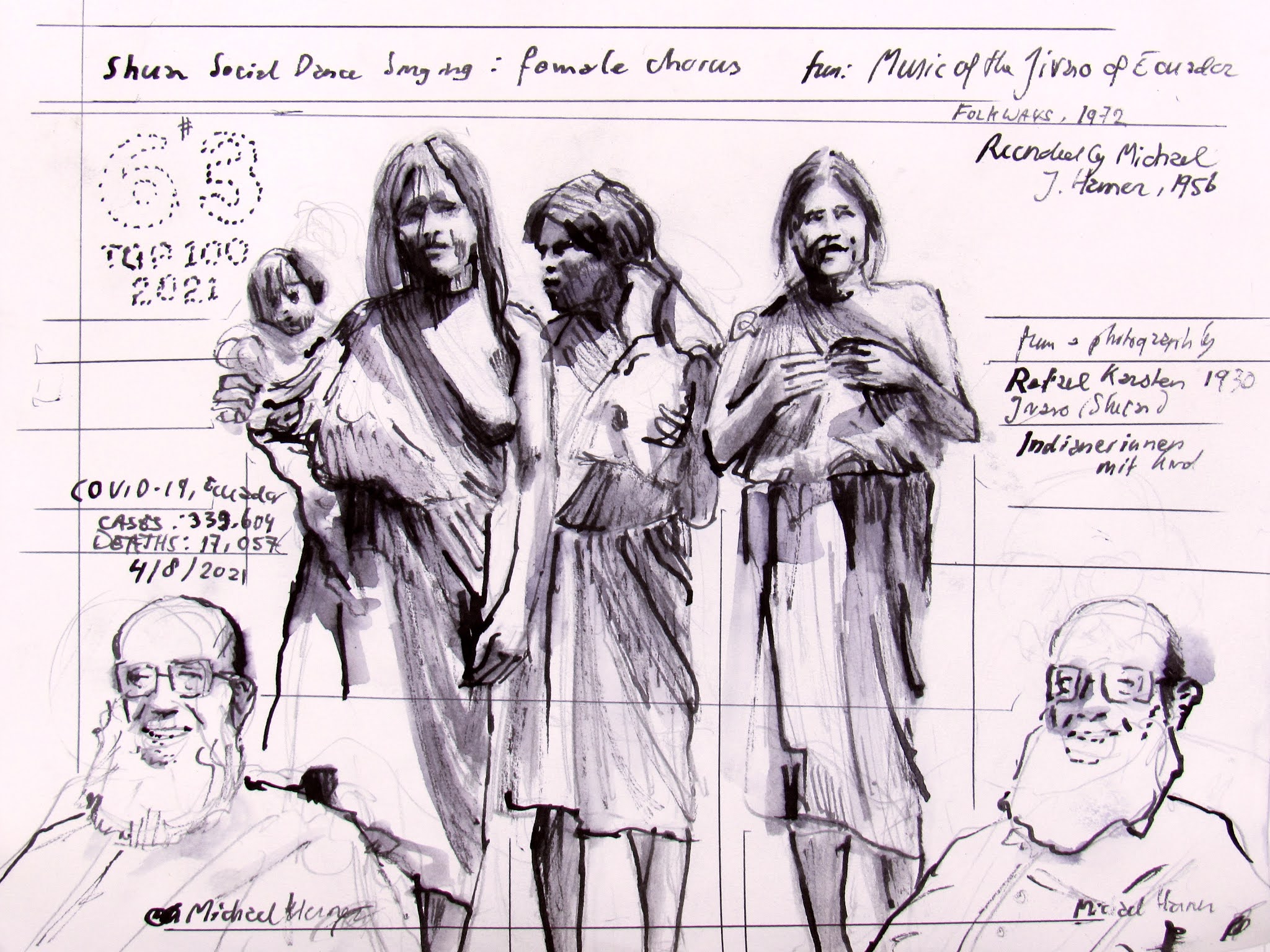
Indianerinnen mit kind (Shuar)/Michael J. Harner

 The Shuar, generally better known by their previous name Jivaro, were one of the most violent tribes written about in the anthropological history. They were head hunters, the source of the once collectable shrunken heads. (Earlier I wrote about the practice of infanticide among the Shuar.) The Jivaro warriors were feared throughout the region by their enemies but also by their own women. While the status of women throughout the world is usually not anywhere near the status of equality, the Jivaro women were worse off. Beatings were common. Only later in life, when widowed, or when they were children they could live in relative freedom. The suicide rate of Shuar women were among the highest in the world. Yet, their songs are among the sweetest and happiest I've encountered. Michael J. Harner recorded several dance songs and lullabies that are included on the Folkways LP 'Music of the Jivaro of Ecuador' along with war songs and other songs by men. Shaman's songs were recorded too. One freedom Shuar women enjoyed was to become a shaman. Not many neighboring tribes had female shamans. Harner was the first to study the Shuar in depth in the 1950s, earlier records are anecdotal, biased, or tainted by biased interpreters from neighboring tribes. Rafael Karsten, in the 1930s was the first anthropologist to attempt a study of the then called Jivaro, but later had to admit to Harner that all his information came from a translator belonging to a tribe not friendly to the Shuar. Harner tracked this individual down for his research and corrected Karsten's otherwise useful data. The photograph I used for this image was taken by Karsten in 1930. Harner, later in his career, became known for his research and books on (neo)shamanism and other spiritual new age practices. Shuar Social Dance Song (2): Female Chorus in #63 in the Top 100 2020.
Marjorie Shostak/!Kun San man
The historical contrast between the Shuar of Ecuador and the !Kung San of Botswana couldn't be greater. The Shuar had a violent death rate among men under 25 at a staggering 42%, the highest number ever recorded in the world, the number !Kung San men in contrast, is less than 0.5%. San women are considered equal. Marjorie Shostak, seen on the left, spend many years with the San people. She recorded the 'Sitenga with one man's voice' in Botswana in 1970. It's at #5 in the Top 100 2021. The song, by /Tilkay (also known as "Jimmy" from /Xai/Xai, itself was not illustrated in the liner notes to the album so I used another image from these notes. The man on the right was photographed by Shostak and is labeled: "A !Kung San man reclining." The ! and / symbols used in the text are vocal sounds, the ! represents the click sound made famous by Miriam Makeba in "The Click Song." One more thing: the object/subject differentiation disappears even further compared to the last painting I wrote about a few days back. The only photo I could find of a 'sitengena' being played was this very image of Marjorie Shostak.

Tuesday, July 21, 2020

Infanticide

Woman preparing the mesh for manioc beer
14x11 inches, watercolor, pencil, spray paint on paper, 2020
I think infanticide is pretty cruel. The whole concept of it seems very alien, but it didn't used to be that way. The practice was actually rather universal and still used among certain cultures that have not been in contact, or are independent from, the industrialized world. It's a debate of ethics I guess. We in the Western civilization would think of infanticide as unethical and the cultures who practice it as barbaric. They themselves think nothing of it. Ethics is a social construct and for most people in the world it is an effect of organized religion. Philosophy has a great deal to say about ethics too, but it is also formed on the same structures our civilization is built on. Philosophers think a lot about ethics,  they think about identity, and how and when a newborn baby becomes a person. They may consider that an infant becomes a person, a human being, at perhaps three years of age. Still philosophy will not condone infanticide. Imagine our cultural norms would shift, perhaps because of the philosophy of personhood, so that we come to think of babies becoming individuals at the age of one. This is when an infant would get "christened," named, assigned a gender, a character of its own, and so forth. The likely result of such a cultural debate would be that the general population could accept an abortion maybe a month or two later in the pregnancy than it is the case now. This, in my opinion, would be a good thing. Let them choose, and we, men, stay out of the debate altogether.

The Shuar are one of the peoples practicing infanticide, at least they did in 1984, when Michael Harner wrote Jivaro: Pepole of the Sacred Waterfalls.[Berkeley: University of California Press, 1984] They would only kill deformed babies though and not, as with some other cultures, do it as a sacred ritual, neither do they have a preference for girls or boys. As I sketched out in May life for a Shuar woman is hell. Who would blame them if they didn't want to bring a new baby girl into the world.
The photograph the above drawing is based on was taken by the same Michael J. Harner who also recorded the Social dance song and produced the record both photo and song are found on: Music of the Jivaro of Ecuador. [Ethnic Folkways, 1972]

Tuesday, May 5, 2020

JIVARO!

Jivaro Family on the Banks of the Alto Maranon, 1901
11 x 14 inches, pencils and spray paint on paper, 2020
I was involved in a discussion on facebook the other day about the separation of an artist's conduct and the work made. How it is now impossible to listen to the music of Michael Jackson or watch a Woody Allen movie no matter how great you thought they were at the time. I contributed to the arguments by stating that I believe today artists are more aware of ethical responsibilities than they were just twenty years ago, that the art world has changed to a culture of accountability. That these days it's harder and less romantic to get away with behaviors that hurt or harm others. Romantic ideas about artists and the creative process are a thing of past and we now come to a consensus that seeking extremes (perhaps required for depth in one's work) and social accountability are not mutually exclusive. Artists that came up as examples in the discussion, beside Woody Alllen and Michael Jackson, included Morrisey, Sinead O'Connor, Lou Reed, and Michelle Shocked. Discussed were the cultural tendencies that would allow and foster predatory behaviors. 

So here I am today painting images of indigenous cultures who may practice female genital mutilation, men who may beat their wives and rape others, trade them like cattle and consider the domestication of girls a task like that of the domestication of wild animals. Cultures who are perpetually at war with one another, who practice infanticide, and, as in the case with the Shuar who I am introducing here, eat human meat. The Shuar (Jivaro) who live in Amazonian Ecuador are perhaps one of worst societies know to men in that respect, whose traditions are so violent and nauseating that one wonders about humanity in general. Yet, the music of the Shuar, through recordings made by field archaeologists, and perhaps because of its outlandish nature, belongs to my most listened to and appreciated music of recent. For all its misogyny and incredible high rate of female suicide the Shuar (unlike the neighboring Yanomamo who are also known for their violent existence) allow for women to become shamans. In a recording made by Isabel Aretz and Felipe Ramon y Rivera from INIDEF of Venezuela one of such shamans is heard. The sounds on the recording, the voice of the woman, are so beautiful, sweet almost, and seem highly sophisticated. Listening to Shuara shamanic cantilation you wouldn't suspect such violent context to such a beautiful song. You would't suspect it either by reading about it. In the notes of the collection La Voz Humana compiled by Carlos Reynoso on which the recording appears, all that is discussed are tonal characteristics and rhythmic patterns. There's no mention that the Shuar beat up their wives.

Ecuador has been faring too well in terms of COVID-19 since I first reported on it a month ago. The numbers have gone up from 3,456 cases and 173 deaths reported on 4/4/20 to 31,881 cases and 1,599 deaths today (5/5/20). Since there are four Shuar recordings in the list I plan on drawing the third one on 6/6 and the fourth on 7/7 and see how the virus develops in Ecuador.

Saturday, April 4, 2020

Coronavirus

Tsantsa (shrunken head) with rope, Shuar
14 x 11 inches, various materials on paper, 2020
Manganja Woman
14 x 11 inches, various materials on paper, 2020
The Coronavirus has stopped life in it tracks for the most part yet the top 100 moves forward. We're well into 2020 and the list for this year starts to take shape. Represented here are the numbers one and two thus far. Both come form the 3-cd set Voices of the World: An Anthology of Vocal Expression [Le Cant du Monde, 1999]. Coordinated by Hugo Zemp it features recordings by some of the world's renown ethnomusicologists. The box set is dominating the list and the track Chingolingo, chant yodle by a group of Mang'anja women from Malawi is destined to end on top at the end of the year. 

It felt appropriate given the circumstances to make these drawings. It's the sort of activity that takes time, is a lot of tedious and sometimes rather mindless work. Like most everybody else, the days spent at home are consumed by the cascade of news surrounding the Coronavirus. I've always been a numbers and lists person and that's what I get lost in; percentages, numbers, comparisons by country and regions, and other statistical trivia. I thought it appropriate to add some stats under the captions I penciled in. When I finished the Mang'anja woman Malawi was one of only a handful countries in the world with no reported cases. This was a few days ago. Now there are four. Nobody's died yet from the disease. Vietnam, whose Bahnar people I wrote about last week, has since doubled their cases, but still no deaths there either. The first country represented in these series who suffered fatalities is Ecuador. The count there as of today: 3,465 cases and 172 fatalities are reported. 

The Shuar, better known by their older name Jivaro, live in the Amazon Rainforests of Ecuador. I won't dwell on their history too much, as history of their shrunken head traditions have been a focus of many writings (including in this blog) but one anecdote I learned today I will mention: The function this tradition has in Shuar culture is for men to keep their wives and daughters in line. The track Ujaj, currently residing at number two, is sung by a group of women. I've always wanted to draw a picture of a shrunken head.