|
Michael J. Harner playing a shaman's drum/Shuar woman preparing beer
|
|
My purchases this year of the LP
Music of the Jívaro of Ecuador as an mp3 file and the book
Visages the
Bronze, and free downloads of the LP
Jívaro
and a pdf of
The Jívaro:
People of the Sacred Waterfalls all contributed to an enormous amount of recordings
by the Shuar people (as the Jivaro are currently referred to) in the Top 100 but
other sources were accessed as well. I've read current academic papers on Shuar
culture as well as some early anthropological studies done in the 1930s. The
four titles listed above are by the ethnologists Philippe Luzuy and
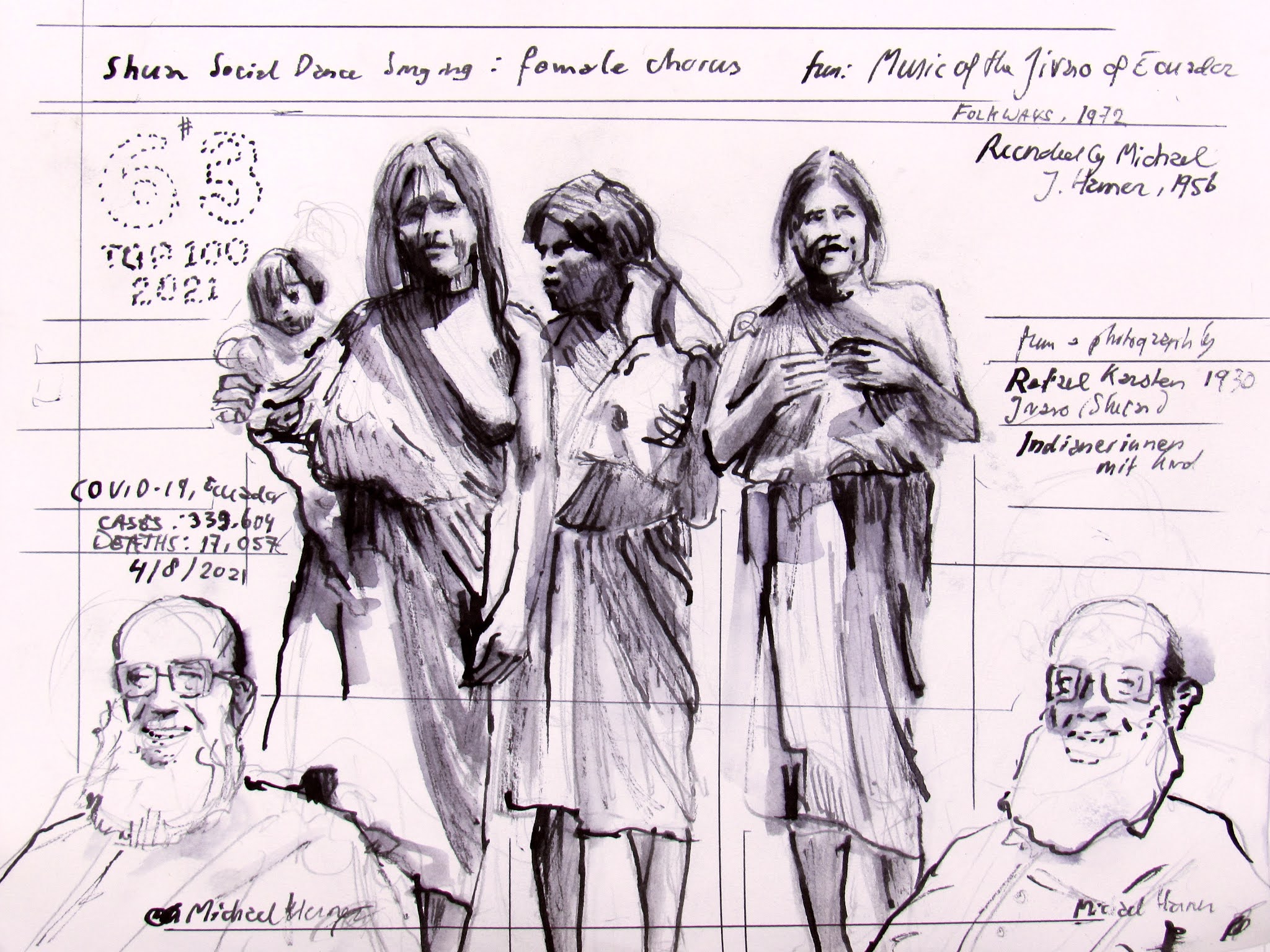
anthropologist Michael J. Harner. I've painted Michael J. Harner here to
illustrate the song
Social Dance Singing (female chorus) that he
recorded in 1972 together with an image of a woman preparing mash for manioc
beer that Harner also took in 1972 and appears in the liner notes of
Music
of the Jívaro of Ecuador. [Folkways,
1973] The image of the woman photographed by Harner would also be appropriate
for the song
Chant de la bière de mais
but for the Luzuy recording of it I used an image of the Finnish anthropologist
Rafael Karsten paired with an image from a photo that he took during his
frequent stays with Ecuadorian Indians in the early 1930.
 |
Shuar man (after a photo by Karsten)/Rafael Karsten
|
Karsten's book
Head-hunters
of the Western Amazonas was the first serious academic study of the Shuar.
The Jivaro, as they were then called, had an almost mythical status in the
Western imagination. So much had been fantasized and speculated since their famous
shrunken heads became a fad for collectors in the late 19th century, yet none
had studied their actual culture until Karsten spent time with them. Karsten's
observations however, as one might expect given the early date, are far from
objective.
The song Chant de la bière
de mais (recorded in 1960 by Luzuy) curiously enough is identical to another
social dance song from Harner's 1972 recordings on Music of the Jívaro of Ecuador. Harner's recording is not just the same
song as the one Luzuy recorded twelve years earlier but it's identical note for
note, as identical as a Beethoven piano sonata recorded by two different pianists
at different times. Beethoven's music was written down but the Shuar songs are
passed on from one singer to another. Stranger yet, even more starteling, is
the fact that the singer recorded by Luzuy is a man while the singer recorded
by Harner is a woman. Michael Harner, as well as others who have studied the Shuar,
observed strict gender roles. (I wrote about the mysogyny of Shuar culture
earlier, you can read it here.) Cultures like the Shuar may be much more
flexible as anthropologists would be able to observe. (Here's the link to all my
recent musings on the recordings of the Shuar.)
 |
Matthew W. Stirling/Shuar woman (after a photo by Stirling)
|
Philippe Luzuy recorded five tracks listed in this Top 100
and I still have not been able to find an image he appears on. For the fifth recording
then, which is called
Chant sur l'oiseau Toucan, I continued to
chronicle the history of Shuar anthropology. A few years after Karsten, still
in the 1930s, the American Matthew W. Stirling, produced a study of much
greater integrity.
Historical and Ethnographical Material on the Jivaro
Indians has the flaw that Stirling relied on a certain translator who was
biased, coming from a rivalling tribe. Harner, who used Stirling's book as a
guidebook, tracked the informant down thirty years later and was able to set
the record straight on some of Stirling's conclusions. In the painting here
Stirling is seen carrying a gun (I think this may be a first for me!) in the
Ecuadorian jungle. Next to him is an image of a Shuar individual he had
photographed.
Note: The photograph I used to portray Matthew Stirling, also features his wife, and long time collaborator, Marion Stirling. It felt really really weird to edit out Marion Stirling and instead, replace her by a Shuar woman, the object of their studies. In reality Stirling is much taller than the (unnamed) Shuar woman.