Showing posts with label Simha Arom. Show all posts

Thursday, December 16, 2021

Not Simha

Cover of Aka Pygmy Music/Pygmy family posing with European man

By today's standards this would certainly not be the most flattering image depicting Simha Arom, the French/Israeli ethnomusicologist and expert of Central African music. Images like these are (were) common in the world of anthropology and ethnography as they are assumed to give credibility to the research being done. It shows rapport between the scientist and his (or her) subjects. No doubt that the photo I used for this painting had nothing but good intentions but the underlying racist tendencies are clear from the fact that the Aka family members are not named. The caption simply reads: "Simha Arom."


Edit: I researched the origin of the photo and it turn out that it's not Simha Arom at all who is depicted. The original photo is from 1921 and appeared in Collier's New Encyclopedia. The caption is: "Pygmy family posing with a European man for scale."

Ivan Polunin/Back cover image of Murut Music of North Borneo
Dr. Ivan Vladimirovitch Polunin (1920-2010) was a professor of medicine until he retired in 1980 in Singapore. He was also an ethnomusicologist, a collector of art, a film maker, photographer, and naturalist among other things. He was a polymath. He was the son of a Russian father and English mother who were both artists for the ballet of Diagilev. Olga Polunin, one of his two daughters, is also an artist. The family settled in Singapore in 1948 and remained on the island to this date. The song in the top 100 he recorded is called Ambubus Perawan and is played on a sumpotan, a gourd with a mouthpiece and bamboo tubes. The tune appeared on Murut Music of North Borneo and was released on Folkways in 1961. The sumpotan was played by a Peluari (one of the Murut peoples in Borneo) girl who remains anonymous.
Chicha trough (hollowed log) of the Perija/Lars Persson
Twelve years ago the Chicha Song was listed in the Top 100 for the first time. I had used an image of two Quechua Indians holding a mug of chicha (traditional beer) and at the verge of keeling over. When several years later the same song entered again I wanted to use the same image but was disappointed I could not find it anywhere. Now the song is listed again and this time I did find the image back but to my consternation I realized the two Indians were men and not women as I had previously understood. It is essential that a woman is painted to represent the chicha song because the song is part of a coming of age rite for young women. And the song is sung by a woman. The song is found on the fabulous collection The Music of Primitive Men. That there a no data provided with that record on the Horizon label is not so fabulous and I chose Lars Persson because he recorded the Motilons on another collection: The Indians of Colombia. It is very well possible that Horizon used Persson's Motilon recordings because I am not aware of any other recordings of this ethnic group (Yuko-Motilón.)


Monday, August 9, 2021

Simha Arom in Cameroon

Young Aka woman/Simha Arom

Simha Arom/Baka child at the Aba encampment
Two tracks from Cameroon: Baka Pygmy Music [UNESCO, 1977] found their way to the midst of the Top 100 2021 list and I decided to work on these simultaneously. As an experiment I divided up both canvases into four equal parts that I then painted a certain color. I then painted the portraits on top of the color fields. Simha Aram, who recorded the tracks on the CD twice, juxtaposed with two young pygmy people he photographed. The Baka child is from the CD liner notes, the young woman is not a Baka but belongs to the Aka people of the Central African Republic. The two songs they represent are Song to Attract Game which is sung by four teenage girls and Hut Song by thirteen young girls and children. Both songs belong to the yeyi category which as a ceremonial origin and is still used in ceremonies but more often has evolved into secular songs. Hut song is secular and Song to attract game is ceremonial. Most Baka songs have a ceremonial or ritual origin giving credence to the theory that the origin of music is to be found within the "sacred." In much of the songs of the Baka people the men are dancers and the women singers. Most voices on the CD are of women and children.
Alice Coltrane
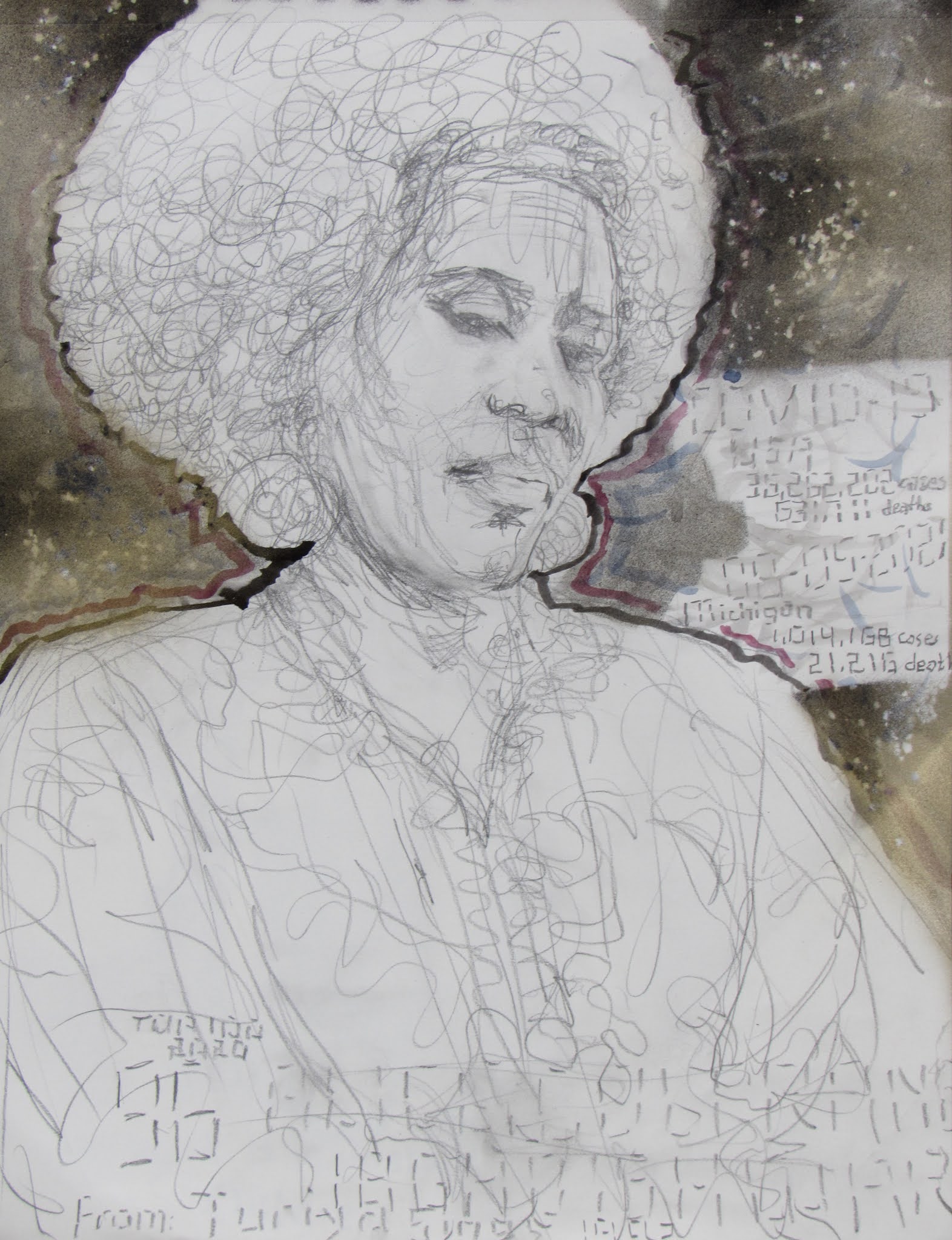
While working the paintings for the Top 100 2021 I continue to work my way down the list of the Top 100 2020. I'm milking it because I want to continue to work on the series until the exhibition goes up. I experienced another two week delay because of electrical issues in the archive space. But the exhibition will be really soon. Number 96 is Alice Coltrane with the track Jagadishwar from her 1981 devotional album Turiya Sings. The album is for voice and Wurlitzer, it's the first time Coltrane sings on a recording. At the time of recording she served as the director of the Interfaith Vedantic Center in Southern California. Alice Coltrane died in 2007, outliving her husband John Coltrane forty years.


Wednesday, March 10, 2021

Moving Along


Jofirsti Lungisa playing a musical bow 
 

The Top 100 2020 contains a larger than usual number of repeats from the year before and again a great number of tunes from 2020 will be repeated again in 2021. There's plenty of different music I play but those recordings that make up the playlist from which I compile my thoughts on the origin of music is getting more established as time goes on. And so do my thoughts. The playlist is front and center of my music appreciation path. At some point when I have enough time and ambition I am going to collect and edit my writings on this subject as they appeared in this blog and other places and compile them into a cohesive paper forming a theory on the origin of music, of art, and creativity. The theory is a meditation on all the big questions concerning the origin and nature of being using insights from hundreds of others. The theory itself is far too big and broad for one person to research. The theory that is forming in my hand circumnavigates materials handily available on line and is not depending on independent research at all but rather on the implications of the sounds on the playlist. And empathy. I haven't posted much recently but have continued the work towards completing the illustrations for the Top 100 2020. The nine works shown here are all from this year and are done on 11 x 14 drawing paper. Ink is the most common material used throughout but a number of other media have also been used. Represented are numbers 45 through 53:

  • 45: Jofirsti Lungisa – Nandel'ekhaye
  • 46: San, Tin Can Bow Solo
  • 47: Yeyi "Hut Song" by thirteen young girls and children from Cameroon
  • 48: Norma Tanega – You're Dead
  • 49: Ya'ak Keodaeng and Ya'Seu Keodaeng – Teum singing
  • 50: Sun Ra and His Akestra featuring June Tyson – Space is the Place
  • 51: Nellie Echalook and Rebecca Natialuk – Katajjait
  • 52: Grande danse, ahidus by a mixed chorus of Ben aissa Berbers
  • 53: Bell'ilba (lullaby) by a Kel ansar Tuareg mother
!Kung San playing a hunting bow

Baka gathering

Norma Tanega
 
Bamboo on the Mountains (cover), Frank Porschin

Sun Ra, preparation sketch for stencil

Sun Ra, stencilprint (A/P)

Nellie Echalook and Rebecca Natialuk

Berber Family

Tuareg mother and child, Bernard Lortat-Jacob