The Top 100 started as a hobby; a fan adoring his musical heroes and paying tribute by making portraits of them. The hobby became obsession and the project went from the boy’s room into the art world. But I'm still that fan, it's about them in the end, their music, and not about me.
Showing posts with label Mary Sivuaraapik. Show all posts
Showing posts with label Mary Sivuaraapik. Show all posts
Carla Bley died less than a week ago. Several websites I frequent, because of a similarity of musical preferences, dedicated space in her memory. I had never really listened to her music because, one day, maybe thirty years ago, I decided I didn't like it. I was so wrong, then. I might have been a bit of a misogynist, then too. I painted her right away, the first oil for the Top 100 2023. I have now rejected the plan to make a stencil print in an edition of five for all 100, yet I still like the stencil and I have not totally abandoned the concept. I did trace the Bley painting and cut a stencil. These are charming things and I will do something with these at some point.
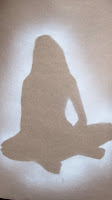
Thus far the stencils have worked better integrated into larger wholes, than as individual prints. Below the stencil for Mary Sivurapik was used on a pillar outside my studio. The stencil print of Sivurapik, an Inuit throat singer, is below that one.
Mary Sivurapik, stencil print, 12 x 18 inches
The stencil I cut for Sun Ra also looks better in a large mural created in the classroom with a couple of students then it does as a print.
Sun Ra
"239" Sun Ra inserted in collaborative mural, stencils and spray paint on wall
Photography provides our culture with ongoing snippets of reality. The instantaneous nature of these snippets are not being questioned because, after all, they are photographs. The camera is a machine and it objectively records reality accurately. It records reality unbiased and we ignore, or forget, the subjectivity of the photographer, who, by selecting which instant to share, already interpreted reality for us. Painting, contrary to this, is not instantaneous, and will not be considered as objective reality. The subjectivity of a painting is an automatic integral aspect in our reading of it, how we interpret what we see. In the same manner objectivity is an aspect of how we see a photograph. While painting from a photograph, which is what I do with these Top 100 portraits, the two different realities overlap, or rather the second (painting) is superimposed on the first Photography.) Certain aspects of instantaneous reality, taken for granted in a photograph, can look rather out of place in a painting. A photo of a figure in mid-motion, for example, could look awkwardly out of balance in a painting. Our mind simply recognizes the continuous motion in the photo but fails to so in a painting. The instantaneous moment is extended in the painting and the figure looks hopelessly unbalanced. You can easily tell the difference between a portrait painting from a photograph from a painting using a live model, a sitter. A big smile in the face is a first and easy giveaway. A big smile can be captured by a camera because its instantaneity, those photographed in fact, often do smile. While painting the smile it can not succeed in capturing the emotion, expression, of the instant. When looking at a painting of a person with a big smile, you will see certain wrinkles, individual teeth, but not a happy joyful expression. When I occupy this place between the instantaneous and the extended, I consider all these aspects of representation. I will remove evidence of the instance, and try to capture a person in an extended viewing, to show a broader view of a person's character as if this person were viewed over time. In the case of my Top 100 paintings this constitutes the viewing of many different photos, or videos.
Alaci Tulaugak;Nellie Nungak/Mary Sivarapik
Lately, I've become interested in reversing this relationship. To paint precisely those things that make a photograph a photograph, aspects of reality that are the unique property of photography. I paint the broad smile, the mid-motion depiction of a figure in motion, the out-of-focus face, or background, the disproportionate view that results from an odd vantage point (like being real close to a person for example.) In a video I recorded last week, I hold a record sleeve of a randomly selected disc. The person depicted on that cover seems up-side down, but she isn't. It's just that she is laying down on the ground and the photographer hovers over her with a (his) camera. In a painting, I thought, the image of the woman would look for sure up-side down. While I was recording the video I was in the process of painting certain Canadian Inuits from Nunavut that are part of the Top 100 2022. The video, shown below the second Inuit painting, became about that record sleeve, rather than about the current painting I was working on at that moment.
Two singers from Canada: Inuit Games and Songs
Even though the record, A Stereo Visit to Italian Movies, is not at all a part of the Top 100 2022 list, far from it, I had to paint it as if it were. I was reinforced doing so because of another random pick from my record shelves. This was a record of the Argentinian singer Ramona Galarza, the cover of which shows a background upside down as trees are reflected in the body of water directly behind Galarza. The painting then is a double portrait of the model featured on the Italian movie record together with Ramona Galarza, as she appears on the cover of the self titled record. At this moment I feel this painting is part of the current Top 100 series but I'm not 100% yet on this issue. This is the painting in question (below.)
The track Katajjait on "Hamma"
features three examples of katajjait, traditional game songs of the Inuit. The
word "hamma" is a syllable of the Inuktitut language, the songs
represented have no words but play on the sound of hamma. The songs appear on Canada: Inuit Games and Songs on UNESCO.
The performers, in order of appearance: Elijah Pudloo Mageeta, Tamegeak
Pitaulassie, Marie Apaqaq, Soria Eyituk, and Napache Semaejuk Pootoogook.
Recorded in Baffin Land at Cape Dorset and Sanikiluaq between 1973 and 1975 by
Nicole Beaudry and Claude Charron. Katajjait are secular song but were banned by encroaching Christianity for a hundred years. Many cultural traditions Inuit have disappeared and exist only in museums and literature but katajjaq vocal games somehow survived and are now practiced widely in Nunavut, the semi-autonomous state under Inuit rule in Northern Canada.

 Thus far the stencils have worked better integrated into larger wholes, than as individual prints. Below the stencil for Mary Sivurapik was used on a pillar outside my studio. The stencil print of Sivurapik, an Inuit throat singer, is below that one.


