Showing posts with label Ainu woman. Show all posts

Saturday, July 24, 2021

Nordic Cultures

V.G. Bogoraz/Chukchi folk tale narrator

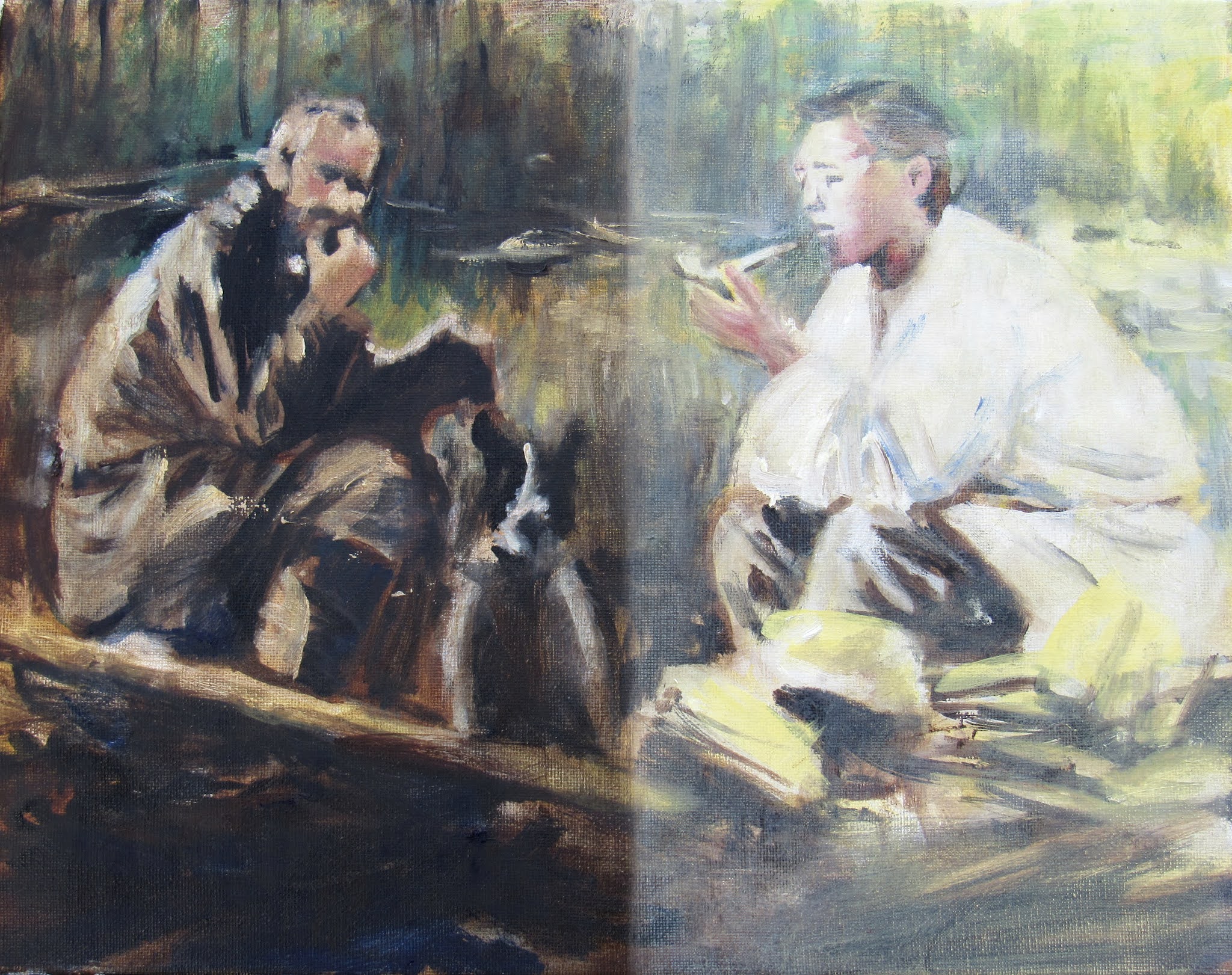
The CD series Voyage en URSS (Anthologie de la Musiques Instrumentale et Vocale des Peuples de l'URSS) consist of Russian recordings and was issued by the Le Chant du Monde label in 1990. I borrowed the CD from the Columbus Public Library sometime in 1999 or 2000. I was using cassette tapes back then and I recorded all volumes in the series. The last in the series: 6 - Caucase du Nord, Volga-Oural, Sibérie, Extrême-Orient, Extrême-Nord has been my favorite and I still occasionally play the tape. Back in the early 2000s it was my introduction to shamanic recordings and established my interest in shamanic culture. There are liner notes that I regret not copying back then but these do not contain images of the performers or the musicologists who recorded them. The musicologists aren't even listed and the information in the liner notes mostly deals with the instruments used, and the history of Russian folk music. All music was recorded between 1922 and 1983 and first appeared on the Soviet Melodiya label. The musicians are credited but in the twenty-odd years of looking, I have yet to find images of any of the musicians that have been featured in the Top 100. I have always used Russian folkloric images to illustrate these songs. My most current search to illustrate the song La Petite Poule (Danse Khantyl) by L. Tebetov brought me to pdf files of this wonderful Canadian magazine Inuktitut, published in three languages. An issue from 1988 is dedicated to the collaborations between (related) Siberian peoples and Canadian Inuits. The magazine has 124 pages full with photos, research, and travel documentation. I got excited by a photo published in this magazine of a Russian anthropologists in a boat interviewing a Chukchi folk tale narrator. That the song illustrated is not by a Chukchi but by a Khantyl didn't deter me. The little chicken of the title is not a folk tale either (as the title suggests), the vocals by Tebetov are echoic. The instrument used is a nars-loukh, a stringed instrument that sounds like a guitar. This is the first painting in the series of double portraits where the source image is also a double portrait. I decided, at the end of painting, to use transparent washes to separate the right half of the image from the left half. 

The Russian song stands at a provisional number 29 at the Top 100 2021. I'm still finishing up the Top 100 2020 and I'll move forward one at a time on each list. In the 2020 list I have arrived at number 91 and the song I illustrated at the same time as the Russian song has a strong cultural connection to it. Chikap Upopo, performed by Kiyo Kurokawa and Teru Nishizima was recorded by Jean-Jacques Nattiez, a Canadian ethnomusicologist who specializes in the related vocal expressions of the Canadian Inuit, Russian Chukchi, and Japanese Ainu people. I painted Kiyo Kurokawa before and I always enjoyed to portray the Ainu with traditional face tattoos. Chikap Upopo comes from the UNESCO album Japan: Ainu Songs.

Kiyo Kurokawa


Saturday, July 20, 2019

Jean-Jacques Nattiez

Rekutkar performers
14 x 11 inches, oil on canvas, 2019

Jean-Jacques Nattiez
14 x 11 inches, oil and spray paint on canvas, 2019
For the obvious reason of similarity in style I assumed that the three vocal throat singing traditions, the Inuit katajjait, the Ainu rekutkar, and the Chukchi pič eynen, found within the arctic circle must be related and/or have a common ancestor. I recently signed up for JSTOR, an online database of scholarly research papers and lo and behold the relationships have of course been studied at length. I am now the proud owner of a wealth of information about this subject. The paper I am referencing here is Inuit Throat-Games and Siberian Throat Singing: A Comparative, Historical, and Semiological Approach by Jean-Jacques Nattiez. I've also downloaded the liner notes to the cd Canada: Inuit Games and Songs produced by Nattiez. In these notes I am now able to identify all singers of katajjait in the Top 100 (there are many) that were previously anonymous. The two paintings presented here are to illustrate Imitation of the Cries of Geese and Assalalaa, the recordings were made by at Baffin Land  by Nicole Beaudry and Claude Charon in the mid seventies. The painting for Assalalaa I was working on from a photograph found by an image search of the terms katajjait combined with Jean-Jacques Nattiez represents not Inuit but Ainu singers. I intuited this was the case since I had not seen katajjait performed sitting down while the pose was the same as in my painting of rekutkar. The image I used was originally taken by I. Kurosawa (used by William P. Malm in 1963) and reproduced in Nattiez' paper. There's a hint of the Scottish flag in the bottom third of the painting that appeared when the thought of painting the flag arose. I never reject a thought but I obscured it later on as both the flag in form and meaning had really nothing to do with what I was painting. What I am most interested in is the history of these three vocal styles and its (ancient) origins. Nattiez hints in his paper at a possible shamanic origin of said vocal styles but it is hard to establish sound evidence for this hypothesis. Scientific papers do not, per definition, use incidental inferences.
Jean-Jacques Nattiez was born in Amiens, France, 30 December 1945. He is a musical semiologist and professor at the Université Montréal. He was made a member of the Order of Canada in 1990.

Nattiez, Jean-Jacques. "Inuit Throat-Games and Siberian Throat Singing: A Comparative, Historical, and Semiological Approach." Ethnomusicology 43, no. 3 (1999): 399-418. doi:10.2307/852555.

Tuesday, July 9, 2019

Ainu Songs

Kiyo Kurokawa
14 x 9 inches, oil on canvas, 2019
Teru Nishizama (?)
14 x 9 inches, oil on canvas, 2019
 
Kiyo Kurokawa and Teru Nishizama perform several duets and a few solos on the cd Chants des Ainu (Ainu Songs) from the Musique & Musiciens du Monde series of the UNESCO collection. Last year songs of theirs were represented by stock images of  traditional Ainu women but now I think that I've found photos that actually depict the two women. The photos were made by Jean-Jacques Nattiez who also recorded the music. These photos are found on Ainu Songs Japan on the Phillips label and was in 1980 the first release of the music recorded in 1978 in Hokkaido. I do not have the original LP and liner notes are not published on the web so I can't be sure the images depict them or who's who. Given the prominence of Kurokawa on the LP and that she's seen clapping on another photo I may assume that the individual on the record sleeve is indeed Kurokawa. Why is this important you may wonder? Well, Kiyo Kurokawa, together with Nishizama is featured twice at #5 and #14 in the Top 100, and individually she comes in at third place of performers for the year, just behind Cat Power and Bongwater. The Ainu, as dwelled upon earlier, are descendants of the indigenous Japanese Jōmon people and share many cultural characteristics with neighboring Siberian and Inuit peoples. A great number used to live (and some still do) in the easternmost Russian territory Sakhalin, an island just north of Hokkaido, the northernmost Japanese island where most Ainu live today. Sakhalin has been disputed territory between  Japan and Russia but became solidly Russian after the second World War. The two songs in the Top 100 are both associated with the bear festival. Upopo is a sitting song and Horippa a dancing song.

Friday, November 23, 2018

The Wonderful Ainu

Two Ainu women performing "Rehbuhkara"
14 x 11 inches, oil and acrylic on canvas, 2018
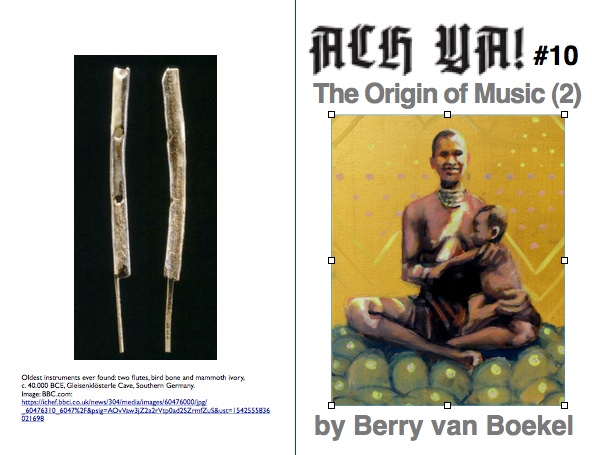
Rehbuhkara is a vocal style closely related to the Chukchi pic-eine'rkin and the Inuit katajjaq typically performed by two women. The three vocal styles form the backbone of a new issue of Ach Ja. It is the tenth issue and the second titled The Origin of Music. Katajjait are performed in the north of America and in Greenland, an area of land that is supposedly isolated from the old world at the end of the last ice age 14,000 years ago. The vocal styles of all three (ethnically related) peoples form yet more striking evidence that there must have been contact between the new and old world. Either that or these styles were already practiced before the separation of Chukchi, Ainu, and Inuit, in which case the traditional singing styles are older than 14,000 years. The Ainu, considered the indigenous people of Japan, live on Japan's northernmost large island Hokkaido. The island is connected to the Kamchatka chain running to Kamchatka in Russia. From Kamchatka run the Aleut island chain all the way to Alaska. The Ainu use their hands as a resonance chamber. The Inuit, as lore has it, use to sing so close together that each others mouths serve as resonance chambers. The source image from the painting is a still from a video uploaded by ainuworld. 
 Ach Ja! #10: The Origin of Music (2) is a zine published in an edition of 25. 8.5 x 5.5 inches, 16 p. It comes with a CD featuring 32 tracks from my collection (I don't own the rights to any of them) and can be purchased for $15 + shipping. Just shoot me an email.

Track listing
  1. Inuit:  Katajjait with geese cries (Canada)                 2:45
  2. Inuit: Katajjait on "Hamma" (Canada)        `        1:29
  3. Inuit: Assalalaa (Canada)                        0:38
  4. Inuit: Qiarpa (Canada)                        3:34
  5. Annie Kappianaq / Jeanne Arnainuk – Vocal And Throat-Games "Pirkusirartup" Huangaahaaq (Inuit, Canada)                0:41
  6. Ainu: Rekuhkara, throat singing (Japan)                0:27
  7. Kiyo Kurokawa, Teru Nishizama – Horippa (Ainu, Japan)        2:23
  8. Utekn, Yuimuk – Women's Wu-unka songs (Aborigine, Australia)             2:04
  9. Kiighwyaq, Sivugun und Nunana – Pic-eine’rkin: Ay-ay-amamay (Cukchi, Russia)         1:59
  10. Anna Dimitrievna Neostroeva – Throat Song                0:52
  11. Nowaylethi Mbizwenti And Nofirst Mbizweni – Duet With 'ordinary' Umngqokol    (Xhosa, South Afrca)                    1:39
  12. Antonia Vasil'evna Skalygina – Alterateur de voix Kal'ni (Even, Rus.)    1:02
  13. Mergen Mongush – Alash (Tuva)                    1:14
  14. The 1898 Torres Strait Recordings: Death Wail (Aborigine, Australia)    2:12
  15. Papua New Guinea: Wame Igini Kamu                 1:43
  16. Shipobo Song (Shipobo, Peru)                    2:09
  17. Ashaninka Songs (Ashaninka, Peru)                    1:15
  18. Ulahi and Eyo:bo Sing with Afternoon Cicadas (Bosavi, Papua New Guinea)             2:47
  19. Ulahi Sings While Making Sago (Bosavi, Papua New Guinea)    1:26
  20. Ana Caraballo & Asuncion Caraballo – Canto Para Pilar Maiz (Venezuela)                 0:54
  21. Gumbojav – Running Horse (Tuva)                    0:36
  22. Deux Femmes Ngozi – Ubuhuha (Ngozi, Burundi)            2:00
  23. Pako Tà Ôi peoples – Duo A'Reng (Pako Tà Ôi, Vietnam)        1:02
  24. Pako Tà Ôi peoples – A'bel (Pako Tà Ôi, Vietnam)            2:16
  25. Te Bow with Two Women's Voices (San, Namibia)            3:03
  26. Princess Constance Magogo KaDinuzulu – Helele! Yiliphi leliyani? (Zulu, South Africa)  3:31
  27. The Indians of the Gran Chaco – Instrumental, strings (Argentina)    0:57
  28. Avdo Mededovic – Bosnjacke Gusle (Montenegro)            1:23
  29. Tin Can Bow Solo (San, Namibia)                    1:44
  30. Marija Nikoforovna Ceculina – Chant et Jajar (Koryak, Russia)    0:57
  31. Chukchi Shamanic Ritual (Chukchi, Russia)                3:57
  32. Kittoro (Roro, Papua, Indonesia)                    1:20

Friday, January 12, 2018

Vagina Dentata

Tattooed Ainu woman
9.5 x 6 inches, oil on board, 2018

Tattooed Ainu woman
9.5 x 6 inches, oil on board, 2018

From the Koryak of Kamchatka to the Ainu of Hokkaido, the top 100 continues to locate itself in Northeastern Asia. It's a long 810 mile boat ride but it can be done by hopping the 56 islands of the Kuril chain. It'll be a beautiful boat ride but rather cold. And while you're hopping and dressed for the cold you can continue to hop the Aleutian Islands and arrive in Alaska and you take a train to Fairbanks and from there (I wouldn't know how) to Canada's Arctic Bay which will be the next destination of the top 100. The route follows the trail of female throat singing duets. I've made the journeyat home through cds in warm and cozy Florida: Japan: Ainu Songs on Unesco (Musiques et musiciens du monde), Sibérie 4, Korjak, Kamchatka: Tambours de danse de l'extrême orient-sibérien (Musique du monde), and Canada: Jeux vocaux des Inuit (Inuit du Caribou, Netsilik et Igloolik). I've painted Ainu women before back in 2006. I remember commenting on the hairy features of the Ainu people. I've read that the Ainu are indeed obsessed with hair and the characteristic women's tattoos represent mustaches. A facebook friend posted some pictures recently and commented: "The lips lips look like labia. Women adapted this look to lure men to oral sex in order to keep from getting pregnant every year. This is just the theory of an uninformed idiot. I’m not an anthropologist." (Thank you Barbara) I love this interpretation! The vagina dentata, one of Jung's archetypes, metaphorically designates the Freudian fear of castration.