Showing posts with label Baka. Show all posts

Sunday, December 5, 2021

Sounds and Visions

One of fon's (Dafut king) wives/Pat Ritzenthaler
Music of the Cameroons [Folkways, 1961]was recorded by Robert and Pat Ritzenthaler in western British Cameroon in 1959. I assume that the more intimate domestic recordings of women and children were made by Pat Ritzenthaler and the men's ceremonial music by her husband Robert. The advantage of a husband and wife team of ethnomusicologists is that there is access to men only as well as women only quarters. It allows me to mix up the genders of the people I portray (it's been a stag fest lately.) The song in the top 100 is called Hail Muma and was performed by children and wives of the brother of the king (fon.) Muma is the brother of fon and the second in command in the Dafut society. I don't know how many wives Muma has but the liner notes tell of 41 wives of fon and over a hundred children. Hail Muma is an improvised song under the influence of palm wine to honor the fon's brother.
Martin Cradick/Bounaka
The British musician Martin Cradick is known for the fusion of world music and western rock and jazz. He founded the band Outback that featured several didjeridu players. His best known fusion is that of western and Baka (pygmy) people of Cameroon in a mixed orchestra he called Baka Beyond. The group featured his wife Su Hart as well as a host of Baka musicians he had recorded in the field on an earlier occasion (1992) including the m'gongo player Bounaka pictured above. On the solo m'gongo performance called Venlouma that Cradick recorded in 1992 Bounaka places his instrument on a cooking pop as a resonator. It appeared on the very successful Heart of the Forest cd from 1993.
Rahsaan Roland Kirk/Dick Fontaine
The song Three for the Festival is almost a customary feature of a Top 100 (I missed last year) and especially the version from the film Sound!! by Dick Fontaine (and narrated by John Cage) is a long time favorite of mine. (There are many version on line and in my own music collection.) I assume it was Dick Fontaine who filmed Kirk in performance for this film. Sound!! is from 1967.


Monday, August 9, 2021

Simha Arom in Cameroon

Young Aka woman/Simha Arom

Simha Arom/Baka child at the Aba encampment
Two tracks from Cameroon: Baka Pygmy Music [UNESCO, 1977] found their way to the midst of the Top 100 2021 list and I decided to work on these simultaneously. As an experiment I divided up both canvases into four equal parts that I then painted a certain color. I then painted the portraits on top of the color fields. Simha Aram, who recorded the tracks on the CD twice, juxtaposed with two young pygmy people he photographed. The Baka child is from the CD liner notes, the young woman is not a Baka but belongs to the Aka people of the Central African Republic. The two songs they represent are Song to Attract Game which is sung by four teenage girls and Hut Song by thirteen young girls and children. Both songs belong to the yeyi category which as a ceremonial origin and is still used in ceremonies but more often has evolved into secular songs. Hut song is secular and Song to attract game is ceremonial. Most Baka songs have a ceremonial or ritual origin giving credence to the theory that the origin of music is to be found within the "sacred." In much of the songs of the Baka people the men are dancers and the women singers. Most voices on the CD are of women and children.
Alice Coltrane
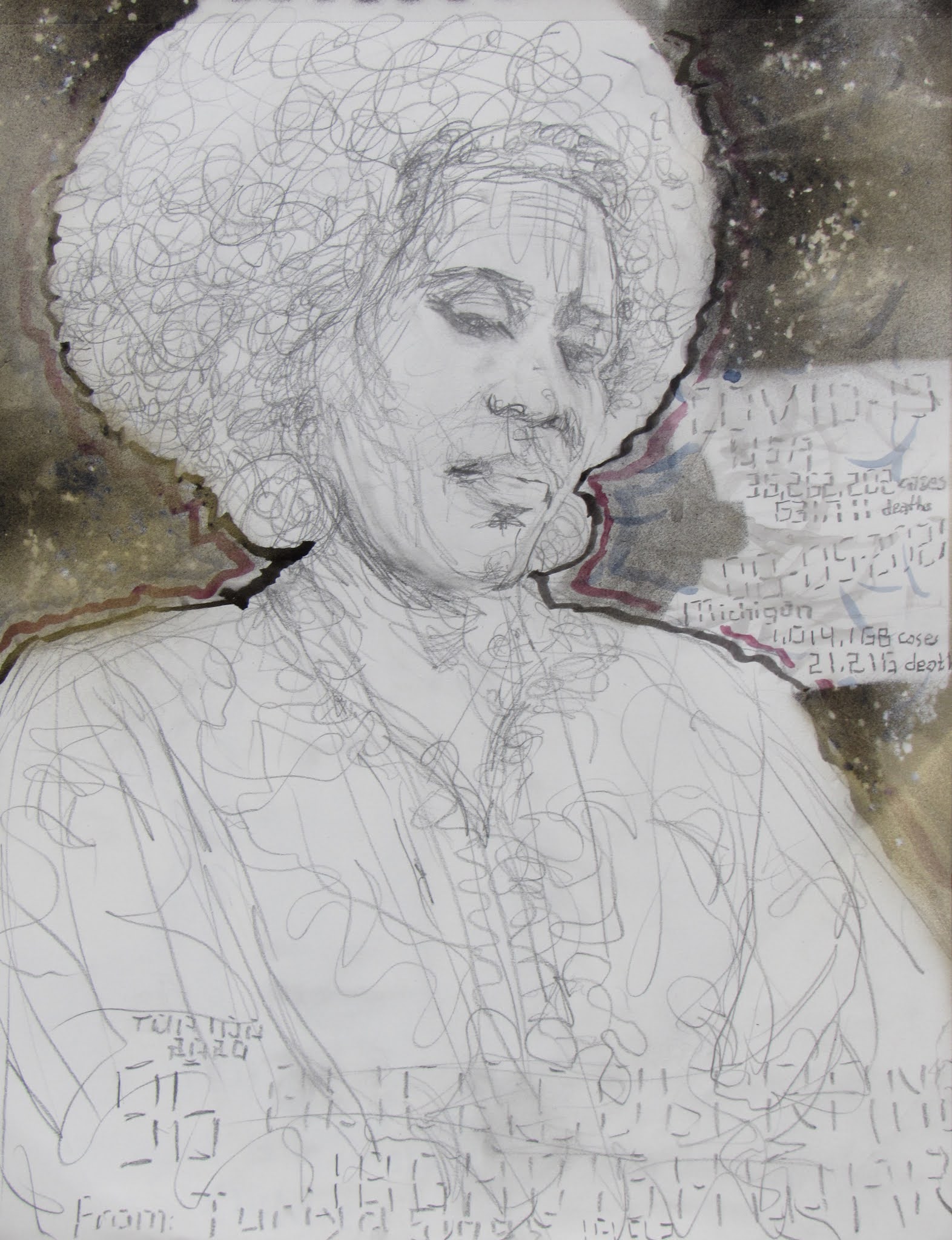
While working the paintings for the Top 100 2021 I continue to work my way down the list of the Top 100 2020. I'm milking it because I want to continue to work on the series until the exhibition goes up. I experienced another two week delay because of electrical issues in the archive space. But the exhibition will be really soon. Number 96 is Alice Coltrane with the track Jagadishwar from her 1981 devotional album Turiya Sings. The album is for voice and Wurlitzer, it's the first time Coltrane sings on a recording. At the time of recording she served as the director of the Interfaith Vedantic Center in Southern California. Alice Coltrane died in 2007, outliving her husband John Coltrane forty years.


Wednesday, May 19, 2021

La Flute de Pan

Hugo Zemp, Sabine Seso, oil on canvas, 11x14 inches, 2021
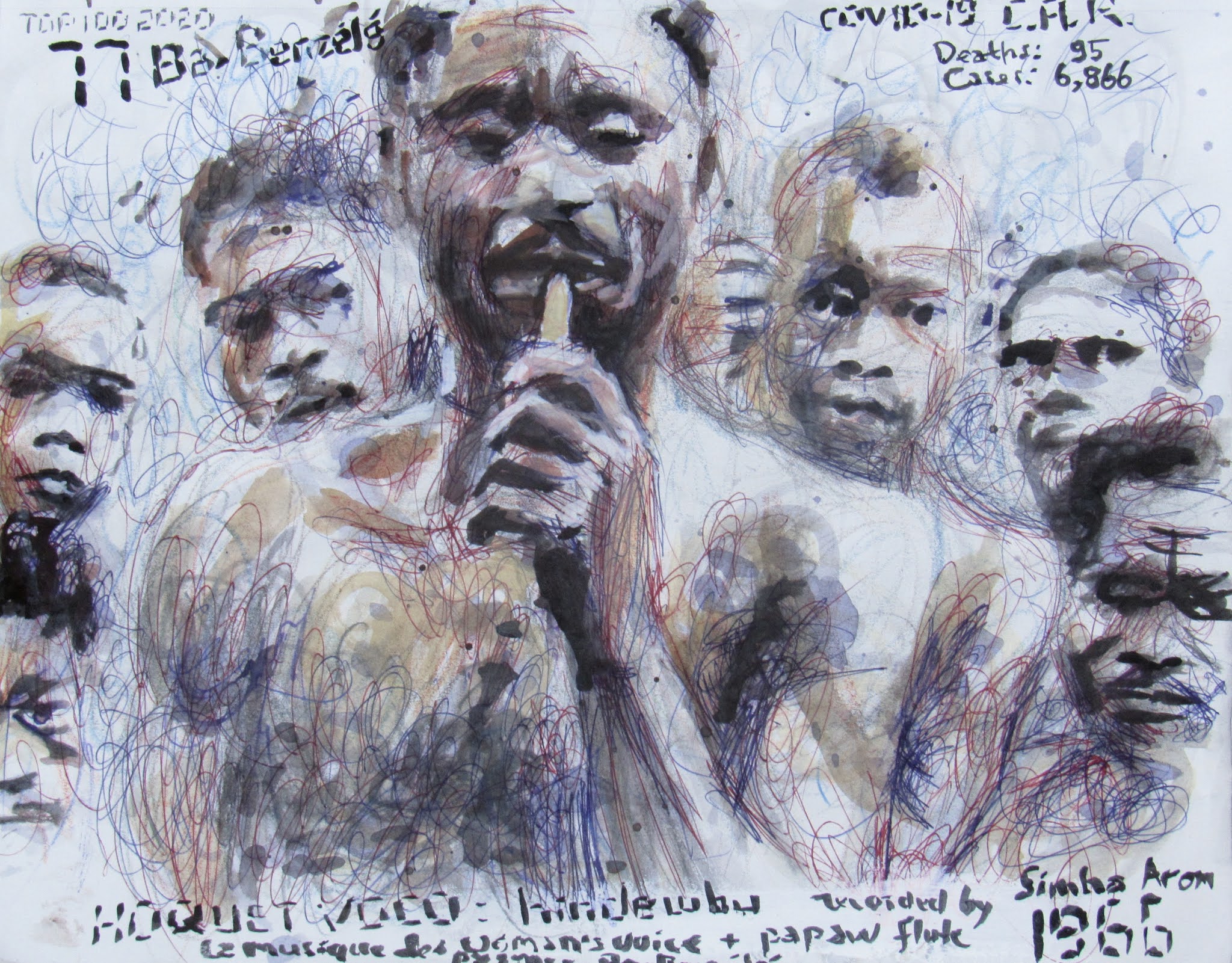
Just a few weeks ago I wrote about a technique that involves simultaneously creating vocal sounds and playing a flute. I was discussing then the track Au waa recorded by Hugo Zemp in the Solomon Islands in the 1970s. In this painting you see Hugo Zemp himself playing one of those flutes made from bamboo stalks. The portrait of Zemp here though is to accompany the track Koleo sung by a woman from Guadalcanal, one of the Solomon Islands. There are no pan flutes heard on the recording. The name of the woman singing is not listed in the liner notes and the one portrayed above is either Sabina Seso or Sylvia Saghorekao, singers who were recorded by Zemp during the same sessions on the island as Koleo currently residing at number 16 in the Top 100 2021. The image of Seso (I assume it's her) was taken by Zemp and I had used it recently to illustrate Ratsi rope sung by Seso and Saghorekao. Koleo is a type of funerary singing. The vocalizing flute technique like that of the au waa of the Solomon Islands is practiced in different parts of the world. The hindewhu of the Ba-Benzele pygmies of Central Africa is very similar to the au waa. The tune Hindewhu in the top 100 was recorded by Arom Simha in 1966 and appears on the album La musique de la pygmées Ba-Benzélé. The flute is made from the stem of a pawpaw. The image I used for this drawing is a photograph taken by Simha that appeared in the liner notes to that album. There too, in the liner notes for the album, it is illustrating this vocalizing flute technique which is called (by Hugo Zemp, when he used it in the collection Les voix du monde) hocketting. The performer on the recording is a woman though, and it may sound familiar to you because Herbie Hancock used a sample of it in the intro of his famous Watermelon Man from the album Headhunter. Or you you may have heard on Madonna's Sanctuary from Bedtime Stories. She credits Hancock for the sample but fails to identify the true source. When listening to the recording you would think it's an improvised ditty. It couldn't be farther from the truth as the very same melody appears on different Baka pygmie recordings using different names. The very same melody, note for note, is included in Louis Sarno's Bayaka CD recorded 20 years after Simha recorded Hindewhu in 1966.

Ba-Benzelle group (Hindewhu), 11x14 inches, ink, 2021

Wednesday, March 10, 2021

Moving Along


Jofirsti Lungisa playing a musical bow 
 

The Top 100 2020 contains a larger than usual number of repeats from the year before and again a great number of tunes from 2020 will be repeated again in 2021. There's plenty of different music I play but those recordings that make up the playlist from which I compile my thoughts on the origin of music is getting more established as time goes on. And so do my thoughts. The playlist is front and center of my music appreciation path. At some point when I have enough time and ambition I am going to collect and edit my writings on this subject as they appeared in this blog and other places and compile them into a cohesive paper forming a theory on the origin of music, of art, and creativity. The theory is a meditation on all the big questions concerning the origin and nature of being using insights from hundreds of others. The theory itself is far too big and broad for one person to research. The theory that is forming in my hand circumnavigates materials handily available on line and is not depending on independent research at all but rather on the implications of the sounds on the playlist. And empathy. I haven't posted much recently but have continued the work towards completing the illustrations for the Top 100 2020. The nine works shown here are all from this year and are done on 11 x 14 drawing paper. Ink is the most common material used throughout but a number of other media have also been used. Represented are numbers 45 through 53:

  • 45: Jofirsti Lungisa – Nandel'ekhaye
  • 46: San, Tin Can Bow Solo
  • 47: Yeyi "Hut Song" by thirteen young girls and children from Cameroon
  • 48: Norma Tanega – You're Dead
  • 49: Ya'ak Keodaeng and Ya'Seu Keodaeng – Teum singing
  • 50: Sun Ra and His Akestra featuring June Tyson – Space is the Place
  • 51: Nellie Echalook and Rebecca Natialuk – Katajjait
  • 52: Grande danse, ahidus by a mixed chorus of Ben aissa Berbers
  • 53: Bell'ilba (lullaby) by a Kel ansar Tuareg mother
!Kung San playing a hunting bow

Baka gathering

Norma Tanega
 
Bamboo on the Mountains (cover), Frank Porschin

Sun Ra, preparation sketch for stencil

Sun Ra, stencilprint (A/P)

Nellie Echalook and Rebecca Natialuk

Berber Family

Tuareg mother and child, Bernard Lortat-Jacob