Showing posts with label John Cohen. Show all posts

Friday, April 21, 2023

Try it again!

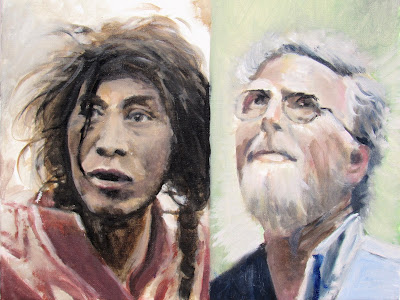
Andrea Quispe Chura/John Cohen, 2023

Andrea Quispe Chura/John Cohen, 2021

Cover of Music of Thailand/Howard Kaufman, 2023

Cover of Music of Thailand/Howard Kaufman, 2021
I'm onto the last dozen paintings for the Top 100 2022, and it gets harder to find appropriate images. Unlike last year it isn't simply one painting per one song now, but a more flexible concept. The two latest paintings are from the same source images I had used last year to illustrate the same songs that recur this year from Music of Thailand, and Mountain Music of Peru. Both double portraits illustrate well the concept I used for the Top 100 2021; that of the juxtaposition of the recorded with the recorder, and, in this case too, the photographed and photographer. The indigenous tribal person and the western academic. I don't know if I like the new paintings better or worse, what do you think?

Tuesday, August 17, 2021

Done!

Top 100 2020, #100: Entrance of the Mani Mask
The caption under the photograph I used reads: "One by one the soaring Spirit Fish masks enter Otei village accompanied by chanting and dancing women." Otei village is situated in Papua New Guinea and the quote and photograph, together with the recording Entrance of the Mani Mask come from a 1978 Folkways LP called The Living, Dead & Dying: Music of the New Guinea Wape which was recorded by William E. Mitchell in the early 1070s. I did not reproduce the photograph, which was also used on the cover the record, but made gesture sketches of some of the individuals seen in the ceremony depicted. Since I'm quoting William E. Mitchell, here's his description of the recording in the Top 100: "As the mani demon prances into the village from the forest, women welcome him with vigorous chant. Here, as in most of the large curing festivals, women have an important ceremonial and musical role." The Wape are unique in Melanesia in the fact that their organization is egalitarian. In most other cultures in the region there is a strict hierarchy in what ethnologists call "the big man political system" or "bikman." [William E. Mitchell, On Keeping Equal: Polity and Reciprocity Among the New Guinean Wape] Entrance of the Mami Mask is number 100 in the Top 100 2020 and thus marks the completion of this series of works. After I organize a showing of the works my undivided attention will become the Top 100 2021, that now is already more than a third done. At a provisional number 36 in the new list resides a second track from Mountain Music of Peru, vol. 1 from 1966, [Folkways] a seminal album of recordings by John Cohen. It is thus also the second portrait I painted of John Cohen in the new series of 100. John Cohen was an influential musicologist and photographer who recorded and shot, beside Peruvian mountain music, mountain music from Kentucky, the Beat generation, among many other topics. The dancing child on the right of the painting is also based on a photo by Cohen, be it in the context of a different collection. John Cohen, known too for being a member of the New Lost City Ramblers, a New York bases string band, died in 2019.
John Cohen/Mountain Music of Peru, vol. 2 cover


Monday, May 3, 2021

Q'eros, Peru


This is the eleventh painting in the Top 100 2021 series, and perhaps the most striking thus far. The painting captures the concepts I set out for the series; double portraits; a juxtaposition of the recorder and the one recorded. Quite often the recorder, so was my preconceived notion, is a Western white middle aged man and the one recorded a female indigenous singer. This particular coupling is actually the first one, of eleven, when this is preconceived notion turned out to be true. While the juxtapositions, in no uncertain terms, comment on the colonial attitude of the object versus subject history of western culture, I make a point of it to treat both object and subject with utmost respect. I am equally in awe of the anthropologists and ethnomusicologists who recorded indigenous cultures, and of the musicians who were recorded, and, after all, provided the music that makes up the Top 100 2021. For myself, as the artist, I'm yet one step further removed, I am the sub-subject in the equation. This painting features Andrea Quispe Chura, a Q'ero woman who was photographed by the American musician, photographer, and musicolgist John Cohen in 1977, and Cohen himself. Both images come from the book: There is No Eye: John Cohen Photographs. The song the painting illustrates was also recorded by Cohen in 1977 in Peru. The song was performed by two Q'eros women, just not (likely) the woman depicted in the painting, and in Cohen's photograph. There is No Eye starts with an anecdote from Cohen's work that really tells a lot about the significance of the work Cohen (and the 99 others in the series) are engaged in and my own infatuation with it all: "On the Voyager space craft is a recording of a young girl singing an Andean huayno. She singing in Quechua, and her song is included as a sample of the sounds of our planet." With these paintings I've come to realize how the world of academia is really a world of respect, equality, and non-bias compared to the world we experience every day. I'm pleased to have been invited to show these works, in the Spring of 2022, in a city, Columbus, Ohio, that was my own city for 17 years until 2011.