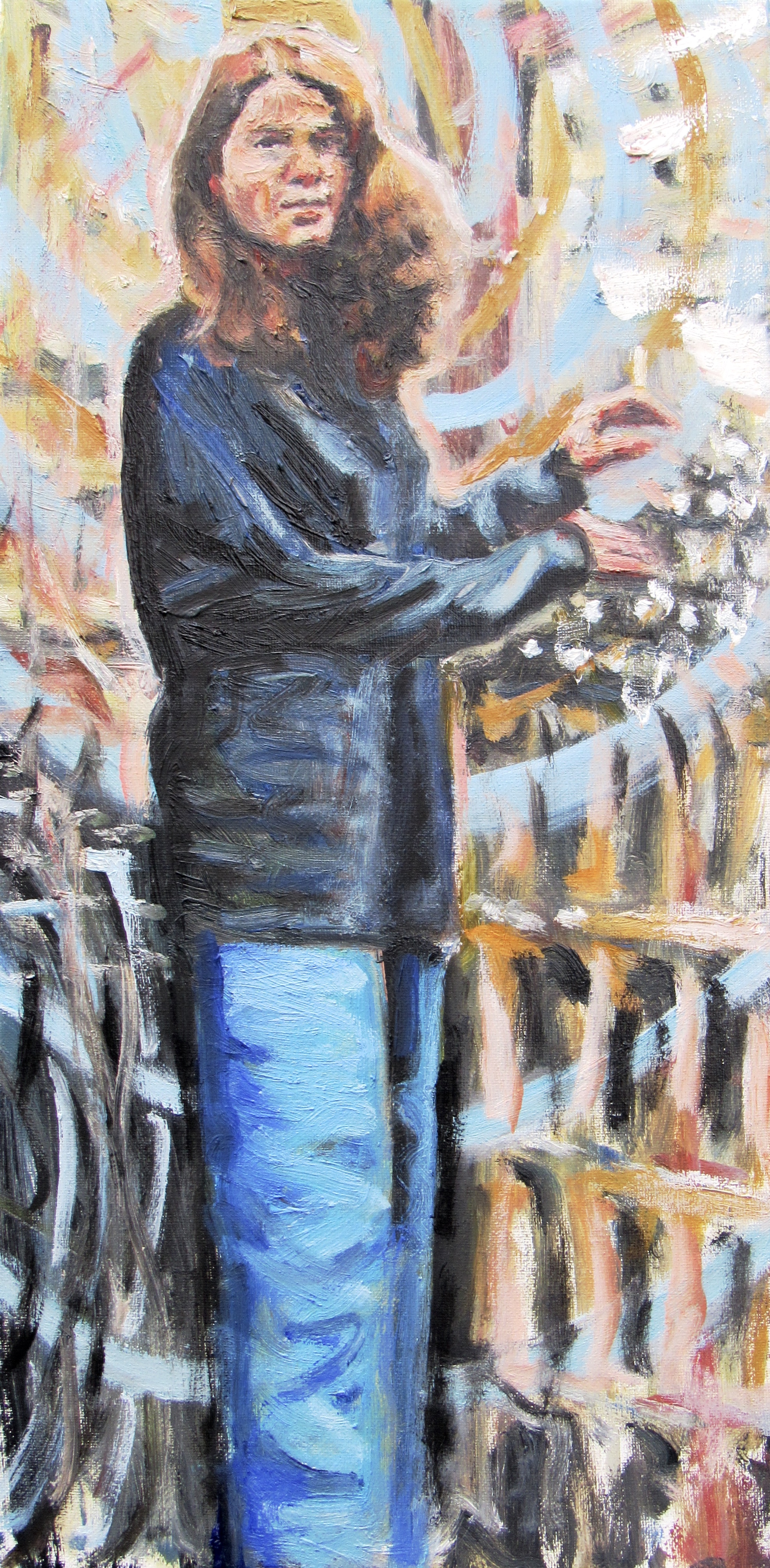
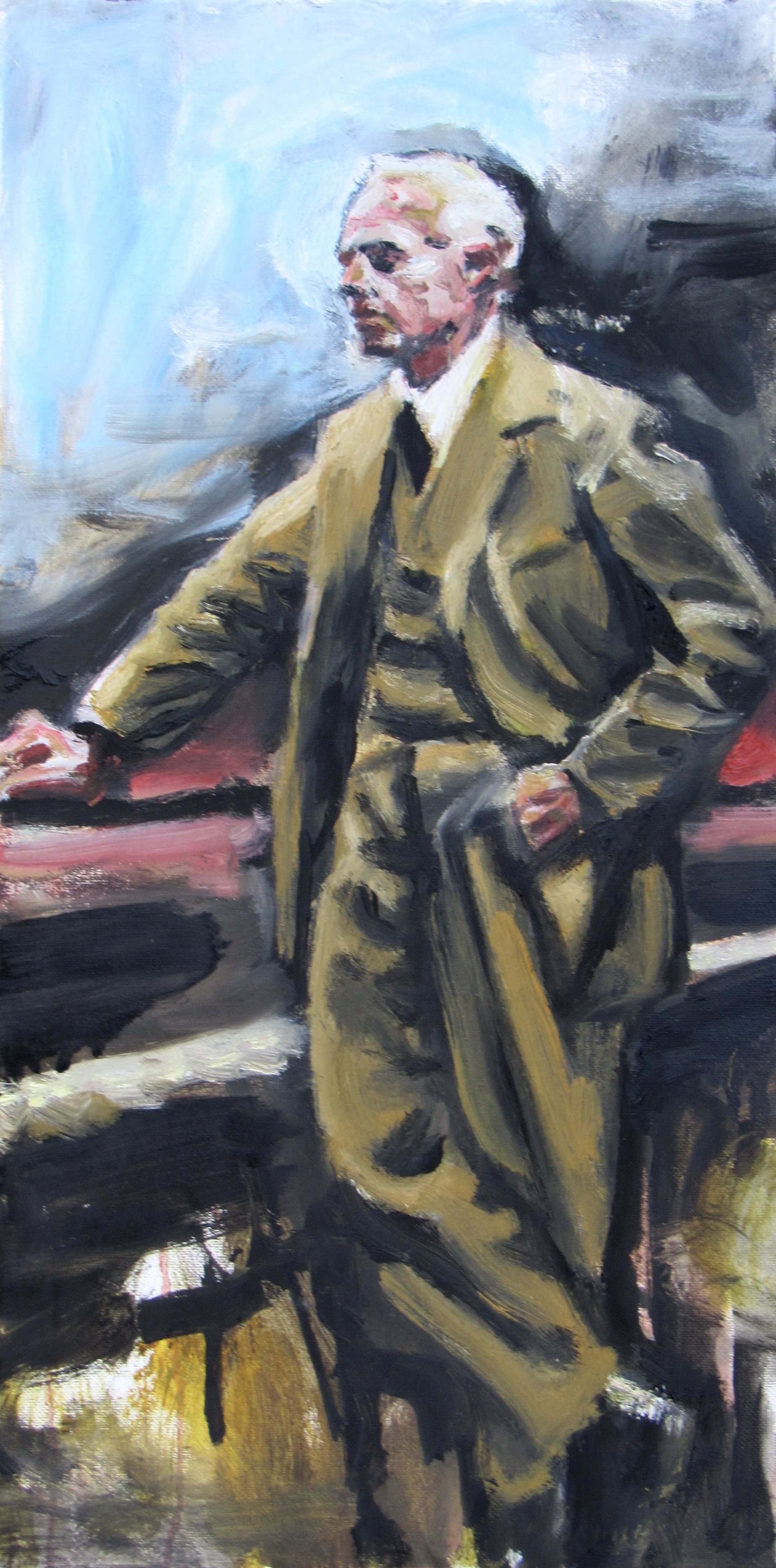
The Top 100 started as a hobby; a fan adoring his musical heroes and paying tribute by making portraits of them. The hobby became obsession and the project went from the boy’s room into the art world. But I'm still that fan, it's about them in the end, their music, and not about me.
Through the LP New Music for Electronic and Recorded Media, I have been aware of Laurie Spiegel since the mid-1980s. It was the inclusion of Laurie Anderson that drew me to the LP of all female composers. A few years ago I acquired The Capriccio Series of New American Music Number Two, another compilation of all female composers. I think I might have to get more.
Giacinto Scelsi
Another contemporary composer I've known since the mid-eighties is Giacinto Scelsi. I recorded live broadcasts from the Holland Festival during those times. I still have the tapes. His association with John Cage, and especially Alvin Curran, brought him back on my radar.
Bela Bartok
Bela Bartok doesn't need much of an introduction. I've painted him several times before and own more than ten records. I stopped buying classical records but I never leave a Bartok behind when looking at thrift shops.
Patti Smith
The Top 100 2024 features a live recording of Horses. Patti Smith has been a continuous presence in the Top 100.
William S. Burroughs
Associated with Patti Smith (above) and many, many other Top 100 regulars, Burroughs now, for the first time has his own recording (A Thanksgiving Prayer) listed. The Bob Rauschenberg Gallery at my school hosted an exhibition about William S. Burroughs, featuring works by Laurie Anderson and himself. It just ended, but a new one (this time with David Bradshaw) will be opening in the new year.
Several versions of Patti Smith rendition of the Them
classic Gloria secured the entry in
the top 100. Different live versions exist on YouTube, notably a 1979
Rockpalast concert but the original recording on Horses, her debut album, is picked for the top 100 playlist. The
song on Horses has two movement: In
Exelsis Deo written by Smith herself and Gloria (version) penned by Them frontman Van Morrison. In 2005 on
its thirtieth anniversary Patti Smith rerecorded Horses live and in 2015, the
40th, she played the full album again in a series of concerts.
Patti Smith
11 x 8.5 inches, stencil print, 2019
62.
Garifuna Indians: Abelagudahami
Garifuna Settlement
Day Festival, oil on canvas,
2019
The Garifuna are descendants of West Africans and the Carib
and Arawak peoples. The song Abelagudahami
appears on The spirit Cries: Music of the
Rainforests of South America & The Caribbean (Smithsonian, Library of
Congress, 1993). It was the first album of the Endangered Music Project series initiated by Mickey Hart (the
Grateful Dead). As with so many indiginous Americans the history of the
Garifuna is one of persecution and displacement. They ended up in Honduras and
spread to neighboring Belize and Nicaragua. The Garifuna heard on Abelagudahami are from Belize. Despite
the "endangered" label on the cd they are today thriving in Belize.
63.
India>Kerala: Malayalis' Kurava
Kerala:
Kurava performer, oil on canvas, 2019 From Wikipedia: "from Latin ulolo, is a long,
wavering, high-pitched vocal sound resembling a howl with a trilling quality.
It is produced by emitting a high pitched loud voice accompanied with a rapid
back and forth movement of the tongue and the uvula." Ululation is an
example of onomatopoeia (another beautiful word) "the formation of a word
from a sound associated with what is named."
64. Gour
Khepa – You Were Unable to Keep the Love Water...
Gour
Khepa, oil on canvas, 2019
Sometimes referred to as madman or wild man, Khepa is not a
name but a Bengali title more properly translated as "wise man." Gour
Kyapa (as Khepa is now spelled) was a storied Baul philosopher and musician.
The Bauls are an ethnic Bengali sect of wandering minstrels traveling through
Bangladesh and eastern India. Their musical tradition goes back to at least the
eighteenth century and was orally transmitted only (until sound recordings and
subsequent transcriptions were made.) The Bauls are ascetics, renouncing
material belongings and marriage. They subsist on gifts or alms in exchange for
(musical) recitals that use only very basic language, including many
profanities. The LP Bengale: Chants des
"fous" (Chants du Monde, 1990) is an excellent compilation. Tu n'as pu conserver le nectar d'amour
by Gour Khepa is the song listed in the top 100 2019/19. Gour Khepa was born in
1947 and died after a traffic accident in 2013.
65.
Xongorzul – The River Herlen
Ganbaararyn
Khongorzul, oil on canvas, 2019 The River Herlen is found on a cd
tucked into the book Where Rivers and Mountains Sing: Sound, Musica and
Nomadism in Tuva and Beyond by Theodore Levin. Unlike the other musicians
on the cd Xongorzul is not discussed as an individual but functions as a sound
example of the Mongolian 'long-song' tradition. The long in long-song
references the extended syllables in the text. "A four-minute song may
only consist of ten words." Ganbaararyn Khongorzul performs with Yo Yo
Ma's Silk Road Ensemble and performed at the opening ceremony at the 2002 World
Cup.
66. Utekn
and Yuimuk – Women's Wu-ungka Songs
From the cover of Aboriginal Music from Australia, oil
on canvas, 2019
The image of an Aboriginal preparing food I used comes from
the LP Aboriginal Music from Australia on
the Phillips label. The source of the music this image represents is a cd
however, a reissue on UNESCO's Collection
of Traditional Music now named: Australia:
Aboriginal Music. The cd has the texts and music of the original LP but not
the photographs. I can not identify the images on the LP cover. I'm not certain
about the gender either but the breast shown seems to indicate a woman. There
is only one track sung by women on the record but it does not necessarily mean
that a photo on the cover illustrates a song on the record. The song is a type
of Wu-unka song sung by Utekn and Yaimuk in the Wik-ngatara language in
northern Queensland. The song was recorded in 1966 by Alice M. Moyle, who I
assume was also responsible for the photograph on the sleeve.
67.
Nowayilethi Mbizweni, Ngqoko group recorded by Dave Dargie
Nowayilethi
Mbizweni, oil on canvas, 2020
The recording is like last year's from Dave Dargie's film Umngqokolo: Thembu Xhosa, Overtone Singing
1985-1998. On the particular section in the top 100 she's not performing
solo or as a duet like she was in a previous top 100 but fronts the Ngqoko
group seen in the movie. The group consists of about fifteen singers, mostly
women but a few men are included too. Nowayilethi sits in front next to (her sister
perhaps) Nofirst Mbizweni. The rest of the group are standing behind them. The
term 'umngqolo' refers to the type of throat singing Mbizweni is known for and
I now learned how to properly pronounce it with the Xhosa clicking sound
included.
68. Cat
Power – Robbin Hood
Cat Power,
pencil on paper, 2019 Talking with my friend Jade before the Cat Power concert last Friday he
mused that most of the musicians I painted would be unknown to her. I told him
that I wouldn't be surprised if Cat Power would be much more familiar to these
ethnomusicological recordings than one would expect. During the concert Cat
Power used her hands to alter her singing voice on several occasions very much
like the Rundi women (#42), most poignantly during a cover of Bob Dylan's Hard Times in New York City (perhaps to
mimic Dylan's nasal voice). One of my favorite tunes she performed that Friday
was Robbin Hood from her latest Wanderer. The above drawing done during
the concert then becomes the official illustration for the song in the Top 100.
69. Lola
Kiepja – Guanaco Myth Chant
Lola
Kiepja, oil on canvas, 2019
In 1964 Ann Chapman went to the Argentinian part of Tierra
del Fuego to meet and record the Ona (Selk'nam) shaman Lola Kiepja. She was the
last, and oldest, remaining indian who had a living memory of Selk'nam customs.
Whe she died in 1966 the Selk'nam were a people of the past. Kiepja was around
ninety. Chapman published eleven photos and numerous recordings of Kiepja, all made
during her stay in 1964/65. A photo of a much younger Kiepja exists and was
published along 47 of Chapman's recordings by Smithsonian on Selk'nam Chants of Terra del Fuego in
1972. Smithsonian released an additional 42 chants on a second volume. Guanaco Myth Chant is one of these. In
the 1905 photo of Kiepja, made by Carlos Gallardo, Kiepja is seen wearing the
traditional guanaco costume.
Lola Kiepja
14 x 11 inches, oil on canvas, 2019
70. Cat
Power – Horizon
Cat Power,
oil on canvas, 2019 Five of the six Cat Power songs, all from the LP Wanderer,
are painted. The Cat Power portrait here, painted several months ago,
belongs to Horizon. The final Cat Power portrait for the Top 100
2018/2019 exhibit, illustrating Robbin Hood, will have to wait until I
go see her live in concert in Tampa in September. It'll be based on sketches
done from life.
Patti Smith
12 x 16 inches, oil on canvas paper, 2017
To Patti Smith poems are like prayers. In an interview she said that she gave up on religion but never on prayer. Her song lyrics are like prayers, some literally so (as in Gloria). Some of her songs are introduced by a prayer and some prayers are directed at specific people. In her lyrics she talks to (and prays for) Jim Morrison, Jimi Hendrix, Robert Mapplethorpe, Patty Hearst (and many others, her Rock and Roll Niggers). Patty Hearst is addressed introducing a cover of Hendrix's Hey Joe, Brian Jones is spoken to introducing Lou Reed's We're gonna have a real good time together. Collected on UbuWeb are some early recordings by Patti Smith, poetry readings basically with minimal accompaniment by her longtime collaborator Lenny Kaye. These recordings are the groundwork for a series of highly important and influential albums she produced in the late seventies and early eighties.
Ain't it Strange is a song found on Patti Smith's second album Radio Ethiopia from 1976. Parts of the song are heard in Dan Graham's film Rock My Religion. Graham had recorded Patti Smith early on a 16 mm camera. The song is one of the main pieces to support Graham's thesis of a lineage from Shaker rituals to punk rock. "Hand of God I feel the finger. Hand of God I start to whirl."