Showing posts with label Tuareg. Show all posts

Thursday, December 9, 2021

Happy Holidays

Tuareg woman/Bernard Lortat-Jacob
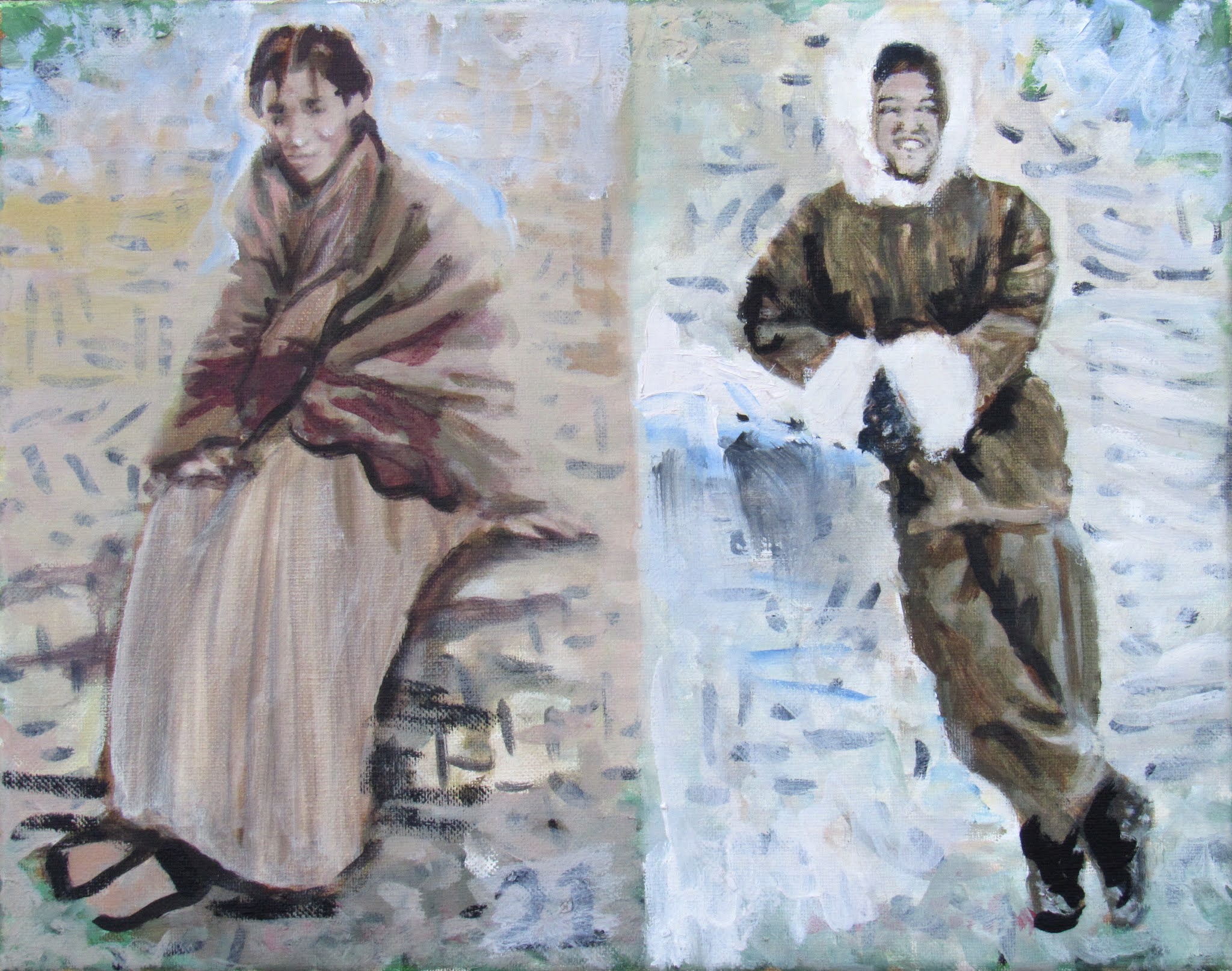
My teaching semester just ended so I'm on my holiday winter break. Happy Holidays to you all. For the occasion I made some cheerful holiday inspired painting to bright up the dark days of December. This one here illustrates a lullaby (or in French, the beautiful word berceuse) dubbed Bell'ilba by Bernard Lortat-Jacob who recorded the Tuareg woman with a baby in her arms in Mali in 1988. The recording, like so many others in this year's top 100, appeared on Les voix du monde: une anthologie des expressions vocales compiled and produced by Lortat-Jacob together with Hugo Zemp and G. Leothaud. The lullaby consist of words and ululations imitating the sounds of a flute. Like in last year's top 100 the song is illustrated with a random Tuareg woman paired with the recorder Bernard Lortat-Jacob. It's silly to just pick an image of a woman to paint from a non-specific Google search but options were few. I simply picked an image that seemed fun to paint, as I did last year. Last year's Tuareg woman looks very much like this year's but I do believe they're two different individuals.
Raúl R. Romero/Gisela Cánepa-Koch
The Taki song, a free-form and improvised song from the Peruvian Department Lambayeque, is also (like the above) by an anonymous performer and without an image too. I opted for two musicologists involved in the recordings and production of Traditional Music of Peru, Volume 4: Lambayeque, on which the taki appears.
Chitenje Tambala/Alain Daniélou
For the third festive design painting I had no problem finding the images of the recorder and the performer, even though the CD liner notes [Music Tradition of Malawi, UNESCO, 1991] does not have an image for either individual. The song in the top is called Ellis (the name of a woman) and is performed on a bangwe, a sort of board-zither. Tambala belongs to the Achewa cultural group. Alain Daniélou is best known for his work in India. He is a noted expert on Hinduism.


Thursday, October 21, 2021

Laura Boulton

Laura Boulton/Tuareg singer
Laura Boulton, a socialite from Ohio (b. 1899, Conneaut, died in 1980), had a 50-year long career in ethnomusicology that started with a trip to Africa in 1929. She recorded more than 30,000 songs travelling throughout the world. She saw herself as a song catcher, doing the noble work of preserving the music of vanishing cultures, that she, like most other early ethnomusicologists, considered primitive. Her legacy, despite the colonial attitude, is the preservation of musical traditions now extinct. She was not only an early practitioner in the world of ethnomusicology, she did so as a woman. (Not many women recorded in the field in the early years. One notable exception is Frances Densmore, whose known for her work with Native American tribes is well known. Densmore started much earlier than Boulton and is also less colonial in her attitudes.) I've painted Laura Boulton four times now, three tracks from the LP African Music recorded in the 1930s made it into the 2021 list. The fourth track in the top 100 (at #2) is the Girl's Game from the LP The Eskimos of Hudson Bay and Alaska in the 1940s during the Second World War. She considered the Eskimo recordings "the most primitive in her collection" and therefore "unusually interesting." I've written about this painting earlier as it was the first painting I created for the current series of 100. I'm reproducing the painting here again because I've altered it quite a bit. I have all paintings in the series hanging on my studio wall and every time I see something in an older painting I don't like I fix it. The individual paintings aren't considered finished until the whole series is finished and exhibited. I did not change the figures much in the painting but adapted the rest to fit an evolved concept for the series as a whole.
Baker Lake Eskimo/Laura Boulton
The Folkways LP African Music [1957] was recorded in the 1930s and originally released as a set of six 78 rpm records on Victor in 1939. The recordings were made mostly in the French Sudan (now Mali) and also includes recordings from Cameroon, Nigeria, and Benin. The three tracks in the Top are War Song by Malinke people recorded in Bamako, Mali, a track with short outtakes from different songs sang by Tuaregs recorded in Timbuktu also in Mali, and Orphan's Wail by a Bakwiri singer from southern Cameroon. The painting up top illustrates the Tuareg recordings, a track that includes a lullaby, a herding song, and a marriage song. I used a photo taken in Timbuktu, from the record sleeve for the Tuareg singer. It is the only photo of the four that was not taken by Boulton as she also appears herself in the same photo. That image of Boulton I had already used for the image illustrating the Bakwari singer on Orphan's Wail. Boulton doesn't name the singer but she did photograph him in the process of recording.
Bakwari singer/Laura Boulton
The third track then from African Music is the War Song performed by Malinke people on harps and drums. The image of the Malinke harpist was again taken by Boulton during the recording. It's one of most fascinating drum rhythms I've ever heard.
Laura Boulton/Malinke harpist


Tuesday, June 8, 2021

New Toys

Portrait of a young Tuareg, ink and gel pen, 14x11 inches
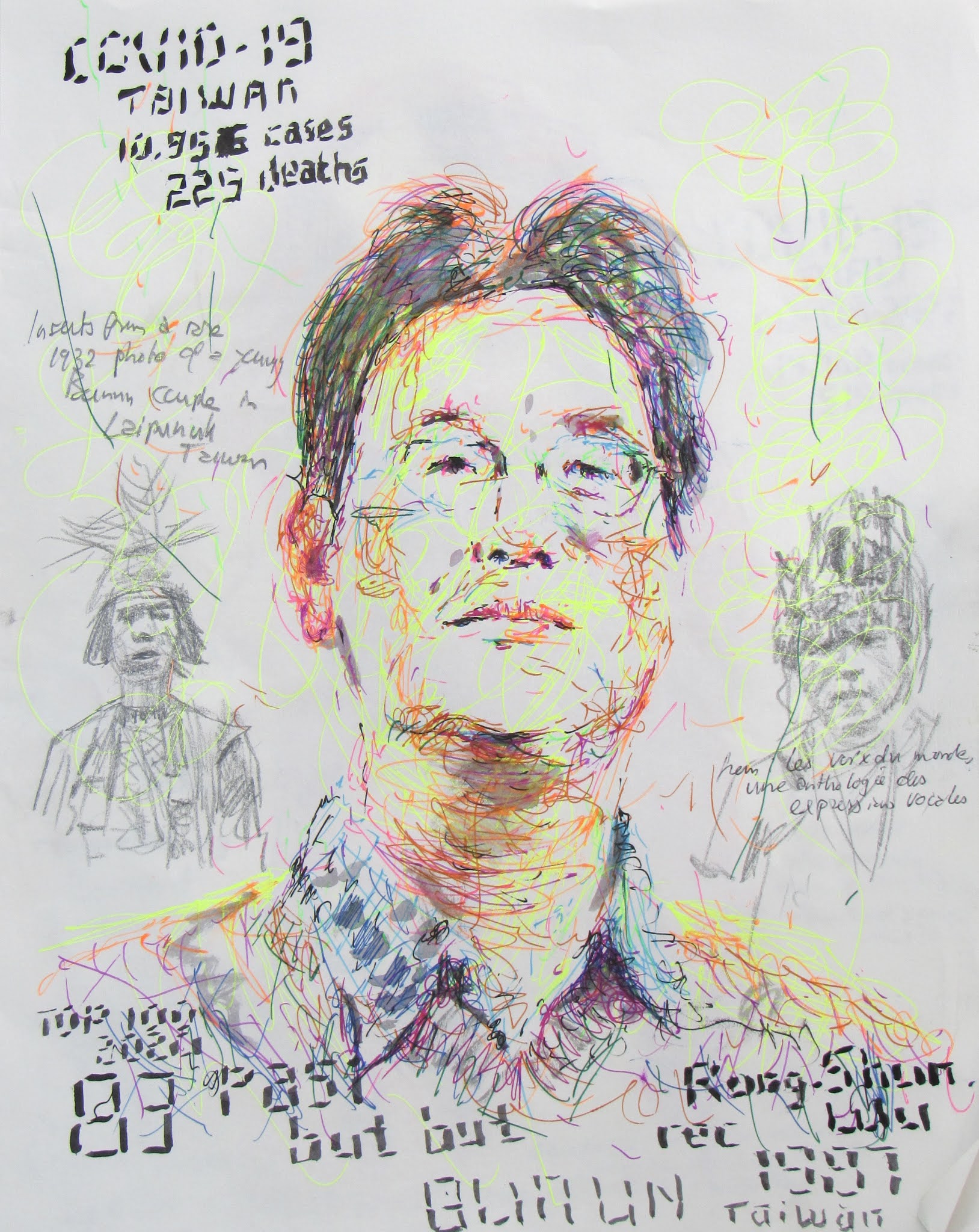
The latest drawings I finished for the Top 100 2020 series are numbers 82, 83, and 84: Depicted above is number 84, an individual from a Tuareg group from Mali. Even though in theory the caste system is abandoned among the Tuareg, the practice continues. The Ikelan, or Bella, are the lowest caste, they are slaves, that simple. The song a group of about 12 Bella sing and that features in the top 100 is a type of song called Ihamma. The word is onomatopoeic and does not have lyrics. Bernard Lortet-Jacob calls it a panting song. The source, like so many in the list, is Les Voix du Monde. I have new toys: A set of gel pens from the dollar store. There are eight pens in the set which makes each pen 12.5 cents. I have no idea how they will hold up over time. When I made a drawing using highlighters depicting Hang on the Box (Chinese punk/pop) in 2008 the colors faded after about a half year.

Number 83 come from the same collection as above. The location is now Taiwan, the ethnic group are the Bunun. The Track Pasi But But was recorded by the Taiwanese musicology professor Rung-Shun Wu, who is also depicted using the same gel pens. At number 82 then is an American popular music entry. The song in the Top 100 is The Theme from The Black Cat and was written and performed by Scotty McKay. Scotty McKay is known for his frantic style of playing (and performing) during the late 1950s into the 1960s. Black Cat is from 1966 and appears on Beat Jazz, a collection of Jazz music related to the Beat Generation. Last year a track from the album featuring a recording of Jack Kerouac made the list. The image I used for the drawing is a commercial publicity shot. I can't help but to recognize the sassy facial expression of this dude in a MAGA hat who was in the news last year.


Wednesday, March 10, 2021

Moving Along


Jofirsti Lungisa playing a musical bow 
 

The Top 100 2020 contains a larger than usual number of repeats from the year before and again a great number of tunes from 2020 will be repeated again in 2021. There's plenty of different music I play but those recordings that make up the playlist from which I compile my thoughts on the origin of music is getting more established as time goes on. And so do my thoughts. The playlist is front and center of my music appreciation path. At some point when I have enough time and ambition I am going to collect and edit my writings on this subject as they appeared in this blog and other places and compile them into a cohesive paper forming a theory on the origin of music, of art, and creativity. The theory is a meditation on all the big questions concerning the origin and nature of being using insights from hundreds of others. The theory itself is far too big and broad for one person to research. The theory that is forming in my hand circumnavigates materials handily available on line and is not depending on independent research at all but rather on the implications of the sounds on the playlist. And empathy. I haven't posted much recently but have continued the work towards completing the illustrations for the Top 100 2020. The nine works shown here are all from this year and are done on 11 x 14 drawing paper. Ink is the most common material used throughout but a number of other media have also been used. Represented are numbers 45 through 53:

  • 45: Jofirsti Lungisa – Nandel'ekhaye
  • 46: San, Tin Can Bow Solo
  • 47: Yeyi "Hut Song" by thirteen young girls and children from Cameroon
  • 48: Norma Tanega – You're Dead
  • 49: Ya'ak Keodaeng and Ya'Seu Keodaeng – Teum singing
  • 50: Sun Ra and His Akestra featuring June Tyson – Space is the Place
  • 51: Nellie Echalook and Rebecca Natialuk – Katajjait
  • 52: Grande danse, ahidus by a mixed chorus of Ben aissa Berbers
  • 53: Bell'ilba (lullaby) by a Kel ansar Tuareg mother
!Kung San playing a hunting bow

Baka gathering

Norma Tanega
 
Bamboo on the Mountains (cover), Frank Porschin

Sun Ra, preparation sketch for stencil

Sun Ra, stencilprint (A/P)

Nellie Echalook and Rebecca Natialuk

Berber Family

Tuareg mother and child, Bernard Lortat-Jacob


Friday, January 31, 2020

Playing Cards

Ahem Mediferai
14 x 11 inches, oil on canvas, 2020
Tamara Ivikovna Sajnav
14 x 11 inches, oil on canvas, 2020
Zeze Musicians, Wagago, Tanzania
14 x 11 inches, oil on canvas, 2020


Ahem Mediferai: From the album West Africa: Drum, Chant & Instrumental Music (1976). Chant performed by three male and four female Tuareg singers led by Ahem Mediferai. Recorded in northern Mali by Stephen Jay. The strong diagonal in the photograph of Ahem Mediferai on the back of the album, and its artist's impression on the front, made me experiment once again with the diagonal 'playing card' (mirroring) axis. I did three the past week, still a long way away from a deck.
Tamara Sajnav: The notes to this song by Alena Uican from the cd Sibérie 4 – Kamchatka: dance drums from the Siberian Far East are odd and short (by Henri Lecomte): "Born in Rekinniki in 1969. She does not work so she can raise her child. This song evokes movements of sea mammals, which she imitates while singing." Life is very mysterious; the more you learn, the less sense it all makes. The image in the painting is of a Koryak woman who appears on the cd cover. The cd is dedicated to the music of the Koryak, the instrument seen is shaman's frame drum as is Uican's.
Zeze Musicians: The zeze is a stringed instrument found throughout Tanzania. The Wagogo of central Tanzania are especially associated with the instrument. The Wagogo Soothing Song can be found on the LP Africa: Ceremonial & Folk Music [Explorer, 1975] and was recorded by David Fenshawe. Two zeze players, a drummer, and mixed choir can be heard in a song that was intended to lull a child to sleep who couldn't. I doubt it if it worked; the performance is quite ecstatic but the zeze has a very soothing sound. The musician depicted appear on a very small photograph on the back of the album and are likely the zeze performers heard on the recording.

Wednesday, July 8, 2015

Primary Colors: Tuareg

Tuareg: Camel Tournament
16" x 20", oil on canvas, 2015
Music for a Camel Tournament performed by Tuareg women was recorded during the Henri Lhote Expedition of 1948. A small black and white photograph taken during the recording sessions dons the liner notes. They are the notes to the album African Music from the French Colonies which is Volume 2 from The Colombia world Library of Folk and Primitive Music series compiled by Alan Lomax. On the recording one can hear a chorus of women accompanied by a tindi (a mortar converted to a drum) which is played, witnessing the photograph, by a little boy. The setting is in Algeria in the Hoggar Mountains of the Sahara Desert. I can't discern any mountains in the photo but I'll take Lomax's word for it. It was my intention to paint one red dot in the sky, which could possibly have been interpreted as the sun. Once one starts to place dots...