Showing posts with label Koryak. Show all posts

Saturday, April 23, 2022

Family First

Cover image from "Les Dani de Nouvelle Guinee, Vol. 2"
The world of ethnomusicology is no longer (and hasn't been for a long time) a field primarily occupied by a handful of adventurous men. As academic practices have shifted from being observers to being  participants for lengthy spells of time, ethnographers, anthropologists, musicologists, and others, travel with their families to go live among the cultures being researched. An added bonus of taken the family along is that of access to ceremonies restricted to one gender only, especially in societies that are strongly stratified. Another bonus is that when contacting the most remote peoples, a family will be perceived as peaceful visitors, while a company of men only can be perceived as a threat. Anne-Marie, and Pierre Petrequin visited, recorded, and lived among the Dani of Western Guinea in Indonesia. Some of their recordings were collected on four disks called Les Dani de Nouvelle Guinee. Two recordings, one from Volume 1, and one from Volume 2, are listed in this year's top 100.

Anne-Marie and Pierre Petrequin
Traditional music among distant cultures is often a family affair. With no television, computer, or radio available, families make music for entertainment (or so it seems.) Below are portraits of Irina Khritoroforovna Kolegova and Anna Vasilevna Kolegova. The two perform several tracks together on Kamtchaka:Tambours De Danse De L'extreme-orient Sibérien recorded by Henri Lecomte. I've painted both Anna and Irina Kolegova twice before. Read here to learn more about their recordings.

Anna and Irina Kolegova
In 1923, four of the six children, Paco, Ezequiel, Pepe, and Elisa, of Dr. Francisco Aguilar, created a lute quartet: Cuarteto Aguilar. From Murcia, Spain, the four made a name for themselves until the Spanish Civil War ended their career. The worked with the composer Manuel de Falla, and are pictured in a photo together with Igor Stravinsky. The tune Fiesta Mora en Tanger appears on an LP from the Secret Museum of Mankind series who are, after a lengthy hiatus, compiling new collections again.

Paco and Elise Aguilar
There are plenty of examples of lovers working together in the field of popular music. Caetano Veloso and Gal Costa are an example. The Top 100 2022 features the track Relance, written by Veloso and sung by Costa. (Edit: Despite some cozy pictures together, I don't see evidence the two were lovers. I guess the musicians of "Tropicalismo" were one big family.)

Caetano Veloso and Gal Costa
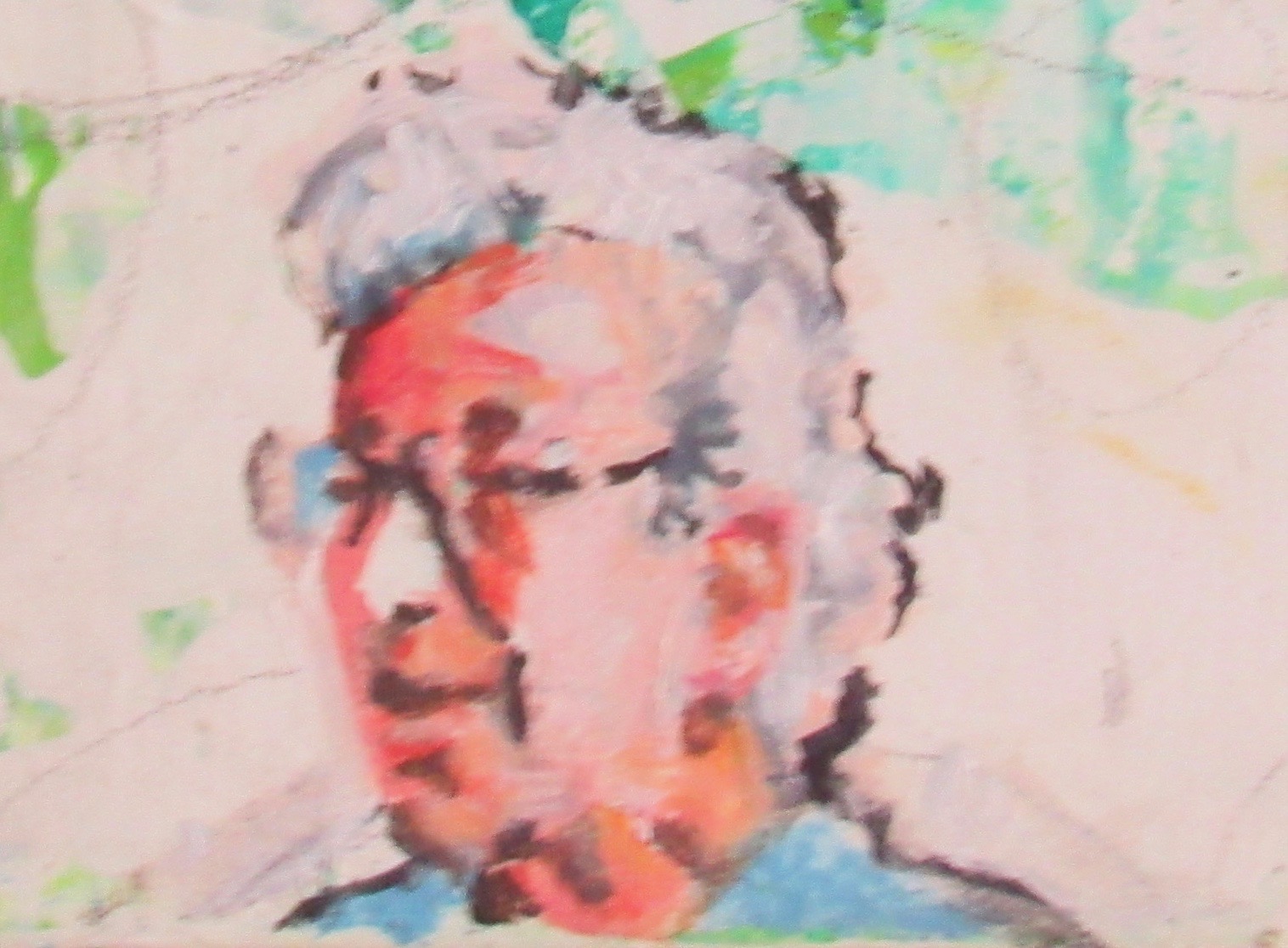
Family is on my mind a lot these days as I travel back and forth from the US to the Netherlands where my mother is battling a serious illness. Here's her portrait too:
Tonnie van Boekel


Wednesday, August 14, 2019

Sibérie

Irina Khistoforovna Kolegova
14 x 11 inches, oil on canvas, 2019

Slava Egorovič Kemlil
14 x 11 inches, oil on canvas, 2019
The paintings here represent two of nine recordings from Siberia in the list of 100. Seven of these were recorded by Henri Lecomte, including the two musicians here. Irina Kolegova (b. 1935) is a Koryak woman from Kamchatka, the easternmost peninsula of Russia. Slava Kemlil (b. 1963) is a Chukchi shaman from Kolyma, a bit northwest from Kamchatka. Both recordings by Lecomte appear in a series of cds on Musique du Monde dedicated to the music of Siberia. Kolegova is found on Sibérie 4, Kamtchatka: dance drums from the Siberian Far East and Kemlil on Sibérie 3, Kolyma: Songs of nature and animals. Kemlil's songs consist of imitations of animals, throat singing, and the 'jajar' (a big shaman's frame drum.) The tundra wakes up in the spring is the title given to the recording that made my list. Kolegova's song, a duet with Anna Kolegova, is called A song about ducks in a style that is reminiscent of the pic-eine'rkin tradition of the Chukchi.

Friday, September 7, 2018

Atavism

Irina Khristoforvna or Anna Vasilevna Kolegova
12 x 9 inches, oil on canvas, 2018
Music is in our DNA and so are genes from our ancestors even down to the Neanderthals. Somewhere hidden in our consciousness is a memory of the music from prehistoric times. That we can't access that memory doesn't mean it isn't there. Somewhere someone will unknowingly perform the music of ancient ancestors. Traditions too are persistent. There must be cultures still around in which the music of prehistoric people continues to be performed and many more whose sounds were recorded by musicologists as far back as the 1890s. I'm collecting the sounds of these traditions and those someones out there.

Saturday, January 6, 2018

Koryak (2)

Tamara Ivikovna Sajnav (cover image of Sibérie 4)
20 x 16 inches, oil on canvas, 2018
The 'Music du Monde' cd Kamchatka: Tambours de danse de l'extreme-orient Sibérien featuring music by the Koryak continues to be loaded in the cd-drive of my computer. It's becoming a sing-along disc. The language used by Tamara Ivikovna Sajnav on a song about the tundra is Čavčuven, which belongs to the Paleo-Siberian family. Needless to say that I don't know what I'm singing about when I sing along (besides that it's about the tundra). The musicians are not very forthcoming when asked about lyrics, they argue that the meaning of the song is in the timbre, not in their words. I agree. (I never pay attention to the meaning of song lyrics much, never did. When I sing "hop-hop" along with the disc, I think I understand the song.) With song, as with image, a deeper understanding is gained in the process of copying. In copying the cover image of the cd, the photograph of Sajnav (probably taken by Henri Lecomte, who also recorded the music) a level of empathy is established. Tamara Ivikovna Sajnav was born in 1928 in Aklan, her Koryak name is Ejgili, which means small stone. She is a small woman with a big drum (zja zjaj frame drum), 65 years old when the photo was taken. Her face in the painting was done with just a few brush strokes and looks younger than in the photo. I left it that way.

Wednesday, January 3, 2018

The Koryak of Kamchatka

Irina Khristoforvna and Anna Vasilevna Kolegova
16 x 20 inches, oil on canvas, 2018
Kamchatka, the far eastern peninsula of Russia, is mighty close to America. Despite the supposed isolation of native Americans since the last ice age (c. 13,000 BCE), the cultures on either side of the Bering Sea have much in common. No surprise then that the Koryak, natives of Kamchatka, have a competition song tradition quite similar to that of their Inuit neighbors in Canada. Compared to native Americans the history of native Siberians is one of coexistence going back to Viking times. Not to say that Siberian (shamanic) traditional cultures weren't threatened in their existence, far from it. As Russians before the Revolution were perhaps more homogeneous as a people than the Americans were, the Communist Soviet period took homogeneity to a further extreme. The villages of far northern and eastern Siberia were considered useless to the Soviet agenda and its people were systematically displaced, villages were closed, and their traditional way of life persecuted. Shamans went in hiding. Just before the new year I received the cd Sibérie 4, Korjak, Kamchatka: Tambours de danse de l'extrême orient-sibérien in the mail. The ordering was quite an ordeal as no English language sites seem to have the item in stock. From the cd, the Chant de compétition, performed by Irina Khristoforovna Kolegova and Ana Vasilevna Kolegova, is the last top 100 entry of 2017. The list now, I decided, continues to run through 2018.