Sunday, October 23, 2022

Modern Classical Music

György Ligeti, Antoinette Vischer
Continuum is a work composed by György Ligeti in 1968. The work was written for harpsichord solo and dedicated to the harpsichordist Antoinette Vischer. A version from 1970, transcribed for barrel organ by Pierre Charial, was the version to enter the top 100 list this year but an older version (1968) recorded by Vischer herself later on scored the majority of points. From what I understand (from comments on YouTube) is that the piece is incredibly difficult to play. In the early 1960s Vischer had commissioned John Cage to compose a work for harpsichord but Cage was hesitant until, in 1967, he saw an opportunity for the harpsichord while on a Visiting Associate-ship at the University of Illinois' Computer Music program led by Lejaren Hiller. The two created a complex composition for seven harpsichords and 52 magnetic tape players called HPSCHD. The premiere at the University of Illinois in 1969 featured Vischer, David Tudor, and Philip Corner, among the seven harpsichordists. The composition is a work to experience, not suited for recording, even though a recording of it made it onto a disc produced by Nonesuch in 1969. I bought that LP this year but the track did not make it onto the 2022 top-100 list. Another work by John Cage did, also from an LP I bought this year, MagnifiCathy: The Many Voices of Cathy Berberian. [1971, Wergo] A Flower and The Wonderful Widow of Eighteen Springs are two compositions by John Cage for voice and closed piano. Bruno Canino plays (taps onto) the closed piano behind Berberian's voice.
John Cage, Cathy Berberian
The great influx of modern classical music was not perpetuated by those two records that I just discussed but rather by a big Iannis Xenakis haul at a local thrift store. One afternoon in the Spring I found no less than five discs by Iannis Xenakis. I bought all five, and all five are really great. One of the five, also a Nonesuch LP (1968), is shared with a contemporary of Xenakis, the Polish composer Krzysztof Penderecki. His Cappriccio for Violin and Orchestra on side B of the shared record comes into the Top 100 2022 as well as Xenakis' Akrata found on side A. Both works, the whole LP, was performed by the Buffalo Philharmonic Orchestra Led by Lukas Foss, the famous German-American pianist, composer, and conductor.
Lukas Foss, Krzysztof Penderecki
Iannis Xenakis is represented five times in the list, and is the highest ranking individual this year. Two further (after Akrata) recordings come from an LP on the Candide label, and were recorded by the Ars Nova Ensemble led by Marius Constant, who also founded the ensemble specializing in contemporary music and especially that of Xenakis. The LP is simply called Iannis Xenakis, the recordings are from 1967, and the top 100 titles are Syrmos for 18 strings and Polytope for 4 Orchestras scattered throughout the Audience. A different Polytope and Polla ta Dhina for Children's Chorus and Orchestra (from Album 2—Music Today series, EMI) are the other Xenakis recordings in the list.
Marius Constant, Iannis Xenakis


Wednesday, October 12, 2022

After Ian (anarchy)

Cover of Les Dani de Nouvelle Guinee, Vol. 1 (r) and 2 (l)
Hurricane Ian has been highly disruptive in many aspects of life. Today marks two weeks since it struck just a little north from where I am. Unlike some others I know, I was lucky and only had to deal with a foot of water in my studio and fallen trees. I only got back to work in my studio three days ago. The result above, is based on the cover images of two French research recordings, Volumes 1 and 2 from Les Dani de Nouvelle Guinee. [CRAVA/nordsud music, 2001] A track from each volume is listed in the Top 100 this year. I'll be more specific in a moment but now I'd like to write a few words about my experience with Ian. I learned something about myself these past two weeks, and this is that I'm fairly conservative; I don't like the lawlessness observed since Ian struck; I don't like anarchy. Growing up in the punk-rock era I always applauded the idea of anarchy. Anarchy was leftist revolution, so I thought, but now I see the world reversed. Now that some parts of 70s/80s ideologies have been accomplished, revolutionary ideas have shifted to the right in an effort to undo these accomplishments. I don't like it at all! Regardless of political leaning I see that humanity, in the context of hierarchies, is anarchy at heart. 

As far away from the realities of the aftermath of a natural disaster in the US, is the music of the Dani people of the Western New Guinea (Irian Jaya) province of the Republic of Indonesia. The two volumes of Les Dani de Nouvelle Guinee are filled to the max with gems of ethnographic recordings. From Volume 1 comes, like last year, Cour D’amour, Air Doux, Tiom, a beautiful example of polyphonic singing by men and women, and from Volume 2 Live beetle jew's harp, where a live (and buzzing) beetle is attached to a wooden splinter and is used like a jew's harp. I am mesmerized by this instrument both for its aesthetic charm and the concept of the extension of the human voice by using a live animal. However beautiful the music, it was not the main objective of the three researchers who compiled the cds, but came to study the traditional making and trading of salt. The three anthropologists are Anne-Marie and Pierre Petrequin, and Olivier Weller. Weller was also the photographer on the expedition and I assume he is responsible for the source images for the above painting that appeared on the cover of the cds. I did not paint Olivier Weller but did put Anne-Marie and Pierre Petrequin together in a double portrait. 

Pierre and Anne-Marie Petrequin
Back to States and to the time when the punk-rock atmosphere was still imbuing the minds of young people with ideals of equality, freedom, and other such good things. Pere Ubu came of age during the same period I did too. Mostly active in the 80s the band was a regular high-achieving band in my Top 100 lists of the 90s and both Laughing and Waiting for Mary had been listed during that decade. Laughing, in the classic line-up that I've painted: Tom Herman; Tony Maimome; Allen Ravenstein; Scott Krauss; and David Thomas, is from The Modern Dance [Plan 9, 1978] while Waiting for Mary is a recording from the live TV show Night Music [NBC, 1988-1990] hosted by David Sanborn. In the performance, from 1989, Tom Herman had been replaced by Jim Jones and Chris Cutler, and the band is backed by a slew of renown musicians including Sanborn himself, and Debbie Harry of Blondie.
David Thomas; Scott Krauss; Tom Herman of Pere Ubu

Tony Maimone; Allen Ravenstine of Pere Ubu
There's one more painting that's somewhat new that I need to display and talk about, even though I already did so in the context of the 100 Faces from the Top 100 2022 preview painting from earlier this year. First I'll copy what I wrote on May 11th about the people portrayed: "The record Musica Sveciae: Fornnordiska Klanger means a lot to me as I'm interested in prehistoric art and the origin of music. Professor Cajsa Lund, who produced the record, and her collaborator Äke Egevad are professionals who research bot interests and use archaeological evidence to reconstruct sounds from the prehistoric era. Two tracks from the album are listed in the top 100: the sound of a bull-roarer and a performance on the Kantflöjter (flute)." Only one painting will suffice for the two tracks since there are no other individuals I know of associated with the two works of music-archaeology.
Äke Egevad/Cajsa Lund


Wednesday, September 14, 2022

The Arkestra

Leaders of the Arkestra: Marshall Allen, Sun Ra
The Sun Ra Arkestra didn't cease to exist after its leader Sun Ra died in 1993. John Gilmore took over as leader in 1993 followed by Marshall Allen in 1995. Marshall Allen joined the Arkestra in 1958 and now, 64 years(!) later, at age 98, still leads the Arkestra. I've painted all three, Sun Ra, Gilmore, and Allen as at least three recordings (and maybe more) will be listed in the top 100 this year. Sun Ra is coupled with Allen, while drummer Clifford Jarvis accompanies tenor sax player John Gilmore on a second painting. A third features three women who were part of the Arkestra. The singers June Tyson, who performed with Sun Ra, and Tara Middleton, the singer of the current incarnation of the Arkestra, and dancer Ife Toyo, who performed with the Arkestra in the early seventies.
John Gilmore/Clifford Jarvis
I've always liked the music of Sun Ra but only recently I feel like I've come to understand his music a little better. I watched the film Space Is the Place, which in and of itself is not a great movie, it's like a B- or Blaxploitation movie, but it does show Ra's intentions and the Arkestra in concert. I never thought of Sun Ra in the context of the Civil Rights Movement, but the movie surely directs you in that direction. Of course, Sun Ra was right there in the midst of it. I've read that Sun Ra was at odds with the Black Panther movement over the issue of how to fight for equal right and against discrimination. The objectives are the same, beautifully laid out in the famous Martin Luther King "I have a dream" speech. Sun Ra's objective was to move African Americans to a different planet. The new planet must be taken metaphorically although Sun Ra took space very seriously. The method to move the people to outer space was music. Hence the name of his band: Arkestra. To create a better world he visualized a better world. The key, I think, of Sun Ra's music is visualization. If it can be visualized it can be a reality. The idea of visualization is closely linked to the practice of (neo) shamanism. Sun Ra was certainly a shamanic figure. (Some years ago I wrote about Rahsaan Roland Kirk as a modern shaman. It's perhaps odd to think of Kirk in terms of visualization, but I have no doubt blind people visualize in the same manner, or better, and non-blind people.)
June Tyson/Tara Middleton/Ife Toyo of the Arkestra
The three songs of inclusion are Space Is the Place, Heliocentric, and a solo improvisation without title by Sun Ra on keyboards. Retrospective and another untitled improvisation by the full Arkestra from 1981, are two other possible tracks included in this year's list. All recordings are from before 1993, when Sun Ra was still leading the Arkestra. Other tracks that scored points this year include two by the Arkestra after 1993, in Sun Ra's name but led by Marshall Allen.
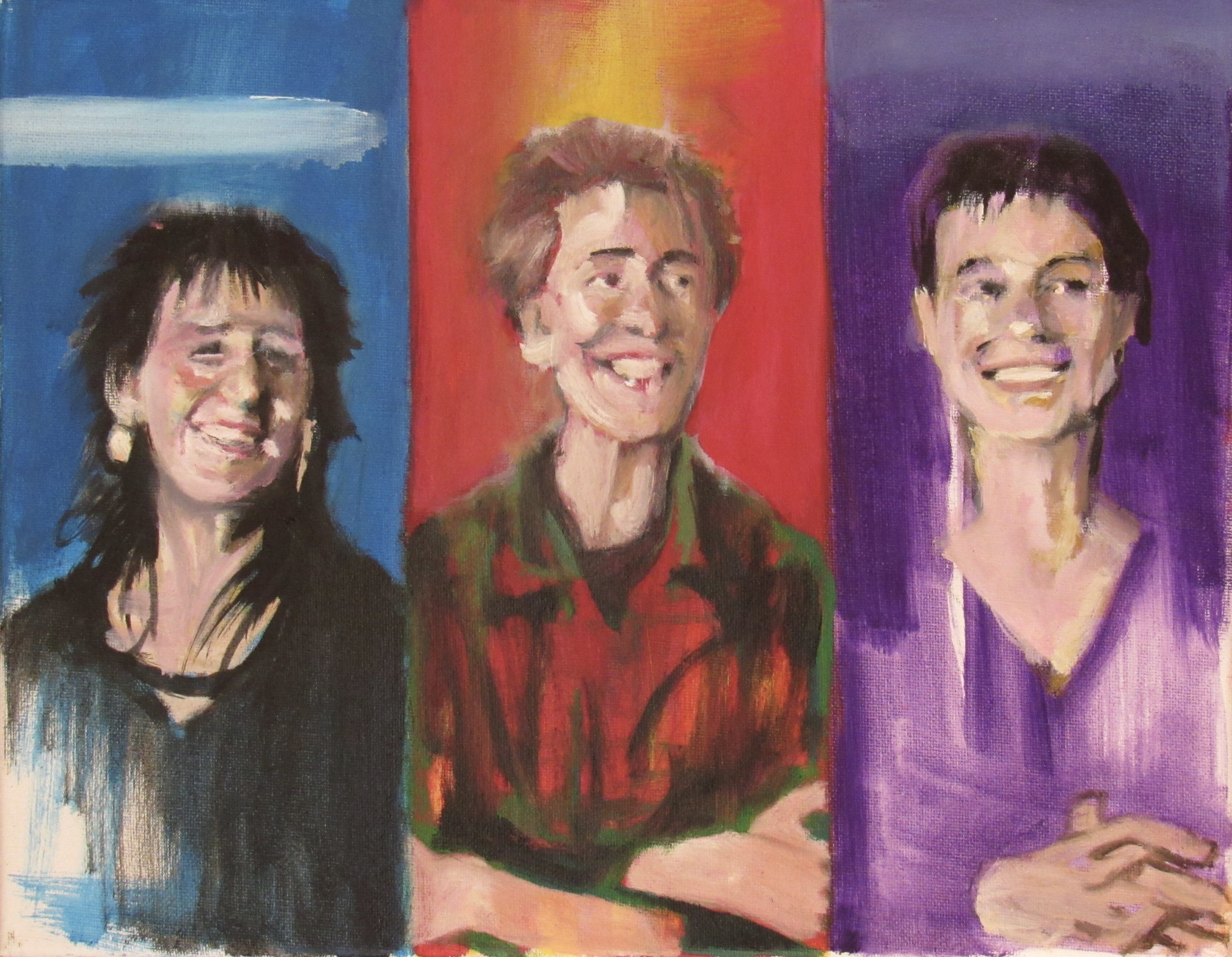
All smiles: CRASS members Joy de Vivre, Eve Libertine, and Gee Vaucher
At the same time I painted the triple portraits of Arkestra members I also painted one of members of the British punk band CRASS. I chose the female band members this time: Joy de Vivre, Eve Libertine, and Gee Vaucher. The song in the Top 100 2022 is the same as in 2021: The medley Step Aside/Rocky Eyes/Mouthing the Words from the album Penis Envy.


Sunday, September 4, 2022

Ex Ethiopia

Terrie and Andy Ex (Terrie Hessels/Andy Moor)
Over the past week I've made four paintings documenting a string of recordings in the top 100 about the connection of the Dutch punk band The Ex with Ethiopian musicians. Five of the eight portraits are of elderly men, but there not ordinary men, they legends of the Dutch punk and jazz, and Ethiopian jazz scenes. The remaining three of women of various ages, but no ordinary women either! Katherina Bornefeld is normally the drummer of The Ex, but on a video recording of The Ex live in Addis Ababa, the legendary Han Bennink sits in and Bornefeld sings the song Eyoleo by the Mahmoud Ahmed while playing percussion on a cowbell. I combined Bennink and Bornefeld in the next double-portrait.
Katherina Bornefeld/Han Bennink
In another video on YouTube The Ex plays a live concert in Groningen (Netherlands) assisted by the Ethiopian saxophone player Getatchew Mekuria on a track written by Mekuria called She Ilelle (or Shellela). Here (below) I combined Mekuria and Ahmed (the two authors of the two songs mentioned.)
Mahmoud Ahmed/Getatchew Mekuria
Mahmoud Ahmed and Getatchew Mekuria both prominently feature multiple times on the influential CD series Ethiopiques. Volume 6 and 19 from the series are by Ahmed while Volume 14 is by Mekuria. Both musicians I've know for a long time as the library in Columbus, where I then lived, had many discs from the series. Both have been in the Top 100 before. In 2011 I wrote about the series, then on Mulatu Astatqe, in this blog. The final double portrait painting is of the contemporary musicians Tirudel Zenebe and Selamnesh Zemene. Tirudel Zemene features on the disc Ilita!: New Ethiopian Dance Music that was produced by Terrie Ex and released on Terp Records, a label founded by Hessels. Zemene, Mekuria, Zenebe, Bennink, Bornefeld, and Terry and Andy Ex, all featured in the preliminary painting for this Top 100 series. (Read here, and here.) Selamnesh Zemene performed with The Ex when she was still in the band Fendika in 2008. There is video called Gonder on YouTube. Gonder is not the actual title of the song that appears on Soundpoetry, part 5, but refers to the city Gondar, from which Fendika hails. In the Spring I saw Zemene perform live in Nijmegen (Netherlands) with Baduma's Band. Selamnesh Zemene is yet represented twice more in the Top 100 independently from The Ex.
Selamnesh Zemene/Tirudel Zenebe


Sunday, August 28, 2022

The Trobrianders of Papua New Guinea

The Trobraianders of Papua New Guinea, cover of zine, 8.5x5.5", stencilprint

 The Trobrianders of Papua New Guinea is the title of an anthropological study by Annette B. Weiner published by Wadsworth in 1988. I read the book last winter and drew all the photos (by Weiner) from it in the summer. I then collected the images and compiled these in a zine I published in an edition of eight. The covers for them are original stencil prints in a variety of colors. They are a remake of the original cover of the book by Weiner. The zine is #12 in the Ach Ja series I have been publishing since 2015. Some images from the inside can be found here. The same image that was used for the cover is found inside as well as photo 16. The caption reads: "About to leave the house for the first time after giving birth, Borobesa wears a long cape and covers her head." 

The Trobrianders are a rather famous subject of anthropology, as they were the subject of Argonauts of the Western Pacific [G. Routledge & Sons, 1922] by Bronisław Malinowski. Malinowski introduced the practice of 'participant observation' to the field of social anthropology, a practice that was adopted by the field of ethnography became the standard of all anthropological fieldwork. Weiner's book, published 66 years after Malinowski's, is a valuable (feminist) update to the Argonauts, as the original work lacked attention and access to the vantage point of the women of the Trobriand Islands. Weiner did not record any music during her research and, interested, I had to look elsewhere. There are several videos on YouTube that have sounds, and sometimes music, most notably Kama Wosi: Music in the Trobriand Islands [Documentary Educational Resources (DER), 1978] by the filmmaker Les McLaren. Between 1915 and 1918, Malinowski also recorded the Trobrianders on a series of wax cylinders that are now at the British Library. One of the recordings, Ragayewo by Tokulubakiki of 1918, made the Top 100 2022 list. The two paintings for the top 100 series are (first) the portraits of Malinowski and Weiner, and below of Tokulubakiki, his wife Kuwo’igu, and youngest child. Malinowski mentions the singer Tokulubakiki as a close friend. The photographic source for the painting is his. In the photo the singer and his wife are much closer. I separated the two for the sake of the canvas size and double portrait format. It now looks like two pages from a book of photographs.

Bronisław Malinowski/Annette B. Weiner

Tokulubakiki, his wife Kuwo’igu, and youngest child (after Malinowski)

Friday, August 19, 2022

Helen Rees: Echoes of History

He Jinhua, Helen Rees, 11x14 inches, oil on canvas, 2022
The next two paintings in the Top 100 2022 series concern the Naxi people of Southwestern China. The two tracks in the top 100 they illustrate come from a cd tucked in the book Echoes of History: Naxi Music in Modern China. [Oxford University Press, 2000] The author is anthropologist Helen Rees, who worked extensively in Southern China. The book is a study of how a minority culture in China (Naxi) fared during a century of regressive policies in the post-dynastic era. While the music and culture of the Naxi was stripped of certain characteristics not in line with official Chinese policies,  they were lucky enough (unlike some others') to receive a status as an officially recognized minority group by the central government. The status allowed the Naxi, to some extend, to practice traditional customs and music. As a result too, the Naxis perform during official festivals organized by the central government to highlight the minority cultures in China, and to give the appearance that the government is good, inclusive, and tolerant.

The first painting is of the author of the study Helen Rees (on the right) and of the Naxi singer He Jinhua. He Jinhua is a distinguished singer who has recorded extensively, most notably (for us) on a recent issue on the Smithsonian label. Echoes of History is an in-depth study of Naxi Music. Rees speaks the local language as well as Chinese, and visited and stayed among them numerous times during the 1990s. After reading the book I was curious if I could find anything published recently on the topic. Most contemporary accounts are about the star singer He Jinhua. It is due to her that the traditional Naxi songs are being preserved. Most Naxi who knew the songs have died or are aging. This was already the case in Rees' accounts of the 1990s. He herself is not included in the top 100 list even though the CD Songs from the Naxi in Southwestern China [Smithsonian, 2022] is a wonderful collection of songs. Several, especially the solo voice performances, are in a style quite similar to the song Bbai neiq bbaq jji huil, by He Fenxiang, recorded by Rees in 1991, and listed in this year's top 100. It is possible, but not likely, Fenxiang and Jinhua are related. He is a common surname among the Naxi.

The image of Rees I used I had already painted about a month ago as part of an experiment of superimposing image upon image on an older painting of Vision of Disorder. It doesn't exist in the form you see below, and I kinda regret destroying it. On the right side is the DJ Ruben Rivera Jr (Aka The Tyrant) who remixed the VoD song Slapped by an X for the film and cd Threat: The Music that Inspired the Movie. [Halo 8, 2006]

Ruben Rivera Jr./Helen Rees, 30x40 inches
The next painting (below) is based on the cover photo of Echoes of History and illustrated the short track Salua bba xiuq bbaq by Yang Houkun. Salua bba xiuq bbaq is a folk melody played a single leaf and was recorded by Rees in 1993. In the image Yang is seen instructing his son Yang Zemin on a transverse flute.
Yang Zemin and Yang Houkun, 11x14 inches
One of my activities during my five-month top 100 hiatus was to draw. And I drew a lot. I drew, for example, all the illustrations from Echoes of History. The following images are snapshots from the sketchbook they appear in.


Saturday, August 13, 2022

Rio Piraparaná

Cristo and Bosco, Tukano elders, Piraparaná, River, Colombia
The second painting for the Top 100 2022 consists of portraits of the two main performers on the Elders chanting origin myths recording made by Brian Moser and Donald Tayler in 1960 during an expedition along the remote Piraparaná river in Colombia. They were recorded in 1960 and filmed, by Moser, ten years later (War of the Gods, 1970) on a consequent visit. The initial expedition was a joint Colombian geological survey and a sound recording mission organized by the BBC. All the recordings, in their raw original state, made by Moser and Tayler are available on the British Library Sound Archive. Highlights from these recordings, now edited for popular consumption, appear on Music of the Tukano and Cuna Peoples of Colombia. [Rogue, 1987] The above image is from a photograph by Moser appears in an on-line essay written by the anthropologists Christine and Stephen Hugh-Jones for the British Library. Below is the finished version of the first painting of Tayler and Moser, who were adventurers in their twenties when they first visited, and recorded, the Tukano peoples. Donald Tayler died in 2012.
Donald Tayler (l), Brian Moser (r). 11x14 inches, 2022
Beside the Elder's chanting origin myths, the likely number 1, three other recordings by Tayler and Moser appear in the Top 100 2022: Music at a Harvest Festival, Paired tortoise shell (goo) and panpipe, by the Tukono people and Kantule medicine man plays eagle-bone flutes by a Makuna Indian. The three individuals seen in the next painting perform a Harvest Festival ceremony in the same War of the Gods film by Moser of 1970. A similar performance was filmed by the Dutch participant on the 1960 expedition Niels Halbertsma. The ceremony continues to be performed annually by the Tukano People. In 2016, after an absence of nearly 40 years Brian Moser revisited the region and some of the same people he had met during previous expeditions. Stephen and Christine Hugh-Jones, as well as his son Titus Moser accompanied him on this reunion trip. Titus Moser documented this trip and made the film Ignacio's Legacy. [Pira Productions, 2017] All the elements of the ceremony are the same except the clothing: Men don't wear their traditional g-strings anymore and women covered up as well. 
Tukano Harvest Ceremony
The fourth and final painting illustrating the four Tayler/Moser recordings in the top 100 portray Niels Halbertsma, the filmmaker who accompanied Tayler and Moser in 1960, and Dr. Christine Hugh-Jones, an anthropologist fluent in the Tukano language. Hugh-Jones had accompanied Tayler and Moser in 1970 and on several consequent trips, as well as the 2016 reunion expedition. The image of Halbertsma comes from the same photo I had used for the initial Tayler/Moser painting. The Hugh-Jones image, like those of the Tukano people from the 1970 documentary War of the Gods. [British Library, 1971]
Niels Halbertma/Christine Hugh-Jones


Tuesday, August 2, 2022

It's a start


Brian Moser and Donald Tayler
The first brushstrokes of the Top 100 2022 have been placed on a 11x14 canvas which means the series have now officially started. The first painting will be a double portrait of two British anthropologists who recorded (and lived with) various tribes along the Río Piraparaná in Amazonia in Colombia. Several of their recordings will be featured in the new Top 100 including the likely #1 "Elders chanting origin myths," a fragment of which, wrongly attributed then, was also featured in the Top 100 2021. The chanting elders appear on The Indians of Colombia, that I believed to have been recorded by Lars Persson. The recording, suddenly of great interest to me this year, did not have much data so I started my research. I found on the British Library "Sounds" website the recordings made by Moser and Tayler in 1960 and 1961 of five different places they visited in Colombia's Amazonia region. A bit later I found the music on an LP named Music of the Tukana and Cuna Peoples of Colombia [Rogue Records, 1987] from which the current #1 is taken. I did not have any images yet but upon relentless searching I came across a movie following Brian Moser on a re-visit to the region 35 years after the recordings were made. The movie The Indians of the Vaupes was made by Titus Moser, who accompanied his dad together with the anthropologists Stephen and Christine Hugh-Jones, who had also visited the same peoples in the 1970s. In the film, outtakes from videos taken by Moser and Tayler during their initial visits were shown, including a fragment of the elders chanting origin myths. It supplied me with images of Moser and Tayler, as well as the leading elders of the song. I have names too: Cristo and Bosco. 

While the format of the 2022 painting is identical with that of the paintings of 2021, the concept has changed dramatically. I decided to do away with the hierarchical structure of the paintings in which the #1 from the list is also the painting in first place. The painting can now be exhibited in any order. Then, the individual paintings do not necessarily illustrate a particular song. The selection of portraits is simply a summary of those people meaningful to the list of 100 songs. It may be that a certain musician I painted is not in the list of 100 but deserves inclusion because of her presence throughout the lists compiled in the year. This way I avoid having to paint multiple portraits of one individual. Hope it works out, we'll see. I will forward the finished painting of Moser and Tayler shortly.

Monday, June 20, 2022

100 Faces from the Top 100 2022

100 Faces from the Top 100 2022

 In order of appearance clockwise from the top left corner, spirals inward:

1.     Marlene Marder (LiLiPUT)

2.     Les Dani de Nouvelle Guinée (CD cover)

3.     Katherina Bornefeld (The Ex)

4.     Marshall Allen (Sun Ra Arkestra)

5.     Allen Ravenstine (Pere Ubu)

6.     Anne-Marie Petrequin (anthropologist)

7.     Pierre Petrequin (anthropologist)

8.     Rundi woman performing "Ubuhuha"

9.     Rundi woman performing "Ubuhuha"

10.  Brian Elliott (Cromagnon)

11.  Austin Grasmere (Cromagnon)

12.  Paco Aguilar (Cuarteto Aguilar)

13.  Han Bennink (drummer)

14.  Lukas Foss (composer, conductor)

15.  Inuit singer performing "katajjaq"

16.  Inuit singer performing "katajjaq"

17.  Penny Rimbaud (CRASS)

18.  Charlie Parker (saxophonist)

19.  Jon Ibragon (saxophonist)

20.  Tirudel Zenebe (Ethiopian singer)

21.  Don Cherry (jazz musician)

22.  Ake Egevad (archeo-musicologist)

23.  Rosa Balistreri (Italian singer)

24.  Alice Coltrane (jazz pianist)

25.  Tukana elder

26.  Henri Lecomte (ethnomusicologist)

27.  Henry Grimes (bassist)

28.  Steven Feld (ethnomusicologist)

29.  Charlotte Heth (Cherokee singer)

30.  Cat Power (American singer)

31.  Kimya Dawson (American singer)

32.  Marjorie Shostak (ethnomusicologist)

33.  Instruments of the Kalahari San (cover)

34.  Stanley Diamond (ethnomusicologist)

35.  Miles Davis (jazz trumpetist)

36.  Miss Palu Vavau Tupou (Tonga)

37.  Jimmie Garrison (bassist)

38.  Rahsaan Roland Kirk

39.  Esna Redzepova (Rom singer)

40.  Lars Persson (ethnographer)

41.  David Sanborn (jazz musician, host "Night Music")

42.  Music from Mato Grosso (cover)

43.  Pierre Sallée (ethnomusicologist)

44.  Neil Young

45.  Rebecca Natialuk (Inuit singer)

46.  Mark Mothersbaugh (DEVO)

47.  ???

48.  Ulahi (Papuan singer)

49.  Kim Gordon (Sonic Youth)

50.  Andrea Quispe Chura (Q'ero)

51.  Andy Moor (The Ex)

52.  Caetano Veloso (Brazilian musician)

53.  Albert Ayler (saxophonist)

54.  Gal Costa (Brazilian singer)

55.  June Tyson (Sun Ra Arkestra)

56.  Sun Ra (jazz musician)

57.  Dave Thomas (Pere Ubu)

58.  Klaudia Schiff (LiLiPUT)

59.  Anna Kolegova (Chuchi singer)

60.  Howard Kauffman (anthropologist)

61.  Eve Libertine (CRASS)

62.  Terry Hessels (The Ex)

63.  Cuna Indian

64.  Deben Bhattacharia (ethnomusicologist)

65.  Iannis Xenakis (composer)

66.  Tangkul storyteller

67.  Donald Tayler (ethnomusicologist)

68.  Michel Vuylsteke (ethnomusicologist)

69.  Tom Herman (Pere Ubu)

70.  Nigeria (Jos plateau)

71.  Loren Bommelyn (Native American singer)

72.  James Mtume (jazz percussionist)

73.  Shuar woman

74.  Tom Maimone (Pere Ubu)

75.  David Blair Stiffler (ethnomusicologist)

76.  Alan Vega (Suicide)

77.  Ansambl Teodosievski (musical director)

78.  Alex Chilton (American musician)

79.  Nicole Beaudry (ethnomusicologist)

80.  Gee Vaucher (CRASS)

81.  Michael Hurley (American musician)

82.  John Cohen (ethnomusicologist)

83.  Hugo Zemp (ethnomusicologist)

84.  Irina Kolegova (Siberian singer)

85.  Getatchew Mekuria (saxophonist)

86.  Sunny Murray (jazz percussionist)

87.  Gyorgy Ligeti (composer)

88.  Elise Aguilera (Cuateto Aguilero)

89.  Rung-Shun Wu (ethnomusicologist)

90.  Brian Moser (anthropologist)

91.  Cajsa Lund (Archeo-musicologist)

92.  John Cage (composer)

93.  Music of Thailand (cover)

94.  Cathy Berberian (singer)

95.  Tukano shaman

96.  Music of the Indians of Panama (cover image)

97.  Thurston Moore (Sonic Youth)

98.  Music of Ngassa (cover)

99.  Aileen Figuaroa (Yurok singer)

100.                 My Larsdotter (My Bubba)

 There are a few questions in the list, they will be answered when I work on the new Top 100, I'm sure. I also noticed there are 101 faces rather than 100. That extra one (between 58 & 59) I can't identify.