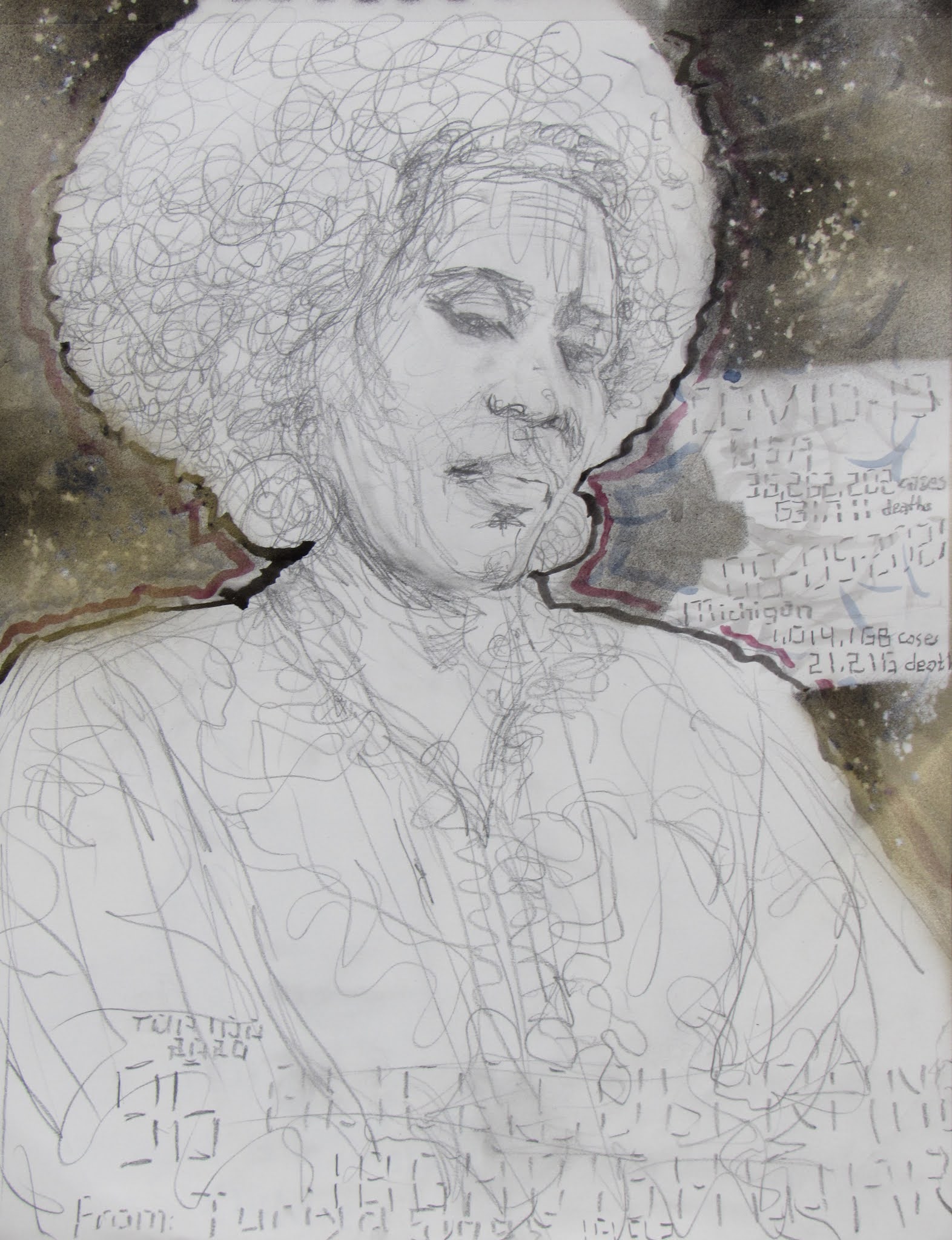
Thursday, August 26, 2021

Gentlemen in the Jungle

Michael J. Harner playing a shaman's drum/Shuar woman preparing beer

My purchases this year of the LP Music of the Jívaro of Ecuador as an mp3 file and the book Visages the Bronze, and free downloads of the LP Jívaro and a pdf of The Jívaro: People of the Sacred Waterfalls all contributed to an enormous amount of recordings by the Shuar people (as the Jivaro are currently referred to) in the Top 100 but other sources were accessed as well. I've read current academic papers on Shuar culture as well as some early anthropological studies done in the 1930s. The four titles listed above are by the ethnologists Philippe Luzuy and anthropologist Michael J. Harner. I've painted Michael J. Harner here to illustrate the song Social Dance Singing (female chorus) that he recorded in 1972 together with an image of a woman preparing mash for manioc beer that Harner also took in 1972 and appears in the liner notes of Music of the Jívaro of Ecuador. [Folkways, 1973] The image of the woman photographed by Harner would also be appropriate for the song Chant de la bière de mais but for the Luzuy recording of it I used an image of the Finnish anthropologist Rafael Karsten paired with an image from a photo that he took during his frequent stays with Ecuadorian Indians in the early 1930. 
Shuar man (after a photo by Karsten)/Rafael Karsten
Karsten's book Head-hunters of the Western Amazonas was the first serious academic study of the Shuar. The Jivaro, as they were then called, had an almost mythical status in the Western imagination. So much had been fantasized and speculated since their famous shrunken heads became a fad for collectors in the late 19th century, yet none had studied their actual culture until Karsten spent time with them. Karsten's observations however, as one might expect given the early date, are far from objective.

The song Chant de la bière de mais (recorded in 1960 by Luzuy) curiously enough is identical to another social dance song from Harner's 1972 recordings on Music of the Jívaro of Ecuador. Harner's recording is not just the same song as the one Luzuy recorded twelve years earlier but it's identical note for note, as identical as a Beethoven piano sonata recorded by two different pianists at different times. Beethoven's music was written down but the Shuar songs are passed on from one singer to another. Stranger yet, even more starteling, is the fact that the singer recorded by Luzuy is a man while the singer recorded by Harner is a woman. Michael Harner, as well as others who have studied the Shuar, observed strict gender roles. (I wrote about the mysogyny of Shuar culture earlier, you can read it here.) Cultures like the Shuar may be much more flexible as anthropologists would be able to observe. (Here's the link to all my recent musings on the recordings of the Shuar.) 

Matthew W. Stirling/Shuar woman (after a photo by Stirling)
Philippe Luzuy recorded five tracks listed in this Top 100 and I still have not been able to find an image he appears on. For the fifth recording then, which is called Chant sur l'oiseau Toucan, I continued to chronicle the history of Shuar anthropology. A few years after Karsten, still in the 1930s, the American Matthew W. Stirling, produced a study of much greater integrity. Historical and Ethnographical Material on the Jivaro Indians has the flaw that Stirling relied on a certain translator who was biased, coming from a rivalling tribe. Harner, who used Stirling's book as a guidebook, tracked the informant down thirty years later and was able to set the record straight on some of Stirling's conclusions. In the painting here Stirling is seen carrying a gun (I think this may be a first for me!) in the Ecuadorian jungle. Next to him is an image of a Shuar individual he had photographed. 

Note: The photograph I used to portray Matthew Stirling, also features his wife, and long time collaborator, Marion Stirling. It felt really really weird to edit out Marion Stirling and instead, replace her by a Shuar woman, the object of their studies. In reality Stirling is much taller than the (unnamed) Shuar woman. 

Tuesday, August 17, 2021

Done!

Top 100 2020, #100: Entrance of the Mani Mask
The caption under the photograph I used reads: "One by one the soaring Spirit Fish masks enter Otei village accompanied by chanting and dancing women." Otei village is situated in Papua New Guinea and the quote and photograph, together with the recording Entrance of the Mani Mask come from a 1978 Folkways LP called The Living, Dead & Dying: Music of the New Guinea Wape which was recorded by William E. Mitchell in the early 1070s. I did not reproduce the photograph, which was also used on the cover the record, but made gesture sketches of some of the individuals seen in the ceremony depicted. Since I'm quoting William E. Mitchell, here's his description of the recording in the Top 100: "As the mani demon prances into the village from the forest, women welcome him with vigorous chant. Here, as in most of the large curing festivals, women have an important ceremonial and musical role." The Wape are unique in Melanesia in the fact that their organization is egalitarian. In most other cultures in the region there is a strict hierarchy in what ethnologists call "the big man political system" or "bikman." [William E. Mitchell, On Keeping Equal: Polity and Reciprocity Among the New Guinean Wape] Entrance of the Mami Mask is number 100 in the Top 100 2020 and thus marks the completion of this series of works. After I organize a showing of the works my undivided attention will become the Top 100 2021, that now is already more than a third done. At a provisional number 36 in the new list resides a second track from Mountain Music of Peru, vol. 1 from 1966, [Folkways] a seminal album of recordings by John Cohen. It is thus also the second portrait I painted of John Cohen in the new series of 100. John Cohen was an influential musicologist and photographer who recorded and shot, beside Peruvian mountain music, mountain music from Kentucky, the Beat generation, among many other topics. The dancing child on the right of the painting is also based on a photo by Cohen, be it in the context of a different collection. John Cohen, known too for being a member of the New Lost City Ramblers, a New York bases string band, died in 2019.
John Cohen/Mountain Music of Peru, vol. 2 cover


Sunday, August 15, 2021

Black is a color

2020 was a horrible year. A political nightmare here in the States, a pandemic of epic proportions, and the killing of several African-Americans by police forces in several cities in the US. The killing of George Floyd in May of 2020, the next one in a series of high-profile instances of police brutality, took things to a boiling point. The country, and the world at that time, were on hold, in quarantine at the higth of the first wave of COVID-19 pandemic, but the racially motivated killings could not keep hundreds of thousands of people to take to the streets. I was not one of them, I'm not one to take to the streets, but I very much felt the pain and I have been a vocal sympathizer to the cause, to the Black Lives Matter movement. Naturally the music selected to listen to in those days reflected these sentiments and I found myself listening to the soundtrack of various Civil Rights movements. Somewhere around that time a documentary was aired (I think it might have been on VH1) about the Black Panther movement of the 60s and 70s. I was highly impressed by the soundtrack of that documentary and by the artwork of Emery Douglas, who provided the graphics for Black Panther publications. One of the anthems for the civil rights/black liberation movements of the 1970s was The Revolution Will Not Be Televised by the soul and jazz poet Gil-Scott Heron. The inclusion in the documentary The Black Panthers: Vanguard of the Revolution made the song re-apear in my Top 100.
Another one that entered the Top 100 2020 in the same week in the early Summer of 2020 was Black Is... by the Last Poets. I've been a long time fan of the Last Poets and by chance I happened to meet Umar Bin Hassan (who wrote and recorded Black Is...). This was in 2005 after a concert by the legendary Reggae group Culture, at Alrosa Village in Columbus, Ohio. The person in charge of the programming, a huge Reggae fan who had been visiting my Top 100 shows around that time, had invited me back stage. This is when I ended up smoking some joints with Umar Bin Hassan. Good times! The focus on civil rights themed music then also brought Nina Simone back on my radar (not that she was ever far off) and I listened to a good many records I own of hers. She's twice in the Top 100 2020. My all time favorite of hers is Black is the Color of My True Love's Hair and after a high ranking in 2020 it reappeared in the 2021 version. The provisional #36 spot in the Top 100 2021 of that song neatly coincided (in terms of painting the entries according to their positions on the lists) with numbers 98 and 99 of the Top 100 2020: The Last Poets and Gil Scott-Heron.
Nina Simone/Emile Latimer


Wednesday, August 11, 2021

Play in the water

A strange thing happened while painting this watercolor of a water game by six 'Are'are women from Malaita in the Solomon Islands. The scene I painted, a still from the movie 'Are'are Music, kept animating in front of my eyes. The whole scene played out continuously as if I were there. I felt a sense of empathy as I could identify with the performers. Not as being one of them but more like an onlooker. There's a voyeuristic element to the scene as it seems such a private gathering. Hugo Zemp, who filmed the scene, must have felt it too, even though the filming and recording of sound and the performance itself must have been carefully planned. The high vantage point enhances this sensation. You are looking at the performance from a perch quite a bit higher than the surface of the water. It helped that the performers are somewhat familiar, especially Aaresi, and Il'eresi as they were recorded by Zemp on various occasions and who are multiple times in this Top 100 and who I've painted already several times. Aaresi is in the center while Il'eresi is on the right. About the music: The sounds are similar to the traditional drums used by the 'Are'are and some rhythms played also mimic traditional drum rhythms. But there are no drums used, only hand clapping, on and beneath the water surface. Water drum games are not unique to the 'Are'are. Many water games, drum rhythms, have been recorded among the people of the Central African rain forests. Water drums by the Baka people, for example, was the first time an ethnographic recording ended up high in a Top 100 list. This was in 2004. The COVID0-19 series are now nearly completed and no active cases of the pandemic are recorded in the Solomon Islands. The total amount of cases during the one and a half year of COVID is a mere 20. Nobody died.


Monday, August 9, 2021

Simha Arom in Cameroon

Young Aka woman/Simha Arom

Simha Arom/Baka child at the Aba encampment
Two tracks from Cameroon: Baka Pygmy Music [UNESCO, 1977] found their way to the midst of the Top 100 2021 list and I decided to work on these simultaneously. As an experiment I divided up both canvases into four equal parts that I then painted a certain color. I then painted the portraits on top of the color fields. Simha Aram, who recorded the tracks on the CD twice, juxtaposed with two young pygmy people he photographed. The Baka child is from the CD liner notes, the young woman is not a Baka but belongs to the Aka people of the Central African Republic. The two songs they represent are Song to Attract Game which is sung by four teenage girls and Hut Song by thirteen young girls and children. Both songs belong to the yeyi category which as a ceremonial origin and is still used in ceremonies but more often has evolved into secular songs. Hut song is secular and Song to attract game is ceremonial. Most Baka songs have a ceremonial or ritual origin giving credence to the theory that the origin of music is to be found within the "sacred." In much of the songs of the Baka people the men are dancers and the women singers. Most voices on the CD are of women and children.
Alice Coltrane
While working the paintings for the Top 100 2021 I continue to work my way down the list of the Top 100 2020. I'm milking it because I want to continue to work on the series until the exhibition goes up. I experienced another two week delay because of electrical issues in the archive space. But the exhibition will be really soon. Number 96 is Alice Coltrane with the track Jagadishwar from her 1981 devotional album Turiya Sings. The album is for voice and Wurlitzer, it's the first time Coltrane sings on a recording. At the time of recording she served as the director of the Interfaith Vedantic Center in Southern California. Alice Coltrane died in 2007, outliving her husband John Coltrane forty years.


Wednesday, August 4, 2021

Activities of the Top 100 Archive and Studio

There are two children's game songs included on the LP The Eskimos of Hudson Bay and Alaska. [Folkways, 1955, recorded by Laura Boulton] One is called Girl's Game and the illustration for it I did about a year ago at the beginning of the Top 100 2020 nicknamed The COVID series. Girl's Game is number 5 on the list. Here's the illustration for the second one found that is fifth from the bottom of that list now that the COVID series nears it's completion: Children's Game. The recording is of two six year old girls holding hands while echoing each others lines, rhythms, breathing and panting. Soon they will be able to perform a proper katajjaq. The image I used this time is not a photo by Boulton but a contemporary image owned by Alamy Stock Photos.

A few days prior to the drawing of the Inuit Children I did a portrait the Uzbek Afghani singer Mijan who's Afghan Old Song is at number 94. The song was recorded in 1965 and functions as a stand in for the Uzbek song by this singer that was recorded in 1967 and found on Musiques Clasiques et populaires d'Afghanistan. [Musee de l'homme, Paris, 1976, recorded by Bernard Dupagne] The two songs are nearly identical. Mijan was 20 in 1967 and after a performance at Radio Kabul some years later she became a well known singer, now renamed Sabza Gul. I recorded a video showing the process of making this drawing. The full drawing took about two hours to complete, one of the quicker ones from the COVID series (most drawings were stretched out over several days.) The video is less than half an hour.


Simultaneous to producing the two drawings above I also continued work on the next series: The Top 100 2021, the double portrait series. On the heels of a double portrait illustrating a recording found on the Russian made Voyage en URRS series comes yet another one from the same collection. As I did with the previous one I had to stretch the perimeters of who I could pick. The recorder is not listed and the singer elusive. I stated just two weeks ago that I have not been able to find an image of any of the many musicians from the collection that have been in a Top 100. But now I just may have identified D. Kosterdine, whose Morceau de Khe has been a long favorite of mine. I'm not totally sure but I think that Delsjumjaku Demnimeevic Kosterkin, who appears on the cover, and inside on the CD, of Siberié 1: Chants chamaniques et narratifs de l'Arctique Siberién, is the same person as the aforementioned D. Kosterdine. Both are Nganasan shamans. There is at least a decade between the recordings made by Henri Lecomte and the Russian recordings but Lecomte encountered a older shaman so that doesn't rule out that the two are one and the same individual. Lecomte then is paired with Kosterkine in this painting. Lecomte took the photo that became the cover of Siberié 1 that I used.  

Support the Top 100 Archive & Studio:

Youtube: https://www.youtube.com/channel/UCPplbOL2148UYBJOwzJAjyg

Patreon: 

https://www.patreon.com/bvanboekel?fan_landing=true

Facebook:

https://www.facebook.com/bvanboekel


Saturday, July 31, 2021

Their subjects are the objects

Võ Vân Ánh (or Vanessa Vo) is a California based Vietnamese musician best known for her work on the đàn tranh zither. [Wikipedia] After some considerations I opted to use an image of her playing the đàn tranh zither to illustrate a Cai Luong, an instrumental played on a đàn tranh zither. Cai Luong is the most popular genre within the Vong Cô form in traditional Vietnamese folk music. The recording in the Top 100 comes from the album Music of North and South Vietnam: Sung Poetry of the North, Theater Music of the South which was recorded by Stephen Addiss and released by Folkways in 1971. Stephen Addiss is a Professor of Humanities and Art at the University of Richmond in Virginia. His art is greatly influenced by Eastern Zen painting and among books he published is The Art of Zen. [1989] Lacking an image of the performer in the liner notes (no name either, the only information given is that it was performed by a woman) it seemed that a portrait of Addiss would make most sense. While learning about Addiss via Google I wasn't inspired though and kept on searching for an alternative, and settled on this specific image of Vo. I had difficulty in capturing her likeness, which is unusual, so I kept trying, and trying, and trying. Gradually what I perceived as her essence announced itself on the paper. Cai Luong is number 92 in the Top 100 of 2020.


Jean-Pierre Estival/Asurini et Arara (cover)
 

The next two paintings I completed for the Top 100 2021 pair two European anthropologists with their exotically themed subjects. The word exotic is cringe worthy as it assumes white Eurocentric western culture as norm and different realities as other. The anthropologists, or ethnologists, or musicologists who have been recording the bulk of the Top 100 2021 materials are often musicians themselves but as musician it would be very unlikely tor them to enter the list. Jean-Pierre Estival, who recorded the Brazilian Asurini do Trocara,  apparently plays the trombone. He is coupled with an individual from a group depicted on the cover of Brésil: Asurini et Arara. [Ocora, 1995] The Asurini used to roam about stark naked but when Estival recorded them and took the pictures in the late 1980s they were wearing baseball caps and soccer shirts (among other modern dresses.) The Eipo people of West Papua (the Indonesian side, formerly Irian Jaya) still go around without clothes but they did give up their cannibal ways. Paired with the German musicologist Prof. Dr. Arthur Simon is the same Eipo individual I used to illustrate the same Dit song in last year's list. The recording was originally part of an enormous research project and 6-CD set Musik aus dem Bergland west-Neuguineas, Irian Jaya. The CD was released in 1993 but the recordings were made in 1976.


Eipo woman/Arthur Simon

Saturday, July 24, 2021

Nordic Cultures

V.G. Bogoraz/Chukchi folk tale narrator

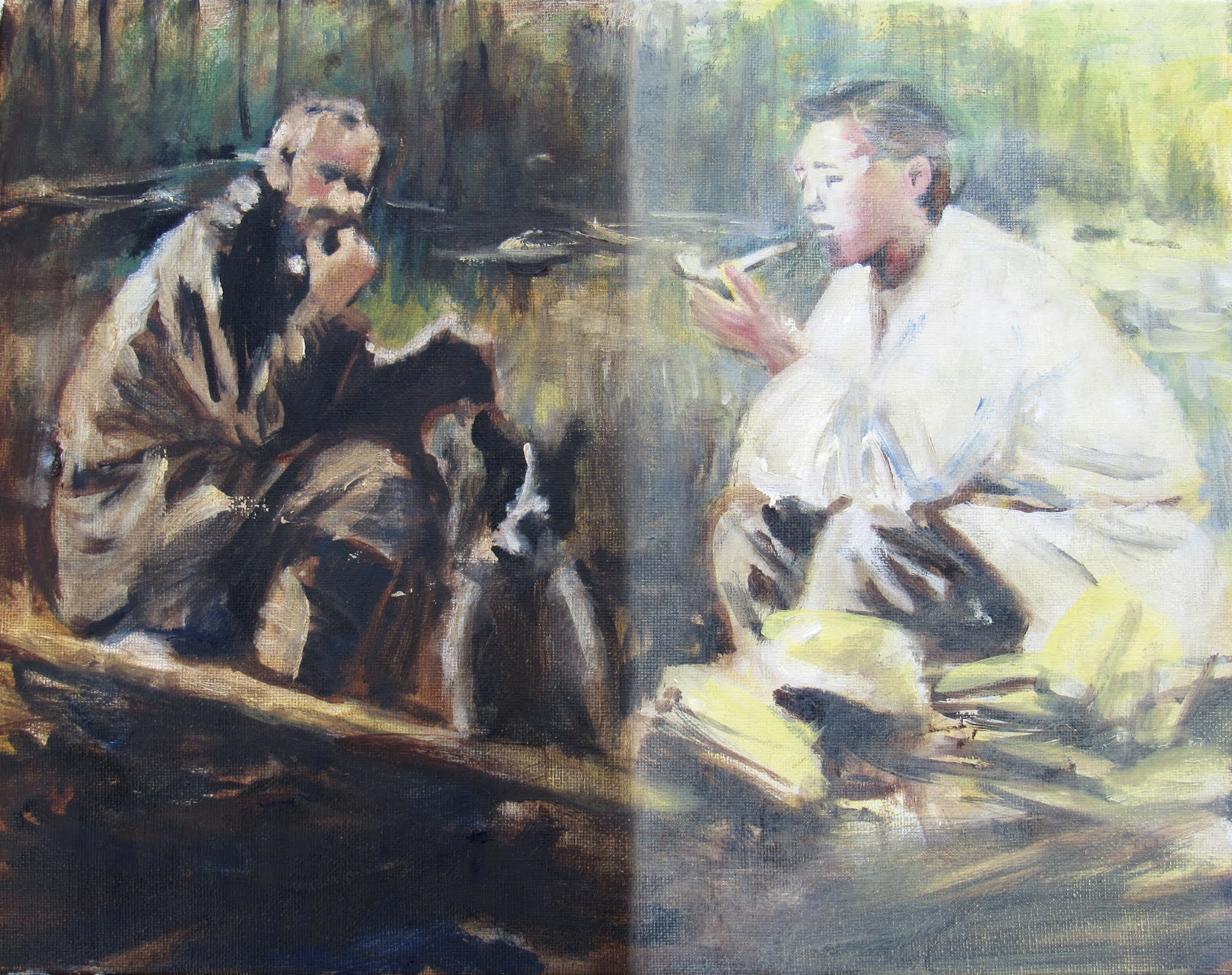
The CD series Voyage en URSS (Anthologie de la Musiques Instrumentale et Vocale des Peuples de l'URSS) consist of Russian recordings and was issued by the Le Chant du Monde label in 1990. I borrowed the CD from the Columbus Public Library sometime in 1999 or 2000. I was using cassette tapes back then and I recorded all volumes in the series. The last in the series: 6 - Caucase du Nord, Volga-Oural, Sibérie, Extrême-Orient, Extrême-Nord has been my favorite and I still occasionally play the tape. Back in the early 2000s it was my introduction to shamanic recordings and established my interest in shamanic culture. There are liner notes that I regret not copying back then but these do not contain images of the performers or the musicologists who recorded them. The musicologists aren't even listed and the information in the liner notes mostly deals with the instruments used, and the history of Russian folk music. All music was recorded between 1922 and 1983 and first appeared on the Soviet Melodiya label. The musicians are credited but in the twenty-odd years of looking, I have yet to find images of any of the musicians that have been featured in the Top 100. I have always used Russian folkloric images to illustrate these songs. My most current search to illustrate the song La Petite Poule (Danse Khantyl) by L. Tebetov brought me to pdf files of this wonderful Canadian magazine Inuktitut, published in three languages. An issue from 1988 is dedicated to the collaborations between (related) Siberian peoples and Canadian Inuits. The magazine has 124 pages full with photos, research, and travel documentation. I got excited by a photo published in this magazine of a Russian anthropologists in a boat interviewing a Chukchi folk tale narrator. That the song illustrated is not by a Chukchi but by a Khantyl didn't deter me. The little chicken of the title is not a folk tale either (as the title suggests), the vocals by Tebetov are echoic. The instrument used is a nars-loukh, a stringed instrument that sounds like a guitar. This is the first painting in the series of double portraits where the source image is also a double portrait. I decided, at the end of painting, to use transparent washes to separate the right half of the image from the left half. 

The Russian song stands at a provisional number 29 at the Top 100 2021. I'm still finishing up the Top 100 2020 and I'll move forward one at a time on each list. In the 2020 list I have arrived at number 91 and the song I illustrated at the same time as the Russian song has a strong cultural connection to it. Chikap Upopo, performed by Kiyo Kurokawa and Teru Nishizima was recorded by Jean-Jacques Nattiez, a Canadian ethnomusicologist who specializes in the related vocal expressions of the Canadian Inuit, Russian Chukchi, and Japanese Ainu people. I painted Kiyo Kurokawa before and I always enjoyed to portray the Ainu with traditional face tattoos. Chikap Upopo comes from the UNESCO album Japan: Ainu Songs.

Kiyo Kurokawa


Saturday, July 17, 2021

The Architecture and Ceremonies of the Abelam

Cover image of: The Abelam/Brigitta Hauser-Schaublin
Nggwal Mindsha, antiphony to the ancestral spirits is a ceremonial song by the Abelam of Papua New Guinea to be sung in the context of the building of a new ceremonial house. In the commentaries it is argued that songs like these should not be considered music because there is no entertainment value and that songs like these can't be separated from, in this case, the architecture they are dedicated to. The song is an integral part of the architectural process. (The architecture, b.t.w., is spectacular.) A description of the song (in the liner notes) mentions alternating voices of a man and a woman, but I really only hear one (I think it's a man's voice.) Beside the recordings found on the CD, Brigitta Hauser-Schaublin also wrote a monograph on the architecture of the Abelam and the larger Sepik River area in Papua New Guinea.

Friday, July 16, 2021

Hum

Fiona Apple

Alanis Morissette
Fiona Apple was 19 when Tidal came out in 1996 and Alanis Morissette 21 in 1995 when her Jagged Little Pill was released. Both albums sold millions of copies and are classics in the genre (what is the genre? Alt-Rock? Angst? Singer-Songwriter?)  Both songs in the top 100 were hits and are now considered classics: listening to Apple's Criminal and Morissette's Ironic for sure will make you hum along (if you happen to not know the words by heart.) The songs follow one another  at numbers 89 and 90 in the Top 100 2020. Both drawings were made using photographs taken much later in their careers by professional photographers.

Saturday, July 10, 2021

The Kora Player Remains Anonymous

Kora harp-lute (Senegal)/Francis Bebey, 14x11 inches, oil, 2021
I was delighted when I found the book African Music: A People's Art by Francis Bebey at a thrift store last year. I cost me a dollar and I've read through most of the book since. Francis Bebey is a Cameroonian author and musician who had been in my top 100 twice about a decade ago so I anticipated an account of African Music from the inside (as opposed to the account of western musicologists.) but I have to say I was a little disappointed by the content of the book. Bebey in his texts, fell into the same traps of western academic chauvinism as he is railing against. An example: While the author dutifully credits western musicologists when credit is due he fails to identify by name many of the musicians he discusses. The images in the book (I don't think they're Bebey's) are not identified. Thus the kora player on the left in the painting is unnamed (the same kora player appears on the cover.) Reading the book did make pull me out the Akwaaba cassette tape that I have and the title song made it into this year's list. The instrument is not a kora but a sanza (similar to the better known Rhodesian mbira.) Bebey is playing a sanza in the portrait on the right. Akwaaba: Music for Sanza is from 1985 and was recorded by John Storm Roberts. Francis Bebey play all instruments himself and sings too. Akwaaba is part of the continued top 100, a list that adds the points of all entries since I started the project in 1983.

Daniel Johnston too played all instruments and sings on his LP 1990 (except that Kramer, who produced the LP, appears on the song Some Things Last a Long Time, which is also the song that appears in the Top 100 2020, his second.) I had just started to make my first lists for the Top 100 2020 when the news broke that Daniel Johnston had died. Daniel Johnston had appeared in many top 100s many many times in the late 1990s and early 2000s but he had not been in the list since 2009. Needless to say Daniel Johnston's passing made quite an impact on me and and as a result I played many of his records.

Daniel Johnston, charcoal, ink, 14x11 inches, 2021


Saturday, July 3, 2021

Numbers

Tuurnagaaluk (6009) and Eunice Kunuk Arreak (6010)
Number 87 of the Top 100 2020 is track from the CD Canada: Inuit Games and Songs on the UNESCO label. The track is labelled Two Katajjait and it, as the title implies, consists of two recordings of a katajjaq, the Inuit style of throat singing in the form of a game. Both recordings are short and are from two different locations with different singers, recorded by different musicologists in the mid-1970s. The first one, recorded by Nicole Beaudy, features Elijah Pudloo Mageeta and Teemegeak Pitaulassie. This was recorded at Cape Dorset. The second one was recorded by Denise Harvey and is a duet by Maggie Grey and Jessie Tomassie at Payne Bay. There have been so many recordings of katajjait in the Top 100 and so few of the singers have been photographed for the albums (or at all on-line for that matter) that I have been forced in being creative when it comes to selecting individuals to illustrate the songs. For this one I stumbled on a very interesting article from the Library Archives Canada Blog titled Inuit: Disc Numbers and Surname Project that chars the history of attempts by the Canadian government to maintain a inventory of the Inuit people. I had never heard that Inuits were given numbers that then were printed on a small plaque (disc) that they had to carry with them at all times. The practice was abandoned in the 1970s. The images I drew in this work are from two photos that were taken directly after one another and did appear in that article. 

While working on the Inuit drawing I also worked on a painting for the Top 100 2021 simultaneously (as I have been doing the past months). Depicted are the Swiss/French photographer Barbara Brandli and one of her subjects who appeared on the cover of the album Music of the Venezuelan Yekuana Indians. [Folkways, 1975] Brandli (1932-2011) is a world renown photographer who, after a successful career as a photographer of the Parisian society, went on to live in Venezuela. She is best known for her work with the Yanomami Indians. The song illustrated is called Edanaka hani amöde and makes the list for the third successive year.

Barbara Brandli and a Yekuana Indian