


 |
| Yamana man holding oar |
 |
| Baker Lake Eskimo and Laura Bolton |
While the drawings for the Top 100 2020 continue to be made until all 100 are done, I started the Top 100 for the year 2021 already. The Top 100 2021 exhibition is scheduled for next summer in Dublin, Ohio and I felt like starting early. I also didn't paint much for a while and now with my studio in working order it is really nice to be out of the house. (A lot of activities, such as my job, are still being done from home.) I had a plan. The concept for the new 100 paintings was to paint double portraits, featuring the musician on one side of the canvas, and the one who recorded it on the other. I figure the juxtaposition is an interesting one. I have now one done and a second one started. I'm still not 100% sure how to tackle certain aspects, like text, in the painting. I experimented here but may change the markings later. The 1 in the top right corner means it's number 1 in the Top 100 2021. This may change because the making of the list for this year is in progress. I am certain, however, that Girl's Game, sung by Agnutnak and Matee, two-fifteen year old Inuit women from Baker Lake, Canada, will be part of the list when it is final. The song was recorded by Laura Bolton in 1974 at Baker Lake and appeared on the Folkways album The Eskimos of Hudson Bay and Alaska. The photograph I used to paint the young woman was taken by Bolton and was included in the liner notes for the record. The song was also listed last year. When I painted an image for the Top 100 2020 I used the same photo. I did include the rest of the family then.
 |
| Karin Johansson-Edvards, Matts Arnberg, and Elin Lisslass |
 |
| Anna Balint Puskas |
 |
| Babinga woman performing Yeli |
 |
| Gardu(?), 14x11 inches, 2021 |
 | ||
| Jofirsti Lungisa playing a musical bow |
The Top 100 2020 contains a larger than usual number of repeats from the year before and again a great number of tunes from 2020 will be repeated again in 2021. There's plenty of different music I play but those recordings that make up the playlist from which I compile my thoughts on the origin of music is getting more established as time goes on. And so do my thoughts. The playlist is front and center of my music appreciation path. At some point when I have enough time and ambition I am going to collect and edit my writings on this subject as they appeared in this blog and other places and compile them into a cohesive paper forming a theory on the origin of music, of art, and creativity. The theory is a meditation on all the big questions concerning the origin and nature of being using insights from hundreds of others. The theory itself is far too big and broad for one person to research. The theory that is forming in my hand circumnavigates materials handily available on line and is not depending on independent research at all but rather on the implications of the sounds on the playlist. And empathy. I haven't posted much recently but have continued the work towards completing the illustrations for the Top 100 2020. The nine works shown here are all from this year and are done on 11 x 14 drawing paper. Ink is the most common material used throughout but a number of other media have also been used. Represented are numbers 45 through 53:
 |
| !Kung San playing a hunting bow |
 |
| Baka gathering |
 |
| Norma Tanega |
 |
| Bamboo on the Mountains (cover), Frank Porschin |
 |
| Sun Ra, preparation sketch for stencil |
 |
| Sun Ra, stencilprint (A/P) |
 |
| Nellie Echalook and Rebecca Natialuk |
 |
| Berber Family |
 |
| Tuareg mother and child, Bernard Lortat-Jacob |
 |
| Gond Ceremonial Group, 11x14, ink on paper, 2020 |
I had fun drawing a group, instead of usual individual. I could explore rhythmic mark making. I'm thinking already about next year's concept even though this year's isn't even half way finished yet. The exhibition of the Top 100 2021 is already scheduled to take place in Dublin, Ohio during the summer of 2022 even though the work for it has not started yet. The works on 14x11 paper that I'm working on right now will exhibited during the spring of next year in my own The Top Archive and Studio space.
Sonic Youth, pencils and spray paint on paper, 11x14, 2020 
The same recording of Shaking Hell from the 1983 Confusion is Sex LP was also featured in last year's 100. I learned about the song however watching the film Rock My Religion by Dan Graham. It was Graham, a friend of Kim Gordon, who commissioned the song for inclusion in the film. The image I chose to work from was an image by that in my mind best represented the four individuals in the band (from left to right): Steve Shelley; Thurston Moore; Lee Ranaldo; Kim Gordon. The photo taken by Chris Carroll was used in Rolling Stone Magazines and is much more recent than the recording of Shaking Hell. The drummer in heard in the recording is Jim Sclavunos, who was a member only briefly in 1983. Steve Shelley joined in 1985. Vocals on the recording are by Kim Gordon.
 |
| Lola Kiepja, pencil on paper, 14x11 inches, 2020 |
I am about to die. Bury me in the white earth (where the guanacos often sleep and rub their backs to rid themselves of vermin) but do not bury me deep in the earth, leave my head and shoulders free. After I die you must perform tachira (the mourning rite) and as you are going away singing of your grief, a man will approach you. He will look exactly like me but he will not be me. He will ask to make love to you, do as he says.
"When he died the daughters did just as their father had ordered. As they walked away, while they were still singing the lament, the father jumped out of his grave, hot with desire to make love to his daughters. He sniffed their tracks and chased wildly after them, urinating as he ran (as if he had already been metamorphosed into a guanaco). When he caught up to them he said: "I am the one your father told you about. Come let us make love." One of his daughters ran on. When he made love to the other both became transformed into guanacos." [Anne Chapman, The End of the World, Buenos Aires, 1988]
A guanaco, a camelid related to the Llama, was a main food staple of the Selk'nam. Check here for more information and other portrait paintings of Lola Kiepja.
Medicine Woman of the Yekuana People (from Los juegos de la Yekuana)
Tawaniwechi is a second track from Music of the Venezuelan Yekuanan Indians [Folkways, 1975] in this year's list. This particular recording of a Yekuana shaman, the last on the record, was not recorded by neither musicologist listed in the credits on the record, but is rather a historic recording from 1912 by the German anthropologist Theodor Koch-Grunberg. Walter Coppens, Barbara Brandli, and Jean Francois Nothomb, who recorded all other music on the collection decided to include the old wax cylinder recording for historical context. In the recording made in Nauakuna in the South of Venezuela, a shaman is heard using the voice of the spirit Tawani. Even though Tawani is a defunct spirit, the voice of Tawani, invoked in this recording, sounds much like it did one hundred years later as can be witnessed in the film Los juegos de los Yekuana by Enrique Blein. The image above is based on a still from the film. 
 |
| Topoke line dance, 11 x 14, ink on paper, 2020 |
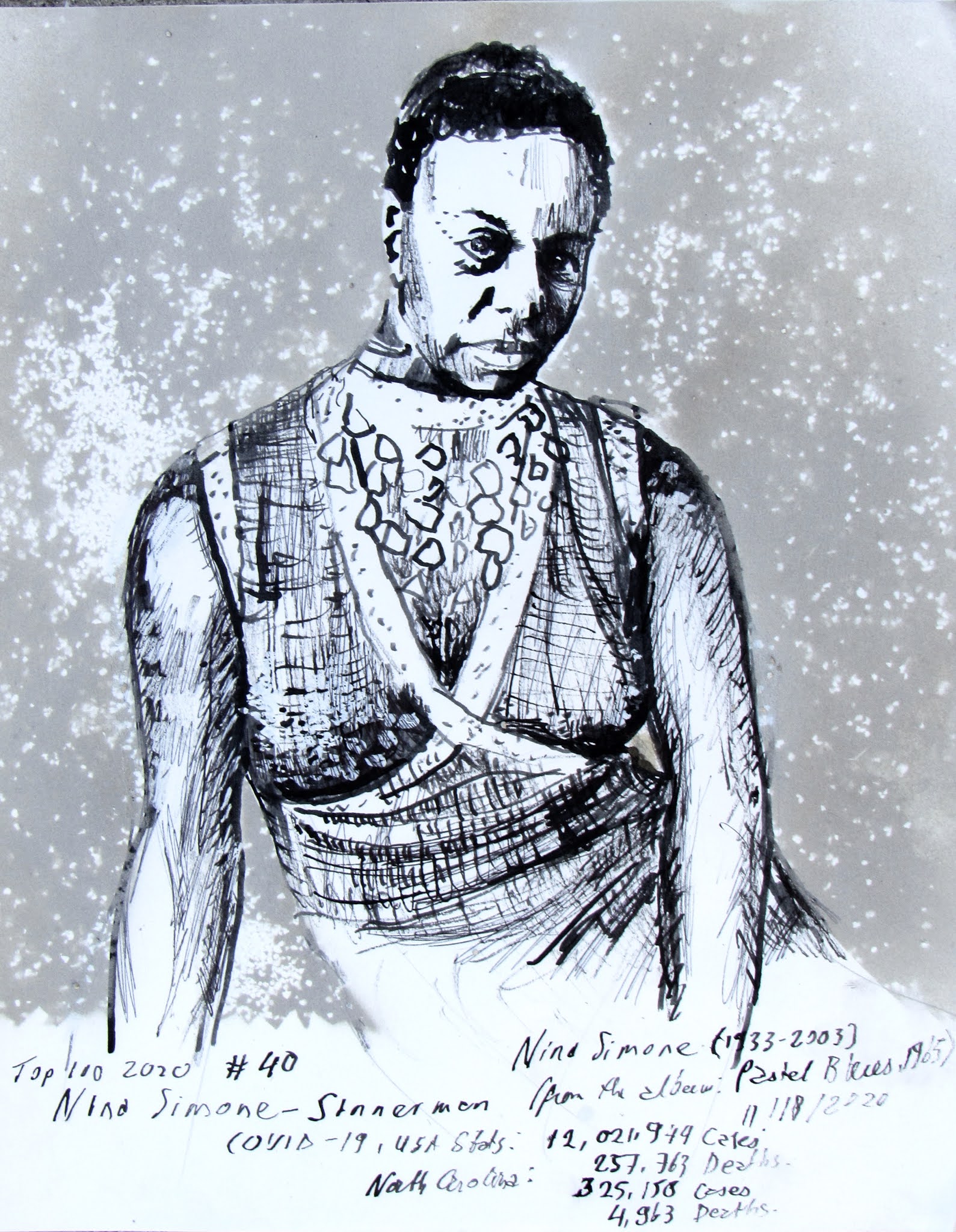 |
| Nina Simone, 14 x 11, ink on paper, 2020 |
 | |
| Charles Mingus, ink on paper, 2020 |
My appreciation for certain jazz musicians active in the 1960s never wanes. In the midst of exploring new musical styles, eras, and geographic locations the old jazz favorites, such as Mingus and Monk, never cease to impress me. A Rolling Stone article Wynton Marsalis on 12 Essential Jazz Recording introduced me to this recording of Meditations on Integration made in Oslo in 1964. Flutist Eric Dolphy had just informed Mingus he was going to stay behind in Europe and the two of them have a little conversation on stage before starting the song. Mingus asks Dolphy how long he is planning to stay in Europe, a poignant exchange as Dolphy dies just a few months later. The approach of the drawing reminded me of how I did a series of Jazz drawings for the Top 100 of 1999, the first one of many that was exhibited publicly. The local Columbus newspaper The Other Paper chose Thelonious Monk to feature the cover of their events section.
 |
| Thelonious Monk, The Other Paper, 2000 |

