Tuesday, May 5, 2020

JIVARO!

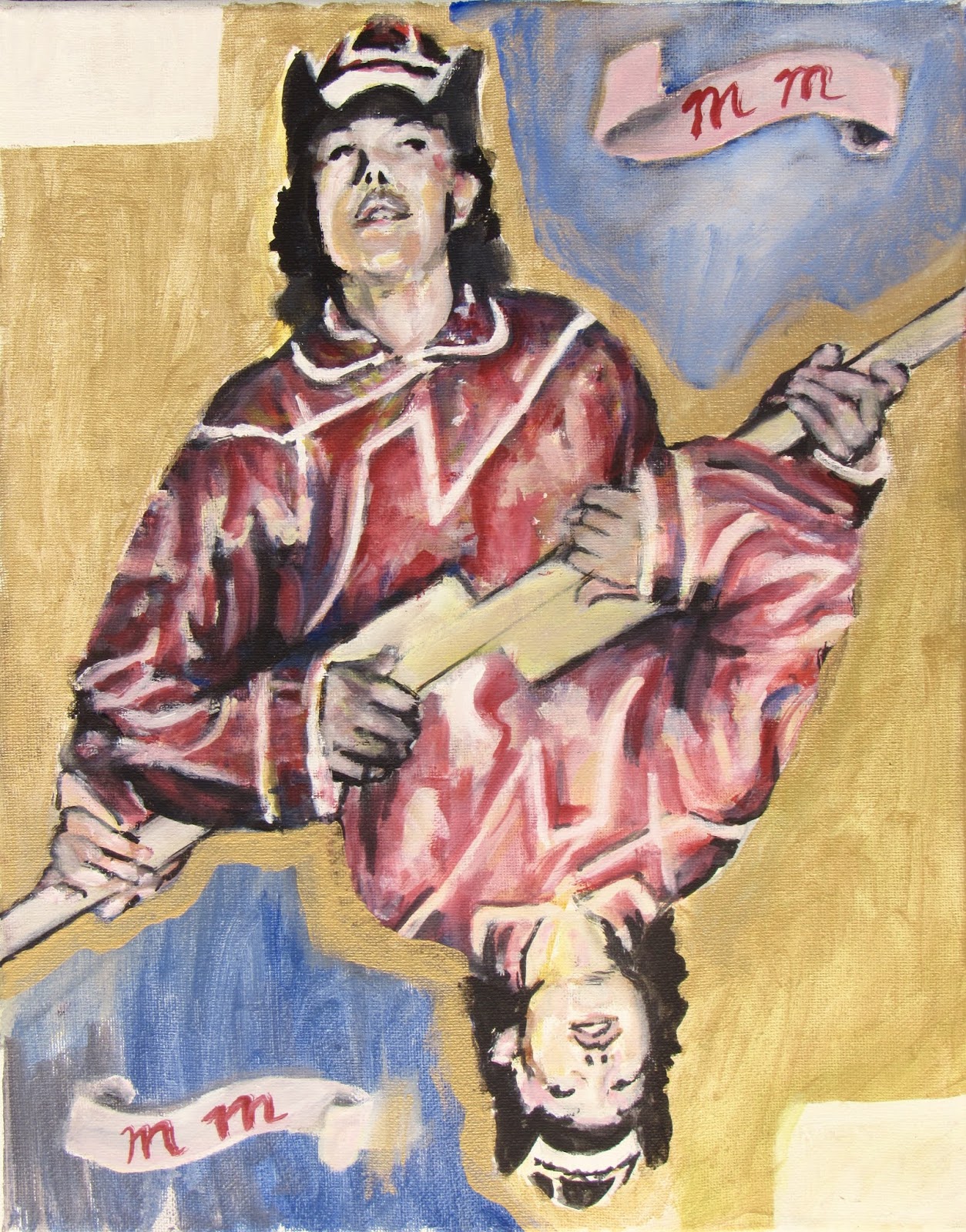
Jivaro Family on the Banks of the Alto Maranon, 1901
11 x 14 inches, pencils and spray paint on paper, 2020
I was involved in a discussion on facebook the other day about the separation of an artist's conduct and the work made. How it is now impossible to listen to the music of Michael Jackson or watch a Woody Allen movie no matter how great you thought they were at the time. I contributed to the arguments by stating that I believe today artists are more aware of ethical responsibilities than they were just twenty years ago, that the art world has changed to a culture of accountability. That these days it's harder and less romantic to get away with behaviors that hurt or harm others. Romantic ideas about artists and the creative process are a thing of past and we now come to a consensus that seeking extremes (perhaps required for depth in one's work) and social accountability are not mutually exclusive. Artists that came up as examples in the discussion, beside Woody Alllen and Michael Jackson, included Morrisey, Sinead O'Connor, Lou Reed, and Michelle Shocked. Discussed were the cultural tendencies that would allow and foster predatory behaviors. 

So here I am today painting images of indigenous cultures who may practice female genital mutilation, men who may beat their wives and rape others, trade them like cattle and consider the domestication of girls a task like that of the domestication of wild animals. Cultures who are perpetually at war with one another, who practice infanticide, and, as in the case with the Shuar who I am introducing here, eat human meat. The Shuar (Jivaro) who live in Amazonian Ecuador are perhaps one of worst societies know to men in that respect, whose traditions are so violent and nauseating that one wonders about humanity in general. Yet, the music of the Shuar, through recordings made by field archaeologists, and perhaps because of its outlandish nature, belongs to my most listened to and appreciated music of recent. For all its misogyny and incredible high rate of female suicide the Shuar (unlike the neighboring Yanomamo who are also known for their violent existence) allow for women to become shamans. In a recording made by Isabel Aretz and Felipe Ramon y Rivera from INIDEF of Venezuela one of such shamans is heard. The sounds on the recording, the voice of the woman, are so beautiful, sweet almost, and seem highly sophisticated. Listening to Shuara shamanic cantilation you wouldn't suspect such violent context to such a beautiful song. You would't suspect it either by reading about it. In the notes of the collection La Voz Humana compiled by Carlos Reynoso on which the recording appears, all that is discussed are tonal characteristics and rhythmic patterns. There's no mention that the Shuar beat up their wives.

Ecuador has been faring too well in terms of COVID-19 since I first reported on it a month ago. The numbers have gone up from 3,456 cases and 173 deaths reported on 4/4/20 to 31,881 cases and 1,599 deaths today (5/5/20). Since there are four Shuar recordings in the list I plan on drawing the third one on 6/6 and the fourth on 7/7 and see how the virus develops in Ecuador.

Monday, May 4, 2020

Fetch the Bolt Cutters

 
Fiona Apple
14 x 11 inches, pencils and spray paint on paper, 2020

The second highest American recording in this year's top 100, standing at #16 for the moment, is the song I Want You to Love Me by the singer-songwriter Fiona Apple. The song is the opening track of a brand new album released just three weeks ago. Fetch the Bolt Cutters, her fifth album, was released during the Coronavirus crisis and thus without the usual tours and interviews that are usually associated with such an event. Perfect timing you might say. The album has been received to critical acclaim and described as an instant classic. 
In keeping track of the COVID data for the locations in which the music originates I have now arrived at the hot spot that is New York City, a city that has seen more than 2% of its population affected and 0.2% die.

Saturday, May 2, 2020

Nang Suy

Nang Suy
11 x 14 inches, stencil-print, 2020 (#1)
For several years now, since I purchased Bamboo on the Mountains [Smithsonian, 1999], the Kmhmu people have been represented by paintings in this blog. Teum singing by Ya' Ak and Ya' Seu Keodaeng, one of my favorite tracks from the disc, returns from last year and will follow a little later. Now, at a provisional number seven on this year's list, a Kmhmu recording from a newly discovered source: Voices of the World: An Anthology of Vocal Expression. [Les Voix du Monde] I spent the last two days preparing for this print by channeling the incredible presence of the tune and its singer, staring at the image of Nang Suy (a surprise find after extensive web searches) and listening to the recording. In most of the eleven images for the Top 100 2020 completed thus far I've used stencils to some degree. Several could potentially be recreated not as an identical print but as a recreation of the original one using the stencils as guides. For this print titled Nang Su I signed it as an open edition, meaning I can print on demand or as I see fit. No two prints could be alike in this process and I included in the image below a second in the edition. The Kmhmu (K'mu on the French language disc and Khmu on Wikipedia) are the highland people of northern Laos and their language that extends into Thailand, Vietnam, and China (Ya' Ak and Ya' Seu Keodaeng are from Thailand). Laos, as I have been forwarding the COVID numbers from different countries, have not been greatly affected by the virus as their reported cases stand at 19. No one has died from it. 

Nang Suy
11 x 14 inches, stencil-print, 2020 (#2)

Thursday, April 30, 2020

Black is the Color...

Nina Simone
14 x 11 inches, various materials on paper, 2020
I'm starting to loose my mind here. Getting carried away copying a photograph: The one Wikipedia uses on their page dedicated to Nina Simone. Their photos are typically high resolution, with warts and all. The more precise you get the more glaring the mistakes. Just a sixteenth of an inch error on the placement of an eye for example changes the whole feel of a drawing and brings out the subjectivity of any drawing more clearly. So here's the first American song in the Top 100 2020 now presiding at number 9. Black is the Color of My True Love's Hair is a traditional ballad of Scottish origin and did become a sort of anthem for Nina Simone. She recorded the song numerous times and this year's version comes from Nina Simone at Town Hall. [Colpix, 1959] Even though the American presence in the Top 100 is steadily diminishing (due to a focus on field recordings of the world's indigenous people) during the last years of compiling these lists, the United States still easily provides the most entries per country. The US is on top of the statistics of the COVID-19 too, easily, with about a quarter of all cases reported, about the same amount as recordings in the Top 100 in recent years. Now the US is a huge country with an enormous population, so their numbers per capita are not that different from other countries in the industrialized world. North Carolina, the place of birth of Nina Simone, for example, compares with say Serbia. What I would like to note in the context of Nina Simone here is the disproportionate illness and death rate among African-American citizens. No politics here today from my keyboard. The epidemic is bad enough.

Wednesday, April 29, 2020

Piaroa

Piaroa lineup, some in costume
11 x 14 inches, various materials on paper, 2020
The collection of field recordings from The Columbia World Library of Folk and Primitive Music, vol. 9: Venezuela features a block of five songs with recordings of the native Piaroa peoples. The recordings were made by Pierre Gaisseau in 1949 in the Upper Orinoco. He was probably also the one to provide the photograph in the booklet of the album produced by Juan Liscano and Alan Lomax. The source I used was a different photo, it is the banner of a facebook page dedicated to the Piaroa. Seventy years between the two photographs but nothing changed. (The presence of a woman in the newer photo may be a change from the old one as in the liner notes it is stated that these costumes were hidden from the women.) The Piaroa are egalitarian in organization which is not all that common in native societies of the Amazon region, or anywhere in the world for that matter. This not only applies to the social hierarchical structures but to the genders as well. They are anti-authoritarian and opposed to the hoarding of resources. [Wikipedia] Like Zen Buddhists they are taught to not hoard possessions and not take themselves too seriously from an early age. They ridicule anyone who displays pride or vanity. They laugh a lot. (Why am I so serious I often wonder.)

The COVID-19 situation did not change a lot in Venezuela since I last wrote about the country on April 8th. There are now 329 cases reported with 10 deaths, three weeks ago the numbers were 166 and 7 respectively. Venezuela is one of a few countries whose numbers will be followed in the months to come as at least four more recordings have found their way into the current top 100. The Piaroa now reside at #8 and have another recording lower down the list. Venezuela as a country, of course, has other issues to deal with beside the coronavirus. (Like corruption in a failing oil-based economy—I'm not sure how this all would affect the Piaroa, I hope they continue to laugh a lot.)

Monday, April 27, 2020

Tomaraho

Tomaraho (in full regalia)
11 x 14 inches, various materials on paper, 2020
The Tomaraho are a small community living in the Chaco region of Paraguay near the Argentinian border. They have remained concealed from Western eyes until relatively recently. The area, arid to begin with, is being further threatened by deforestation. I've been writing down at the bottom of each drawing in these series the numbers of COVID-19 cases and deaths in the music's country of origin. The numbers themselves however, do not reflect the severity or absence of the coronavirus in the communities portrayed. The more seclusive a people are, the less affected one would think. While this may be true in general it could also mean that once the disease is introduced there might not be the same resources available to fight it thus the effect on such groups might me more severe. It is known that the coronavirus was introduced to the Yonomami by illegal miners deep into the Amazon rain forest and recently further south as well when a Kokama woman was tested positive after being in contact with a medical doctor. The authorities in Brazil are fearful for the potentially deadly impacts the disease could have to these communities. The numbers in North America's Navaho Nation (in an area across the states of New Mexico, Utah, and Arizona), who are of course not nearly as secluded, the numbers of infected and deaths are staggering. I could not find any COVID-19 data on the Tomaraho. Paraguay, home to these people, is lauded for its response to the outbreak and had just 228 cases with 9 deaths when I tagged the drawing. 
The Top 100 song, again from Voices of the World: An Anthology of Vocal Expression [Les Voix du Monde], is a song for the dead titled on the cd box-set as ouhla teichu.


Sunday, April 19, 2020

Dit

Eipo woman
14 x 11 inches, various materials on paper, 2020
The Eipo are a people speaking the Mek (Eipo-mek) language along the valleys of the Eipo River in Western Papua which is the part of Papua that belongs to Indonesia. The other half of this giant island is the autonomous country Papua New Guinea. As I have been doing for a while I have written down the COVID-19 numbers applying to country of origin of the music at the particular moment of me finishing the drawing at the bottom. The large number of infected and dead people in Indonesia are not very representative of the situation in West Papua, so I included also the numbers for Papua New Guinea (only two known cases a few days ago.) The track from the Eipo people in the Top 100 is again from this majestic compilation Voices of the World: An Anthology of Vocal Expression. [Le Chant du Monde, 1996] The track is named Dit, individual singing and refers to style of song that is teasing, often sexual in content.

Wednesday, April 8, 2020

The Ye'kuana

Ye'kuana ceremonial dance
14 x 11 inches, stancil and pencils on paper, 2020
Number four here from the top 100 2020 series that I now should nickname as the COVID-19 series. The song illustrated is called Edanaka hani amöde but is the very same as the Yucca Fertility Chant in last year's 100. The difference is made by the collection it is featured on. Whereas last year's came from a compilation record of South American indigenous music, this one comes from a record dedicated specifically to the Yekuana of Venezuela [Music of the Venezuelan Yekuanan Indians] and was like the Anthology released on Folkways (1974). I painted a Ye'kuana Indian in August on 2019 and discussed the song briefly (as brief as the liner notes) accompanied by a longer political rant. Read about the song and rant right here. 
I used three different stencils in making this work on paper. It situates itself between a print and a unique work. There is no edition or anything but I would be able to reproduce this drawing to a great degree of similarity while it still would be a unique work. I'm tempted now to compile the new series using a similar technique. It would allow me to, if I stick with it, to reproduce the whole series. I would be able to offer a complete set of 100 unique works for a relatively low prize.

Tuesday, April 7, 2020

Trois jeux de gorge

Nellie Echalook and Rebecca Natialuk
11 x 14 inches, mixed media on paper, 2020
As long as the stay-at-home order stays in place, I'll keep doing these meticulous drawings for the Top 100 2020. I'll go by my preliminary list starting at no. 1 which I did last week. This is then the no. 3 thus far; a recording made by Nicole Beaudry at Cape Corset, Baffin Land in 1974. The recording is the first track from the CD Canada: Chants et Jeux des Inuit [Musiques & Musiciens du Monde, Unesco Collection, 1991; first appeared as an LP in 1976]. The track is labeled Trois Katajjait de la Terre du Baffin and alternatively Trois Jeux de Gorge, Katajjaq. The one track has three recordings made on different occasions by four singers (each recording is a duet, as Katajjait are typically performed by two singers.) The performers are: Elijah Pudloo Mageeta, Quanak Martha Meekeega; Napache Samaejuk Pootoogook, and Napache Etidloie Toonoo. I have not been able to find any photographs of any of the performers on the CD but was delighted to find an image of two performers who in a previous year were listed, Nellie Echalook and Rebecca Natialuk. I did not have this image available to me when I made a painting illustrating their katajjaq. At this point there are already ten different katajjait listed in my top 100 list, several from the CD mentioned above.

Saturday, April 4, 2020

Coronavirus

Tsantsa (shrunken head) with rope, Shuar
14 x 11 inches, various materials on paper, 2020
Manganja Woman
14 x 11 inches, various materials on paper, 2020
The Coronavirus has stopped life in it tracks for the most part yet the top 100 moves forward. We're well into 2020 and the list for this year starts to take shape. Represented here are the numbers one and two thus far. Both come form the 3-cd set Voices of the World: An Anthology of Vocal Expression [Le Cant du Monde, 1999]. Coordinated by Hugo Zemp it features recordings by some of the world's renown ethnomusicologists. The box set is dominating the list and the track Chingolingo, chant yodle by a group of Mang'anja women from Malawi is destined to end on top at the end of the year. 

It felt appropriate given the circumstances to make these drawings. It's the sort of activity that takes time, is a lot of tedious and sometimes rather mindless work. Like most everybody else, the days spent at home are consumed by the cascade of news surrounding the Coronavirus. I've always been a numbers and lists person and that's what I get lost in; percentages, numbers, comparisons by country and regions, and other statistical trivia. I thought it appropriate to add some stats under the captions I penciled in. When I finished the Mang'anja woman Malawi was one of only a handful countries in the world with no reported cases. This was a few days ago. Now there are four. Nobody's died yet from the disease. Vietnam, whose Bahnar people I wrote about last week, has since doubled their cases, but still no deaths there either. The first country represented in these series who suffered fatalities is Ecuador. The count there as of today: 3,465 cases and 172 fatalities are reported. 

The Shuar, better known by their older name Jivaro, live in the Amazon Rainforests of Ecuador. I won't dwell on their history too much, as history of their shrunken head traditions have been a focus of many writings (including in this blog) but one anecdote I learned today I will mention: The function this tradition has in Shuar culture is for men to keep their wives and daughters in line. The track Ujaj, currently residing at number two, is sung by a group of women. I've always wanted to draw a picture of a shrunken head.

Monday, March 23, 2020

At Home


Xylophone (Highland People, Vietnam)
11 x 14 inches, mixed media on paper, 2020

Jane Wiedlin
14 x 11 inches, stencilprint on paper, ed. 52, 2020


Top 100 Archive and Studio (in progress)
Home, weathering out the coronavirus outbreak. Teaching remote, twiddling around. I should have had the Archive building finished but a combination of know-how, or lack thereof and laziness keep me from achieving this coveted milestone. I'm getting closer however slow the progress. After finishing all 100 paintings for the Top 100 2019 I'm slowly starting to think about this year's. For no other reason than 'I just felt like it' I started faithfully copying an image from the booklet tucked in the LP Introduction to the Music of Viet Nam that has been a mainstay on my player in recent weeks. Earlier, in the context of my twice-annual stencilprint project with Art Appreciation students, I had already created a print depicting Jane Wiedlin, known for her part of the Go Go's. After watching a fantastic concert of Go Go's classics at the Bob Rauschenberg Gallery earlier this year I chose Jane Wiedlin as subject to trading prints with students. Jane is being sent one too and so is the artist Beatriz Monteavaro who sat in on drums. I met them both and got a high five from Jane Wiedlin. So now there's two disparate works that could end up being the start of the Top 100 2020. I have not decided on a theme, style, format, or topic (if any) for the upcoming series.

Tuesday, March 17, 2020

The Top 100 2019 is finished!

György Ligeti
All images 14 x 11 inches, oil and spray paint on canvas, 2020

Les Siècles Live: György Ligeti (2016), directed by Francois-Xavier Roth featuring cover art that was found by the publisher Actes Sud on this very blog. A beautiful CD on which Les Siècles perform Six Bagatelles, Kammerkonzert, and Dix Pièces pour Quintette à vent. The last of these is in the top 100. I'm still very proud of their use of my painting. This one is brand new though.

Cat Power
For the upcoming Top100 2019 exhibition this painting replaces the concert drawing I did in September of 2019 that was to illustrate the track Robbin Hood from Cat Power's latest album Wanderer. The image above comes from an earlier Cat Power album Moon Pix. In the book called You Should Have Heard Just What I've Seen both my work, and the Moon Pix cover are featured. The Moon Pix cover is a work by renowned photographer Roe Ethridge.


Otto von Schirach
A track from my favorite hardcore disc Threat: Music that Inspired the Movie (Halo 8/King's Mob, 2006). The track Champagne Enemaz features a remix by Otto von Schirach of the recording by the Californian metalcore band Eighteen Visions. After Sun Ra, who I painted recently, von Schirach is yet another musician in this top 100 who claimed to have been born in outer space. His biography states that he was dropped either by UFO or Graviton in the third point of the Bermuda triangle, which is Miami. He was indeed born in Miami, FL in 1974 from German and Cuban ancestry. His grandmother practiced Santeria. As customary with DJs, I had assumed that breakcore musician von Schirach was an assumed name but apparently it's real. Typing von Schirach into Google search results in the biography of the infamous Nazi politician Baldur von Schirach.

Three Women performing 'Harawi'
The track Pasqakuymi comes from the cd Traditional Music of Peru, Vol. 6: The Aycho Region. Heard are women of Socos (Peru) performing Harawi. The women depicted above are not the women heard on the Pasqakuymi but part of a group performing harawi (a style of singing) on a later track on the CD. Pasqakuymi relates to, and is performed on Compadres' and Comadres' Thursday, part of the Peruvian carnaval following Ash Wednesday.

Mergen Mongush
Mergen Mongush is represented in both books (with cd inserts) that I have on the subject of Tuvan throat singing. In Overtone Singing by Mark van Tongeren three pages are dedicated to  including a biography. Mongush was born in Chadan, Tuva in 1962. The cd tucked in that book features an example of the 'chilangit' style of overtone singing that Mongush personally developed. Alash the track in the top 100, named after a Tuvan river) appears on the cd that accompanies the book Where Rivers and Mountains Sing: Sound Music in Tuva and Beyond by Theodore Levin.