Friday, December 21, 2018

Strange instruments from Vietman

Duo a'reng
14 x 12 inches, oil and acrylic on canvas, 2018
The paintings represent the 1 & 2 listed below: The A'bel and A'reng - Co Tu and Ta Oi Pako peoples of Hue Province, Vietnam. Both tracks are from a video uploaded to YouTube in 2013 by angklung eds, using footage from The Vietnamese Institute of Musicology, Hanoi, Vietnam. One man sings into a reed the other end of which ends in a woman's mouth that functions as a resonance chamber. The A'reng is a simple reed instrument with one hole that is traditionally performed by a mixed couple but the traditions is now extinct. The second tune shows a man playing a one string instrument, a dan k'ni, with a bow and uses his mouth as a resonance chamber. Information found on Rare and Strange Instruments by Nicolas Bras.
Strange instruments from Vietnam: 1.  The Dan k'ni; The players mouth is the resonance chamber of this string instrument. 2. A'reng is a simple reed instrument by two players, one blows into the mouth of the second (who features as the resonace chamber. 3. The dan-bau is a one-string instrument (like a diidley bo). 4. Dan-da is lithophone, like a xylophone but made fro stones. 5. Dan klongput is a giant panflute. 

The history of instruments

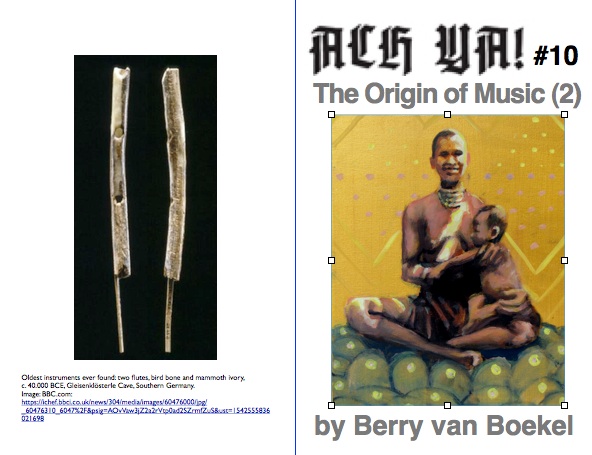
The oldest instruments ever found were two flutes made of mammoth bone and tusk. They're about 42,000 years old, slightly older than another flute also found in Southern Germany next to the oldest figurative sculpture known. We know humans decorated themselves and the world around them long before that time and they made music as well. Before there were instruments humans used their voices and bodies to create music. Like the origin of art, the origin of music is to be found on a different plane from the everyday experience. Music (and dance too) are an excellent means to escape that everyday consciousness and enter a plane of altered consciousness that would provide a reality more real than empiric reality. A reality of timelessness and placelessness, in other words "the sacred." The voice of music is distinctly different than the voice of language. It appears music came before language, which is utilitarian. To become sacred the voice must be distorted, one must become someone or something else. Instruments were initially created as an extension of the body or voice. The first instruments were likely found in nature, a conch shell, hollow wood, or stones that would provide a range of different sounds. Reeds could mimic, like the later trumpet and wind instruments, the sound of animals by blowing on them between your thumbs. Your hands are the resonating chamber. Try it! Later instruments were man-made either to perfect the nature found materials or to substitute the body. A drum sounds better and doesn't hurt as much as pounding on your own body. A resonance chamber, like the bag of a bagpipe, substitutes for vocal chambers as it is much easier to store air in than in your own body using the strenuous techniques involved in circular breathing. String instruments at first, obviously, consisted of one string only. The mouth was used as the resonance chamber. Only later the chambers were built outside the body and more strings were added.

There are no cultures without music, music is universal, but there are cultures without instruments.
Duo a'reng
14 x 12 inches, oil and acrylic on canvas, 2018
      

Sunday, December 16, 2018

Popular Music (sort of)

Inger Lorre
14 x 9 inches, oil and acrylic on canvas, 2018
I don't listen to popular much anymore, sure, the radio is on sometimes and Maria, my wife, plays a tune now and then, but other than Cat Power I'm not selecting any. What I have been playing most are ethnographical field recordings, a bit of (modern) classical music, free jazz, and also a bit of word-jazz. The last category is directly related to two exhibitions at the Bob Rauschenberg Gallery celebrating the work of Jack Kerouac. I listened to a number of Kerouac cds, some spoken word and some with a jazz accompaniment. One cd in particular I've played several times; a tribute cd that features a host of well known (popular) musicians and (beat) poets. On it are the poets Allen Ginsberg, Hunter S. Thompson, Kerouac himself, and William S. Burroughs. The musicians include expected names for a compilation on Kerouac such as members of Sonic Youth, Patti Smith, and Lydia Lunch but there are also REM's Michael Stype, Aerosmith's Steven Tyler, Eddie Vedder, Juliana Hatfield, John Cale and other notables from the music scene. Inger Lorre (depicted above) teams up with Jeff Buckley for a performance of Kerouac's poem Angel Mine set to music. It's my favorite track. Inger Lorre, btw, is a singer and painter from San Francisco, she once led a band named The Nymphs.

Saturday, December 15, 2018

Grinding Corn, Pounding Maize

Ana Caraballo
14 x 9 inches, oil and acrylic on canvas, 2018
Another work song (see Ulahi) that is featured on the CD The Origins of Music (see post from November 23.) Every track on that CD is part of this year's top 100. From Magarita Island in Venezuela comes a recording of Ana Caraballo made by Francisco Carreño and Miguel Cardona in 1949. When I painted the same image in 2013, I must have missed the information concerning the identity of the singer when I tagged the painting as Venezuelan Girl (I should have named her woman instead of girl). I assume that the photographer responsible for this tiny black & white image in the liner notes of volume 9 of The Columbia World Library of Folk and Primitive Music would be either Carreño or Cardona. What's different too is that I have the recording listed as Corn Grinding Song whereas five years ago it was Pounding Maize. Maize is the staple of the inhabitants of Margarita Island as Sago is the staple of the Bosavi forest people to whom Ulahi belongs. The authors also credited Asuncion Caraballo as musician but I have hard time making out a second person on the recording.

Sunday, December 2, 2018

Father and Son

Gombojav
14 x 11 inches, oil on canvas, 2018
Musicians often come from musical families. This is true in popular music, classical music, folk music, but nowhere as pronounced as in traditional music. Often traditions in music hinge on the transmission from parents to children. It is rare, however, to find two generations independently featuring in a top 100 of mine. I can't think of a single occasion until this year, when Mongolian tsuur players Gombojav and his father Narantsogt, who had learned to play the instrument from his grandfather, are separately listed. A tsuur (shoor in Tuva) is a simple flute with three finger holes typically made from a hollowed out larch or willow. The instrument mimics, rather than imitates, the sounds of nature. Legend has it that spirits possess the instrument. The shoor has completely vanished and the tsuur tradition in Mongolia has nearly died out. The instrument was forbidden during Soviet occupation in both Tuva and Mongolia. Gombojav and Narantsogt are two of only a handful of players knowing how to play the tsuur and both have now passed. Narantsogt died of old age and Gombojav of cancer at age thirty-five. The first painting presented here is of the son, Gombojav. The more eccentric looking Narantsogt will follow soon.

Friday, November 23, 2018

The Wonderful Ainu

Two Ainu women performing "Rehbuhkara"
14 x 11 inches, oil and acrylic on canvas, 2018
Rehbuhkara is a vocal style closely related to the Chukchi pic-eine'rkin and the Inuit katajjaq typically performed by two women. The three vocal styles form the backbone of a new issue of Ach Ja. It is the tenth issue and the second titled The Origin of Music. Katajjait are performed in the north of America and in Greenland, an area of land that is supposedly isolated from the old world at the end of the last ice age 14,000 years ago. The vocal styles of all three (ethnically related) peoples form yet more striking evidence that there must have been contact between the new and old world. Either that or these styles were already practiced before the separation of Chukchi, Ainu, and Inuit, in which case the traditional singing styles are older than 14,000 years. The Ainu, considered the indigenous people of Japan, live on Japan's northernmost large island Hokkaido. The island is connected to the Kamchatka chain running to Kamchatka in Russia. From Kamchatka run the Aleut island chain all the way to Alaska. The Ainu use their hands as a resonance chamber. The Inuit, as lore has it, use to sing so close together that each others mouths serve as resonance chambers. The source image from the painting is a still from a video uploaded by ainuworld. 
 Ach Ja! #10: The Origin of Music (2) is a zine published in an edition of 25. 8.5 x 5.5 inches, 16 p. It comes with a CD featuring 32 tracks from my collection (I don't own the rights to any of them) and can be purchased for $15 + shipping. Just shoot me an email.

Track listing
  1. Inuit:  Katajjait with geese cries (Canada)                 2:45
  2. Inuit: Katajjait on "Hamma" (Canada)        `        1:29
  3. Inuit: Assalalaa (Canada)                        0:38
  4. Inuit: Qiarpa (Canada)                        3:34
  5. Annie Kappianaq / Jeanne Arnainuk – Vocal And Throat-Games "Pirkusirartup" Huangaahaaq (Inuit, Canada)                0:41
  6. Ainu: Rekuhkara, throat singing (Japan)                0:27
  7. Kiyo Kurokawa, Teru Nishizama – Horippa (Ainu, Japan)        2:23
  8. Utekn, Yuimuk – Women's Wu-unka songs (Aborigine, Australia)             2:04
  9. Kiighwyaq, Sivugun und Nunana – Pic-eine’rkin: Ay-ay-amamay (Cukchi, Russia)         1:59
  10. Anna Dimitrievna Neostroeva – Throat Song                0:52
  11. Nowaylethi Mbizwenti And Nofirst Mbizweni – Duet With 'ordinary' Umngqokol    (Xhosa, South Afrca)                    1:39
  12. Antonia Vasil'evna Skalygina – Alterateur de voix Kal'ni (Even, Rus.)    1:02
  13. Mergen Mongush – Alash (Tuva)                    1:14
  14. The 1898 Torres Strait Recordings: Death Wail (Aborigine, Australia)    2:12
  15. Papua New Guinea: Wame Igini Kamu                 1:43
  16. Shipobo Song (Shipobo, Peru)                    2:09
  17. Ashaninka Songs (Ashaninka, Peru)                    1:15
  18. Ulahi and Eyo:bo Sing with Afternoon Cicadas (Bosavi, Papua New Guinea)             2:47
  19. Ulahi Sings While Making Sago (Bosavi, Papua New Guinea)    1:26
  20. Ana Caraballo & Asuncion Caraballo – Canto Para Pilar Maiz (Venezuela)                 0:54
  21. Gumbojav – Running Horse (Tuva)                    0:36
  22. Deux Femmes Ngozi – Ubuhuha (Ngozi, Burundi)            2:00
  23. Pako Tà Ôi peoples – Duo A'Reng (Pako Tà Ôi, Vietnam)        1:02
  24. Pako Tà Ôi peoples – A'bel (Pako Tà Ôi, Vietnam)            2:16
  25. Te Bow with Two Women's Voices (San, Namibia)            3:03
  26. Princess Constance Magogo KaDinuzulu – Helele! Yiliphi leliyani? (Zulu, South Africa)  3:31
  27. The Indians of the Gran Chaco – Instrumental, strings (Argentina)    0:57
  28. Avdo Mededovic – Bosnjacke Gusle (Montenegro)            1:23
  29. Tin Can Bow Solo (San, Namibia)                    1:44
  30. Marija Nikoforovna Ceculina – Chant et Jajar (Koryak, Russia)    0:57
  31. Chukchi Shamanic Ritual (Chukchi, Russia)                3:57
  32. Kittoro (Roro, Papua, Indonesia)                    1:20

Friday, November 9, 2018

The Golden Paintings

After many years of random formats I decided to, once again, choose the serial approach to the new top 100 that started in August. Tempted to seriously study abstract painting I would create a series of 100 abstract works on an 11 x 9 canvas with a golden acrylic lining. Over the next few months I created a number of such painting but then the urge came to paint musicians once again (on 11 x 9 canvases with golden backgrounds.) Now they exist side by side. I still want to make one hundred abstract works—for abstract work to be valid, quantity is needed. The abstract works so far seem way too specific to add figures too, as intended, later on. What do you think?


Eyo:bo

Eyo:bo
14 x 11 inches, oil and acrylic on canvas, 2018
Ulahi starts a song and Eyo:bo repeats. Eyo:bo is an echo as it were of Ulahi, but her voice is different. The echo, together with a chorus of cicadas in the background makes for a spellbinding musical recording. Steven Field recorded it in 1977 in the Kulali area of the Bosavi rain forest in Papua New Guinea.

Friday, November 2, 2018

Wanderer

Cat Power (after Ryan Pfluger)
11 x 14 inches, oil and acrylic on canvas, 2018
Wanderer is out now. I had preordered a copy that came with a 45. My first Cat Power 45. The record is great and my favorite thus far is the title track Wanderer. The song appears at the beginning and the end of the album and my preference is the latter version. The source for the image of the painting was provided by a September 23 New York Times article with a photo by Ryan Pfluger. A painting often paints itself and in this case it meant staying true to Pflugers photograph. All 100 for the current top 100 will be painted on a golden acrylic ground, some with an abstract design, some with none. The blue rectangle in the background here makes it look a cover for the National Geographic.

Sunday, October 28, 2018

Ulahi

Ulahi
14 x 9 inches, oil and gold acrylic on canvas, 2018
Ulahi is heard cutting sago, a staple for the inhabitants of the mountainous Bosavi rainforest in Papua New Guinea. It's a work song. Indeed singing makes work go faster, makes it easier, less tiresome. The cutting of the food becomes rhythmic as if it were a game. As a new mother Ulahi carries her child with her wherever she goes. When she has to work, the baby must be set aside. The baby cries, Ulihi sings, the baby stops crying.

Friday, October 26, 2018

Avdo Međedoviƈ

Avdo Međedoviƈ
14 x 9 inches, oil on canavs, 2018
Avdo Međedoviƈ (1875-1953) was an illeterate epic balladeer from Montenegro, part of the Ottoman Empire and later Yugoslavia. His repertoire included several poems that counted well over 1,000 lines, similar in length to Homer's (9th century BCE, Greek) Iliad and Odyssee. The British Homeric scholars Milman Perry and Albert Lord in the 1930s, seeking to find credble evidence of their hypothesis that Homer's works were the result of oral transmission (of much older traditions,) found in Međedoviƈ living evidence on the memory capabilities of illeterate communities, and their sustaining traditions. The  now fast disappearing tradition of oral poetry was in the twentieth century still found and recorded in parts of eastern Europe and in Anatolia. Despite numerous academic approaches to reconstruct how Homer would have sounded almost three-thousand years ago, I believe the Međedoviƈ recordings come much closer.

Sunday, September 30, 2018

Cardi B and Lady Leshurr

Cardi B
8 x 8 inches, stencil on paper, ed. 43, 2018
Another round of teaching art appreciation, another round of stencils to trade with students. I choose popular musicians to trade with them and for this session I picked Cardi B. I like to double the stencil assignment with a top 100 entry and so I set out to listen to a bunch of her songs to nominate one for this year's list. I settled on I Believe the Children Are Our Future in a collaboration with MonoNeon. It's actually really great and so is the video that comes along with it. The subtitle to I Believe the Children Are Our Future shows Cardi B at her characteristic finest: "But not today tho, Today I'm Wilin', Today I'm Buggin' and Thuggin'." After a bit of searching I had to conclude that the song shouldn't be filed under Cardi B in my archive but rather under her collaborator MonoNeon. MonoNeon is a kind of YouTube star who does mash-ups of existing content. MonoNeon is the bass player Dywane Thomas Jr. who really has quite some credentials. His discography is extensive and include work with Prince (he was one of the last musicians to work with Prince), his influences include Dada, conceptual art and John Cage, his instrument is a "ready-made bass" that uses duct tape and other mundane items and turn the instrument into a quarter note instrument. His style of playing is also unique and inventive and is lauded by numerous musicians. Unknowingly I picked out a tune that fits right in with the avant garde lean of this year's list. Since I haven't quite forwarded all the paintings from last year I'll stay on topic with the stencil print I did last semester of another hip-hop star. Lady Leshurr had already been on the list in 2016 with Lego one of my all time favorite raps.

Lady Leshurr
8 x 8 inches, stencil print, ed. 18, 2018

Friday, September 7, 2018

Atavism

Irina Khristoforvna or Anna Vasilevna Kolegova
12 x 9 inches, oil on canvas, 2018
Music is in our DNA and so are genes from our ancestors even down to the Neanderthals. Somewhere hidden in our consciousness is a memory of the music from prehistoric times. That we can't access that memory doesn't mean it isn't there. Somewhere someone will unknowingly perform the music of ancient ancestors. Traditions too are persistent. There must be cultures still around in which the music of prehistoric people continues to be performed and many more whose sounds were recorded by musicologists as far back as the 1890s. I'm collecting the sounds of these traditions and those someones out there.