Tuesday, February 18, 2014

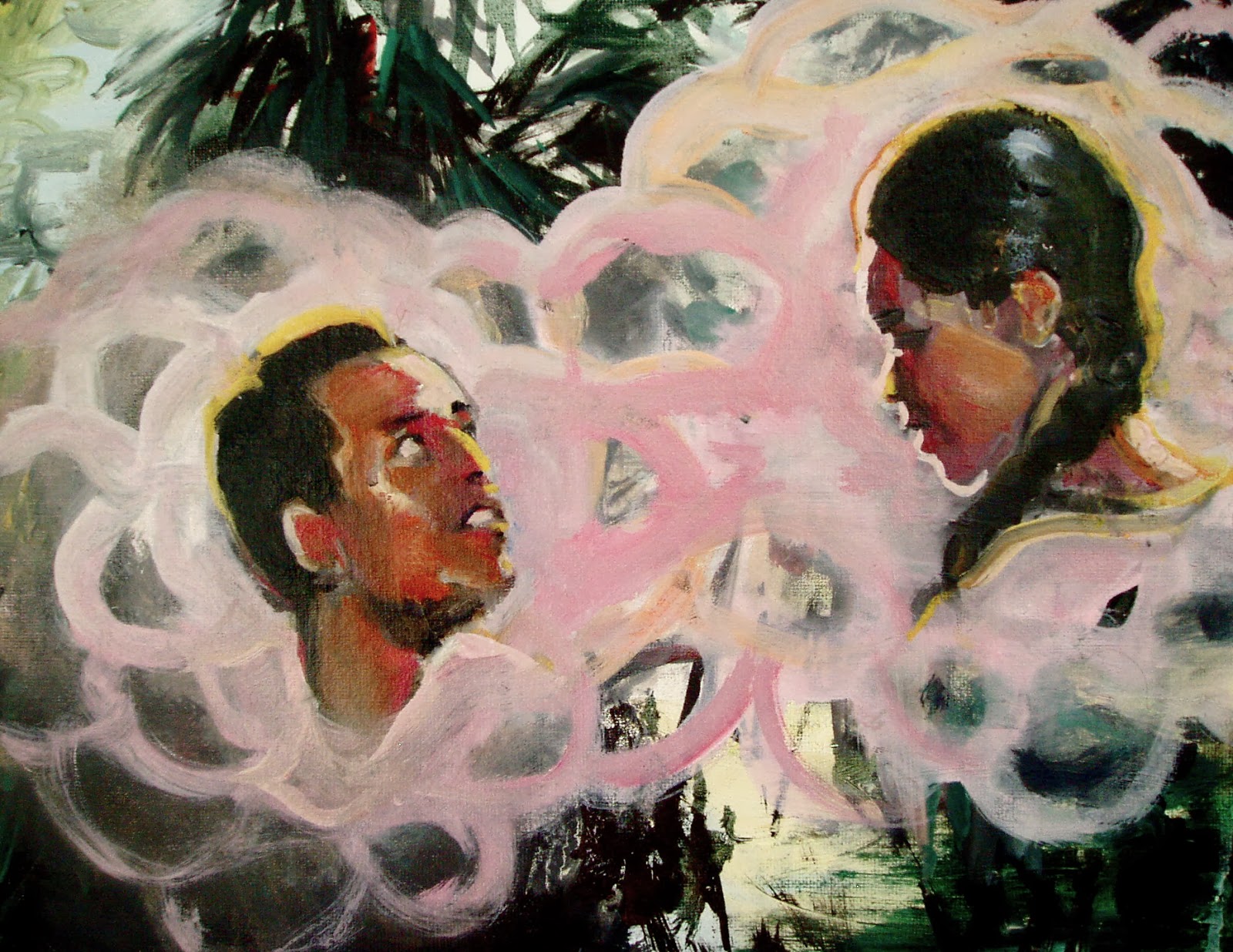
Good Ol' Dirty

O' Dirty Bastard
11" x 14"
oil on wood, 2014
No I haven't been listening to music much this past year but that's not to say I haven't been around music much. The neighborhood bordering our house to the north is largely hip-hop culture. Many have those hip-hop mobiles—revved up American made vehicles, the dodge is particularly popular, with amped up stereo systems—that ride the street in front of hour house with the stereo full blast. A friend continues to complain about it and asks me: "How can you stand that?". I can not only stand it, I'm loving it. The neighborhood to our south, at the other side of the creek, is largely populated by Mexicans, and the house directly behind our property organizes regular parties often with life music. Someone there plays the accordion. Needless to say: "I'm loving it". But none of this music comes with a play list and most hip-hop I hear consists of soundbites no longer than fifteen seconds. I'm hearing great fragments of which I do not know performer or title.

The hip-hop repertoire I play at home is limited to a few names or songs that I've grown to like over the years. I don't really know who's who in hip-hop. If I play selective hip-hop music at home it's either Shimmy Shimmy Ya or Brooklyn Zoo, both by Ol' Dirty Bastard, and both through YouTube. Both songs are part of my YouTube repertoire, which consists of about 25 music videos, all being played regularly. I there's a "YouTube-off" held, chances are I'll pick Brooklyn Zoo. The song stands at #6 at my combined top 100 of 2013 and 2014. The painting is clearly influenced by the stencil print I created a week ago. I painted like how you would make a print: I first painted the portrait in blue, and after it dried, I painted the portrait again but now in red. And besides a little tweaking...that was all.

Friday, February 14, 2014

The stencil

Cat Power
8" x 6"
stencil. 2014
The top 100 is compiled using a scoring system determined by regular lists of ten songs. The number one in each top 10 gets 10 points, number two gets 9 points, and so on. After a year that runs from mid-February to mid-February all points are added up. The top 100 year of 2013 has ended. Time has flown by. In my teaching obligations I've seen more than 250 students between August and now divided over 20 courses. Yes I've been busy, so busy that the top 100 of 2013 only yielded 50 top 10s, a little over half of a typical year. Only 65 songs scored 10 points or more, which is the cut off number for inclusion in the top 100. 30 of these 65 have received a complimentary painting. I have now decided to keep a running tab through December 31st in 2014 and compile the top 100 from this extended period: The Top 100 2013/2014. From then on the top 100 will run from January 1st through December 31st.

About half of the 20 classes have been painting courses and I have produced plenty of paintings in the form of demos during this time. All these demo paintings will now turn into top 100 portraits. The most intensive, and also most rewarding classes in the last half year have been lecture classes at Edison State College. The "Art Appreciation" course compiles everything about art into one semester. From hands on art experiments to the full scope of art history, the students truly received a crash course in art. The most fun assignment has been the stencil in which the students make an edition of ten prints. They trade these with other students and one comes to me. As a trade they receive one of mine. (I did the work too. I made an edition of 75, one for each of the 67 students and then some for myself.) The source image for my stencil of Cat Power came from Paste magazine. The song it illustrates in the top 100 is Metal Heart which featured on both on Moon Pix and Jukebox.


Monday, January 20, 2014

Roland Kirk (Shaman?)


Rahsaan Roland Kirk
14" x 11", oil on wood, 2014

A wisdom encircled Rahsaan that had folks believing he had something greater to say, something supreme to impart each time he spoke. Part southern preacher, part stand-up comic, part ancient-prophet—Rahsaan’s voice boomed with authority with his words always aimed at delivering the most hard-hitting truths.
       
May Cobb, Songs of Our Life: Rahsaan Roland Kirk’s “The Inflated Tear,” The Rumpus, 2013.

For the last two or three years I have been following the blog The Man Who Cried Fire, dedicated to the life and music of Rahsaan Roland Kirk, and written and collected by Mary K. Cobb.  Kirk has been a mainstay in the Top 100s since 1999, and the more you hear and see of him, the more his place as one of the great artists’ of twentieth century music is cemented in the annals of the history of the world. I have considered Kirk a shaman, one who could traverse the mythical realms of the spirit world. As an artist and art historian I have been convinced that the true function of art is that what it was in the beginning: the intermediary of the gods. “One who is a specialist in ancient techniques of ecstacy.”
“The shaman normally is a functionary for a nonliterate community, serving as its healer, intermediary with the gods, guide of the souls of the dead to their rest, and custodian of traditional tribal lore. The typical shaman comes to this role through either heredity or having manifested idiosyncratic traits (epilepsy, sexual ambiguity, poetic sensitivity, dramatic dreams). Psychologically, shamans depend on an ability to function in two worlds, the ordinary reality of daily life and the extraordinary reality they encounter through their ecstatic journeys. As well, they serve their tribe as a defense of meaning, by incarnating a contact with the powers thought to hold the tribe's destiny.” (Carmody & Carmody 1989:33)

Andreas Lommel, in his work on shamanism (Shamanism: The Beginnings of Art), draws a distinction between a medicine person and a shaman, noting that the future shaman acts under an inner compulsion “...a psychosis that is emerging for some reason or other is so strong that the only way out open to the individual attacked by it is to escape from it into shamanistic activity, that is to say essentially by means of artistic productivity, such as dancing or singing, which always involves a state of trance.” (1967:9-10)

In Siberian Tungustic the word is "saman," meaning "one who is excited, moved, raised," and refers to individuals who, while in a trance state, visit the realm of mystical beings to communicate with them and in the process gain mystical power.
1941 saw the discovery of Paleolithic paintings in caves at Lascaux. At the time they were considered the oldest known paintings and, according to the French philosopher Georges Bataille, it represented the “birth of art.” Bataille was one of the first to see these paintings and he immediately saw in them something so profound that the whole of art history should be rewritten. 1941, of course, was during the second World War, and the dominating force of the avant-garde (what was left of it) then were the surrealists, with whom Bataille himself was briefly associated.

(Has the subject of this 17,000 year old painting been photographed in Siberia?)

Saturday, January 11, 2014

Burundi: Musiques Traditionelles

Inanga player
12" x 12"
oil on wood, 2014
The Whispering Song with "inanga" accompaniment recorded in Burundi in 1967 is one of those "classic" recordings that would make anyone's top 100 list of traditional African recordings, even any top 100 list of traditional world music recordings. It could even make anyone's list (as it did mine) of musical recordings in general. The record Burundi: Musique Traditionelles contains actually several of such classic recordings; I already mused about the Rundi Wake that's on that record that also contains a recording of drummers from Bukirasazi which was sampled by Burundi Steiphenson Black on his international 1971 hit Burundi Black. The recordings were made by Michael Vuylsteke in 1967, Wikipedia also credits Charles Duvelle as being responsible for the recording. The record now contains five tracks (from the 12) that will be included in the Top 100 2013 (That is still running for another month). The image for the painting is taken from the front cover of the record. As the size is precisely that of the record and, after it dries, it will be slipped in to the plastic protective cover to take the place of the original cover. (As it is customary with these paintings I would not throw the images of the paintings on line if they weren't at least as good as the photograph that was the source for it. You can buy the painting from me—if you would like to—but it will not come with the record that's married to it. That record is priceless!)

Friday, January 10, 2014

Rosa Balistreri – A Curuna

Rosa Balistreri
24" x 16"
oil on wood, 2014
Asira lu me beddu vinni 'i fora
supra un cavaddu d'ora ca vulava
sutta li me finestri e il barcuna
cu un fazzutettu 'nmanu e lacrimava
S'affeccianu lu re cu la regina
"A 'sta picciotta l'hamu e 'ncurunari".
"Su picciridda e non cangiu parola
a iddu vogghiu e non vogghiu curuna".

Such are the lyrics to the song A Curuna by Rosa Balistreri. Google translate didn't help much; there's a king, there's a queen, and there's weeping, but other than that...? I suspect that the lyrics aren't proper Italian. Balistreri is from Sicily and she doesn't appear to be one who would sing in proper Italian. The song, first on side B from the record Amore, tu lo sai, la vita e'amara sounds quite dramatic, like most of the songs do on the record. She wears the same dress on the painting as she did in last year's painting. I suspect the source material came from the same photographer. Here's the link to that picture. And here's the link to what I wrote when I bought the album at a local thrift store.
Arrivederci.

Tuesday, December 31, 2013

Egypt

Nagat
12" x 9"
oil on canvas board, 2013
Nagat El Sagheera (pictured above) is an Egyptian singer I found through my friends at Bodega Pop, the one source to instruct me on the music from the Arabic world, old and new. Nagat is in between, neither old nor new, but a singer unlike I’ve ever heard in older or newer music. In stead of dwelling on this terrific recording of Ana Bashak El Bahr from the album Eyoun el Calb, I’ll talk about some of the techniques I used in painting these portraits. I direct you to Bodega Pop for more on Nagat (and you can listen to her music in the process).

After a series of double portraits I’m back to painting a single performer. Whenever a sort of series within the series happens (and this usually happens accidentally), there’s this urge to continue the trend. In 2006 I made the same attempt to paint all double portraits but then too, I gave up after the idea just didn’t make any sense anymore within the concept of the one hundred paintings. There’s a lot to be said for double portraits, both formally and conceptually, a whole range of ideas waiting to be explored, but I opt now to depart this exploration and leave it for the long term. Another thing the last series of paintings have in common is that the musicians are superimposed on landscape paintings that were made as demos for landscape painting classes I teach. And this, my friends, should continue, as at least three more of such 5 week classes are scheduled over the next few months. In contrast to last year’s, when the paintings were all done plein-air in my backyard. The new paintings are random Florida landscapes, and not as precious as the backyard ones. They are less planned out compared to last year’s. I randomly use these backgrounds as if they were blank canvases. You probably noticed that the landscape in the painting above was turned sideways. This also is the result of the randomness I treat the backgrounds with. For Nagat’s I simply chose to flip the landscape format of the demo into a portrait format. The choice is of course a formal one, but what does it mean conceptually? What does it do, for example, to my mantra “as it is above, so it is below?” Two halves of the composition exist side by side, rather than on top of one another. Except maybe in non-representational painting, or in diptychs, you don’t see this orientation much in two dimensional art. Sure the old Egyptians would paint trees sideways but they didn’t use the concept of the horizon. A concept abandoned again in the shift to non-representational painting that happened in the 20th century. In a parallel universe there’s no orientation. (Let’s leave it at that.)

And, by the way,….HAPPY NEW YEAR!

Tuesday, December 24, 2013

A Rundi Wake

Rundi women performing "Ubuhuha"
12" x 16". oil on wood, 2013
So my friend from the Netherlands came to visit for the holidays. He brought with him, as a gift, from his own collection, a fantastic set of records. My favorite so far from the set is a volume of traditional music from Burundi recorded in 1967. I've played the whole record several times already and it contains, perhaps the biggest bonus of all, an example of a lamentation that were traditionally performed during a wake. Once upon a time the lamenting of the dead was an almost universal practice but has since disappeared. About a year ago I compiled all examples I collected of recordings of such practices on a CD that I called Keening Songs and Death Wails. I am thrilled that I can add yet another one. Ubuhuha as these lamentations are called in Burundi is maybe my favorite of them all. (From the liner notes by Michel Vuylsteke:) "The women use their lips like reeds to set in motion the volume of air contained in the cavity formed by cupping both hands against their mouths. The resultant sounds vary in pitch, timbre and volume according to the postion of their hands and the  tension of their lips."

Saturday, December 14, 2013

DEVO!

Jerry Casale and Mark Mothersbaugh of Devo
11' x 14", oil on canvas board, 2013
In 1984 the song Wiggly World by Devo made an appearance in the top 100 for that year. It came from the only LP that I owned of them back then, it was their second, the 1979 release Duty Now for the Future. Even though I acquired two more records in the following 29 years, Devo did not return to the list until this year when I met and befriended Jade Dellinger, (co)author of the book We Are DEVO! I read it and became hooked (again) to their story, their videos, and the music. The book is a "culturally essential" read, and I strongly recommend it to anyone interested in that era of (rock) history (the punk and new wave era that is). What I would recommend too is to watch (on YouTube) their video for Jocko Homo, a sort of Devo anthem. The video from 1976 is part of the short film (an art film) The Truth About De-Evolution. Jocko Homo was rerecorded in 1978 to feature on Devo's first album Q: Are We Not Men? A: We Are Devo!
I'm particularly interested in the concept of de-evolution (hence the name Devo), in which human kind, in stead of evolving is regressing backwards. It fits right in with the topic of paleolithic cave paintings that has kept my brain occupied for a while now. I have this vague notion that a concept (be it art, be it evolution) is at its strongest at the moment it appears. It is then when the circumstances are ideal for something to exist. Or as Devo would have it "the beginning is the end".

Thursday, December 12, 2013

Women from Papeete

Women from Papeete 
(cd jacket of The Gaugain Years)
10" x 8".oil on canvas board, 2013
In front of me here I got this record with the title The Gaugain Years: Songs and Dances of Tahiti. The title is misleading because the songs on the record were not at all recorded during the Gaugain years but a good 75 years later. The text on the back sleeve puts Gaugain in the same category (tourists) as Captain Cook, missionaries, and European diseases. The text, however, is a fun piece of writing, full of irony, and from a very respectable source; that of the Nonesuch Explorer Series. It was written by Jane Sarnoff. She downplays the notion Westerners had of Tahiti as a synonym for paradise and argues that you would get a clearer picture of (pre-Western) Tahiti if you substitute “love,” and “easy living,” for “war,” and “oppression.” The song illustrated here is listed on the sleeve as Song for Birds in Flight and this is Sarnoff’s interpretation: “We may be romantically affected when we hear a singer in ecstasies about the flight of a bird (as if ‘we’ would be able to understand the words—ed.)—more likely the composer was trying to placate a bird after killing another one.” “No, the music of Tahiti isn’t just love—it’s hate, and fear, pride, and teaching, a way of life and a way to keep death at a distance.” The image in the painting comes from the jacket of the CD reissue of the LP (which hasn’t any photos). The photo (by Dennis Stock) includes a 1960s sports car. Gaugain would have rolled his eyes at that.
All the while, while painting these women from Papeete, I was thinking about the cave paintings of Lascaux. There is a hypothesis forming in my head. “What does that have to do with this painting?” you may ask yourself. And honestly: “I don’t know!”, but my intuition tells me that in some way it does.

Friday, December 6, 2013

A Greek myth

Breno Mello and Marpessa Dawn 
as Orpheus and Eurydice
11" x 14", oil on canvas board, 2013
My wife accuses me of gravitating towards the sad and subversive when it comes to works of music and visual art. Her choices are more those of a loving, romantic, and happy kind of human expression. While I obviously have to agree with her assessment, I can not explain it. I like to think that my choices are ART while hers are not, but deep in my heart I know this is not true. The questions that a comparison between our preferences raise are not easily answered, in fact it raises many more. Questions about the nature of creativity, the nature of art, the nature of love. Is a human being good or bad, peaceful or violent deep inside? And where is that place we call deep inside? Is it a construct, an illusion, or something real?
Western culture has its roots in the Classical Greek period, whose dramas and tragedies depicted the dramatic and tragic mythologies of their deities, who in turn are metaphors for what human beings essentially are. Did we inherit the tragic arts from the Greek? Is the whole concept of art Greek?
Enough of that existential questioning; I tried to paint a lovingly portrait of two Brazilian actors, the lead characters in the film Orfeu Negro (Black Orpheus). The soundtrack for the 1959 French/Brazilian film came courtesy of the legendary Brazilian musicians Antonio Carlos Jobim and Luis Bonfá. The story of the movie, of course, based on a screenplay by Vinicius de Moraes is an adaption of the Greek myth of Orpheus and Eurydice. A story of true love with a tragic ending (but with a glimmer of hope at the end of the Camus film). The Top 100 this year features a track from the album, but not one written by either Jobim or Bonfá. In stead it is recording of traditional Brazilian music that is labeled as Générique on the sleeve.

Saturday, November 23, 2013

Group from Kigali

Two pygmy musicians
16" x 12", oil on wood, 2013
Different painting, but the same song as in last year's 100. Here's the link to the text and image from March this year. Painted on top of a landscape of my backyard that I turned 90〬.

Wednesday, November 20, 2013

Pop Music: Björk

Björk
10" x 8", 2013
oil and pastel on canvas
Music that could be labeled as pop is sparse in my top 100, and paintings of pop stars I make only once so often. I don't hear much pop music. I've established a mechanism that excludes me from hearing it too much. I mean, it's easy these days, you pick yourself what you listen to. You don't need radio or tv anymore and indeed, I have neither of them. Last weekend I indulged in a lot of listening to Icelandic pop star Björk. I always liked her music, as I did also like The Sugarcubes (the band she was in before her solo career), but—to my own surprise—she was never featured in any of the previous 30 top 100s. So it's kind of overdue...