Monday, March 6, 2023

FC Weiland

Frits Weiland/Karel Appel
Poeme Barbare is like the art of Karel Appel; agressive, intense, uncompromising, and Dutch. I can relate to some of these characteristics. Frits Weiland is a Dutch composer and sound artist, who assists Karel Appel on the LP Musique Barbare. The filmmaker Jan Vrijman, and photographer Ed van der Elsken documented the making of it.
Leon Williams/Sarah Webster Fabio
Sarah Webster Fabio is an American poet who recorded several collections of poetry with a musical background. Chromo is from the LP Jujus/Alchemy of the Blues. [Folkways, 1976] The musicians on the record are some of the children of Webster Fabio and some of their friends. They called themselves "Don't Fight the Feeling" for the occasion. The band is led by an experienced and professional jazz musician: Leon Williams.
Alan Vega/Alex Chilton
Fat City is the eight-and-a-half minute opening track from the LP Cubist Blues [2.13.61, 1996] by Alan Vega, together with Alex Chilton and Ben Vaughn. Alan Vega is best known for his work with Martin Rev in Suicide, but not not so much as a solo act, even though he recorded a large string of albums. Both Chilton and Vega have been in the Top 100 several times with their respected bands Big Star, and Suicide.


Friday, February 24, 2023

The Glitch

There is such a thing as glitch art. It consists of willfully manipulating a computer as to cause image processing errors. My 1997 graduation thesis was called Painting in the Digital Era in which I explored how a computer interprets visual data. Within my experiments I was especially interested in the so-called 'glitches' that happened when data were interpreted differently from my expectations. Whimsically I concluded that there were forces at work inside the machine that were unintended by the creators of them. Those forces were perhaps archaic structures that could be found anywhere in nature and in the products created by nature, including humans, something like Turing patterns or fractals. The thesis was a text supporting various paintings and digital art works I created at the time. The paintings were a reversal of the pattern of digital image processing programs (such as photoshop) that are based on the history of image processing (graphic design) of the material world. I'm interested in the glitches of a computer handling images, more so than the willfully manipulating of it for aesthetic pleasure, although I recognize how people are drawn in by these glitches and want to control them. They are beautiful in a way that the outcome of surrealist games are beautiful, and any result of chance operations are beautiful, exactly because they're unexpected. The unexpected will delight anyone.

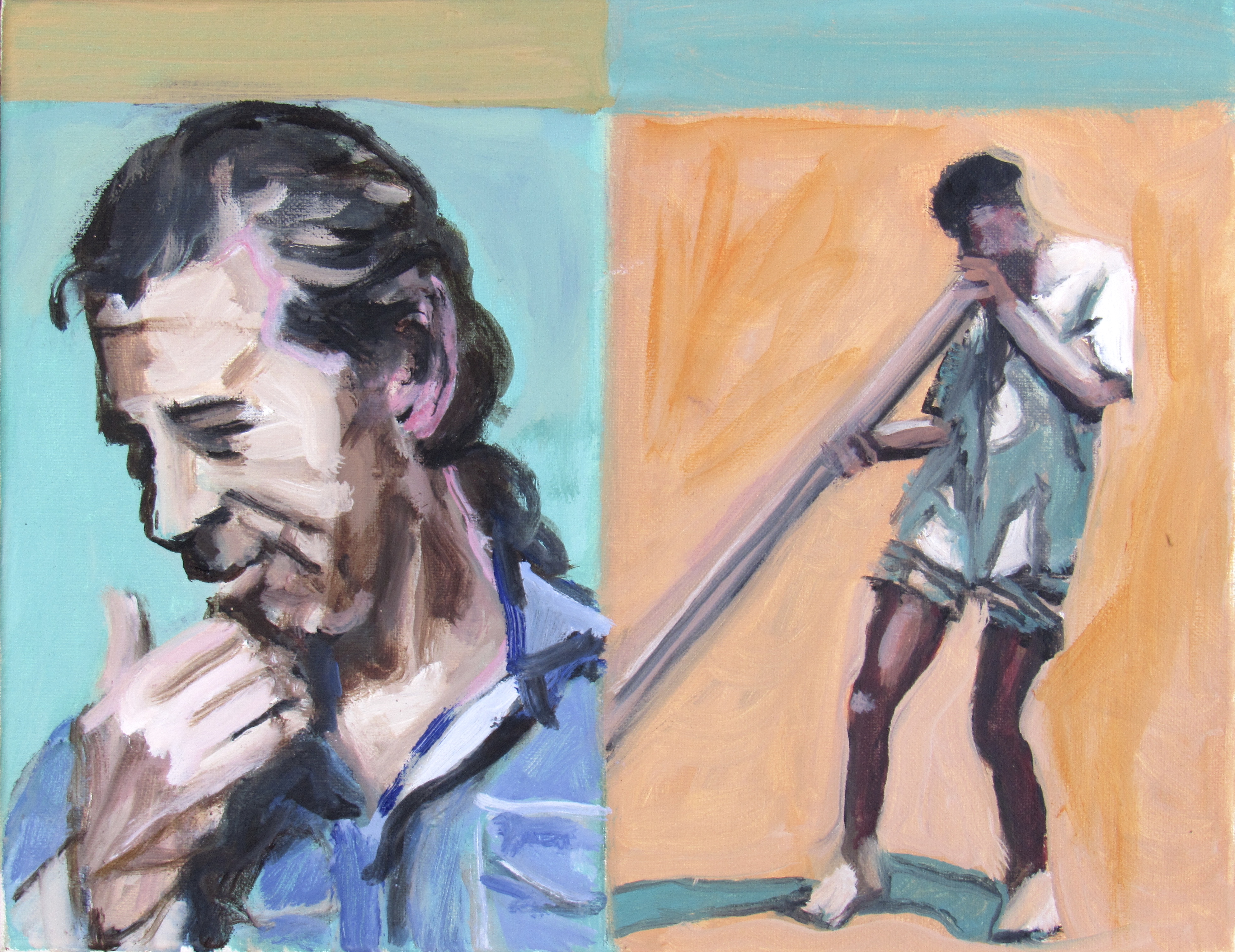
Stanley Diamond/Anaguta drummer
Above is one result of my experiments with this concept. It's done with a little hesitance. I've done a few others with results that did not satisfy me. That's the problem of the glitch; it doesn't always do what you want it to do. The machine is in nature formal, it acts on forms rather than ideas. The opposite of formal is not informal (in art) but content. Form and content, the ingredients of an artwork. When I try to impersonate a machine, I obviously can't be 100% objective (formal.) The argument is here that the machine isn't 100% formal either. Stanley Diamond, btw, is an important anthropologist. Surprisingly there aren't many pictures on line, so I used the same as last year, illustrating a song that was there last year too: Women with mortar and pestle, a recording of Nigerian Anaguta women. On the LP Music of the Jos Plateau and Other Regions of Nigeria, the track is coupled with Two Anaguta drummers. Olga Diamond (love that name) took a photograph during the performance, on which I based the musician on the right.

Wednesday, February 15, 2023

An Armenian Case

Adrina Otero/Zabelle Panosian
Zabelle Panosian was a Armenian-American soprano born in Turkey in 1891. She recorded eleven songs in 1917 and 1918 that have recently been reissued together with a book titled I am a Servant of Your Voice. The CD has 21 tracks, I don't own it (just bought the one track in my Top 100, Groung, from bandcamp), which means the authors probably found some alternate takes from the Colombia sessions. The song Groung (meaning 'crane') is reputedly a secret song more than 400 years old and sounds truly mesmerizing. Zabelle Panosian, the Armenian refugee from Turkey, continued through her long life (she died in 1986), supporting the Armenian case, and at the end of her life, left a significant amount to the Amenian-American community. The left half of the painting is modeled after a publication shot of the dancer/actress Adrina Otero, daughter of Zabelle Panosian. The image depicts her as a flamenco dancer. After a twenty year hiatus there is once again flamenco music in the Top 100 (see this post from a month ago.)
 

Saturday, February 11, 2023

I.M. Gal Costa

Caetano Veloso/Gal Costa
Gal Costa died just a few months ago at the age of 77 in Sao Paulo. I only learned about it a week ago when preparing for this painting and updating my archive. Back in my old radio days in the Netherlands I used to know it quite fast when a musician had died, my friend Wim, once a year, in January, did a radio special playing music from musicians who had died that year. He kept a list all year, and of course I was being kept up to date. Not so much anymore, if it isn't news for the big media, I probably won't hear about it. I'm actually surprised the passing of Gal Costa was not newsworthy enough, as she had been an important figure in Brazilian, and world music. I had never painted her before and her Relance, a b-side of her hit Milho Verde, written by Caetano Veloso, is her first ever listing in a Top 100. Together with Veloso, Maria Bethania (Veloso's sister), Os Mutantes, and Gilberto Gil, Gal Costa formed the core of the Tropicalia movement in Brasil, a mix of bossa nova, samba, and rock 'n' roll. The version of Relance in my list is a live TV performance with the group Dumingunhos from 1970.
 

Friday, February 3, 2023

Positive Body Image

Janis Ian/Nina Simone
Janis Ian and Nina Simone were friends at some point. Then they fell out. Who knows what happened exactly but Simone was known to have a bad temper and was later diagnosed with bi-polar disorder. While in the process of finishing the above painting, I re-listened to Simone's cover of Ian's song Stars, and Maria, my spouse, commented "she must be on drugs." I never considered that and thought of the song, that Simone paired with the famous hit Feelings at the Montreux Jazz Festival in 1976, as a brilliant and intense performance. Maria was right though, towards the end of the 17 minute rendition, Simone herself alludes to drug use. A review on the Guardian confirms that Simone was sometimes incomprehensible and unsteady during the performance. Ian's original, from 1974, is a manifesto of what is called today "positive body image," as was her most famous hit At 17. The message spread by Ian and Simone had been analogous at times, and Simone acknowledges Ian in the performance by mentioning her name in the same breath with Janis Joplin and Billie Holiday.
 

Tuesday, January 31, 2023

The "gentlemen" of ethnology


Jaap Kunst/Robert von Heine-Geldern
Jaap Kunst (1891-1960) was an official of the Dutch colonial government in Indonesia. Kunst had a law degree, was a musician, and an ethnographer. Robert von Heine-Geldern (1886-1968) an Austrian nobleman carrying the title of Freiherr, a leftover title from the Holy Roman Empire. He was a grandnephew of the poet Heinrich Heine, and a noted archaeologist and ethnographer. Both specialized in Southeast Asian culture. Von Heine-Geldern introduced Southeast Asian studies as an academic field while Kunst coined the term ethnomusicology in 1955 (to this day underlined in red—misspelled—by Google.) Kunst was the first one to record Indonesian gamelan music. The natural companion to Jaap Kunst in this painting would have been a certain Mr. Hobbel, a Dutch army official serving in Indonesia who recorded (or collected) the music of the Moluccas that is featured in the top 100. Kunst, in the liner notes to an album in the Columbia World Library of Folk and Primitive Music series dedicated to Indonesia, suggest to the Barbar song in question, an "extremely ancient cultural connexion [sic]." In the same paragraph he mentions von Heine-Geldern as having demonstrated similar conclusions. Mr. Hobbel's identity remains unsure to me (a photo doesn't seem to exist, not on-line at least.) Jaap Kunst became interested in folk music while, as a young man, vacationing in Terschelling, an island in the North of the Netherlands. He recorded an album for Moses Asch's Folkways label dedicated to the music of the Netherlands. Several tunes I can sing-a-long with including my shower classic Drie Schuintamboers.

Tuesday, January 24, 2023

Into the Black (The story of Johnny Spud)

Mark Mothersbaugh/Neil Young
Neil Young is forever linked with the state of Ohio because of his song Ohio (four dead in Ohio) in response to the Kent State shootings in 1970. This was years before he hooked up with Kent State alumni band DEVO (Jerry Casale was in the midst of the chaos in 1970.) DEVO performs with Neil Young in the film Human Highway. Mark Mothersbaugh (as Booji Boy) sings Hey Hey, My My (Into the Black), he substitutes Johnny Rotten in the lyrics for Johnny Spud. He also introduced Neil Young to the term "rust never sleeps" which became the title of the album that featured Hey Hey, My My.
 

Thursday, January 19, 2023

The Problem with the Avant-Garde

Edgard Varèse/Le Corbusier

The concept for the current series of 100 paintings disallows me to paint individuals twice. Iannis Xenakis has with five works a huge presence in the list and I'm finding ways to reflect this presence in the paintings as well. There are two "Polytopes" in the list so I made myself familiar with the concept of polythopes in order to select two appropriate individuals to illustrate the the polytopes by Iannes Xenakis. The first, and highest ranked polytope, is the Polytope de Cluny while the second one is called Polytope de Montreal. The latter is a work for four orchestras spread throughout the audience. Each of Xenakis' Polytopes (meaning many/place) is linked to a site. Each work is a site specific installation and is a so-called gesamtkunstwerk (a term borrowed from German, used by Wagner to mean a total-work of art.) The fist of Xenakis' polytopes (although not named yet that way) was the installation for the Phillips Pavilion at the 1958 World Fair in Brussels. Xenakis worked for the Swiss-French architect Le Corbusier (1887-1965) at the time. Xenakis is credited with the architecture of the site while Le Corbusier collaborated with the composer Edgard Varèse on the sound and engineering of the work. The title: Poeme électronique. The musical part (by Varèse) was once early on in a top 100 of mine. The three, Varèse, Le Corbusier, and Xenakis, are truly heavyweights of the avant-garde, and the three combined nothing short of an experimental/intellectual supergroup. When I started painting Varèse and Le Corbusier, the weight of importance made itself felt immediately. But then, especially in the right half (Le Corbusier), something started to manifest itself that was different from awe. I started to dislike the character of the face I was painting, in a similar way as a painting last year (that of Jean Rouch, also a super-important white-middle-aged-French-male) the face spoke to me in an authoritarian way. I sorta knew there was some controversy surrounding Le Corbusier but I didn't know what, or how. The last time I wondered about Le Corbusier was in art history class in the 1980s. So I Googled Le Corbusier and read about his (early) flirtations with Fascism and eugenics. (To his credit, later on he did not engage in any of such rhetoric anymore, but he didn't atone either.) When, in the process of painting, his image started to remind me of Rudy Guliani (the disgraced former major of New York), the case was settled: I was painting someone I couldn't feel sympathy for. (Now my critique of Le Corbusier is only in the field of eugenics, because I could not possibly criticize him for his work. To be completely honest with you: the concepts I have been reading about mostly go straight over my head. I'm not smart enough to understand their philosophies in the same way I can't understand quantum mechanics, and the theory of relativity. I still find it interesting though.) There is a lot of antisemitism and nationalism in the avant-garde of pre-WWII. It's a little scary to consider how those, mostly left-wing, cultural pace-setters, subscribe to visions so much at odd with ideals of equality and justice. What the avant-garde needed was diversity.

Monday, January 16, 2023

A grab bag of musicians

Alvin Curran/Giacinto Scelsi
20th Century avant-garde classical music really has a presence this year in the top 100 as it had once before in the late eighties. String quartets #3 and #4 by the Italian composer Giacinto Scelsi (1905-1988) and Canti Illuminati by Alvin Curran (Am. b. 1938, lives in Rome) all scored points in 1987 and again in 2022. Neither of these musicians I had painted before (I started illustrating the top 100 in 1990.) Portraits for both are thus long overdue. Scelsi featured in the Top 100 1987 (Curran did not,) while Curran is in this year's list (Scelsi is not.) The current format of double portraits without duplicates allows me to catch up on painting musicians that should have been painted in the history of the Top 100 but were not. Scelsi was a mentor and friend to Alvin Curran and Canti Illuminati (seen by Scelsi weeks before his death) is a sort of hommage to the old master.
Pat Conte/Andalusian (Rom) guitarist (from a photo c. 1900)
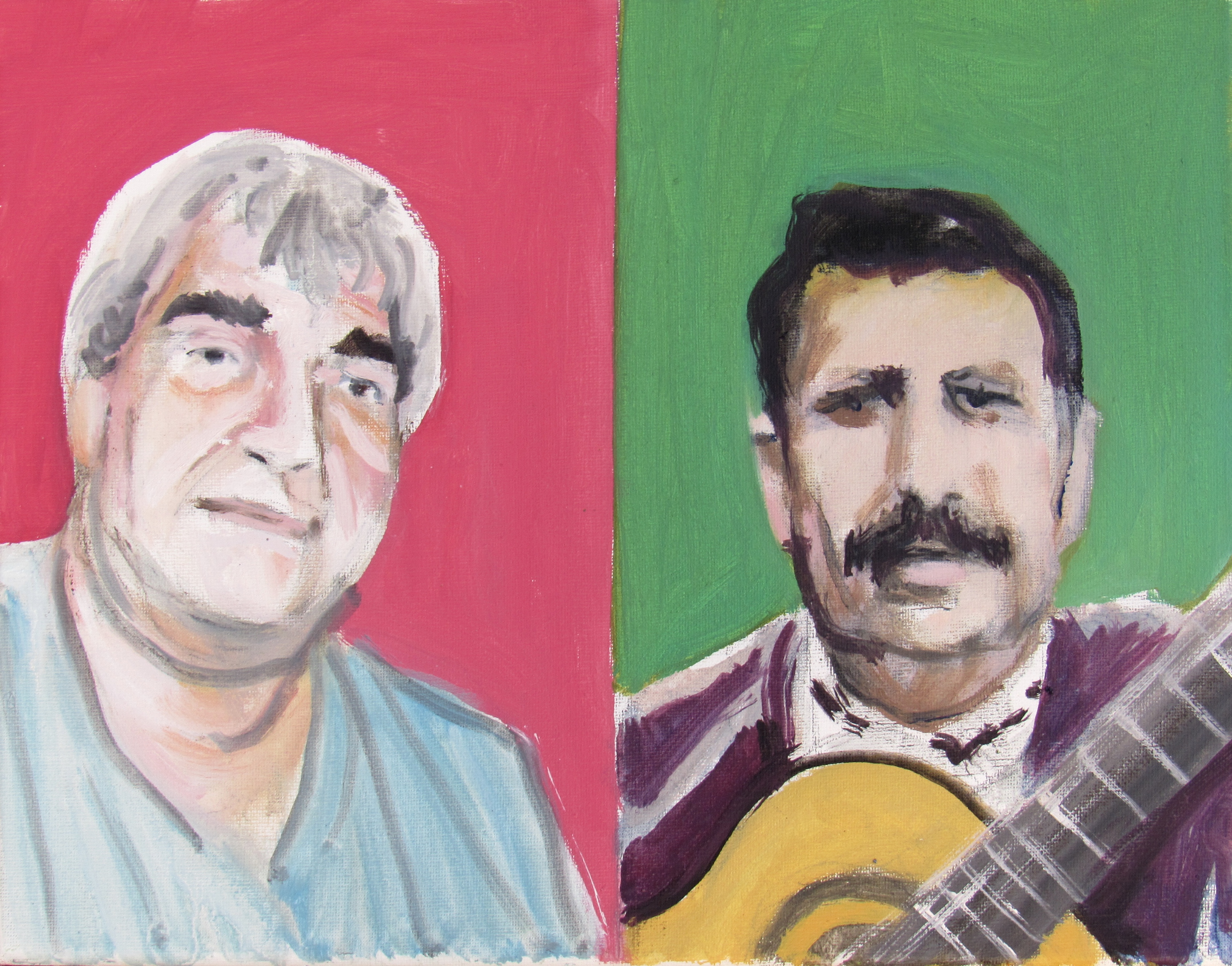
Now Pat Conte, the American multi string-instrument/guitar player, I did paint before, twice, but not as a musician but as a collector of old 78 records. This year Pat Conte returns as collector, and originator of the series The Secret Museum of Mankind, with a 78 called Vlach Longassi, from 1929 of the Andalusian Gypsy guitarist Oudi Jorghi. The track is included on the latest release in the Secret Museum series: Guitars, Vol. 1: Prologue to Modern Styles. I was delighted to find out that the Secret Museum was alive again after silence of more than a decade. I bought the record and a second tune also is listed in this year's 100. Fiesta Mora en Tanger by the, at the time, famous string quartet Cuarteto Aguilar. They were famous enough that there's pictures of them on line. I painted all three of the brothers and the one sister Aguilar.
Cuarteto Aguilar
They're not all new faces I'm painting. Take Cat Power, for example, just like in all of the last twenty years she's in this year's list once again (be it towards the bottom this time.) A brand new record appeared on the market but this new one failed to make the list. Not that I don't like it, but hey, times change. The song in the list is an old one: Metal Heart appeared first on Moon Pix [1998, Matador] and then again on Juke Box. [Matador, 2008] The song is one of her classics and a continuous (as far as I can tell) presence in her live sets. These live sets, by the way, for the last 15 years or so, feature Erik Paparazzi, who also played bass on Moon Pix.
Erik Paparazzi/Cat Power
Another familiar face, who was painted numerous times over the years is Michael Hurley. Like Cat Power, I'm a longtime fan of this musician who debuted on Folkways in 1964, the year I was born. In his eighties now he is still recording and performing. The track in the Top 100 was recorded in 2016 and is called O My Stars, a song that features the Swedish folk duo My Bubba. I painted the blond one from the duo but I took me a while to figure out who was the blond one and who the brunette was. I figured it out: The blonde one is My, while the brunette is Bubba.
Michael Hurley/My Larsdotter
Alright, I'll do one more before I let you go. Unrelated to any of the five above is a track by Piaroa Indians recorded by Pierre Gaisseau in 1949 in Colombia during the Orinoco-Amazon expedition of 1948/50. Some of the recording I've had for a long time on an album called The Columbia World Library of Folk & Primitive Music, Volume 9: Venezuela, but did find the original release Musique Primitive Indienne that not only has longer versions of some on the Columbia LP, but also uses a different set of titles. Bark Music of the Piaroa has been in the Top 100 several times but this time it listens to Rituel Saisonnier & D'initiation : Musique De Nuit (1). Gaisseau was part of the famous Ogooue-Congo expedition of 1946, who were the first to record the Pygmy people of the rain forests of Central Africa. As important as that expedition was, Gaisseau is even more famous for the film Sky Above and Mud Beneath, filmed in 1959 in previously unexplored areas of Papua New Guinea. The film had an enormous impact on the "Western mind."
Pierre Gaisseau/Piaroa bark horn player


Saturday, December 31, 2022

Token Dutch Music Personality; Happy New Year

Annette Apon/Louis Andriessen
Because of the time difference New Year in the Netherlands is six hours earlier than here in Florida. It means that the time leading up to tonight's midnight hour comes sooner for someone who was born at the same time and at the same place than for me. I often go back to the Netherlands and this year I went back a lot. Every visit to the Netherlands comes with a shopping extravaganza at record stores. Vinylarchief in Nijmegen is my favorite place to go shopping. This time around, at the Vinylarchief, I browsed through a section labeled "Dutch Avant-Garde" (yes, there is such a thing.) I selected a handful of records from that section but ended up buying only two. One I did misidentify (by remembering a different first name) and, even though it was quite good, I left it behind because it dissatisfied my expectations. The other one I took with me, and I did find that one quite beautiful, Golven (Waves,) soundtrack to a film by Annette Apon by Louis Andriessen. Some musicians on the record were part of the Willem Breuker Kollektief, last year's token Dutch musician, and the record belongs the one of the most played vinyl on my player this past year. There are quite a few tunes from films in this year's list. Music, to me, seems to make a greater impression when it's accompanied by visuals. Golven doesn't belong in this category because I never seen the film. Sound!!! on the other hand, is a on a repeated watching loop on my computer. The film by Dick Fontaine, features the music of Rahsaan Roland Kirk, and is narrated by John Cage. Cage himself is not in the Top 100 this year but is associated with a handful of recordings as is elaborated in this post from a few months ago.
Dick Fontaine/Rahsaan Roland Kirk
There are still a number of paintings that are finished but not discussed yet. I'll forward one more and wait till next year for the others. I set myself the goal of getting half way with the Top 100 paintings and that's precisely where I'm at right now. The last painting I share here then is a double portrait of the Italian (Sicilian) singer Rosa Balistreri and the Portuguese singer Amalia Rodrigues. The two were friends. Balistreri is the in Top 100 with a song called Mirrina, while Rodrigues almost made it in this year after I was given two wonderful live records of hers. I have now eight records of Amalia Rodrigues, I had yet to make a painting. Both Balistreri (d. 1990) and Rodrigues (d. 1999) are (were) heroes of their respected communities, and both championed a communist/socialist cause.
Rosa Balistreri/Amalia Rodrigues


Wednesday, December 21, 2022

The nature of photography

Charlotte Heth/Aileen Figueroa
Photography provides our culture with ongoing snippets of reality. The instantaneous nature of these snippets are not being questioned because, after all, they are photographs. The camera is a machine and it objectively records reality accurately. It records reality unbiased and we ignore, or forget, the subjectivity of the photographer, who, by selecting which instant to share, already interpreted reality for us. Painting, contrary to this, is not instantaneous, and will not be considered as objective reality. The subjectivity of a painting is an automatic integral aspect in our reading of it, how we interpret what we see. In the same manner objectivity is an aspect of how we see a photograph. While painting from a photograph, which is what I do with these Top 100 portraits, the two different realities overlap, or rather the second (painting) is superimposed on the first Photography.) Certain aspects of instantaneous reality, taken for granted in a photograph, can look rather out of place in a painting. A photo of a figure in mid-motion, for example, could look awkwardly out of balance in a painting. Our mind simply recognizes the continuous motion in the photo but fails to so in a painting. The instantaneous moment is extended in the painting and the figure looks hopelessly unbalanced. You can easily tell the difference between a portrait painting from a photograph from a painting using a live model, a sitter. A big smile in the face is a first and easy giveaway. A big smile can be captured by a camera because its instantaneity, those photographed in fact, often do smile. While painting the smile it can not succeed in capturing the emotion, expression, of the instant. When looking at a painting of a person with a big smile, you will see certain wrinkles, individual teeth, but not a happy joyful expression. When I occupy this place between the instantaneous and the extended, I consider all these aspects of representation. I will remove evidence of the instance, and try to capture a person in an extended viewing, to show a broader view of a person's character as if this person were viewed over time. In the case of my Top 100 paintings this constitutes the viewing of many different photos, or videos.
Alaci Tulaugak;Nellie Nungak/Mary Sivarapik
Lately, I've become interested in reversing this relationship. To paint precisely those things that make a photograph a photograph, aspects of reality that are the unique property of photography. I paint the broad smile, the mid-motion depiction of a figure in motion, the out-of-focus face, or background, the disproportionate view that results from an odd vantage point (like being real close to a person for example.) In a video I recorded last week, I hold a record sleeve of a randomly selected disc. The person depicted on that cover seems up-side down, but she isn't. It's just that she is laying down on the ground and the photographer hovers over her with a (his) camera. In a painting, I thought, the image of the woman would look for sure up-side down. While I was recording the video I was in the process of painting certain Canadian Inuits from Nunavut that are part of the Top 100 2022. The video, shown below the second Inuit painting, became about that record sleeve, rather than about the current painting I was working on at that moment.
Two singers from Canada: Inuit Games and Songs

Even though the record, A Stereo Visit to Italian Movies, is not at all a part of the Top 100 2022 list, far from it, I had to paint it as if it were. I was reinforced doing so because of another random pick from my record shelves. This was a record of the Argentinian singer Ramona Galarza, the cover of which shows a background upside down as trees are reflected in the body of water directly behind Galarza. The painting then is a double portrait of the model featured on the Italian movie record together with Ramona Galarza, as she appears on the cover of the self titled record. At this moment I feel this painting is part of the current Top 100 series but I'm not 100% yet on this issue. This is the painting in question (below.)
Ramona Galarza/Cover of Italian Movies


Sunday, December 4, 2022

Jazz, jazz, jazz, jazz, jazz, jazz, jazz, jazz

Sunny Murray/Albert Ayler
Jazz music's been coming to me from many angles. From the "No Wave" facebook group, spending time with my best friend—and jazz aficionado—in Holland, to my own not too shabby jazz collection on vinyl. I became acquainted with a host of musicians from the past I had never listened to before and I re-listened to lot a familiar ones as well. All of the numerous jazz tunes in the Top 100 2022 are free jazz (or New wave in jazz, avant-garde, fusion, etc.) The double portrait format, moreover, results in many portraits of jazz musicians I never painted before. Sunny Murray, drummer with Albert Ayler is one of those musicians. Albert Ayler, and the song Ghosts, had been listed multiple times in the past, but never did I paint Sunny Murray, or bass player Gary Peacock before. Ghosts was recorded a week before I was born in New York City. It comes from the LP Spiritual Unity on the ESP (Esperanto) label. I bought the LP The ESP Sampler earlier this year that includes abridged versions of numerous outstanding jazz recordings, introducing me to a whole new clique of jazz men (they're all men, all 50 of them,save for Patty Waters.) Spiritual Unity is one of a handful of discs I already had in my collection from ESP (I own Spiritual Unity on CD rather than on vinyl.) 
Cecil Taylor/Jimmy Lyons
The Cecil Taylor track in the list is called Mirror and Water Gazing from the LP For Olim. [Soul Note 1987] The LP, that I've had for a long time but never featured in the Top 100, is a solo piano concert recorded 1986 in Berlin. The recording took place while Jimmy Lyons, his long-term collaborator, was on his dying bed due to cancer. The LP is dedicated to the "living spirit of Jimmy Lyons."
Miles Davis/Teo Macero
The remaining two new jazz paintings concern tracks that were also listed in 2021. Rated X by Miles Davis and Anthropology by Jon Ibragon are again both high in the Top 100. Last year I paired the Miles Davis portrait with that of the percussionist James Mtume. Mtume passed away in January this year. Teo Macero is a componist and sax player but is best known for his production work at Columbia Records. He worked extensively with Miles Davis and contributed greatly to the groundbreaking early 1970s records such as Bitches Brew and On the Corner. Rated X comes from Get Up With It that contains unreleased recordings from both Bitches Brew and On the Corner.
Jon Ibragon/Charlie Parker
Like last year I coupled Jon Ibragon with Charlie Parker as the LP Bird With Streams [Irabbagast, 2021] contains solo improvisations by the saxophonist Jon Ibragon on themes by Charlie Parker. Click here to read more on last year's painting. The Charlie Parker portrait comes from the LP The Happy "Bird" [1951, Charlie Parker Records] one of a handful LP's I have of his and that I all played while in my studio painting the portraits. Charlie Parker almost single-handedly started modern jazz in the 1940s.