Thursday, January 19, 2023

The Problem with the Avant-Garde

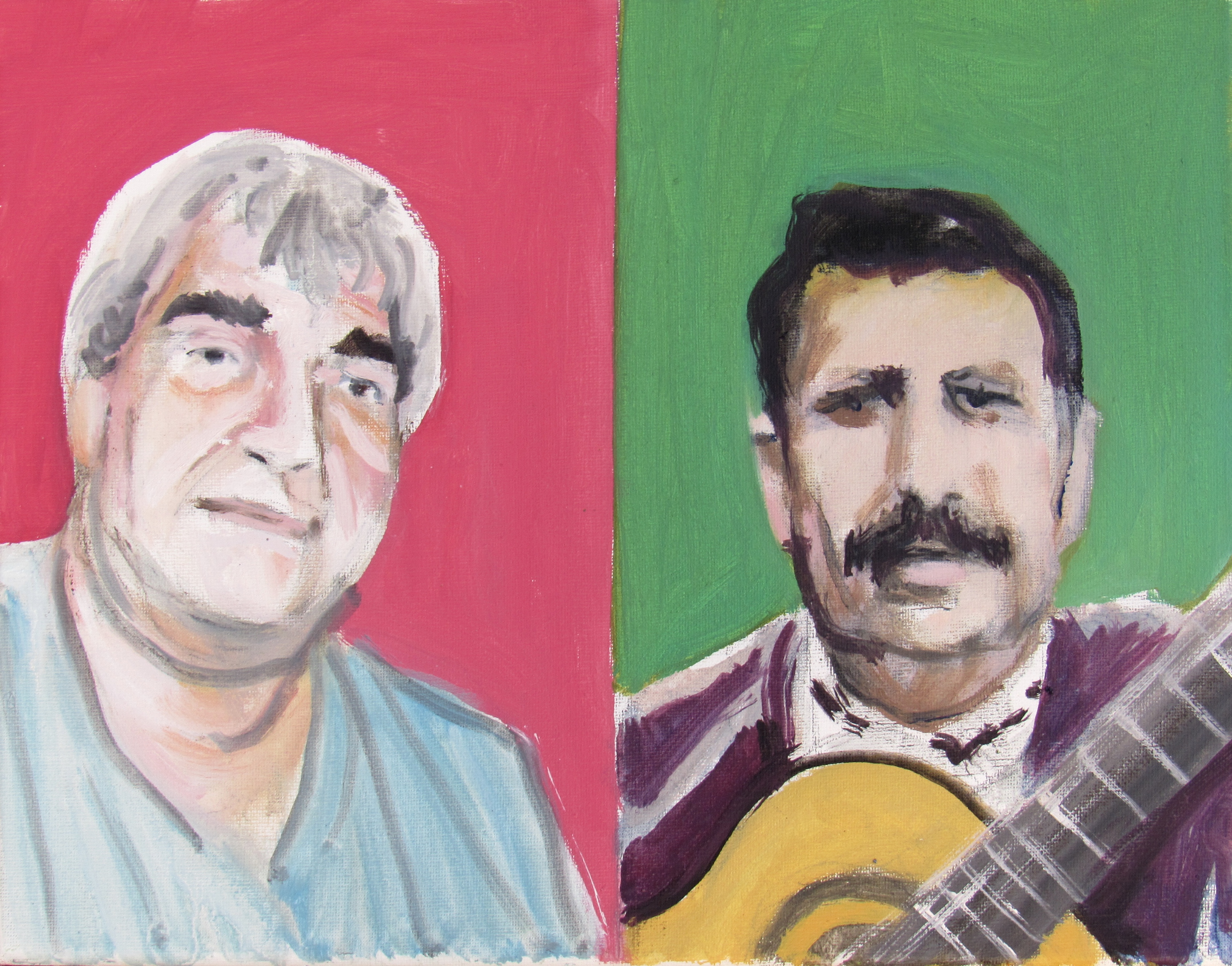
Edgard Varèse/Le Corbusier

The concept for the current series of 100 paintings disallows me to paint individuals twice. Iannis Xenakis has with five works a huge presence in the list and I'm finding ways to reflect this presence in the paintings as well. There are two "Polytopes" in the list so I made myself familiar with the concept of polythopes in order to select two appropriate individuals to illustrate the the polytopes by Iannes Xenakis. The first, and highest ranked polytope, is the Polytope de Cluny while the second one is called Polytope de Montreal. The latter is a work for four orchestras spread throughout the audience. Each of Xenakis' Polytopes (meaning many/place) is linked to a site. Each work is a site specific installation and is a so-called gesamtkunstwerk (a term borrowed from German, used by Wagner to mean a total-work of art.) The fist of Xenakis' polytopes (although not named yet that way) was the installation for the Phillips Pavilion at the 1958 World Fair in Brussels. Xenakis worked for the Swiss-French architect Le Corbusier (1887-1965) at the time. Xenakis is credited with the architecture of the site while Le Corbusier collaborated with the composer Edgard Varèse on the sound and engineering of the work. The title: Poeme électronique. The musical part (by Varèse) was once early on in a top 100 of mine. The three, Varèse, Le Corbusier, and Xenakis, are truly heavyweights of the avant-garde, and the three combined nothing short of an experimental/intellectual supergroup. When I started painting Varèse and Le Corbusier, the weight of importance made itself felt immediately. But then, especially in the right half (Le Corbusier), something started to manifest itself that was different from awe. I started to dislike the character of the face I was painting, in a similar way as a painting last year (that of Jean Rouch, also a super-important white-middle-aged-French-male) the face spoke to me in an authoritarian way. I sorta knew there was some controversy surrounding Le Corbusier but I didn't know what, or how. The last time I wondered about Le Corbusier was in art history class in the 1980s. So I Googled Le Corbusier and read about his (early) flirtations with Fascism and eugenics. (To his credit, later on he did not engage in any of such rhetoric anymore, but he didn't atone either.) When, in the process of painting, his image started to remind me of Rudy Guliani (the disgraced former major of New York), the case was settled: I was painting someone I couldn't feel sympathy for. (Now my critique of Le Corbusier is only in the field of eugenics, because I could not possibly criticize him for his work. To be completely honest with you: the concepts I have been reading about mostly go straight over my head. I'm not smart enough to understand their philosophies in the same way I can't understand quantum mechanics, and the theory of relativity. I still find it interesting though.) There is a lot of antisemitism and nationalism in the avant-garde of pre-WWII. It's a little scary to consider how those, mostly left-wing, cultural pace-setters, subscribe to visions so much at odd with ideals of equality and justice. What the avant-garde needed was diversity.

Monday, January 16, 2023

A grab bag of musicians

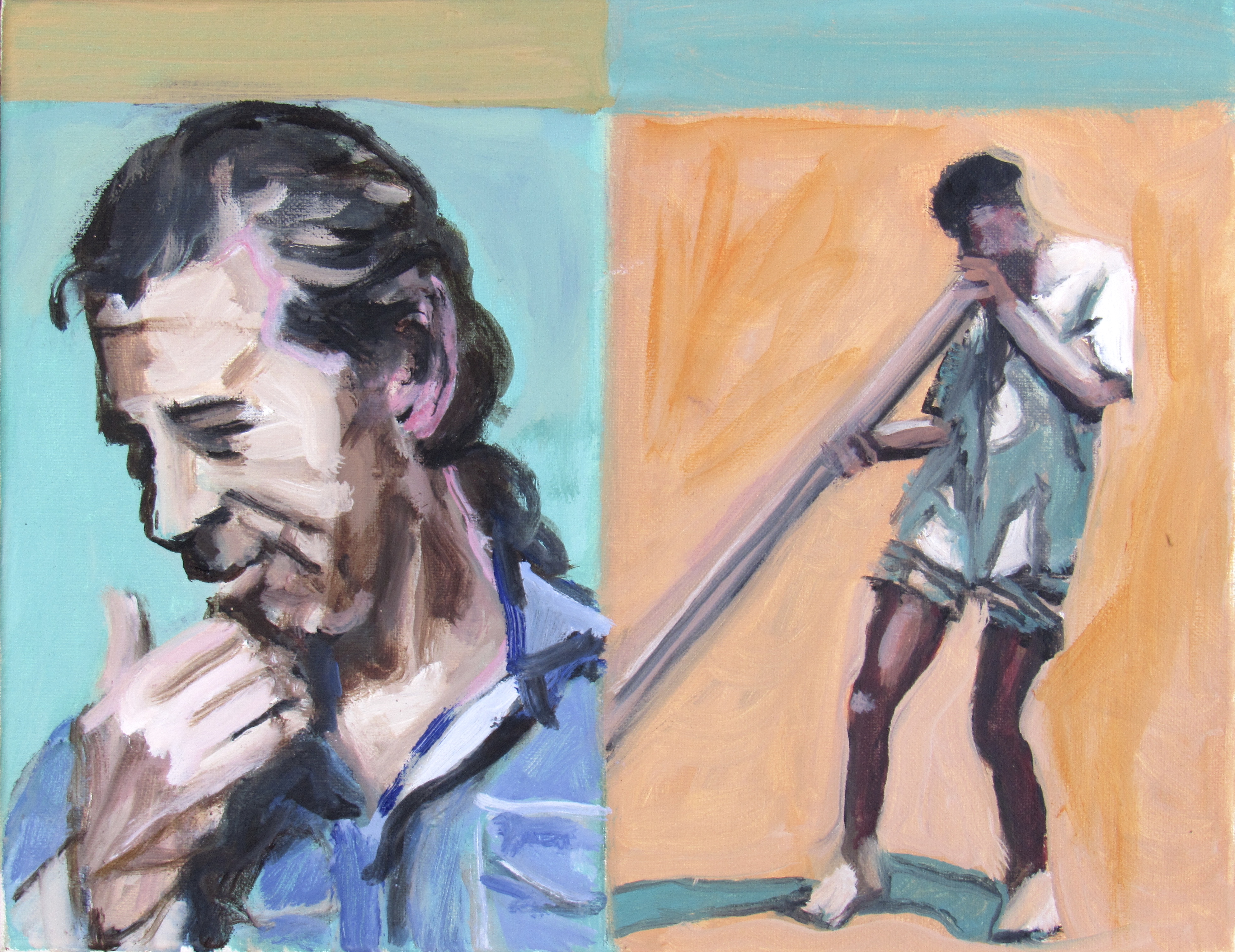
Alvin Curran/Giacinto Scelsi
20th Century avant-garde classical music really has a presence this year in the top 100 as it had once before in the late eighties. String quartets #3 and #4 by the Italian composer Giacinto Scelsi (1905-1988) and Canti Illuminati by Alvin Curran (Am. b. 1938, lives in Rome) all scored points in 1987 and again in 2022. Neither of these musicians I had painted before (I started illustrating the top 100 in 1990.) Portraits for both are thus long overdue. Scelsi featured in the Top 100 1987 (Curran did not,) while Curran is in this year's list (Scelsi is not.) The current format of double portraits without duplicates allows me to catch up on painting musicians that should have been painted in the history of the Top 100 but were not. Scelsi was a mentor and friend to Alvin Curran and Canti Illuminati (seen by Scelsi weeks before his death) is a sort of hommage to the old master.
Pat Conte/Andalusian (Rom) guitarist (from a photo c. 1900)
Now Pat Conte, the American multi string-instrument/guitar player, I did paint before, twice, but not as a musician but as a collector of old 78 records. This year Pat Conte returns as collector, and originator of the series The Secret Museum of Mankind, with a 78 called Vlach Longassi, from 1929 of the Andalusian Gypsy guitarist Oudi Jorghi. The track is included on the latest release in the Secret Museum series: Guitars, Vol. 1: Prologue to Modern Styles. I was delighted to find out that the Secret Museum was alive again after silence of more than a decade. I bought the record and a second tune also is listed in this year's 100. Fiesta Mora en Tanger by the, at the time, famous string quartet Cuarteto Aguilar. They were famous enough that there's pictures of them on line. I painted all three of the brothers and the one sister Aguilar.
Cuarteto Aguilar
They're not all new faces I'm painting. Take Cat Power, for example, just like in all of the last twenty years she's in this year's list once again (be it towards the bottom this time.) A brand new record appeared on the market but this new one failed to make the list. Not that I don't like it, but hey, times change. The song in the list is an old one: Metal Heart appeared first on Moon Pix [1998, Matador] and then again on Juke Box. [Matador, 2008] The song is one of her classics and a continuous (as far as I can tell) presence in her live sets. These live sets, by the way, for the last 15 years or so, feature Erik Paparazzi, who also played bass on Moon Pix.
Erik Paparazzi/Cat Power
Another familiar face, who was painted numerous times over the years is Michael Hurley. Like Cat Power, I'm a longtime fan of this musician who debuted on Folkways in 1964, the year I was born. In his eighties now he is still recording and performing. The track in the Top 100 was recorded in 2016 and is called O My Stars, a song that features the Swedish folk duo My Bubba. I painted the blond one from the duo but I took me a while to figure out who was the blond one and who the brunette was. I figured it out: The blonde one is My, while the brunette is Bubba.
Michael Hurley/My Larsdotter
Alright, I'll do one more before I let you go. Unrelated to any of the five above is a track by Piaroa Indians recorded by Pierre Gaisseau in 1949 in Colombia during the Orinoco-Amazon expedition of 1948/50. Some of the recording I've had for a long time on an album called The Columbia World Library of Folk & Primitive Music, Volume 9: Venezuela, but did find the original release Musique Primitive Indienne that not only has longer versions of some on the Columbia LP, but also uses a different set of titles. Bark Music of the Piaroa has been in the Top 100 several times but this time it listens to Rituel Saisonnier & D'initiation : Musique De Nuit (1). Gaisseau was part of the famous Ogooue-Congo expedition of 1946, who were the first to record the Pygmy people of the rain forests of Central Africa. As important as that expedition was, Gaisseau is even more famous for the film Sky Above and Mud Beneath, filmed in 1959 in previously unexplored areas of Papua New Guinea. The film had an enormous impact on the "Western mind."
Pierre Gaisseau/Piaroa bark horn player


Saturday, December 31, 2022

Token Dutch Music Personality; Happy New Year

Annette Apon/Louis Andriessen
Because of the time difference New Year in the Netherlands is six hours earlier than here in Florida. It means that the time leading up to tonight's midnight hour comes sooner for someone who was born at the same time and at the same place than for me. I often go back to the Netherlands and this year I went back a lot. Every visit to the Netherlands comes with a shopping extravaganza at record stores. Vinylarchief in Nijmegen is my favorite place to go shopping. This time around, at the Vinylarchief, I browsed through a section labeled "Dutch Avant-Garde" (yes, there is such a thing.) I selected a handful of records from that section but ended up buying only two. One I did misidentify (by remembering a different first name) and, even though it was quite good, I left it behind because it dissatisfied my expectations. The other one I took with me, and I did find that one quite beautiful, Golven (Waves,) soundtrack to a film by Annette Apon by Louis Andriessen. Some musicians on the record were part of the Willem Breuker Kollektief, last year's token Dutch musician, and the record belongs the one of the most played vinyl on my player this past year. There are quite a few tunes from films in this year's list. Music, to me, seems to make a greater impression when it's accompanied by visuals. Golven doesn't belong in this category because I never seen the film. Sound!!! on the other hand, is a on a repeated watching loop on my computer. The film by Dick Fontaine, features the music of Rahsaan Roland Kirk, and is narrated by John Cage. Cage himself is not in the Top 100 this year but is associated with a handful of recordings as is elaborated in this post from a few months ago.
Dick Fontaine/Rahsaan Roland Kirk
There are still a number of paintings that are finished but not discussed yet. I'll forward one more and wait till next year for the others. I set myself the goal of getting half way with the Top 100 paintings and that's precisely where I'm at right now. The last painting I share here then is a double portrait of the Italian (Sicilian) singer Rosa Balistreri and the Portuguese singer Amalia Rodrigues. The two were friends. Balistreri is the in Top 100 with a song called Mirrina, while Rodrigues almost made it in this year after I was given two wonderful live records of hers. I have now eight records of Amalia Rodrigues, I had yet to make a painting. Both Balistreri (d. 1990) and Rodrigues (d. 1999) are (were) heroes of their respected communities, and both championed a communist/socialist cause.
Rosa Balistreri/Amalia Rodrigues


Wednesday, December 21, 2022

The nature of photography

Charlotte Heth/Aileen Figueroa
Photography provides our culture with ongoing snippets of reality. The instantaneous nature of these snippets are not being questioned because, after all, they are photographs. The camera is a machine and it objectively records reality accurately. It records reality unbiased and we ignore, or forget, the subjectivity of the photographer, who, by selecting which instant to share, already interpreted reality for us. Painting, contrary to this, is not instantaneous, and will not be considered as objective reality. The subjectivity of a painting is an automatic integral aspect in our reading of it, how we interpret what we see. In the same manner objectivity is an aspect of how we see a photograph. While painting from a photograph, which is what I do with these Top 100 portraits, the two different realities overlap, or rather the second (painting) is superimposed on the first Photography.) Certain aspects of instantaneous reality, taken for granted in a photograph, can look rather out of place in a painting. A photo of a figure in mid-motion, for example, could look awkwardly out of balance in a painting. Our mind simply recognizes the continuous motion in the photo but fails to so in a painting. The instantaneous moment is extended in the painting and the figure looks hopelessly unbalanced. You can easily tell the difference between a portrait painting from a photograph from a painting using a live model, a sitter. A big smile in the face is a first and easy giveaway. A big smile can be captured by a camera because its instantaneity, those photographed in fact, often do smile. While painting the smile it can not succeed in capturing the emotion, expression, of the instant. When looking at a painting of a person with a big smile, you will see certain wrinkles, individual teeth, but not a happy joyful expression. When I occupy this place between the instantaneous and the extended, I consider all these aspects of representation. I will remove evidence of the instance, and try to capture a person in an extended viewing, to show a broader view of a person's character as if this person were viewed over time. In the case of my Top 100 paintings this constitutes the viewing of many different photos, or videos.
Alaci Tulaugak;Nellie Nungak/Mary Sivarapik
Lately, I've become interested in reversing this relationship. To paint precisely those things that make a photograph a photograph, aspects of reality that are the unique property of photography. I paint the broad smile, the mid-motion depiction of a figure in motion, the out-of-focus face, or background, the disproportionate view that results from an odd vantage point (like being real close to a person for example.) In a video I recorded last week, I hold a record sleeve of a randomly selected disc. The person depicted on that cover seems up-side down, but she isn't. It's just that she is laying down on the ground and the photographer hovers over her with a (his) camera. In a painting, I thought, the image of the woman would look for sure up-side down. While I was recording the video I was in the process of painting certain Canadian Inuits from Nunavut that are part of the Top 100 2022. The video, shown below the second Inuit painting, became about that record sleeve, rather than about the current painting I was working on at that moment.
Two singers from Canada: Inuit Games and Songs

Even though the record, A Stereo Visit to Italian Movies, is not at all a part of the Top 100 2022 list, far from it, I had to paint it as if it were. I was reinforced doing so because of another random pick from my record shelves. This was a record of the Argentinian singer Ramona Galarza, the cover of which shows a background upside down as trees are reflected in the body of water directly behind Galarza. The painting then is a double portrait of the model featured on the Italian movie record together with Ramona Galarza, as she appears on the cover of the self titled record. At this moment I feel this painting is part of the current Top 100 series but I'm not 100% yet on this issue. This is the painting in question (below.)
Ramona Galarza/Cover of Italian Movies


Sunday, December 4, 2022

Jazz, jazz, jazz, jazz, jazz, jazz, jazz, jazz

Sunny Murray/Albert Ayler
Jazz music's been coming to me from many angles. From the "No Wave" facebook group, spending time with my best friend—and jazz aficionado—in Holland, to my own not too shabby jazz collection on vinyl. I became acquainted with a host of musicians from the past I had never listened to before and I re-listened to lot a familiar ones as well. All of the numerous jazz tunes in the Top 100 2022 are free jazz (or New wave in jazz, avant-garde, fusion, etc.) The double portrait format, moreover, results in many portraits of jazz musicians I never painted before. Sunny Murray, drummer with Albert Ayler is one of those musicians. Albert Ayler, and the song Ghosts, had been listed multiple times in the past, but never did I paint Sunny Murray, or bass player Gary Peacock before. Ghosts was recorded a week before I was born in New York City. It comes from the LP Spiritual Unity on the ESP (Esperanto) label. I bought the LP The ESP Sampler earlier this year that includes abridged versions of numerous outstanding jazz recordings, introducing me to a whole new clique of jazz men (they're all men, all 50 of them,save for Patty Waters.) Spiritual Unity is one of a handful of discs I already had in my collection from ESP (I own Spiritual Unity on CD rather than on vinyl.) 
Cecil Taylor/Jimmy Lyons
The Cecil Taylor track in the list is called Mirror and Water Gazing from the LP For Olim. [Soul Note 1987] The LP, that I've had for a long time but never featured in the Top 100, is a solo piano concert recorded 1986 in Berlin. The recording took place while Jimmy Lyons, his long-term collaborator, was on his dying bed due to cancer. The LP is dedicated to the "living spirit of Jimmy Lyons."
Miles Davis/Teo Macero
The remaining two new jazz paintings concern tracks that were also listed in 2021. Rated X by Miles Davis and Anthropology by Jon Ibragon are again both high in the Top 100. Last year I paired the Miles Davis portrait with that of the percussionist James Mtume. Mtume passed away in January this year. Teo Macero is a componist and sax player but is best known for his production work at Columbia Records. He worked extensively with Miles Davis and contributed greatly to the groundbreaking early 1970s records such as Bitches Brew and On the Corner. Rated X comes from Get Up With It that contains unreleased recordings from both Bitches Brew and On the Corner.
Jon Ibragon/Charlie Parker
Like last year I coupled Jon Ibragon with Charlie Parker as the LP Bird With Streams [Irabbagast, 2021] contains solo improvisations by the saxophonist Jon Ibragon on themes by Charlie Parker. Click here to read more on last year's painting. The Charlie Parker portrait comes from the LP The Happy "Bird" [1951, Charlie Parker Records] one of a handful LP's I have of his and that I all played while in my studio painting the portraits. Charlie Parker almost single-handedly started modern jazz in the 1940s.


Sunday, November 20, 2022

The color of a frog

Shuar man, woman (after Pierre Allard, Visages de bronze)
Like last year, a number of recording from the LP Jivaro: Indiens Shuar, Cayapa, Otavalo are listed in the Top 100. I still have not been able to find a photo of Philippe Luzuy, who recorded the music on the LP, or Pierre Allard, the photographer who was with him in 1960. And, as I did last year, I used images from the book Visages de bronze [1960] with photographs by Pierre Allard and text by Luzuy. The two portraits here represent a social dance song sung by a man and a woman. I had already commented before on social and gender relations in Shuar communities, and the recording here illustrates further the discrepancy between the written account of archaeologists concerning the separation of genders and their photographs and musical recordings. For a second painting illustrating the Shuar I used the image of Simone Dreyfus-Roche, listed as the editor on the sleeve. In another gender reversal of norms, it is Dreyfus-Roche who is the authority and well known anthropologist. Luzuy, I assume, is working under her guidance. Simone Dreyfus is known for her work and recordings done in the Amazon regions of Brazil. She recorded the Capoeira among others in the mid-1950s.
Capoeira indian with Simone Dreyfus
I did not use the random color selector for the Dreyfus painting. The Shuar painting was the last of a series of works with random colors. I do like the generator though, it makes me use colors I would have never thought of using. Here's an anecdote about random colors from about twenty years ago: While my boss at a museum job was at a meeting I sat down behind his desk. I don't remember if I put my feet on his desk or not, but I did make myself comfortable. With one hand I was playing with pencil sharpener in the shape of a frog and with the other a book of color samples. Then my boss unexpectedly came back early, catching me and asking what the hell I was doing. I told him I was looking up the color of the frog. And when I actually matched the color, its name was "frog green." I chose golden colors for my painting illustrating Kulali singers from Papua New Guinea because I had done the same thing for the Top 100 2018.
Ulahi and Eyo:bo
Ulahi was still a repected and active singer among the Kulali of the Bosavi Rain Forest when Steven Feld revisted them some 25 years later in 1991. Now she was wearing western style clothing and make-up but she hardly looked much older then in 1977 when Feld took the photo I used above. This time Feld took the famed Grateful Dead drummer Mickey Hart with him. Hart produced a follow up CD with brand new recordings. [Voices of the Rainforest, 1991, Smithsonian] Ulahi is now credited for her performances as modern day pop singers would be credited—Her name comes first.


Monday, November 7, 2022

Of Cromagnon man and Kalahari healers

Marjorie Shostak and Nisa
In May of last year I wrote how Margaret de Wys successfully sought the help of an Ecuadorian shaman to heal and recover from breast cancer. It's a romantic idea that healers from indigenous communities have a certain knowledge lacking in the industrialized world. There's some truth in it (it seems to me) that traditional healers know things about the properties of obscure plants and the often mysterious workings of the human body, that are unknown to the western scientific world. But let's not forget that the science of the western world has advanced to such a degree that healing of diseases, especially those of the industrial world, such as cancer, has a very good success rate, perhaps as good, or better, than traditional methods. The American anthropologist Marjorie Shostak, a decade before de Wys, and on different continent, was not as lucky. Shostak sought the help from her friend Nisa, a !Kung San woman from Botswana. Nisa, in 1970, had been the subject of a book by Shostak: Nisa, the Life and Words of a !Kung Woman. [Harvard University Press, 1981] The book gained importance and became a standard of anthropological literature. Sound recordings made during her three year stay among the !Kung appeared on two discs by the Folkways label. The record Instrumental Music of the Kalahari San appeared in 1982. Like last year the tune Sitengena with one man's voice is listed in the top 100. Read here about the recording.
Cromagnon: Austin Grasmere; Brian Elliot; Sal Salgado
The two colors behind Shostak and Nisa are olive green and olive brown, hardly to be called random. The first time I used the Random Color Generator at randomwordgenerator.com a month ago I these three colors behind three members of the 60s garage band Cromagnon. I didn't write down the names of colors then but they do come up with wonderful (but not truly random) colors. I learned about this obscure band from New York City when I was looking into the ESP label that is the home of many free jazz musicians I'm interested in. ESP refers to the language and not psychology. It was founded in 1963 to showcase esperanto-based music, but after its only second release, a disc by Albert Ayler (Spritual Unity, 1965) the label focused on free jazz and other experimental music. The song Caledonia from the album Orgasm of 1969 (later reissued as Cave Rock) is a real tour de force heavy metal song with bagpipes prominently heard with fuzz guitar, bass and drum. Taped sound effects also feature on the recording. More music from ESP will feature in this year's 100 as well as another recording of the !Kung San of the Kalahari Desert in Botswana.


Wednesday, November 2, 2022

Color

Don Cherry, Aluminum grey/Mori Cherry Turquoise blue
Most paintings produced in the top 100 series now have a solid background color. The choice for each color, naturally, is of great concern. At first the colors were decided by the colors used within the two portraits, complementary to the portraits, or by some related symbolism. Later they became independent, applied before the portraits were painted. Sometimes, as I did with the portraits in this post, I used a random color generator. The first time I used it was last year in a portrait of John Cage, who uses chance operations in composition.There are two programs that I use. The first has about 600 colors the second millions of colors. The 600 of the first one consist of colors that are named. There are about 600 named colors. Perhaps the generator is linked to commercial interests, such as paint manufacturers. When I select two colors from this generator they always appear to go together well. This is nice but it questions the randomness of the selection processes. An advantage of this generator over the other one is that its colors tend to be more vibrant. (Vibrant colors are named more often than dull or dirty colors.) The generator that has millions of colors (the eye can distinguish millions of colors) is more random. Every color is made from a random percentage number of the three RGB primaries, red, green, and blue. The resulting color (nearly) always has all three values represented, so that no color is a true color. The color is always poop, but there's warm poop and cool poop. When I materialize the computer color in paint, I do not go by the levels. This would be pointless anyway because green is not a primary paint color. Colors of light are additive, whereas paint colors reductive. But even if I were to convert RGB into CMYK the same problems persist. I don't work with cyan or magenta, I can make these colors putting together others. There really aren't any primary colors in paint, any color can be made using other colors. Certain pigments are hard to recreate though, phthalo or gold for example, but I have yet to come across any difficulty copying any of the random colors in paint. The colors in the above painting of Don and Moki Cherry are aluminum grey and turquoise blue. The photo reproduction doesn't do these named colors any justice. Don Cherry is one of a handful musicians to appear multiple times in this year's top 100. The colors behind Giampiero Pramaggiore and Naná Vasconcelos, collaborators with the Cherrys in the Organic Music Theatre, are pearl mouse grey and graphite black.
Giampiero Pramaggiore/Naná Vasconcelos
Don Cherry started the Organic Music Theater during an extended stay in Sweden. He married Moki Karlsson and they recorded the album Organic Music Society with a score of mostly local musicians.
Naná Vasconcelos, the Brazilian percussionist was with him and stayed with him through various tours and albums. When Organic Music toured France and Italy, Vaconcelos and both Cherrys were accompanied by the Italian guitarist Giampiero Pramaggiore. Both tracks by the Organic Music Theater in the Top 100 are from from a video recorded by RAI, the Italian national broadcast station. The Organic Music Theater was truly organic (free and democratic) and well ahead of its time. Musicians contributed whatever they were associated with. The Organic Music Theater blended any traditions in the world of sound they'd come across. A third appearance by Cherry in the Top 100, be it a minor contribution, is behind his stepdaughter Neneh Cherry during a videotaped concert by her band Rip, Rig & Panic. The other singer in Rip, Rig & Panic seen in the video is Andi Oliver, today a celebrity chef and Neneh's longtime friend.
Neneh Cherry/Andi Oliver (Rip, Rig & Panic)


Sunday, October 23, 2022

Modern Classical Music

György Ligeti, Antoinette Vischer
Continuum is a work composed by György Ligeti in 1968. The work was written for harpsichord solo and dedicated to the harpsichordist Antoinette Vischer. A version from 1970, transcribed for barrel organ by Pierre Charial, was the version to enter the top 100 list this year but an older version (1968) recorded by Vischer herself later on scored the majority of points. From what I understand (from comments on YouTube) is that the piece is incredibly difficult to play. In the early 1960s Vischer had commissioned John Cage to compose a work for harpsichord but Cage was hesitant until, in 1967, he saw an opportunity for the harpsichord while on a Visiting Associate-ship at the University of Illinois' Computer Music program led by Lejaren Hiller. The two created a complex composition for seven harpsichords and 52 magnetic tape players called HPSCHD. The premiere at the University of Illinois in 1969 featured Vischer, David Tudor, and Philip Corner, among the seven harpsichordists. The composition is a work to experience, not suited for recording, even though a recording of it made it onto a disc produced by Nonesuch in 1969. I bought that LP this year but the track did not make it onto the 2022 top-100 list. Another work by John Cage did, also from an LP I bought this year, MagnifiCathy: The Many Voices of Cathy Berberian. [1971, Wergo] A Flower and The Wonderful Widow of Eighteen Springs are two compositions by John Cage for voice and closed piano. Bruno Canino plays (taps onto) the closed piano behind Berberian's voice.
John Cage, Cathy Berberian
The great influx of modern classical music was not perpetuated by those two records that I just discussed but rather by a big Iannis Xenakis haul at a local thrift store. One afternoon in the Spring I found no less than five discs by Iannis Xenakis. I bought all five, and all five are really great. One of the five, also a Nonesuch LP (1968), is shared with a contemporary of Xenakis, the Polish composer Krzysztof Penderecki. His Cappriccio for Violin and Orchestra on side B of the shared record comes into the Top 100 2022 as well as Xenakis' Akrata found on side A. Both works, the whole LP, was performed by the Buffalo Philharmonic Orchestra Led by Lukas Foss, the famous German-American pianist, composer, and conductor.
Lukas Foss, Krzysztof Penderecki
Iannis Xenakis is represented five times in the list, and is the highest ranking individual this year. Two further (after Akrata) recordings come from an LP on the Candide label, and were recorded by the Ars Nova Ensemble led by Marius Constant, who also founded the ensemble specializing in contemporary music and especially that of Xenakis. The LP is simply called Iannis Xenakis, the recordings are from 1967, and the top 100 titles are Syrmos for 18 strings and Polytope for 4 Orchestras scattered throughout the Audience. A different Polytope and Polla ta Dhina for Children's Chorus and Orchestra (from Album 2—Music Today series, EMI) are the other Xenakis recordings in the list.
Marius Constant, Iannis Xenakis


Wednesday, October 12, 2022

After Ian (anarchy)

Cover of Les Dani de Nouvelle Guinee, Vol. 1 (r) and 2 (l)
Hurricane Ian has been highly disruptive in many aspects of life. Today marks two weeks since it struck just a little north from where I am. Unlike some others I know, I was lucky and only had to deal with a foot of water in my studio and fallen trees. I only got back to work in my studio three days ago. The result above, is based on the cover images of two French research recordings, Volumes 1 and 2 from Les Dani de Nouvelle Guinee. [CRAVA/nordsud music, 2001] A track from each volume is listed in the Top 100 this year. I'll be more specific in a moment but now I'd like to write a few words about my experience with Ian. I learned something about myself these past two weeks, and this is that I'm fairly conservative; I don't like the lawlessness observed since Ian struck; I don't like anarchy. Growing up in the punk-rock era I always applauded the idea of anarchy. Anarchy was leftist revolution, so I thought, but now I see the world reversed. Now that some parts of 70s/80s ideologies have been accomplished, revolutionary ideas have shifted to the right in an effort to undo these accomplishments. I don't like it at all! Regardless of political leaning I see that humanity, in the context of hierarchies, is anarchy at heart. 

As far away from the realities of the aftermath of a natural disaster in the US, is the music of the Dani people of the Western New Guinea (Irian Jaya) province of the Republic of Indonesia. The two volumes of Les Dani de Nouvelle Guinee are filled to the max with gems of ethnographic recordings. From Volume 1 comes, like last year, Cour D’amour, Air Doux, Tiom, a beautiful example of polyphonic singing by men and women, and from Volume 2 Live beetle jew's harp, where a live (and buzzing) beetle is attached to a wooden splinter and is used like a jew's harp. I am mesmerized by this instrument both for its aesthetic charm and the concept of the extension of the human voice by using a live animal. However beautiful the music, it was not the main objective of the three researchers who compiled the cds, but came to study the traditional making and trading of salt. The three anthropologists are Anne-Marie and Pierre Petrequin, and Olivier Weller. Weller was also the photographer on the expedition and I assume he is responsible for the source images for the above painting that appeared on the cover of the cds. I did not paint Olivier Weller but did put Anne-Marie and Pierre Petrequin together in a double portrait. 

Pierre and Anne-Marie Petrequin
Back to States and to the time when the punk-rock atmosphere was still imbuing the minds of young people with ideals of equality, freedom, and other such good things. Pere Ubu came of age during the same period I did too. Mostly active in the 80s the band was a regular high-achieving band in my Top 100 lists of the 90s and both Laughing and Waiting for Mary had been listed during that decade. Laughing, in the classic line-up that I've painted: Tom Herman; Tony Maimome; Allen Ravenstein; Scott Krauss; and David Thomas, is from The Modern Dance [Plan 9, 1978] while Waiting for Mary is a recording from the live TV show Night Music [NBC, 1988-1990] hosted by David Sanborn. In the performance, from 1989, Tom Herman had been replaced by Jim Jones and Chris Cutler, and the band is backed by a slew of renown musicians including Sanborn himself, and Debbie Harry of Blondie.
David Thomas; Scott Krauss; Tom Herman of Pere Ubu

Tony Maimone; Allen Ravenstine of Pere Ubu
There's one more painting that's somewhat new that I need to display and talk about, even though I already did so in the context of the 100 Faces from the Top 100 2022 preview painting from earlier this year. First I'll copy what I wrote on May 11th about the people portrayed: "The record Musica Sveciae: Fornnordiska Klanger means a lot to me as I'm interested in prehistoric art and the origin of music. Professor Cajsa Lund, who produced the record, and her collaborator Äke Egevad are professionals who research bot interests and use archaeological evidence to reconstruct sounds from the prehistoric era. Two tracks from the album are listed in the top 100: the sound of a bull-roarer and a performance on the Kantflöjter (flute)." Only one painting will suffice for the two tracks since there are no other individuals I know of associated with the two works of music-archaeology.
Äke Egevad/Cajsa Lund


Wednesday, September 14, 2022

The Arkestra

Leaders of the Arkestra: Marshall Allen, Sun Ra
The Sun Ra Arkestra didn't cease to exist after its leader Sun Ra died in 1993. John Gilmore took over as leader in 1993 followed by Marshall Allen in 1995. Marshall Allen joined the Arkestra in 1958 and now, 64 years(!) later, at age 98, still leads the Arkestra. I've painted all three, Sun Ra, Gilmore, and Allen as at least three recordings (and maybe more) will be listed in the top 100 this year. Sun Ra is coupled with Allen, while drummer Clifford Jarvis accompanies tenor sax player John Gilmore on a second painting. A third features three women who were part of the Arkestra. The singers June Tyson, who performed with Sun Ra, and Tara Middleton, the singer of the current incarnation of the Arkestra, and dancer Ife Toyo, who performed with the Arkestra in the early seventies.
John Gilmore/Clifford Jarvis
I've always liked the music of Sun Ra but only recently I feel like I've come to understand his music a little better. I watched the film Space Is the Place, which in and of itself is not a great movie, it's like a B- or Blaxploitation movie, but it does show Ra's intentions and the Arkestra in concert. I never thought of Sun Ra in the context of the Civil Rights Movement, but the movie surely directs you in that direction. Of course, Sun Ra was right there in the midst of it. I've read that Sun Ra was at odds with the Black Panther movement over the issue of how to fight for equal right and against discrimination. The objectives are the same, beautifully laid out in the famous Martin Luther King "I have a dream" speech. Sun Ra's objective was to move African Americans to a different planet. The new planet must be taken metaphorically although Sun Ra took space very seriously. The method to move the people to outer space was music. Hence the name of his band: Arkestra. To create a better world he visualized a better world. The key, I think, of Sun Ra's music is visualization. If it can be visualized it can be a reality. The idea of visualization is closely linked to the practice of (neo) shamanism. Sun Ra was certainly a shamanic figure. (Some years ago I wrote about Rahsaan Roland Kirk as a modern shaman. It's perhaps odd to think of Kirk in terms of visualization, but I have no doubt blind people visualize in the same manner, or better, and non-blind people.)
June Tyson/Tara Middleton/Ife Toyo of the Arkestra
The three songs of inclusion are Space Is the Place, Heliocentric, and a solo improvisation without title by Sun Ra on keyboards. Retrospective and another untitled improvisation by the full Arkestra from 1981, are two other possible tracks included in this year's list. All recordings are from before 1993, when Sun Ra was still leading the Arkestra. Other tracks that scored points this year include two by the Arkestra after 1993, in Sun Ra's name but led by Marshall Allen.
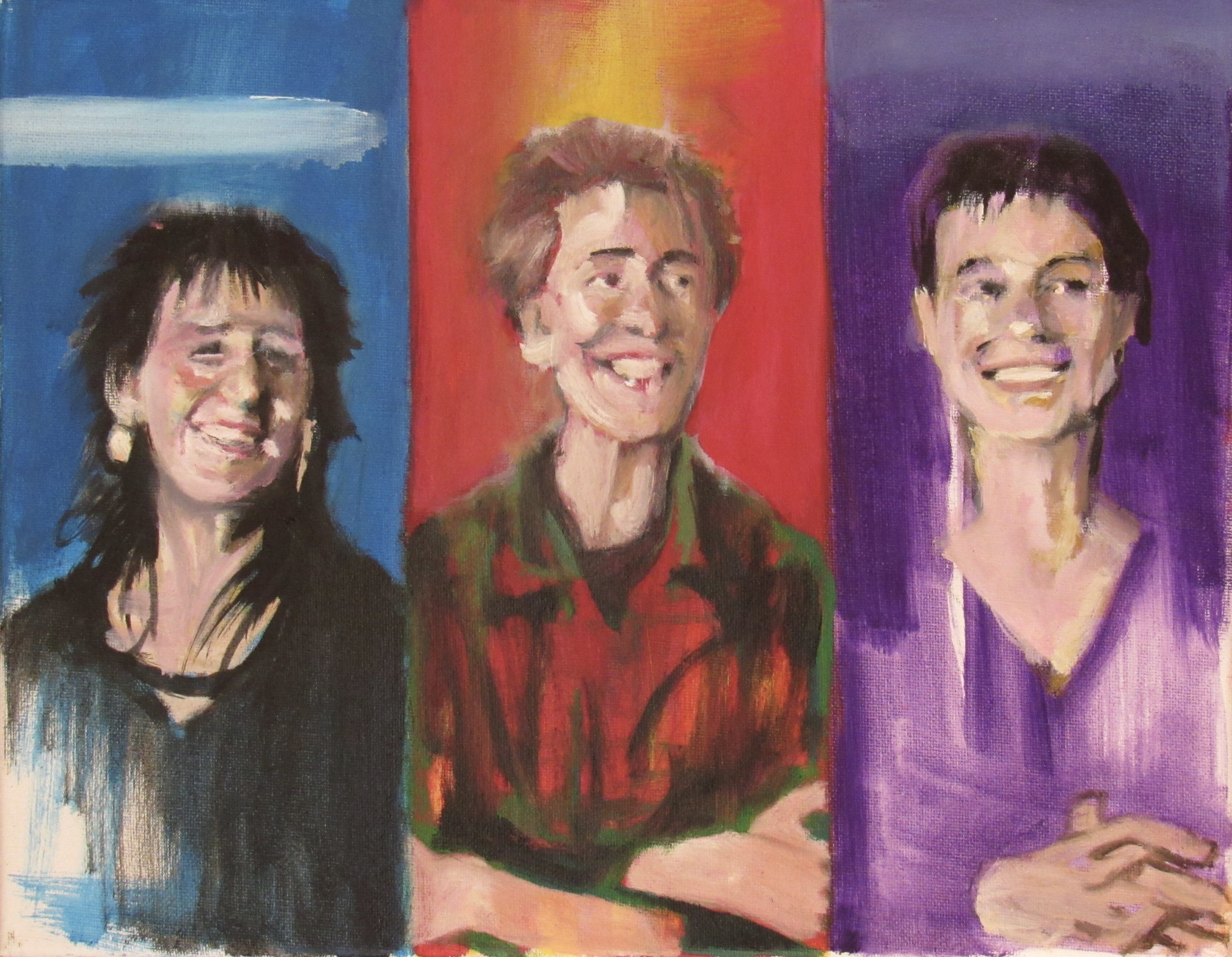
All smiles: CRASS members Joy de Vivre, Eve Libertine, and Gee Vaucher
At the same time I painted the triple portraits of Arkestra members I also painted one of members of the British punk band CRASS. I chose the female band members this time: Joy de Vivre, Eve Libertine, and Gee Vaucher. The song in the Top 100 2022 is the same as in 2021: The medley Step Aside/Rocky Eyes/Mouthing the Words from the album Penis Envy.


Sunday, September 4, 2022

Ex Ethiopia

Terrie and Andy Ex (Terrie Hessels/Andy Moor)
Over the past week I've made four paintings documenting a string of recordings in the top 100 about the connection of the Dutch punk band The Ex with Ethiopian musicians. Five of the eight portraits are of elderly men, but there not ordinary men, they legends of the Dutch punk and jazz, and Ethiopian jazz scenes. The remaining three of women of various ages, but no ordinary women either! Katherina Bornefeld is normally the drummer of The Ex, but on a video recording of The Ex live in Addis Ababa, the legendary Han Bennink sits in and Bornefeld sings the song Eyoleo by the Mahmoud Ahmed while playing percussion on a cowbell. I combined Bennink and Bornefeld in the next double-portrait.
Katherina Bornefeld/Han Bennink
In another video on YouTube The Ex plays a live concert in Groningen (Netherlands) assisted by the Ethiopian saxophone player Getatchew Mekuria on a track written by Mekuria called She Ilelle (or Shellela). Here (below) I combined Mekuria and Ahmed (the two authors of the two songs mentioned.)
Mahmoud Ahmed/Getatchew Mekuria
Mahmoud Ahmed and Getatchew Mekuria both prominently feature multiple times on the influential CD series Ethiopiques. Volume 6 and 19 from the series are by Ahmed while Volume 14 is by Mekuria. Both musicians I've know for a long time as the library in Columbus, where I then lived, had many discs from the series. Both have been in the Top 100 before. In 2011 I wrote about the series, then on Mulatu Astatqe, in this blog. The final double portrait painting is of the contemporary musicians Tirudel Zenebe and Selamnesh Zemene. Tirudel Zemene features on the disc Ilita!: New Ethiopian Dance Music that was produced by Terrie Ex and released on Terp Records, a label founded by Hessels. Zemene, Mekuria, Zenebe, Bennink, Bornefeld, and Terry and Andy Ex, all featured in the preliminary painting for this Top 100 series. (Read here, and here.) Selamnesh Zemene performed with The Ex when she was still in the band Fendika in 2008. There is video called Gonder on YouTube. Gonder is not the actual title of the song that appears on Soundpoetry, part 5, but refers to the city Gondar, from which Fendika hails. In the Spring I saw Zemene perform live in Nijmegen (Netherlands) with Baduma's Band. Selamnesh Zemene is yet represented twice more in the Top 100 independently from The Ex.
Selamnesh Zemene/Tirudel Zenebe