Sunday, February 3, 2013

Hirut Bekele

Hirut Bekele
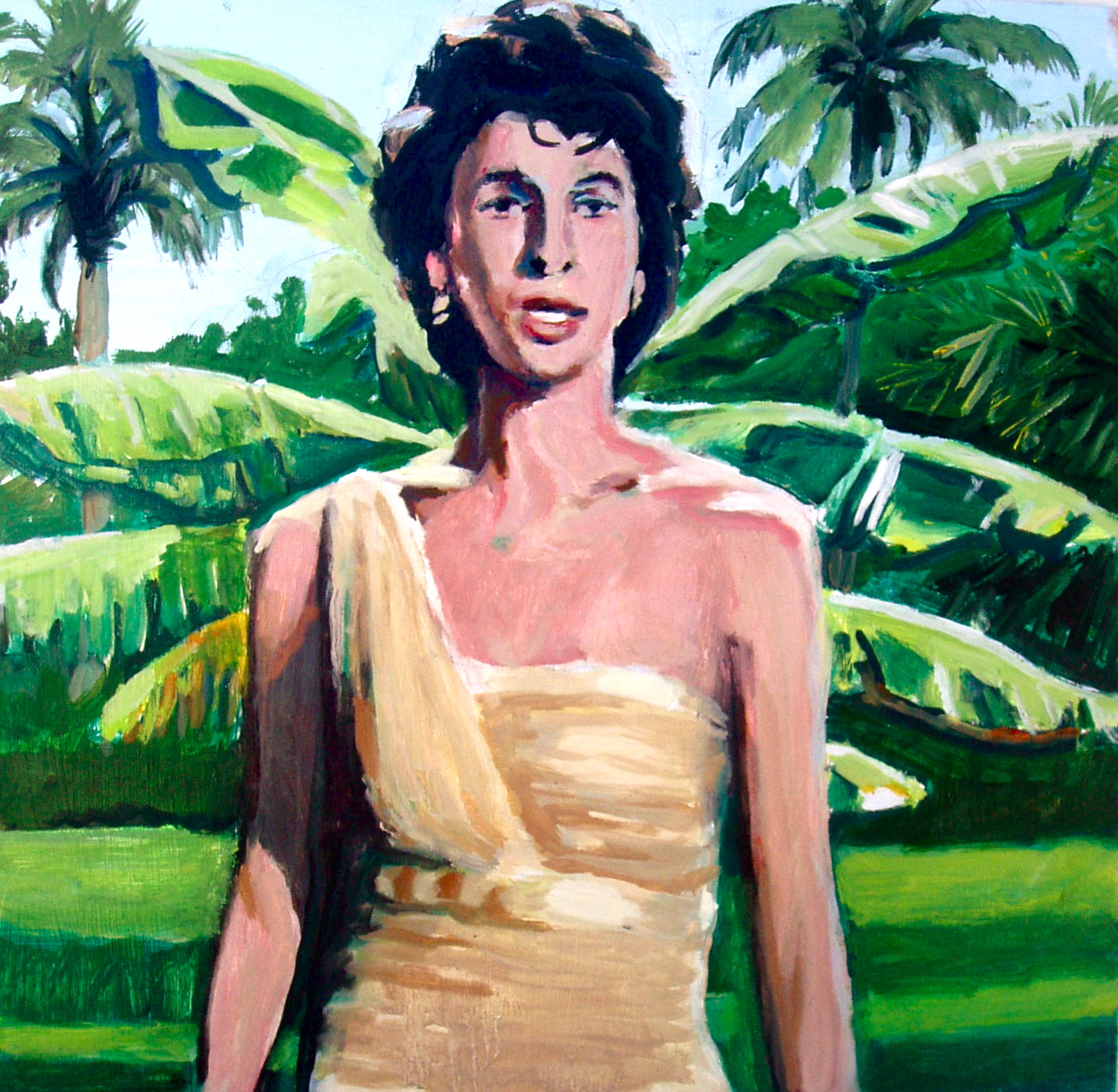
11" x 8.5", India ink on paper, 2013

There's just no chance I can get all 100 musicians for the Top 100 painted in oils in time. There are still almost 60 musicians to be painted and time is running out (the usual mid-March deadline). The solution to this problem is simple: I resort to ink drawings on paper. So in the next month there will be an onslaught of such colorful ink drawings as the one above, published here. The portrait of Hirut Bekele was made to test the materials I have in mind for finishing the Top 100 2012. I think I like my new bottles of ink. Hirut Bekele, by the way, is an Ethiopian singer who recorded in the 1970s in Addis Ababa. The 1970s was the golden age of "Ethio-Jazz". Music from that era has been Top 100 material for many years now largely because of the release of the multi-volume series Ethiopiques. Hirut Bekele is not represented in these series as far as I can tell, but that doesn't mean she wasn't a star. If you go by the amount of videos on which she can be seen on YouTube, she certainly is a big star. The track in the Top 100 isn't quite like any of the YouTube videos though. There's no jazz band to back her up, instead you hear a simple and sober accompaniment of organ and krar (said to be an ancestor of the banjo) that allows Bekele to fully exploit her mesmerizing voice. Thanks to Brian Shimkovitz who posted the music on Awesome Tapes from Africa from an original cassette, and at the same time, introduced me to it.

Saturday, February 2, 2013

Bosavi Rainforest Music

Bosavi Women Lamenting
(after a 1966 photo by Edward Schieffelin)
12" x 12", oil on masonite, 2012
Consider the lives of Papua New Guinea natives living in the Bosavi rainforests for a moment. Just for the sake of reflection you should try to imagine what it would be like to live a life like they do. Imagine not to know any of the things you learned in school, imagine that most everything you do is guided by tradition rather than by reason. What a different life they live compared to that of ours. All of their days turn into music, their most sacred as well as the most profane moments of their lives are accompanied by a song, by humming, or by drumming. Me? I can't even remember the last time I sang a song. I don't even sing in the shower anymore. My most musical moments are when I'm in my car waiting for a traffic light and I tap my fingers on the dashboard to the rhythm of my left turn signal. My most sacred moment? I can't even conceive the meaning of that word anymore, as all days and every moment are profane, mundane, and secular. And yet there they are, in my back yard, a group of six Bosavi women whose weeping in front of a deceased relative turns into the most wonderful of songs. And yet it is music that colors my days...but it's the idea of music rather than the experience of it.

Saturday, January 26, 2013

Kel Hamza

"Kel" Hamza Şenses
12" x 12", oil on masonite, 2013
Kel Hamza, one of the three singers that are featured on the CD Master Musicians of Urfa, might be the least colorful one of them (and therefore the least likely to be included in the Top 100) but ends up making the most of an impression on me. Hamza's appearance and sound are relatively polished. He was literate, well dressed, and a gentleman. The song Kışlalar Doldu Bugün, one of the songs featured in an article in the blog Bodega Pop, went straight into the list of my "100 greatest songs heard in the year". When the article appeared in April last year, all three singers (the others are Mukim Tahir and Bekçi Bakir) were raking in the points in my ranking system, and the CD is found high in the list of albums for the year. Urfa (or Şanlıurfa) is a city in Southern Turkey near the Syrian border famed for it's rich musical traditions. It's also known for its conservatism, which probably helps if it comes to the survival of old traditions. (One of the many contradictions of my life that make up the character that I am is my love for conservation while in social life and politics I favor the opposite.) Kel (meaning bald) Hamza Şenses was born in 1904 and died in 1939 as a result of a fall after being beaten in a brawl. 

Friday, January 25, 2013

The Blues (cont.)

Abner Jay with unidentified girl
12" x 16", oil on masonite, 2013
Twenty years ago I moved to the United States, the biggest lure for me were the blues. It was that music that were the origins of all the music I was interested in as a teenager. I played guitar in a rock band. I was 16 and Eric Clapton was my hero, but I wasn’t all that good. Coming in contact with the blues songs that were the blueprint for much of the music I admired, rendered my belief in rock music as the meaning of life...futile. That, together with the realization that the music I was involved in was so commercial, and the realization that I was better with a pencil than with a guitar pick, made me quit the band. I didn’t lose faith in music altogether, but the balloon wasn’t made out of lead after all. For a while after that the only music I was interested in was the authentic Mississippi folk blues. But I could never be a true blues musician, I could only be a listener, a fan.

But I didn't really expect to encounter the blues in the US when I came. I figure I'd come across a mere vestige of something that happened in history. I was surprised to learn that there are still pockets of isolated areas in the south where the tradition lives on (although these are disappearing too.) Abner Jay, who died in 1993, was one those few musicians who played the blues from a local tradition that hadn't changed. He was from Southern Georgia, a stone throw away from the location of the annual Florida Folk Festival in White Springs, and just a few hours up the street from where I'm at. The above painting is modeled after a photograph of Jay (the unidentified girl is possibly Jay's daughter Brandie) taken at that festival which I am plan on attending this year. Both Abner Jay and the girl are seen singing and playing bones. Jay's recordings have been reissued by the Mississippi label, and the song in the Top 100 is My Middle Name is the Blues from a record called Last Ole Minstrel Man.

Monday, January 21, 2013

The Blues

Junior Kimbrough
oil on wood, 2007
Eisenberg collection
Some people say the blues is age old. Some people say the blues came from Africa. Some people say that there wouldn’t have been any pop music without the blues. Some people say that Robert Johnson learned to play guitar after signing a pact with the devil. There’s probably a grain of truth in every myth. The blues came into being around 1890, originating in the hill country of northern Mississippi, in the Mississippi Delta, southern Texas, and possibly in other southern US locations as well. The blues were an oral tradition. The first published blues was WC Handy’s Memphis Blues of 1912. It was first recorded in 1914 but it was really a jazz tune. The first blues recorded (albeit with a jazz orchestra) was Mamie Smith’s Crazy Blues in 1920. Both these examples of blues songs are far removed from the origins, the solo voice with guitar performances, that could be heard in the towns of the South and that to a certain extent still exist in the rural hill country of Mississippi, to this day. How the blues in its purest form initially must have sounded can be heard through various field recordings starting from the 1920s. A field recording that was made around 1910 is regrettably lost.

Some people find the structure of the blues too rigid but it’s that aspect that intrigues me the most. It is a characteristic the blues has in common with other traditional music as well as with other forms of oral poetry. The structure itself is like a language, when growing up with it, its use comes naturally. The vocabulary is available to all native speakers. It is in such traditions nearly impossible to establish the exact authorship of a certain phrase, verse, or a certain song. That is not to say that the performers within such traditions are not creators. On the contrary the constructions of the traditional frameworks allow the performers to freely express or communicate. When the form is established on the onset of a work, the performer doesn’t have to formalize, and can go directly to the heart of the matter. With every performance the blues musicians re-create their songs. Composition is improvisation.
Even though blues musicians are only a small percentage of all the musicians I have painted over the years, I feel a great affinity with the blues in my art processes. By separating the conceptual structure from the actual activity of painting I find myself able to move freely within the canvases, unburdened by the considerations of concept and validity. The structure is the Top 100, a concept that I put to use while still a teenager exploring music in the early 1980s.

But it’s not just with the issue of moving within a pre-circumscribed framework that I feel the affinity with the blues performers, what’s more important yet is the attitude—to paint with a blues feeling—the circumstances of the blues. I adopted the mindset of the traditional blues performers perhaps unconsciously. Or perhaps according to some universal law. The blues feeling has to do with fate: “in the long run there’s no change, so that there’s nothin’ else to do but what you’re doin’...and sing the blues.” I like music over art. There is more harm in harmony than there is pain in painting. My paintings are like blues songs that are contradictory and inconsistent, that “reflect both the struggles and the difficulties”, are regressive and conservative, from a vantage point of an outsider that could never become an insider. It’s a prerequisite of traditionalism that things don’t change. “It’s only when people think that things can or are getting better that the blues begin to lose their appeal.” Some people think that the blues is out of date, that it’s become stale.

What has become out of date is perhaps the reliance of the blues (and oral traditions in general) on subjective experience in a time where human existence is conditioned by objective empirical reality. Experience becomes more and more irreconcilable with knowledge. What we experience is at odds with what we know. In our experience the sun sets while everybody knows all too well that it’s not the movement of the sun but the rotation of the earth causing the sunset. People will think you’re a lunatic if you proclaim the world is flat, yet most everybody will experience it that way. Knowledge is omnipresent and it comes at the cost of losing touch with experience. The quickly disappearing cultural traditions of the world could well be symptomatic for the decline in subjective expression in general.
What will be left after every myth is busted?

Friday, January 11, 2013

Kimya Dawson


Kimya Dawson
12" x 12"
oil on luan, 2012
The 2012 top 100 year is coming to a close and I'm wrapping up the list in the next few weeks. There are about 8 or 9 more paintings to complete in order to have the first 50 all done in oils. They're either 12 inch square or 1 x 2 feet. The last 50 then will become watercolors at 8.5" x 11". There still is a lot of uncertainty who those last 50 will be as I select them from almost one hundred songs that gathered 10 points in 2012. The paintings that still need to be painted from numbers 1 through 50 are either additional songs by musicians that were already in the list (and painted) or by musicians that are anonymous or without an available photograph to paint from. Kimya Dawson clearly belongs to the former category. The painting of her that I did before, was the first one for the Top 100 2012 series back in April, followed by a portrait of her daughter Panda a few days later. Then I painted Dawson together with Adam Green for the 100 Greatest Recordings Ever series in the Summer. I had not heard of Kimya Dawson or the band The Moldy Peaches (Dawson and Green) before the the year started but since then I've gathered most of their recordings. Dawson will probably appear 5 times in this year's list (more than anyone else), twice with Adam Green in the Moldy Peaches, and three times solo. Two of the three solo tunes come from My Cute Friend Sweet Princess. This painting then is dedicated to the song Being Cool from that CD (2004).

Sunday, January 6, 2013

Pounding Maize

Girl pounding corn meal with 
pestle and mortar
24" x 12", oil on luan, 2013
The song Canto para Pilar Maiz was recorded by Francisco Carreño and Miguel Cardona on El Margarita Island in Venezuela in 1949. It was part of the collection of Venezuelan folk and aboriginal music edited by Juan Liscano that appeared a few years later as volume 9 of The Columbia World Library of Folk and Primitive Music under the auspices of Alan Lomax. It's a beautiful series of records with great music, lots of texts, and beautiful photographs. The photographs in this particular album are not credited. Typically they were made by the same person who did the recording or else by another member of the expedition. I really should give credit to the photographer providing the source material for this painting. Not often am I as enchanted with a photo I use as a source, as I am with this one (typically I opt for the most casual, least professional photo available for a certain musician.) The photo illustrating the corn grinding song is really a great image, great composition, I could not go wrong. I substituted the large cross in the background in the photograph for a setting in my back yard.

Thursday, January 3, 2013

Kathleen Hanna


Kathleen Hanna
24" x 12"
oil on luan, 2013
I can't remember the precise circumstances but Kathleen Hanna appeared in a dream I had on New Year's. The only other time that I remember a musician appearing in a dream was about twenty years ago when the Belgian-French composer Cesar Franck took me for a ride on a moped. All I remember about the Hanna dream was that it was situated at a party and she offered me something to eat, but I grabbed a beer instead. Kathleen Hanna came to the forefront in my 2012 music year several times. She was an outspoken supporter of the Russian group Pussy Riot in their controversial trial versus the state, and lauded their music in the process. Earlier in the year I had watched a La Tigre documentary film and earlier yet I brought the CD The Singles by Bikini Kill with me on a long drive traversing the country. I don't play that CD too often anymore but on the rare occasions that I do I play it loud and enjoy every second of it. New Radio, a single from 1993, produced by Joan Jett, was the song that stood out most on the occasion. It was in the top 100 before but that was 12 years ago. Tobi Vail, Billy Karen, and Kathy Wilcox, were besides Hanna the other musicians on this recording. Bikini Kill was a pioneer of the riot grrrl movement. The band is from from Olympia, Washington, where they formed in 1990.

Thursday, December 27, 2012

Metal Heart, Amazing Grace

Cat Power
24" x 12"
oil on luan, 2012
She has a brand new look, a brand brand new hair style, a brand new music style too. She's Cat Power. Her song Metal Heart has been in the the Top 100 before, before I even blogged about those songs. I really thought of Cat Power back then as her having a metal heart (metal as in heavy metal). Can't be so sure anymore as she seems to have traded it for a hip hop heart now. Metal Heart is a Cat Power song that quotes from the classic Amazing Grace hymn. It's a blues song really (years ago I also likened Cat Power's music to the oral history of the blues traditions in American music). Metal Heart was featured on her third recording, an LP called What Would the Community Think, as well as on her second to last one Jukebox, recorded with the Dirty Dozen Blues Band. I've heard claims made that hip-hop is the linear ancestor to the blues, and that Grandmaster Flash and the Wu-Tang Clan could be considered as part of the same long line of African-American oral history traditions as Son House, and Muddy Waters would have been. I've done about 28 or so Cat Power paintings over the years, enough that you would think it's a career in and of itself but even the 2,000+ musicians overall that I've painted still don't add up to much of a career... There is still hope, the hobby continues, I'm still that fan.

Wednesday, December 19, 2012

Faiza Ahmed

Faiza Ahmed
12" x 12"
oil on luan, 2012
Faiza Ahmed (1934-1983) was an Egyptian singer of Syrian and Lebanese ancestry. Her top 100 song Set El Habayeb Yahabieba that was featured in an item on Faiza Ahmed in Bodaga Pop, is one of her best known songs, apparently a Mother's Day favorite. I went out of my way this time in preparation for the painting. I took a bunch of photographs of my banana plant in the early morning sun and planned the composition with superimposing a photograph of Faiza Ahmed onto one of the banana pictures's. The painting totally existed in my head (and on paper as well) before I started applying the first paint. I was after a lushness of both vegetation and singer's expression that I think in the end only partly materialized. Mother's Day in Egypt falls on March 21st, which was my father's birthday, and also the date the Top 100 2012 will be played. That day in 2013, when days have the same length as nights all around the world, I intend to play the Top 100—radio show style—live on line. I'll keep you posted on this.

Saturday, December 15, 2012

Bocet in my back yard

Bocet: Lament for a dead father, Romania
12" x 12", oil on luan, 2012
It's all happening in my back yard. All my favorite musicians have been visiting and they came from all over the world. I had Bob Marley and Jimi Hendrix over to play some soccer, just a week ago I had some girls from Borneo prepare the rice. I had tons of live music happening, from Guatemalan street musicians to a performance by Rahsaan Roland Kirk, there's been naked people, Muslim women that only showed their eyes, Siberian people dressed to withstand extreme (cold) temperatures, cannibals, and pacifists, and now there's a funeral going on. Maybe it's time to do some further landscaping, to make the background more inviting. Especially since one of my next visitors will be my sister, and she is for real. What I really need to do is to make the house presentable, because my sister, unlike all the luminaries I've painted, will also come inside. The three sisters in the painting, lamenting the death of their father, are not the same Romanian women that lamented their brother on a 1930s recording by the Hungarian composer Bela Bartok, that will feature in this year's Top 100. There's actually only one woman singing the Lament for a dead brother. The song is, of course, also represented on the CD Keening Songs and Death Wails I recently compiled. The following text accompanies the Romanian Bartok recordings:

"The woman designated at the funeral to bewail the death in Romania is called a bocitorre (comp. voceratrice in Corsica), and the lament a bocet (vocerata in Corsica). The tradition of funeral lamentation in Romania is similar to those of other catholic countries. The laments are often sung by relatives of the deceased but sometimes a professional wailer is hired. The bocitorres on the LP Folk Music of Rumania (as Romania was spelled) are relatives of the deceased except in Lament for the dead which is sung by a professional. It is also the only bocet that has a musical accompaniment (in the form of a flute). All bocitorres are anonymous on the LP that was released by the Folkways label of Moses Asch in 1968. The recordings however, all made by the Hungarian composer Bela Bartok, are much older. (Smithsonian-Folkways on their website, gives 1951 as recording year, but this can’t be true: Bela Bartok died in 1945. He was living at this time in New York City. I suspect the recordings stem from the 1930s, or even earlier)."

Friday, December 14, 2012

Rosa Balistreri

Rosa Balistreri
24" x 12"
oil on luan, 2012
I don't speak Italian, so the lyrics to the song Buttano di to mà by Sicilian singer Rosa Balistreri don't really make an impact on me but the song certainly did. It's clearly one of Balistreri's more dramatic songs. Not I'm an expert though, I had never heard of Rosa Balistreri until just a week ago when I picked up a copy of her album Amore tu lo sai,la vita è amara. I have since heard about twenty of her songs, 12 on the album and an additional eight or so songs on YouTube (the site that pretty much has everything you can think of). Buttano di to mà was not on the album, but it was the song that stood out for me most upon my first introductions to the music of the Sicilian singer. The blog(ger) Kalliope Amorphous states that the song "is quite possibly the most powerful 'fuck you' song ever recorded." Kalliope also states that Balistreri deserves more attention outside of Italy. In Rosa Balistreri: The Sicilian Folk Singer You Should Know About she writes: "I have been listening to Rosa Balistreri for many years, but was surprised to find very little mention of her in English speaking articles and reviews. It is unfortunate that these voices can become so easily lost in the miasma of what passes for music in our culture." Despite that there is "very little mention of her in English speaking articles", there is plenty of presence on line. Lots of texts in Italian, and also lots of music and photographs that don't require any language skill to indulge in. Great photos too! I may have to paint some more soon (I have to, if I keep listening so much to her music). Rosa Balistreri was born in 1927, grew up in a brutal, feudal Sicily. As an escape she began to sing Sicilian folk songs but it took her through many inhumane jobs and relationships before she was, at the age of 39, able to make a recording. Balistreri fled from Sicily to Florence in the 1960s, but moved back again in the 1970s. She died in Palermo in 1990.