Monday, March 23, 2020

At Home


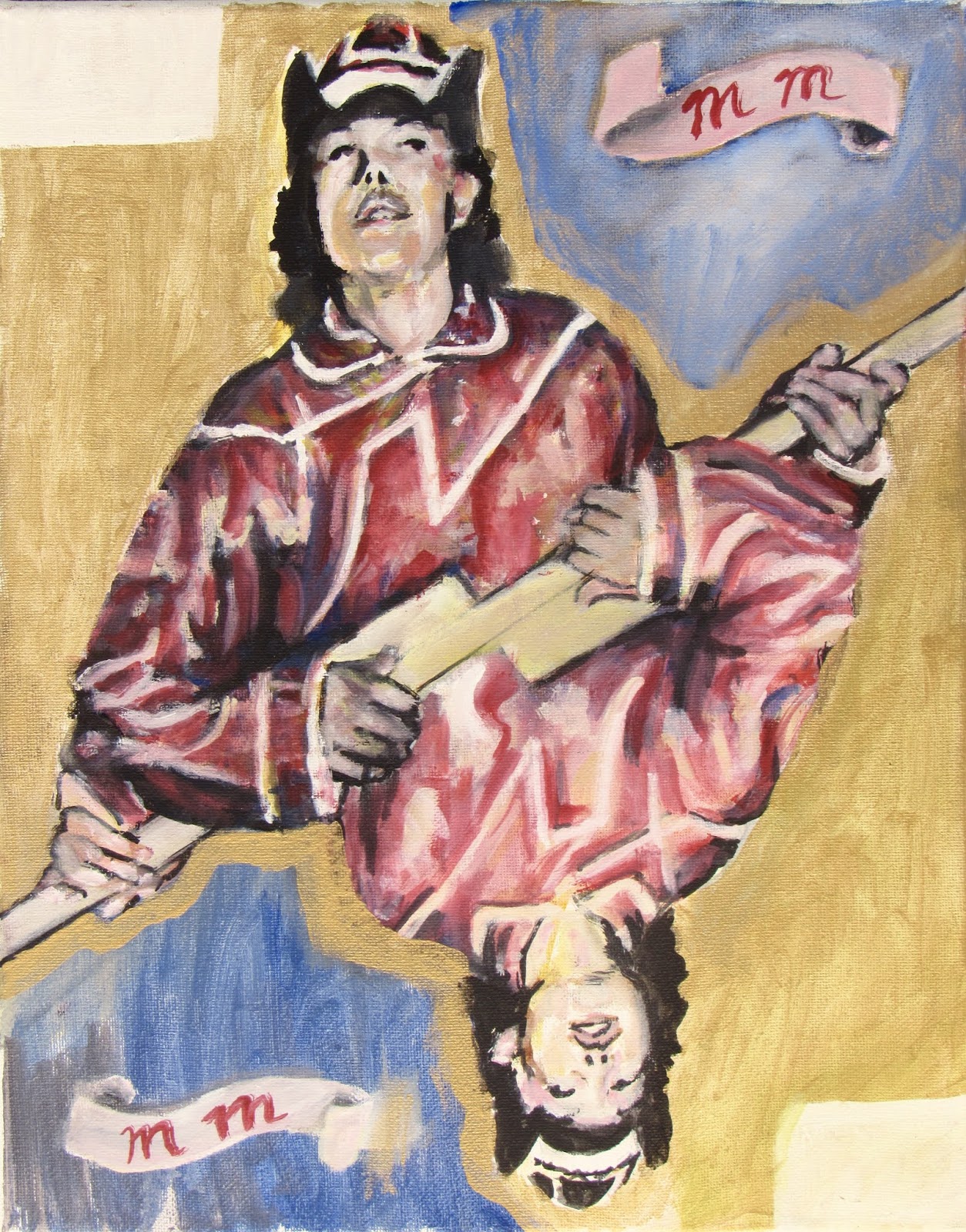
Xylophone (Highland People, Vietnam)
11 x 14 inches, mixed media on paper, 2020

Jane Wiedlin
14 x 11 inches, stencilprint on paper, ed. 52, 2020


Top 100 Archive and Studio (in progress)
Home, weathering out the coronavirus outbreak. Teaching remote, twiddling around. I should have had the Archive building finished but a combination of know-how, or lack thereof and laziness keep me from achieving this coveted milestone. I'm getting closer however slow the progress. After finishing all 100 paintings for the Top 100 2019 I'm slowly starting to think about this year's. For no other reason than 'I just felt like it' I started faithfully copying an image from the booklet tucked in the LP Introduction to the Music of Viet Nam that has been a mainstay on my player in recent weeks. Earlier, in the context of my twice-annual stencilprint project with Art Appreciation students, I had already created a print depicting Jane Wiedlin, known for her part of the Go Go's. After watching a fantastic concert of Go Go's classics at the Bob Rauschenberg Gallery earlier this year I chose Jane Wiedlin as subject to trading prints with students. Jane is being sent one too and so is the artist Beatriz Monteavaro who sat in on drums. I met them both and got a high five from Jane Wiedlin. So now there's two disparate works that could end up being the start of the Top 100 2020. I have not decided on a theme, style, format, or topic (if any) for the upcoming series.

Tuesday, March 17, 2020

The Top 100 2019 is finished!

György Ligeti
All images 14 x 11 inches, oil and spray paint on canvas, 2020

Les Siècles Live: György Ligeti (2016), directed by Francois-Xavier Roth featuring cover art that was found by the publisher Actes Sud on this very blog. A beautiful CD on which Les Siècles perform Six Bagatelles, Kammerkonzert, and Dix Pièces pour Quintette à vent. The last of these is in the top 100. I'm still very proud of their use of my painting. This one is brand new though.

Cat Power
For the upcoming Top100 2019 exhibition this painting replaces the concert drawing I did in September of 2019 that was to illustrate the track Robbin Hood from Cat Power's latest album Wanderer. The image above comes from an earlier Cat Power album Moon Pix. In the book called You Should Have Heard Just What I've Seen both my work, and the Moon Pix cover are featured. The Moon Pix cover is a work by renowned photographer Roe Ethridge.


Otto von Schirach
A track from my favorite hardcore disc Threat: Music that Inspired the Movie (Halo 8/King's Mob, 2006). The track Champagne Enemaz features a remix by Otto von Schirach of the recording by the Californian metalcore band Eighteen Visions. After Sun Ra, who I painted recently, von Schirach is yet another musician in this top 100 who claimed to have been born in outer space. His biography states that he was dropped either by UFO or Graviton in the third point of the Bermuda triangle, which is Miami. He was indeed born in Miami, FL in 1974 from German and Cuban ancestry. His grandmother practiced Santeria. As customary with DJs, I had assumed that breakcore musician von Schirach was an assumed name but apparently it's real. Typing von Schirach into Google search results in the biography of the infamous Nazi politician Baldur von Schirach.

Three Women performing 'Harawi'
The track Pasqakuymi comes from the cd Traditional Music of Peru, Vol. 6: The Aycho Region. Heard are women of Socos (Peru) performing Harawi. The women depicted above are not the women heard on the Pasqakuymi but part of a group performing harawi (a style of singing) on a later track on the CD. Pasqakuymi relates to, and is performed on Compadres' and Comadres' Thursday, part of the Peruvian carnaval following Ash Wednesday.

Mergen Mongush
Mergen Mongush is represented in both books (with cd inserts) that I have on the subject of Tuvan throat singing. In Overtone Singing by Mark van Tongeren three pages are dedicated to  including a biography. Mongush was born in Chadan, Tuva in 1962. The cd tucked in that book features an example of the 'chilangit' style of overtone singing that Mongush personally developed. Alash the track in the top 100, named after a Tuvan river) appears on the cd that accompanies the book Where Rivers and Mountains Sing: Sound Music in Tuva and Beyond by Theodore Levin.

Saturday, February 29, 2020

Babinga

Babinga Ceremony
14 x 11 inches, oil on canvas, 2020
The woman in the painting already appeared once behind Andre Didier in a painting I did not too long ago. Then I removed her. The photograph from which I pulled her image did not appear in the photo of Andre Didier but appeared on a separate photo that was also taken by Gilbert Rouget stemming from the same Ogooué-Congo Mission of 1946. Chant magique en partant pour la chasse au filet is unlike the work song that was illustrated in the Didier painting a recording of a ceremony. This was the reason the image was removed. For this track the image is more appropriate and may very well be depicting the actual person dancing in front of the chanting chorus of women that feature in Roget's photograph.

Friday, February 14, 2020

Some thoughts on representing "the other"

Bapende Chief
14 x 11 inches, oil on canvas, 2020
The Bapende Work Song found on Folk Music of the Western Congo does not come with any images associated with it. The song is a work song that was performed in the process of villagers building a house for their chief and was recorded by Leo A. Verwilghen in 1954. A photograph of a xylophone player is the only of the Bapende people included in the booklet that all Folkways' series come with. A Google image search on the Bapende yield an incredibly rich array of photos associated with Bapende ceremony. The song however is not a sacred song so I refrained from using any of the images showing those ceremonial masks and costumes that are associated with the Bapende and celebrated in Western art appreciation. While usually shying away from using images owned by giant image databases such as Getty, I settled for a small black and white photograph made by Michel Huet and owned by Getty Images. The fabric used on the chief's hat has the same pattern as the headdress on one of the Rundi women that I painted and subsequently adopted not too long ago. The pattern is made of triangles that create intricate negative space patterns. 
The photo also clearly shows facial markings on the chief (either tattoos or scarification) that I assume functions as identification of a chief. I've been thinking about identity a lot lately, reading Reasons and Persons by the philosopher Derek Parfit and using the topic repeatedly in the art appreciation I currently teach. Body art, including the ever so popular art of tattooing, is a medium closely associated with personal identity. Yet, in many non-Western cultures the identity expressed is not a personal identity but a belonging to a certain group, religion, class, family and so on. The function of the tattoo is almost the exact opposite than the expression of individuality as it is used for in Western society. The person as individual, and the idiosyncrasies are more of the threat to the social structure than that they are celebrated. Many ceremonies, the sacred nature of these, are meant as a means to rise above (or beyond) oneself as an individual. To denounce personhood and become a sacred being shared with the ancestral (spirit) realm. It is perhaps rather unfortunate that over time the sacred meaning of ceremony and the subsequent loss of individuality has been used to simply control  ever larger groups that make up a society. So it happens that without any dissent the Bapende villagers happily get together and construct the roof over the new chief's building while performing the Bapende Work Song watched over by Leo Verwilghen.

Sunday, February 9, 2020

It's not all that esoteric


Dillinger
14 x 11 inches, oil on canvas, 2020
Cocaine in My Brain was a huge Top 40 hit for Reggae star Dillinger during my coming of age years in the Netherlands. It made it all the way to #1 in 1976. I'm sure the single Marijuana in My Brain from the following year was intended to replicate that success but failed to do so. You'd expect more given the Dutch affinity with marijuana. The band Doe Maar had a smash hit in 1980 with their marijuana anthem Nederwiet. I bought the Dillinger single in 1987 (I used to write dates on 45s). Dillinger, named by the legendary producer Lee Perry, was born Lester Bullock on June 25, 1953 in Kingston, Jamaica. I just finished painting Dillinger and have now just six more to go for the Top 100 2019. I figure I forward some of the (not so esoteric) paintings from these series that were painted last year. First Nick Cave, who after so many years made the list again due to the Peel Session Sampler LP that I played a few times last year. The record features Big Jesus Trash Can by Cave's band The Birthday Party. Adam Horovitz returned because of an MTV video  Live in Glasgow that can be watched on YouTube, and Captain Beefheart's Owed t'Alex appears on the compilation The Dust Blows Forward from 1999. It originally appeared on Shiny Beast from 1978.
Captain Beefheart
14 x 11 inches, oil on canvas, 2019
Nick Cave, The Birthday Party
14 x 11 inches, oil on canvas, 2019
Adam Horovitz, The Beastie Boys
14 x 11 inches, oil on canvas, 2019

Sunday, February 2, 2020

Saturnalian

Sun Ra
14 x 11 inches, oil on canvas, 2020
Sun Ra was born in Birmingham, AL as Herman Poole Blount in 1914 but he never liked to be reminded of that fact; "That is his-story, my story is my-stery." He claimed to be from Saturn but returned to Birmingham when his health was failing and died there in 1993. Searching the web for an image to paint I came across an interesting story by Mike Walsh called Stranger from Outer Space. I settled for the illustration Walsh used, and the article directed me to the movie Space is the Place that I diligently watched, the whole extended version of it. He's out there, for sure. The film features the Arkestra with singer June Tyson. The title track, which appears during the end credits, made sure that Sun Ra reappears in the top 100 2020. The entry for 2019, illustrated here, is from a video on YouTube of a concert in Berlin in 1983. The track is called Happy Birthday/Stars that Shine Darkly and the Arkestra features Archie Shepp on tenor. I can't resist to yet again quote Sun Ra, again from Walsh's article: In tomorrow's world, men will not need artificial instruments such as jets and space ships. In the world of tomorrow, the new man will 'think' the place he wants to go, then his mind will take him there. -- Sun Ra, 1956

Friday, January 31, 2020

Playing Cards

Ahem Mediferai
14 x 11 inches, oil on canvas, 2020
Tamara Ivikovna Sajnav
14 x 11 inches, oil on canvas, 2020
Zeze Musicians, Wagago, Tanzania
14 x 11 inches, oil on canvas, 2020


Ahem Mediferai: From the album West Africa: Drum, Chant & Instrumental Music (1976). Chant performed by three male and four female Tuareg singers led by Ahem Mediferai. Recorded in northern Mali by Stephen Jay. The strong diagonal in the photograph of Ahem Mediferai on the back of the album, and its artist's impression on the front, made me experiment once again with the diagonal 'playing card' (mirroring) axis. I did three the past week, still a long way away from a deck.
Tamara Sajnav: The notes to this song by Alena Uican from the cd Sibérie 4 – Kamchatka: dance drums from the Siberian Far East are odd and short (by Henri Lecomte): "Born in Rekinniki in 1969. She does not work so she can raise her child. This song evokes movements of sea mammals, which she imitates while singing." Life is very mysterious; the more you learn, the less sense it all makes. The image in the painting is of a Koryak woman who appears on the cd cover. The cd is dedicated to the music of the Koryak, the instrument seen is shaman's frame drum as is Uican's.
Zeze Musicians: The zeze is a stringed instrument found throughout Tanzania. The Wagogo of central Tanzania are especially associated with the instrument. The Wagogo Soothing Song can be found on the LP Africa: Ceremonial & Folk Music [Explorer, 1975] and was recorded by David Fenshawe. Two zeze players, a drummer, and mixed choir can be heard in a song that was intended to lull a child to sleep who couldn't. I doubt it if it worked; the performance is quite ecstatic but the zeze has a very soothing sound. The musician depicted appear on a very small photograph on the back of the album and are likely the zeze performers heard on the recording.

Monday, January 6, 2020

Abelam

Abelam man, 1917
14 x 11 inches, oil on canvas, 2020
The Abelam are one of those groups of indigenous peoples that speak to my imagination. Like the Jivaro, Selk'nam, and the Andamanese, the Abelam of Papua New Guinea belong to those most remote and prehistoric one can imagine. Situated just south of the equator along the Sepik River, running from the Highlands of Papua north to the Pacific Ocean, the Abelam were first seen by westerners a mere hundred years ago remaining with characteristics of the stone age. No metallurgy or writing system they knew of, tools are just of stone or bone. I first learned of the Abelam through the collection The Music of Primitive Man [Horizon, 1973] that featured two short outtakes. One, Abelam Warning, belongs to the most outlandish recordings I've ever heard and was listed in a top 100 some ten years ago. Last year I came across the cd Music of Oceania: The Abelam of Papua Niugini [Musicaphone, 1983, Germany] and downloaded several tracks. Nggwal mindsha, antiphony to the ancestral spirits is now part of the latest top 100 edition. The sleeve features a photo of a characteristic Abelam ceremonial house. As primitive as the technology of the Abelam is, their ceremonial houses are exquisite and display highly advanced building techniques. The music was recorded by Brigitta Hauser-Schaublin who also wrote a lengthy paper of the distinguished architecture of the ceremonial houses. The first mention of these houses, and the Abelam for that matter, was recorded by another German, Richard Thurnwald in 1913. The individual in the painting above was situated in front of a ceremonial house in a 1913 photograph by Thurnwald. There are no women depicted in early photographs of the Abelam, and in more recent pictures women only feature as bystanders. Figures in ceremonial costume, at dances and in front of ceremonial houses are all men. Unlike in more recent photographs, in which men wear western style shorts or ceremonial attire, they are seen nude (at least the one that I painted). Remaining in recent photos is the unique hair fashion of Abelam men coiffed into a near perfect circle, like a halo, or sun disc. Noteworthy too in the appearance of the individual I painted are the feminine looking breasts. Perhaps this individual, standing while others in the photograph are sitting in front of him, is an important person, maybe a shaman. An often seen characteristic of shamans is gender ambiguity. I may be reading too much into this photo but a mind may wander and wonder at the marvels of such distant people.

Saturday, January 4, 2020

No Way and No First

Nowayilethi Mbizweni
14 x 11 inches, oil on canvas, 2020
The first painting of 2020 is of Nowayilethi Mbizweni. This is my third painting of her and together they make an interesting triptych. The recording in (last year's) top 100 is again from Dargie's film Umngqokolo: Thembu Xhosa, Overtone Singing 1985-1998. On the particular section in the top 100 she's not performing solo or as a duet like she was in a previous top 100 but fronts the Ngqoko group seen in the movie. The group consists of about fifteen singers, mostly women but a few men are included too. Nowayilethi sits in front next to (her sister perhaps) Nofirst Mbizweni. The rest of the group are standing behind them. The term 'umngqolo' refers to the type of throat singing Mbizweni is known for and I now learned how to properly pronounce it with the Xhosa clicking sound included.

Monday, December 30, 2019

Garifuna Celebration

Garifuna Settlement Day Festival
14 x 11 inches, oil/mixed media on canvas, 2019
The Garifuna are descendants of West Africans and the Carib and Arawak peoples. The song Abelagudahami appears on The Spirit Cries: Music of the Rainforests of South America & The Caribbean (Smithsonian, Library of Congress, 1993). It was the first album of the Endangered Music Project series initiated by Grateful Dead drummer Mickey Hart. As with so many indiginous Americans the history of the Garifuna is one of persecution and displacement. Native to what is now the Virgin Islands they ended up in Honduras and spread to neighboring Belize and Nicaragua. The Garifuna heard on Abelagudahami are from Belize. Despite the 'endangered' label on the cd they are today thriving in Belize.
This will be the last painting and posting of the year. I didn't paint quite a hundred pictures. Happy New Year, dear readers!

Saturday, December 28, 2019

South African Politics

Princess Constance Magogo kaDinuzulu 
14 x 11 inches, oil on canvas, 2019
The image above appears on the cover of the LP The Zulu Songs of Princess Constance Magogo KaDinuzulu as part of The Music of Africa Series produced in the 1960s by Hugh Tracey. The album is number 37 in the series and was also recorded by Hugh Tracey. The recordings are from 1939. The song in top 100 this year is from that album and is called Helele! Yiliphe Ielyiani? meaning 'which regiment is that?' in the Zulu language. I have no clue what the song is really about but the word regiment hints at a political subject. The princess was the daughter of King Dinuzulu kaCetshwayo of the semi autonomous Zulu Nation (r. 1884-1913) and sister of King Solomon kaDinuzulu (r. 1913-1933). Her son Mangosuthu Buthelezi (b. 1928) is a politician and Zulu leader who founded the Inkatha Freedom Party (1971) and remained in the South African Parliament until just a few months ago. Princess Constance remained an advocate for Zulu culture and music throughout her life. You can read more on Princess Constance here.

Sunday, December 22, 2019

Tibetan Monks

Tibetan Monks, 1903
14 x 11 inches, oil on canvas, 2019
The monks presented here were originally photographed by William Hayman during a controversial British military expedition into Tibet in 1903. Tibet was then still a secretive mysterious country and the British set out to remove Russian influence. The expedition also introduced the first images of Mount Everest to a western audience. I've painted them to illustrate a lament sung by Tibetan monks. Lament for the Dead: Chant appears on a 1951 compilation on Folkways titled Music of the World's Peoples, Vol. 1. The following paragraph appeared in the online VAN magazine:

This field recording from the Smithsonian Music of the World’s Peoples series, captures, according to the liner notes, “Lamas chanting in unison with percussion and bells accompaniment.” The deeply resonant baritone voices, combined with the barely audible, overtone-rich bells, create an almost unbearably chilling sound. This is a lament for the dead by the living, but the sound seems more to emanate from somewhere beneath the earth—from the dead themselves. [Jake Romm – A Giacinto Scelsi Playlist: Sacred Sounds and Sacred Syllables, 2017]