Showing posts with label Vietnam. Show all posts

Sunday, November 3, 2024

No title


Cover Image from Musique Proto-Indochinoise

Musique Proto-Indochinoise - Recueillie Chez Les Moïs Des Hauts Plateaux Du Viet-Nam is a record recorded in 1955 by Frantz Laforest: "Mission Ethnographique 1955 sur les Hauts Plateaux du Viet-Nam." Moïs or Montagnard (from la montangne—the mountain) is an umbrella term for several groups of indigenous people from the central highlands of Vietnam. The record does not specify between different groups. The woman represented here (and on the cover of the record) is most likely one of the main performers from the recordings by Laforest; she also appears on the back sleeve playing a jew's harp. In the image above she's playing a stringed bamboo instrument that I don't recognize from the descriptions of the songs, neither from instruments I've come across before. The top 100 song is performed on a "carillon hydraulique," a sort of bamboo organ. It's also possible that Laforest, who took the photo featured on the cover and back sleeve, posed a particularly cute indigenous woman with the instruments for the sake of increasing sales. Probably not, but the practice of employing cute women, stripping them above their waist, was very much standard procedure a half a century ago. The anthropologists paid extra for the the women, to reinforce the notion they were primitives, to strip. Years ago I swore not to use gratuitous nudity anymore for my Top 100 illustrations but recently a number of 50s and 60s racy photographs have functioned as a source for paintings. Another painting recently completed is of a woman from a group of women in a healing ceremony from an image by the famous Charles Duvelle, that appeared on the record Anthologie de le Musique du Tchad from 1966.
Moundang woman (Duvelle)


Tuesday, November 9, 2021

Switched

Walter Carlos (1970)/Wendy Carlos (1979)
Wendy Carlos (Am., b. Walter Carlos, 1939) came to prominence in 1968, when her debut album Switched on Bach, became an instant classic of electronic music, it won her three Grammy Awards. The album popularized the Moog synthesizer, a craze of the 1970s. More importantly she helped to raise awareness of transgender issues when she revealed she was living as a woman since 1968 and had reassignment surgery in 1972. The tune in the Top 100 is Dialogue for Piano and Two Loudspeakers from her 1975 album (still as Walter Carlos) By Request. The album was less of a commercial success than some other that followed Switched on Bach, but contains a bit more experimentation. I feel a bit self-conscious about this painting as I wonder if Ms. Carlos would approve. 
Doàn Van Chop Và Kän Xua/Dan Tao
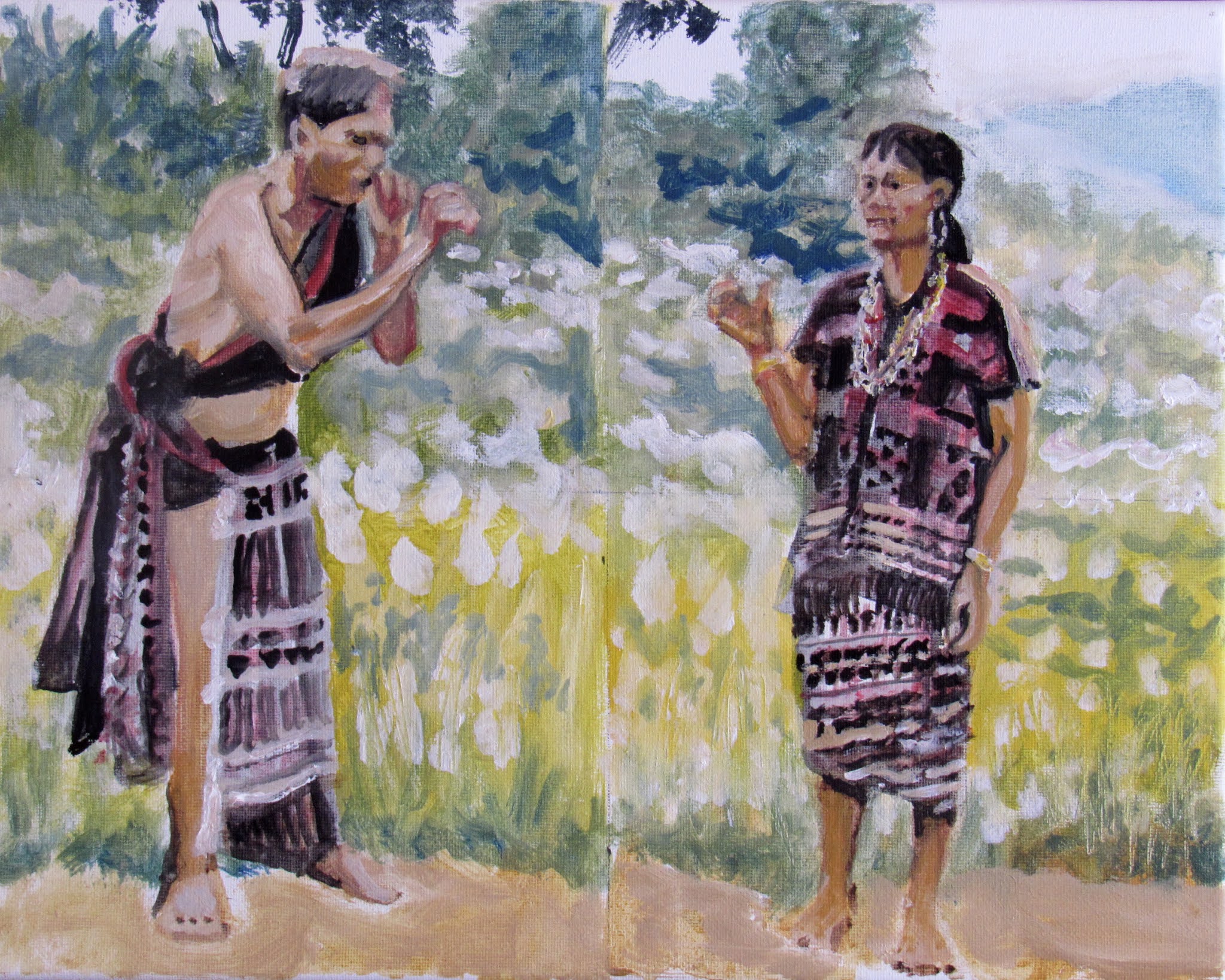
If I understand the Vietnamese words in a video from the Vietnamese Institute of Musicology in Hanoi correctly, Doàn Van Chop Và Kän Xua and Dan Tao are the performers of the A'bel. They belong to an ethnic group called Pako Tà Ôi, while the type of song is called A'bel. The instrument used, a simple bamboo flute with one finger hole, is an A'reng. The location is the Huong Läm community in the Loui district of the Thua Thien Hue province. A'reng is a simple reed instrument played by two players, one blows into the mouth of the second (who features as the resonace chamber) and is traditionally performed by a mixed couple. The tradition may be extinct. The painting shows the two performers who, in the video, stand very close together, they touch. They are separated in the painting.
Kiyo Kurokawa/Kazuyuki Tanimoto
Ihumke is a lullaby (nursery song) performed by Kiyo Kurokawa. The song features a strange vocal technique that involves a high-pitched trill and a rolling tongue. It comes
from the UNESCO album Japan: Ainu Songs, which was recorded by Jean-Jacques Nattiez and Kazuyuki Tanimoto in Hokkaido, Japan in 1978. Tanimoto is like Kurokawa from Hokkaido.


Saturday, July 31, 2021

Their subjects are the objects

Võ Vân Ánh (or Vanessa Vo) is a California based Vietnamese musician best known for her work on the đàn tranh zither. [Wikipedia] After some considerations I opted to use an image of her playing the đàn tranh zither to illustrate a Cai Luong, an instrumental played on a đàn tranh zither. Cai Luong is the most popular genre within the Vong Cô form in traditional Vietnamese folk music. The recording in the Top 100 comes from the album Music of North and South Vietnam: Sung Poetry of the North, Theater Music of the South which was recorded by Stephen Addiss and released by Folkways in 1971. Stephen Addiss is a Professor of Humanities and Art at the University of Richmond in Virginia. His art is greatly influenced by Eastern Zen painting and among books he published is The Art of Zen. [1989] Lacking an image of the performer in the liner notes (no name either, the only information given is that it was performed by a woman) it seemed that a portrait of Addiss would make most sense. While learning about Addiss via Google I wasn't inspired though and kept on searching for an alternative, and settled on this specific image of Vo. I had difficulty in capturing her likeness, which is unusual, so I kept trying, and trying, and trying. Gradually what I perceived as her essence announced itself on the paper. Cai Luong is number 92 in the Top 100 of 2020.


Jean-Pierre Estival/Asurini et Arara (cover)
 

The next two paintings I completed for the Top 100 2021 pair two European anthropologists with their exotically themed subjects. The word exotic is cringe worthy as it assumes white Eurocentric western culture as norm and different realities as other. The anthropologists, or ethnologists, or musicologists who have been recording the bulk of the Top 100 2021 materials are often musicians themselves but as musician it would be very unlikely tor them to enter the list. Jean-Pierre Estival, who recorded the Brazilian Asurini do Trocara,  apparently plays the trombone. He is coupled with an individual from a group depicted on the cover of Brésil: Asurini et Arara. [Ocora, 1995] The Asurini used to roam about stark naked but when Estival recorded them and took the pictures in the late 1980s they were wearing baseball caps and soccer shirts (among other modern dresses.) The Eipo people of West Papua (the Indonesian side, formerly Irian Jaya) still go around without clothes but they did give up their cannibal ways. Paired with the German musicologist Prof. Dr. Arthur Simon is the same Eipo individual I used to illustrate the same Dit song in last year's list. The recording was originally part of an enormous research project and 6-CD set Musik aus dem Bergland west-Neuguineas, Irian Jaya. The CD was released in 1993 but the recordings were made in 1976.


Eipo woman/Arthur Simon

Friday, May 28, 2021

Cantos de pilon (worksongs)


Canto Para Pilar Maiz
has been in my top 100 twice before. Both in 2013 and in 2018 I used the image that illustrates the song in the liner of the album The Columbia World Library of Folk and Primitive Music, Volume 9: Venezuelan Folk and Aboriginal Music. Now I used the image as an insert (upper left corner.) In 2018 I knew more about the song and the image as I did in 2013 and now in 2021 the picture concerning the song and image becomes clearer again but also more confusing. I am not exactly sure anymore how to interpret the data provided in the liner notes with the Columbia record (of whom Alan Lomax is the final editor) as there are certain errors in the text. I am not sure if the image provided with the song is indeed Ana Caraballo (or Asuncion Caraballo—who is listed as a collaborator—for that matter.) I'm not sure anymore if the performers of the song are correctly identified. There seems to be some confusion about names involved, of the singers, the recorders, and individuals mentioned in the lyrics. On line I found another song (called Cantos de Pilon, undated but more recent than the 1949 date of Canto Para Pilar Maiz) that has almost identical lyrics (even though the lyrics of Canto Para Pilar Maiz were improvised, according to Juan Liscana, who is credited as writer of the liner notes together with Alan Lomax.) In the lyrics of Cantos de Pilon the taparo tree from Canto Para Pilar Maiz is substituted for a lime tree, and the name Alfred Caraballo, the dedicatee of Canto Para Pilar Maiz, is substituted for Asuncion(!?) One thing is certain: Canto Para Pilar Maiz is a work song. The rhythm of the song follows the rhythm of the pestle beating down on the corn inside a mortar. The job and song are typically performed by two women. The main image in the drawing comes from a photo used in a review of Cantos de Pilon. The source of the information: Luis Felipe Ramón y Rivera, an important figure in the history of Venezuelan music, and folklore.
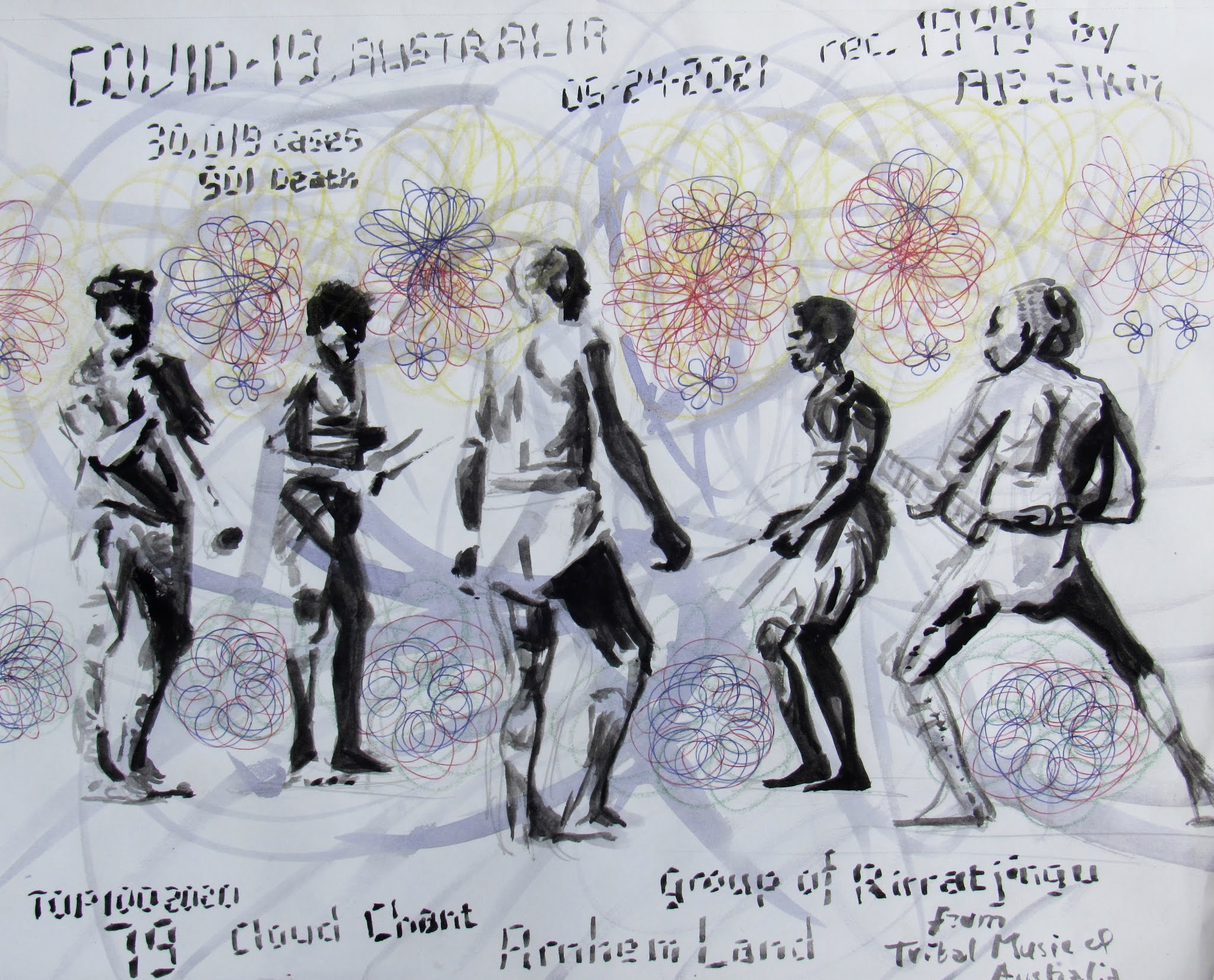
More paintings and drawings have been finished for the Top 100 2020 and 2021. The above image is to illustrate number 79 in the Top 100 2020: Cloud Chant from the album Tribal Music of Australia from 1949 that features recordings by A.P. Enkin. I would have dwelt a bit more on this one were it not that I recently talked about him in the context of a mourning song from the same album. The image is taken from the liner notes in the album. I realized I never forwarded the impression I made of the cover of the album that I used for number 71 on the same list: Djedbang-Ari.

Traveling northwest from Australia you may encounter the island of Java in Indonesia, which is another location on the world map that has seen a good many anthropological and ethnomusicological projects undertaken throughout the twentieth century. From a 1950 album, again on Folkways, comes Udan Iris, a love song by a Sundanese woman coming in at number 81 in the Top 100 2020. The music on the album was recorded by Raden Suwanto and Harold Courlander. The portrait above is of Courlander, whose main focus was on African and Haitian music. Courlander (1908-1996) today, is mostly remembered for a lawsuit in which he charged Alex Haley, the author of Roots, of plagiarism. Several anecdotes that appear in Roots were taken from Courtlanders adventure novel Africa, so he claimed. I find no evidence of Courlander actually traveling to Indonesia so I must assume the recording was made by Suwanto. That Courlander was given credit was probably because he was the main editor for the Ethnic Folkways Library label, a name devised by himself. Folkways itself was the project of Moses Asch. A great number of top 100 entries come from the Ethnic Folkways Library. And so does the next work discussed: It's from the Folkways album An Introduction to the music of Viet Nam. Geographically located about the same distance from Java as Java is from Arnhem Land in Australia, be it on a more northerly track. The 1965 album is a compilation by Stephen Addiss of historic recordings made by the famous Vietnamese composer and folklorist Pham Duy (1921-2013). The track in the Top 100 2021 is Ho Ru Con, which is a lullaby of ancient origin recorded in the north of Vietnam. "Ho" in the title stands for "work song." I have not come across the qualification of a lullaby as a work song before.
The image on the left, next to the portrait of Pham Duy, comes from the cover of the album mentioned the song appears on. The woman may or may not represent the singer of the lullaby. Seeing the painting now reproduced I find the face of the woman too narrow. I will go out later today to my studio to fix it. (This is not the first time it happens—what I need to fix, or hone rather, are my observation skills.) The country of Vietnam (in the 1960 still spelled as Viet Nam) also appears in the Top 100 2020. At number 72 in that list is a recording taken from the other main source of the music in the Top 100 2020, which is Les voix du monde, une anthologie des expressions vocales, a 3-cd set compiled by Hugo Zemp. Xi is yet another Vietnamese work song. This one sung by two boys is about the joys and troubles of daily life. The boys belong to the Nung An tribal people of again northern Vietnam and were recorded by Patrick Kersale in 1993.


Friday, December 21, 2018

Strange instruments from Vietman

Duo a'reng
14 x 12 inches, oil and acrylic on canvas, 2018
The paintings represent the 1 & 2 listed below: The A'bel and A'reng - Co Tu and Ta Oi Pako peoples of Hue Province, Vietnam. Both tracks are from a video uploaded to YouTube in 2013 by angklung eds, using footage from The Vietnamese Institute of Musicology, Hanoi, Vietnam. One man sings into a reed the other end of which ends in a woman's mouth that functions as a resonance chamber. The A'reng is a simple reed instrument with one hole that is traditionally performed by a mixed couple but the traditions is now extinct. The second tune shows a man playing a one string instrument, a dan k'ni, with a bow and uses his mouth as a resonance chamber. Information found on Rare and Strange Instruments by Nicolas Bras.
Strange instruments from Vietnam: 1.  The Dan k'ni; The players mouth is the resonance chamber of this string instrument. 2. A'reng is a simple reed instrument by two players, one blows into the mouth of the second (who features as the resonace chamber. 3. The dan-bau is a one-string instrument (like a diidley bo). 4. Dan-da is lithophone, like a xylophone but made fro stones. 5. Dan klongput is a giant panflute. 

The history of instruments

The oldest instruments ever found were two flutes made of mammoth bone and tusk. They're about 42,000 years old, slightly older than another flute also found in Southern Germany next to the oldest figurative sculpture known. We know humans decorated themselves and the world around them long before that time and they made music as well. Before there were instruments humans used their voices and bodies to create music. Like the origin of art, the origin of music is to be found on a different plane from the everyday experience. Music (and dance too) are an excellent means to escape that everyday consciousness and enter a plane of altered consciousness that would provide a reality more real than empiric reality. A reality of timelessness and placelessness, in other words "the sacred." The voice of music is distinctly different than the voice of language. It appears music came before language, which is utilitarian. To become sacred the voice must be distorted, one must become someone or something else. Instruments were initially created as an extension of the body or voice. The first instruments were likely found in nature, a conch shell, hollow wood, or stones that would provide a range of different sounds. Reeds could mimic, like the later trumpet and wind instruments, the sound of animals by blowing on them between your thumbs. Your hands are the resonating chamber. Try it! Later instruments were man-made either to perfect the nature found materials or to substitute the body. A drum sounds better and doesn't hurt as much as pounding on your own body. A resonance chamber, like the bag of a bagpipe, substitutes for vocal chambers as it is much easier to store air in than in your own body using the strenuous techniques involved in circular breathing. String instruments at first, obviously, consisted of one string only. The mouth was used as the resonance chamber. Only later the chambers were built outside the body and more strings were added.

There are no cultures without music, music is universal, but there are cultures without instruments.
Duo a'reng
14 x 12 inches, oil and acrylic on canvas, 2018