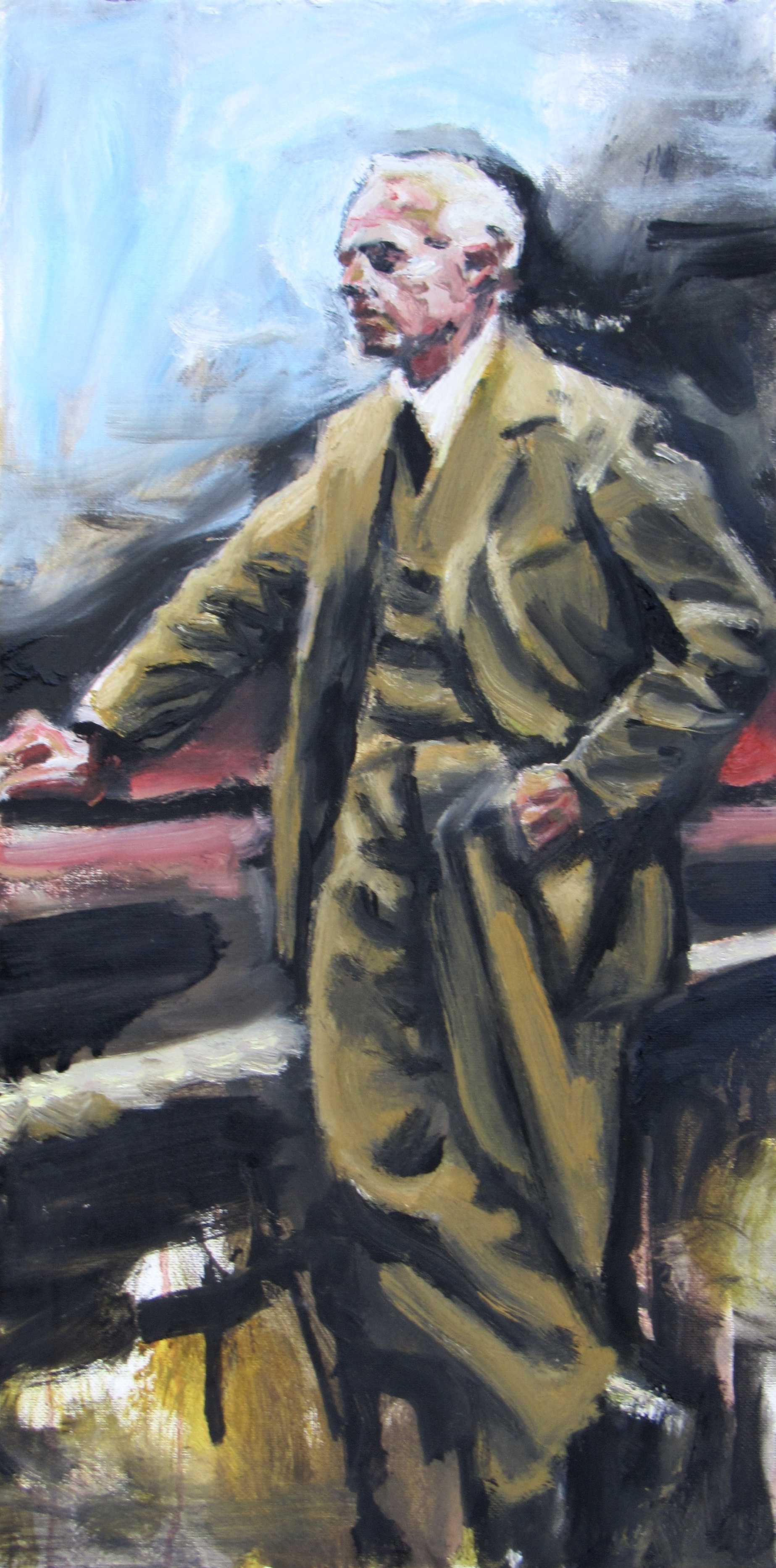
The album: Lost Shadows: In Defence Of The Soul (Yanomami Shamanism, Songs, Ritual) is featured in the Top 100 twice, while another song, Flying Witch Music, from Papua New Guinea. from the BBC archives, at #3 in the Top 100 of 2024, was featured on one of his radio shows for the BBC.  The above is rather big painting (well, 30x30 inches isn't all that big) that I've adding to for almost two years. Originally the painting was one that I found in the stacks of the art room, left behind by a student, featuring Princess Leia of Star Wars, in a pose reminiscent of some Victorian portrait paintings. The painting had some obvious mistakes, that I, out of boredom, I guess, fixed. At the time I didn't know the Star Wars connection, as I never was interested in any of that. The main thing I had to fix was the skin tone of Leia, which looked awful; eventually the face was substituted by one of another skin color: Aida Victoria, a contemporary American blues singer. On the top left of the canvas I reproduced an image of Lady Maria Conyngham by Sir Thomas Lawrence. Central top is a remake of a painting by Pablo Picasso, a portrait of one of his lovers. I started adding, after Aida Victoria, other Top 100 2024 entries: The Static, a group around Glenn Branca, and Teenage Jesus and the Jerks, led by Lydia Lunch, and notably included James Chance on tenor saxophone.
 Sun Ra appeared on a canvas that I had laying around to experiment with. The context again is my office hours as a professor of art at FSW. If no students attend these times dedicated to them I fill these hours with doing some painting myself in the classroom. Sun Ra has been the highest scoring musician from the Top 100 2024 and needed some extra exposure in the series of paintings. Three songs are in the list, Watusa is linked now to this painting, and it appeared in the movie Space is the Place. If you haven't seen it: Now's the time.
  Again an image I used before: Two Ainu women performing the "Rekukara," the Japanese equivalent to the Canadian katajjait. The difference between the previous painting and the current one is that the Top 100 song is that it represents neither geographical location; A small but significant population of Ainu had settled in Kamchatka, the eastern most territory of the Soviet Union. The recording "rekukura examples" was made in Kamchatka, Russia; the two Ainu women performing a Rekukara is the oldest known of this kind, and was recorded in 1941. The painting was done on a 20x10 canvas reserved for the Top 100 20024. Half of the paintings in that series were done on this format. The next five images are painted on a 10x20 inch canvas.
 Gidole, Ethiopia
 Chrissie Hynde, Pretenders: For the first time since I started in 1983, the Pretenders are listed in a Top 100: Message of Love.
 This is the first instance of me painting a work of folk art as a substitute for a track of which a more appropriate image could not be found. This is the cover of: Kwangkay: Funerary Music of the Dayak Benuaq of Borneo.
 Interpretation of an image found on Musique Ethiopennes. Throughout the year I have explored several collections of traditional Ethiopian music.