Tuesday, September 7, 2010

September!

Edward Kamau Brathwaite
11.5" x 7.75"
oil on wood, 2010

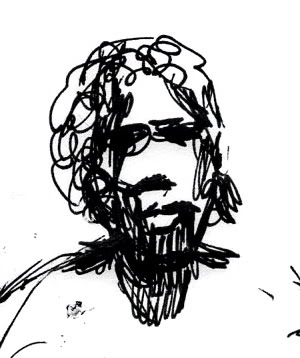
September has come around and that means the Top 100 season is getting serious now. Less than six months to get all hundred paintings done. They'll be coming fast and furious now as I have to average one painting every two or three days in order to get it done. My time in the studio will have much more of a decisive character, no more fiddling (diddling, doodling, fidgeting) around. Still, no painting is officially done until the Top 100 2010 comes around. There were several older paintings that I picked up and worked on again this weekend as a matter of fact. All these paintings, scrolling through this blog, may not exist anymore in the form you see them in. I've changed the Cat Power painting, the Joseph Spence, the second Beth Orton, and the second Nina Simone (I may have to remove the original from this site as I decided to cover up a fair amount of skin.) But I can only paint as many paintings as there are songs guaranteed to be in the Top 100. With this Edward Kamau Brathwaite painting I've pretty much painted every one in the list so far. The painting I started immediately after the Coleman painting (see previous). I painted the background first, a copy of the design I used behind Ornette Coleman. In the Coleman painting this design were random colors and lines breaking up the picture plane and (random) black shapes to animate the edges of it. I repeated these in the new painting but now the colors, lines, and shapes are conscious in stead of random. Edward Kamau Brathwaite is a poet born in Barbados. The recording in the Top 100 is Wings of a Dove, a poem performed by Brathwaite. The recording can be found on a cd tucked in the book Sound States - Innovative Poetics and Acoustical Technolgies, edited by Adelaide Morris.

Monday, September 6, 2010

Free Jazz!


Ornette Coleman
14.25" x 8"
oil on wood, 2010

I don't really consider Nina Simone a Jazz musician. It's the style she's most associated with but I file her under Popular, the broadest category in my wall of vinyl. No, Ornette Coleman is the first Jazz musician in the Top 100 2010. Coleman was the featured artist in residence at this year's North Sea Jazz Festival in the Netherlands. I didn't go to it, but my best friend did, he goes every year, he's the one that turned me on to John Zorn last year, he's Wim. John Zorn was artist in residence at North Sea Jazz last year, three of his recordings were in the Top 100 2009, so how fitting is it to pay some extra attention to Ornette Coleman this year? I have six of his records/cds but not Free Jazz: A Collective Improvisation. I really ought to get that some day. On vinyl with the original cover featuring a Jackson Pollock. The record gave a name to a whole new style of Jazz: Free Jazz. The record has only one track, it's called Free Jazz. I have Free Jazz–part 1, a quarter of the original LP, on a nice box set called Jazz: Opus Musicum, that contains many other Free Jazz greats, Anthony Braxton, Peter Brötzmann, Cecil Taylor, among others. So, with Jazz finally entering the list the question arises who will be the first Blues musician this year? More than half way into the year but not a sign of any Blues yet. What's going on? I don't consider Joseph Spence a Blues musician. I have him filed in yet another broad category that was given the nice acronym of ANABEL (Artists Not of American, British, or [Western] European Linage) by Ross Simonini of The Believer. Ornette Coleman was one of the first Western musicians to work together with ANABEL; he recorded with the Master Musicians of Jajouka. For one of Coleman's 2010 North Sea Jazz concerts he once again played with the Jajouka musicians, nearly forty years after the original collaboration in Morocco.

Sunday, September 5, 2010

Klezmer!

In 1983, when I started the Top 100, I had just moved from the small town I grew up in, to go to art school in the big city of ‘s-Hertogenbosch. With it came a shift in my musical interests as I clearly sought to distance myself from the narrow mindedness of my teenage years. My broadening of music interests coincided with a general shift towards an eclectic taste, towards globalization. (Twenty years into the post-modernist era—some of its characteristics caught on to a broader audience. Ironically many musicians then, especially those with a different cultural background than the dominant white European male, started to reference their specific cultural heritage.) I started to look into the vanguard of modern music. In the mid-eighties this consisted of the modern classical, especially minimalist practices, art-rock by bands like Sonic Youth, and Free Jazz. I didn’t get into the Free Jazz until much later but the former two dominated the first Top 100. Tehillim by minimalist Steve Reich was in 1983 my first number one. Tehillim for me represented my foray into eclectic taste. I did not consciously know back then that Tehillim was for Steve Reich his first exploration of his own Jewish heritage. Maybe I did know it, but I ignored it. Maybe, beside a break from the narrow minded small town teenager, it also hinted to my intention to break from the lingering bigotry (there was a latent antisemitism among some of my friends). There certainly have been many Jewish performers in the Top 100 since—Bob Dylan, to mention one, has been the most listed musician in the top 100’s history—but it took another 26 years before the issue of a Jewish music was tackled again. Last year the overtly Jewish Piram by John Zorn with his ensemble Masada, was ranked high in the Top 100. In my research for the commentaries for Zorn’s music I came across his belief that the popular music as we know it today has strong Jewish roots. When I read it I dismissed it immediately as Judo-centric nonsense because I strongly believed that the roots of our popular music came with the slaves brought into America from Africa. I dismissed the possibility of a Jewish colored history too easily I realize now. Many of the earliest 20th Century songwriters as well as performers had strong traditional Jewish roots. With reading Henry Sapoznik’s book Klezmer! Jewish Music from Old World to Our World I now embrace this possibility and get excited by it. And when the Klezmer tune Doina by Joseph Moskovitz claims its inclusion in the Top 100, I realize to my own consternation I never had Klezmer music in a Top 100. The process of breaking down the barriers in order to be able to appreciate all music is thirty years later still continuing and, I suspect, will continue for years to come. I get excited when a whole new vantage point makes itself available and sheds new light on issues I thought were set in stone.

Joseph Moskovitz
6" x 4.5"
ink on paper, 2010

Sunday, August 29, 2010

New South Wales, 1898


Wailwan Boree 1898

Images are of Wailwan Aborigines from photographs made in 1898. All drawings are in pen on a note pad, 6" x 4", 2010. I made about 60 of them today. I'll post a bunch more later. Good night everybody, sleep tight. Snaveltjes toe en oogjes dicht.

You know what my favorite concert has been so far this year? It was an ensemble of Chinese-Americans performing traditional Chinese music in a neighborhood park in Chinatown, Manhattan on a sunny Saturday afternoon. And why? Because I intuited, maybe for the first time, why music exists and what its function is. I'm a musical tourist.
My favorite finds when I shop for music are books, academic ones, with a research music cd tucked into it. The newest of such finds is a book by Henry Sapoznik called Klezmer! Jewish Music from Old World to Our World. The 30th Top 10 of the Top 100 2010 is as follows:
  1. The Wailwan Boree 1898 with Wadimir. (hence the little drawings)
  2. Joseph Moskowitz - Doina (from Klezmer!)
  3. Diakari Dia Diakite dit Dia - Sadjona (latest entry from a blog I follow: Awesome Tapes from Africa)
  4. Bejing Opera: Edison cylinder 1902 (just like the music in Chinatown)
  5. Italy: Sardinia:: Ballo Tondo (Traditional music recorded in the 1950's by Alan Lomax)
  6. (Cantor) Yoselle Rosenblatt - Ato Yozarto (both Klezmer recordings in this list recorded around 1914)
  7. Unidentified record printed in Hong Kong (2nd hand store: decorated sleeve by previous owner, Chinese characters only, both record and sleeve are heartwarming and beautiful)
  8. Italy: Calabro:: Balletto (sung by a group of young women)
  9. Miriam Makeba - Umquokozo (I just bought my ninth record of her: Makeba!, it's a good one)
  10. Torres Strait Island Aborigines: Adud Leluti (as #1 recorded in 1898, but from a different expedition. This recording is from the very first British field recoding session. The first field recording ever was made by the American J. Walter Fewkes, who recorded the Passamaquoddy Indians in the US in 1890)

Wednesday, August 25, 2010

Heart of Soul


Beth Orton
10.5" x 8"
oil on wood. 2010

Heart of Soul is the second Beth Orton song to enter the list of 100. It's the other song, besides Heartlandtruckstop (see the July post with that title), from the CD Comfort of Strangers in the list to start with the word 'heart'. Thus it is also the second painting of Beth Orton, and I have to say they make a nice pair. The two paintings are the same size, the ratio background/portrait is similar, and are each other's opposite in terms of light: dark figure on light (yellow) background vs. light figure on purple ground. They also look opposite ways: when placed next to each other they 'look' at each other. None of the above was planned out. The painting, from a black and white photograph, looks like it's done rather quickly. This is an illusion. I worked all week on it. Little by little the nuances on the photograph made themselves known, each important to the way they were rendered. The black form on the left made itself known to me to be a bird, once I figured that out I had to change the blob in the painting into a bird-like form, it also altered the dynamics of the pose. Most nuances were within the figure though: I found out (very late in the process) that she was pregnant, and that she had a tattoo. Which lines belonged to her hair, to her back, or to the tattoo, was instrumental for successfully painting her shoulders and back. Unlike the photograph in which every line is taken equally, and for granted, the painting chooses the importance of certain lines and shapes above others, and omits ones not essential or confusing. Heart of Soul is more upbeat than the rest of Comfort of Strangers and has this sing-a-long hit quality to it. I started to sing-a-long the first time I heard it, so much so that I thought I've heard it before. But it's not the Yardbirds' Heart Full of Soul, and not Stevie Ray Vaughan's Heart and Soul. It is not, although I thought it was for little while, Put a Little Love in Your Heart by Jackie deShannon. It's nothing but a great Beth Orton song.

Sunday, August 22, 2010

1898

I used to have this record celebrating the 100th anniversary of the gramophone. The record opened with Mary Had a Little Lamb, assumed to be the first sound recording (acoustical, the history of mechanical sound recordings goes back much further). The voice on it is the voice of the inventor Thomas Edison himself, as he recites the nursery rhyme to demonstrate his invention in 1877.

Before I started to write this blog entry I spent a few hours researching the numerous facts I intend to use. Since publishing all the written commentaries for the Top 100 (by means of this blog, but also the catalog for the Top 100 2009 —see previous blog entry), I try to make it a habit to check all facts. A good habit I believe :), as I did make numerous silly mistakes in the past. My memory may make for an interesting story but not necessarily a true one. Some years ago I had Van Morrison, for example, incorrectly born in Dublin in stead of Belfast :( . I'm glad too, I had checked my sources in a recent blog entry on Nina Simone, when the author of an article I quoted from checked in on me. Saved myself an embarrassment there :D.

Anyhoo, I was checking the facts on this recording by Edison and it turns out that sound had been recorded seventeen years earlier by the French inventor Edouard-Léon Scott de Martinville. His recording was of a female voice singing Au Clair de la Lune. But honor to whom it deserves: The French recording was never audible until American researchers managed to transcribe the data (and cleaned it up in the process), while Edison's instantly played back. But I do like Au Clair de la Lune a whole lot better than Mary Had a Little Lamb. The song -now audible and accessible-, as a matter of fact, scored a few points in my last top 10. That happening truly reinforced my claim that the music in the Top 100 is an account from the history of recorded sound.

Why was I checking the facts on Edison? Because I was preparing a written commentary on a recording of aborigines wailing made by Prof. A.C. Haddon of the 1898 Cambridge Anthropological Expedition. The recording, aptly titled The 1898 Torres Strait Death Wail, is the oldest to feature in a Top 100. It did so last year and returns this year. The oldest recording used to be a recording of Swift Flying Feather performing a love song made in Minnesota in 1899. The death wail is an absolute gorgeous recording. It is eerie (upon first hearing one may think it's an under water recording of the sounds of humpback whales), unhuman sounding, but so human and musical too. It was recorded on a wax cylinder only 21 years after Edison's first but 11 years after Emile Berliner's invention of the (flat) phonograph record. While recordings were being made, using this crisp sounding technology, of opera singers and folk ensembles on both sides of the Atlantic, the Torres Strait recordings sound gritty at best.

Veteran Minnasie Chief and Daughter-in-law, Marrakai Plains, Northern Teritory
14" x 8"
oil on wood, 2010 (from an original 1915 photograph)

Friday, August 20, 2010

Top 100 2009 Revisited


The Top 100 2009, cover
9.75" x 7.5"
artist book, edition of 100, signed
Iconoclast, Published on the occasion of the exhibit The Top 100 2009


The Top 100 2009 is up an running in Cincinnati's Country Club gallery, they have the catalog available for $60. It contains reproductions of all 100 paintings and their accompanying texts. Maybe it's worth a field trip to look at (and listen to, on request) the Top 100. The Top 100 2009 is shown together with Morning Star, a brand new project/series of works by Mark Harris. Both exhibits will be on view at Country Club Projects until October 23.


I'm more than halfway into the Top 100 2010 and the influence of last year's list considerable. A third (8) of the 24 songs were in the list last year as well. I'm not keeping any surprises behind so the following list is an overview of the music that will be in the Top 100 2010, voila!
  1. Vampyre Corpse - Dogs of War
  2. Blooddawn - Nailed Fist
  3. Time and Temperature - Havana
  4. Sung Poetry of North Vietnam (Hat Do) - Ty-Ba
  5. M.I.A. - Born Free
  6. Tsjuder - Blasphemy
  7. Torres Strait Islanders 1898 Death Wail
  8. Roberto Carlos Lange - Amazonian Pacific
  9. Darkthrone - Transylvanian Hunger
  10. Sekouba Traore - Walinyumadon
  11. Clarinetes de Linares - El Gallito Giro
  12. Smodern (?) - Miss Smodern
  13. Louise and Joseph Spence - Won't That Be a Happy Time
  14. Mother of Fire - The Beast and I
  15. Joni Mitchell - All I Want
  16. Trelldom - Sonar Dreyri
  17. Beth Orton - Heartland Truckstop
  18. Bob Marley - Put it on
  19. Nina Simone - I Ain't Got No—I Got Life
  20. Edward Kamau Brathwaite - Wings of a Dove
  21. Helado Negro - Dahum
  22. Ustad Vilyat Khan - Arrival in Benares
  23. The Gits - Twisting, Breathing
  24. John Jacob Niles - Go 'Way from My Window

Wednesday, August 18, 2010

Nina Simone (2)


Nina Simone
14" x 8"
oil on wood, 2010

It's finished, the second Simone painting of the year. It's a strange one. I sort of like the top part, the bottom part too, but together... It's just strange. Thus comes the second writing of the year about Nina Simone... But I'm at a loss, confused, confused by the painting, confused by my previous post (on Simone's diary), confused by her nakedness (I'd so vowed not to paint nudes anymore!) For inspiration on what to write I looked at comments made by viewers on YouTube. I viewed some videos of my favorite Simone songs and read hundreds of comments. Most of these comments, as one could expect, are not worth being published... I take that back: everything is worthy, as a matter of fact I'd wish some people would comment on mine. anything, even a :) or a :(, better yet an xoxo, or an lol. The painting... Clearly more about me than about Nina Simone. The writing too then, should be an exercise in auto-psycho-analysis 101, doing the patient part as well as the therapist's... But confusion prevails; the comments—no matter how sincerely—from my fellow-Nina-Simone-YouTube-watchers didn't help, and my own typed words lead to no particular conclusion...

Saturday, August 14, 2010

Nina Simone


Nina Simone
20" x 6"
oil behind plexiglass, 2010

Nina Simone has been in and out of my top 100 lists since the beginning in 1983. I own ten LPs, two CDs, and eight singles with her recordings, and this year year a whole score of her songs have been listed in various top 10 lists. Through gossip columns of music magazines I've been aware of her troubled mind, the difficult circumstances of her life, and her eccentric character, but what I knew of her was anecdotal at best. An article by Joe Hagan in The 2010 Music Issue of the Believer I've read recently, is different from the scandalous fodder usually associated with Simone, as it is a humanistic character sketch based on a newly discovered 'secret' diary of hers. The ten-page article deals with Simone's private and public life, and her sexual and racial identity. Simone herself is quoted at length through her lyrics and texts, passages from her diary are reproduced and used as illustrations, and a newly published song is tucked on a CD inside the magazine. It's a cover of an Alice Cooper song called I Never Cry, and illustrates an epitaph at the closing of the article, that was also on the last page of Simone's diary: "I learned that my pain, no matter how great, is a private matter (my hell is my own) and I must not tell it to any one else—there are no people who can help me."

Monday, August 9, 2010

Mia Zapata (2)

Mia Zapata (the Gits)
17.25" x 8.5"
oil on wood, 2010

Good weekend (in the studio.) I made one of my better paintings of the year so far. Painting is a mysterious business, its criteria elusive. What I do know about painting is that in order to achieve a quality that's fresh and new, you need to spent hours and hours in the studio, until the differentiation between the thinking mind, the painting, and the unconscious mind cedes to exist. I managed to do just that this weekend, I really painted, and the painting above of Mia Zapata is really a painting. Unlike most illustrations, a painting doesn't reproduce well. You really gotta see this one for real, the spirit of the person portrayed, the spirit of the painting, Joie de vivre! A few weeks ago (see Zapata post of July) I promised a brand new painting depicting Mia Zapata, the singer of the Gits. The painting, like last year's, illustrates the song While You're Twisting, I'm Still Breathing by the Gits. The song is found on the record Frenching the Bully (1992). The painting of Mia Zapata reminded me of a painting I did in 2004 of Ari Up, singer of the Slits. It was my favorite painting for the Top 100 2003 for the same reasons as this one of the Gits. To the right is a small reproduction of that Ari Up painting, it's about 16 inches tall, also done in oils.

The painting of Mia Zapata is based on a photograph by Lucy Hanna. More about this artist you can find on the following link. Check it out!
www.luhanna.com/photography

Saturday, August 7, 2010

Good Weekend


Art Brut
12" x 12"
oil on wood, 2007

So I've been doing a fair amount of reading lately, music literature as usual. A very enlighting activity indeed but frustrating in the sense that it shows my shortcomings as a writer. It wouldn't be so bad if I had no writers' ambition, if I kept it to myself, diary-style. But no: I publish, blog-style and beyond. I want to be a writer.
I've been writing seriously since graduate school starting in 1995. My thesis paper was my first publication, followed by Perfect Solution, a hand-made artist book in an edition of 185. The thesis paper is alright but Perfect Solution has many flaws. My main output as a writer are the Top 100 commentaries such as in this blog. I've written about a thousand of them. They are short, don't require much depth, and don't need to be consistent. When I attempt to write a longer piece I fail hopelessly. Some day I will write a full length novel even though this day writing a novel seems to be the hardest thing to do. In 1998 I started to write a novel, a love story, an erotic story really, but I didn't get further than three pages. The only thing I liked from those pages is the first line: "The first time I saw her naked". So I thought, when I tried again a few years later, to use the same opening line. I didn't get further than a page and a half that time. I forgot about the opening line until the band Art Brut had a song in the Top 100 2006 called Good Weekend. My love story pages are rubbish compared to the lyrics of that song: "First time I saw her/I wanted to do more than just hold her/I wanted to bend her and fold her/So I lent over and told her... We came home from the cinema/We went through the front door/Up the stairs/Through the bedroom door/Onto the bedroom floor/I've seen her naked twice."

I drew this picture here in my sketchbook the other day and it made me think of this project again. "The first time I saw her naked": The text will be an illustration of the drawing rather than the other way 'round. I'll keep you posted if anything happens with it.