![]() |
| Sivugun und Nunana, 11x14 inches, 2020 |
The Top 100 started as a hobby; a fan adoring his musical heroes and paying tribute by making portraits of them. The hobby became obsession and the project went from the boy’s room into the art world. But I'm still that fan, it's about them in the end, their music, and not about me.
Tuesday, November 10, 2020
I Light the Fire
Friday, October 30, 2020
Bunun Music
![]() |
| Bunun Men |
Taiwan was in the news headlines just this morning for their success in tackling COVID-19. Yesterday marked 200 days without a new infection reported. The country is seen as a model to follow in how to deal with a pandemic. The Bunun (Vunun on the record) are one of the largest groups of indigenous peoples on the island and are known for their polyphonic music. The are two examples of such music on The Columbia World Library of Folk and Primitive Music, Vol. 11: Japan, The Ryukyus, Formosa and Korea. The two songs Marisitomal and Pisila-Railas are hard to distinguish on the record as a whole bunch of songs are grouped together. In history the Bunun are known as fierce warriors and head hunters. (Without knowing I seem to select music from such tribes for this year's Top 100.)
Monday, October 26, 2020
Willem Breuker
Willem Breuker
And here's one from the home country. It doesn't happen too often that my Top 100 list features Dutch music. It's been a while! Willem Breuker (1944-2010) used the traditional Dutch "draaiorgel" (barrel organ) for his Psalm 64. The recording appears on Lunchconcert for Three Barrel Organs on the Instant Composers Pool (ICP) label that he founded in the mid-sixties together with Han Bennink and Misha Mengelberg. The LP is from 1966 and it's the first one he recorded under his own name. The 64 in the title does not relate to the year 1964 but is a psalm number (he may have composed the music in 1964 though.) The drawing is done with just pencil, an accumulation of several frantic hours of mark making. Like all of the Top 100 2020, the work is on 11x14 inch paper. 
Saturday, October 24, 2020
Maybe Mental
The title of this post suggests I'd be illustrating a song by a band with that name from Phoenix, Arizona. They're really great, I love that band, (I'm listening to their LP Music for Dreaming as I write this) but no, they didn't make it into the Top 100 2020. The title above, rather, signifies my own bouts with mental illness. During a random web browsing session (on Reddit, of all places) I came across an image, a portrait, created by a patient of a psychiatric institute. Immediately I could empathize and identify with the maker of this portrait. I thought this portrait was the best I've seen if it comes to current activities within the medium of drawing. Looking at this drawing caused me to self-reflect, to wonder why I was so attracted to this drawing, why this drawing, of all of the hundreds of drawings I've seen in the past weeks, stood out to me as being real. The drawing reminded me of drawings I had done in the past during states of utterly despair, utter drunkenness, or utter whatever, drawings that in retrospect belong to my drawings I cherish most. The drawing made me realize I was one of them too. How I've worked so hard to be considered normal, fitting in into the world of contemporary art, how I rationalized works I've made, how I pretended, over the years, to be a voice of academic endeavors that came to define my identity. But I ignored those aspects that were off in this picture, that didn't fit my manufactured existence, aspects that really make me the person I am. Looking back at some works from my past, I recognize things I was ashamed of, embarressed, but some of these things represented me as I am, no matter how I rejected them. A few days ago, when I wrote about the Sakalava spear thrower, I derided myself for the image I selected to draw. What happened next was that I again selected an image of a spear thrower, again somewhat too exotic, out of context (from a different time) than the music I was representing. There are two sides to one's identity: what you think of what's right, and what you feel. What one feels is really not in accordance to how one perceives themselves. Experience doesn't accord to knowledge very well. You experience the world to be flat but you know for a fact it's round. 
Batak krijgers met speren Tropen Museum
The song, btw, I'm illustrating here is called Ile Ile, performed by Ropaoen Batoebare, recorded by Raden Suwanto in 1950 on the Island of Sumatra. Rapaoen Batoebare belongs to the Batak people. The album the song appeared on is Music from Indonesia on Folkways.
Monday, October 19, 2020
Madagascar
![]() |
| Kanusiky-Sakalava of Morondova (after Dr. A. Voltzkow) |
Saturday, October 17, 2020
Worried Shoes
"I took my lucky break and I broke it in two" is how Daniel Johnston started his 1983 recording Worried Shoes. The line is just one of many unforgettable one-liners in the oeuvre of the late Daniel Johnston. Worried Shoes, the highest of ten of his songs in my all-time list of 500, reappears as a sort of tribute in this year's Top 100. Daniel Johnston died on September 11th 2019, a month into the Top 100 2020 year. I remain a big fan.
Thursday, October 15, 2020
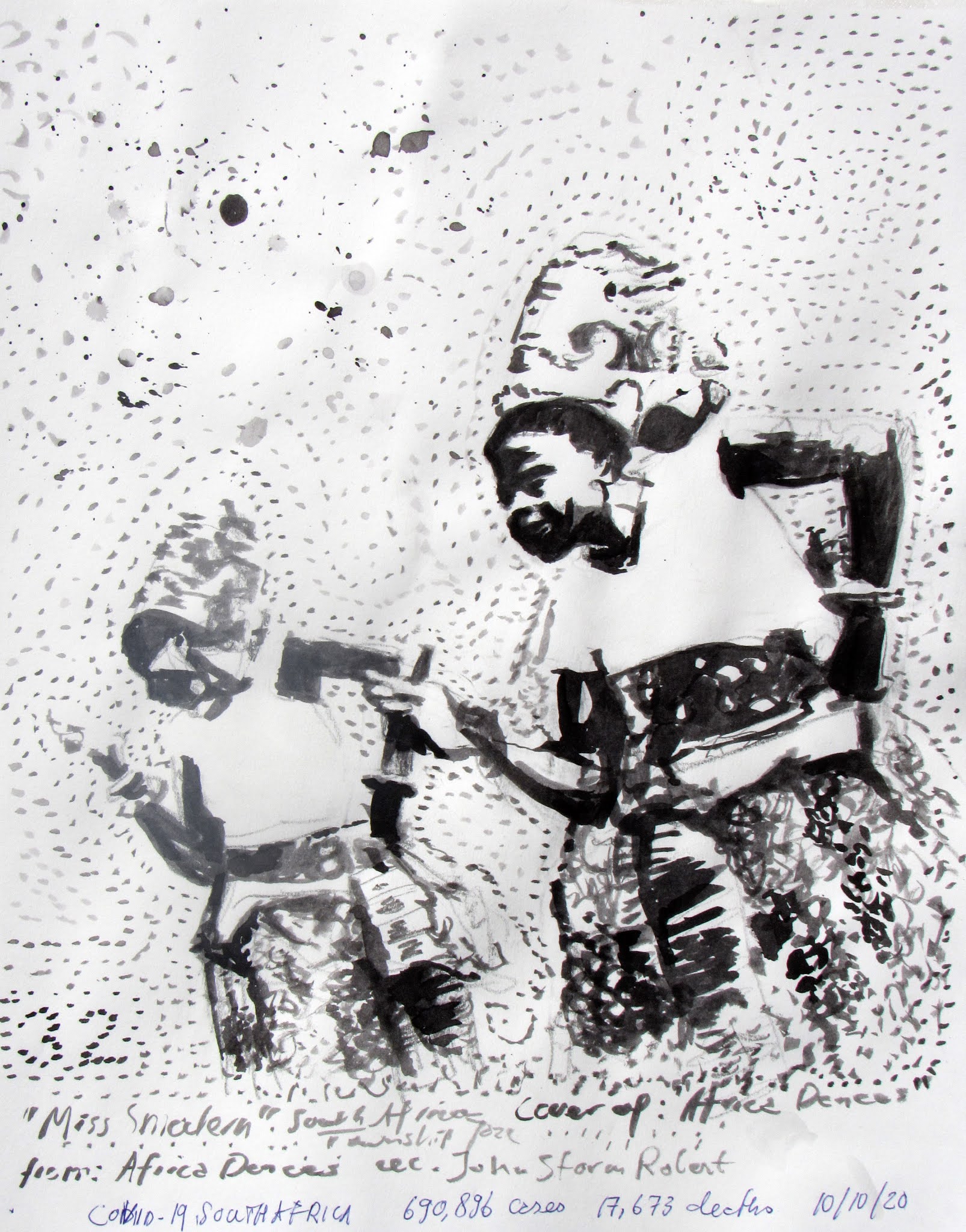
Africa Dances
![]() | ||
| Cover of Africa Dances |
Saturday, October 10, 2020
Yaqui Deer Dance
The collection called Anthology of Central and South American Indian Music on Folkways [1975] yielded a number of recordings nominated for inclusion of the Top 100 2019. At number 31 a song called Deer Dance was the only one to make it in though. This intriguing recording of Yaqui male singers with rasping sticks and water drums was made by Henrietta Yurchenco in Mexico in 1952. Only much later I checked out the original 1952 album it was included on: Indian Music of Mexico: Seri/Cora/Yaqui/Huichol/Tzotzil. It provided the recording with much more context. Later yet, in preparation to create an illustration for it, I became further acquainted with the Deer Dance ceremony and with the Yaqui. Yurchenco wrote in 1952: "the original Yaqui cultural pattern has largely disappeared with very few either material or spiritual elements remaining." Yet in 2020 there is ample of information to be found online, mostly of the Yaqui people of Arizona in the US. The Yaqui who performed this ceremony in front of Henrietta Yurchenco in 1952 were living along the Yaqui River in the state of Sonora south of the US border in Mexico. The Deer Dance is still widely performed today.
Yaqui Deer Dance Performer
Sunday, October 4, 2020
World: 35M, Nunavut 0
![]() | ||
| Katajjait singing |
Much of the the Top 100 2020 comes from regions barely affected by the global COVID-19 epidemic. More than a month after I painted the previous Inuit entry, the numbers for Nunavut (the Canadian Inuit Province) remain at zero. The katajjait vocal style features two women singing/breathing into each other's mouths so their voices resonate. Needless to say that COVID-19 would easily spread in the process. Nunavut is the location with most recordings in this top 100 followed by the Solomon Islands. I just read in the news today that the Solomon Islands recorded their first case of COVID-19. Maria and I both work in public spaces in a city where the virus is spreading rapidly. I thought it would be wise to get ourselves tested which we did today: the results came back negative. The song illustrated is a Qiarpaa, a variation of the katajjaq genre that really are considered games rather than music. This particular example from the collection Canada: Jeux Vocaux Des Inuit was performed by Issumartarjuak and Watuak and recorded by Roman Pelinski at Eskimo Bay.
Tuesday, September 15, 2020
Saturday, August 22, 2020
Chant funebre de femmes
Hugo Zemp, 14x11 inches, various materials on paper, 2020
Top 100 2020, #23 Chant funebre de femmes, Koleo from Iles Salomon: Musique de Guadalcanal. [Ocora, 1994] Recorded by Hugo Zemp, 1990.