Friday, May 9, 2014

The Fall

Mark E. Smith (The Fall)
16" x 12"
oil on canvas paper, 2014

A quick little oil sketch on canvas paper depicting Mark E. Smith of the Fall done on top of a hopelessly awkward flowers-in-a-vase painting that I had laying around since the day I instructed a group of students how to paint flowers. How I was talked into that assignment I don't know, but I feel for those students who witnessed my louse attempt at a flower painting demo. I'm in the process of using up all demo paintings done in the past year-and-a-half. It just happened to be The Fall that got assigned to go on top of these flowers. If I'm gonna leave it at that I don't know. I do know that when it comes time to display the 100 paintings in a gallery setting I have a lot of work to do because half of the paintings are rather unfinished, abandoned at a point when I felt like writing about it on this platform. The song Hey Luciani! happened to be the highest in the list of the paintings I had not done yet. The song, recorded in 1986, is about Albino Luciani, who became Pope John Paul I for 33 days in 1976. (An excellent opportunity for me to publish an image of an old painting called Kings and Queens that depict a bunch of people of power—kings, queens, popes, cardinals, generals, and presidents. The painting was done in 1995. I don't know if Pope John Paul I is included in the painting.)
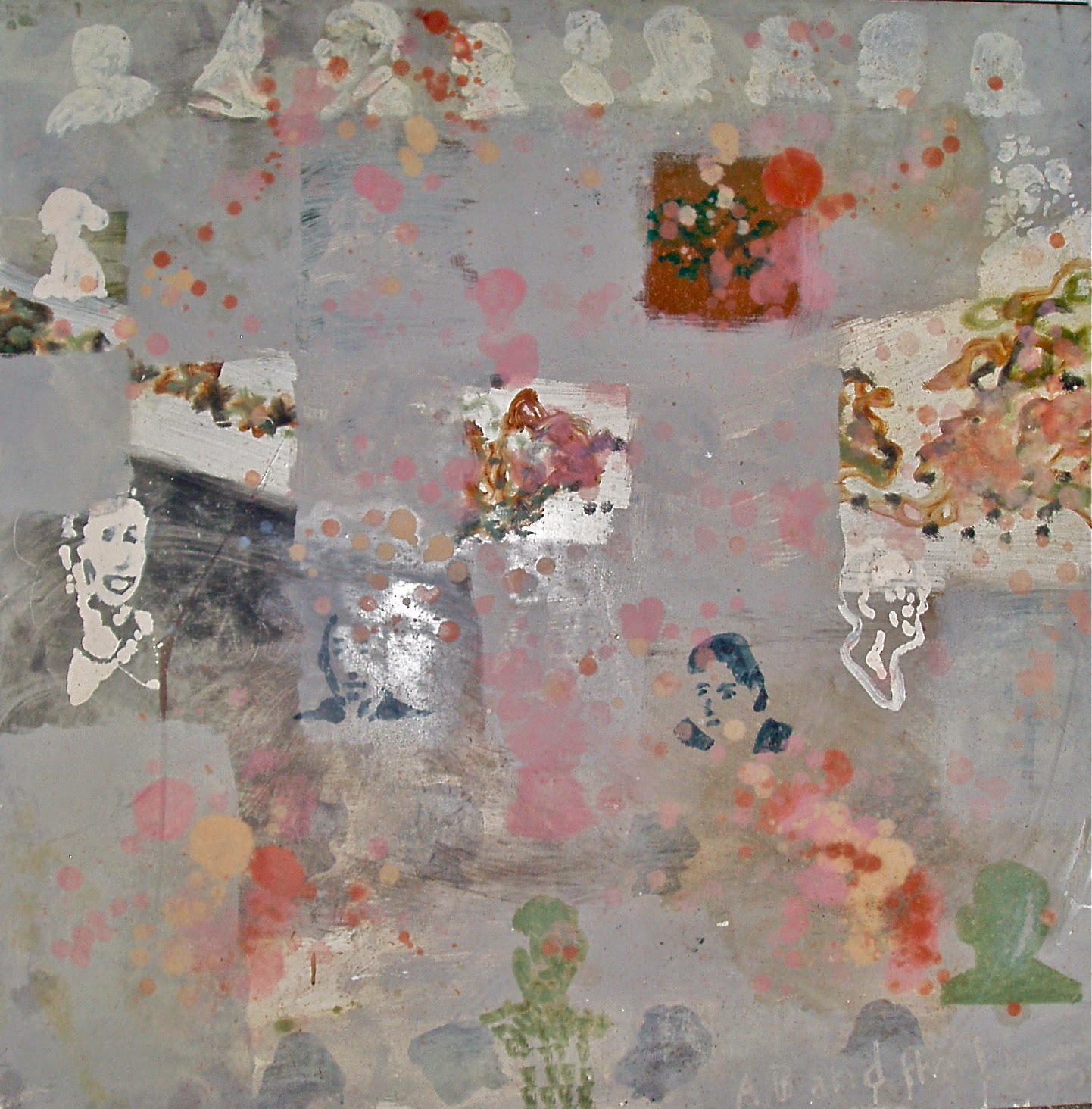
Kings and Queens
48" x 48"
oil on board, 1995

The Fall is really the music of my generation. The band did not feature too many times in the Top 100 but has accumulated points throughout the years nevertheless, and cemented a spot within the list of the 100 musicians with most points over the 32 years of list making. The very same photograph of Mark E. Smith (by Giles Price of the Telegraph) I had used before in a pop quiz compiled in honor of the 50th birthday of my friend Andy Spence, a huge fan of the band. The quiz consisted of 15 drawn portraits of people that I knew he would recognize. He had to win the quiz because the first prize was a record of Kurt Weill intended to be his birthday present. He did win, but not as convincingly as I had expected. Other portraits in the quiz included the footballer George Best, coach Avram Grant, film director Werner Herzog, and comedian Tommy Cooper. Here's that one too.

Mark E. Smith
5.5" x 4.25",
pen on paper, 2011


Thursday, May 8, 2014

Celia Cruz

Celia Cruz
12" x 9"
oil on board, 2014
It's a bit of a diary these writings. It reflects periods of excitement as well periods of self doubt and depression. The writings have embedded into it the memories of my infatuation with the music I write about and the process of making the painting. Each of the songs illustrated on this blog, represent episodes in my life in which it was meaningful. Sometimes they illustrate a topic, an attitude, or a feeling I was dealing with at a particular time while other times they're associated with a specific event. Mostly though, the songs represent a moment of intense empathy with the sounds, performers, or with the context. The paintings then represent a different moment in time than that of the music. They too, are sort of a diary, but independent from the music. They have their own internal psychology.
The Celia Cruz painting illustrates the song Mi Bomba Sonó, the first track on an album called La Tierna, Conmovedora, Bamboleadora. The album consists of sons, boleros, criollas, and bombas. Úrsula Hilaria Celia de la Caridad Cruz Alfonso de la Santísima Trinidad known simply as Celia Cruz, the Queen of salsa, was born in Cuba in 1925, immigrated to the United States in 1959, and died there in 2003. The event associated with Mi Bomba Sonó was a dance party on Thanksgiving 2013 when I picked this Celia Cruz record somewhat randomly from a stack of recently bought Latin records. I don't think I had ever played it before, but it sure turned out a good pick for dancing. We played the whole record, every track danceable. We had no idea when we were dancing a son, a bomba, or a criolla.

Tuesday, May 6, 2014

Exoticism

Fille Watutsi. Ruanda - Urundi
12" x 9", oil on board, 2014
Exoticism is a term used in art history designating western art works depicting ‘primitive’ scenes. Gaugain, in this context, is probably the best known exoticist. Exoticism started in the 19th century. The term is closely related to orientalism, a style in art that depicts scenes (or uses features) from the Near, Middle, and Far East, as well as North Africa. Both terms allude to the patronizing Western (white, male usually) artist who caters to a Western white male audience. (Images of harems were particularly in vogue.) “Exoticism, by one definition, is the charm of the unfamiliar,” (Wikipedia) or in more complex definition “born of the age of imperialism, possessing both aesthetic and ontological value, while using it to uncover a significant cultural otherness.” (Wikipedia: Victor Segalen) Orientalism is associated with the Neo-Classicist and Romantic styles of 18th and 19th century art, whereas exoticism started in the 19th century and persisted into the 20th. When the terms exoticism and orientalism are used these days it is usually not meant as a complement.

Exoticism and orientalism were but an excuse for male painters to paint exotic bare breasted females. In truth I’ve used the excuse myself. I had another excuse too: the Top 100. Only in 2006 I vowed to abort this unseemly practice. Yet the definitions forwarded maintain to be a major factor in my practice. “The charm of the unfamiliar” and “to uncover cultural otherness” continue to inform my Top 100 series. Even worse than the true exoticist I do not travel to exotic places to record images first hand, I take them from photographers and the adventurers who were ambitious enough to do so. I am couch tourist as it were. Personally I extend the definition of exoticism to a much broader use which includes the work of anthropologists, musicologists, and other sciences that study material found in cultures and lands far away, and even to tourists who travel exotic locations. Much of the music in the top 100 was recorded by those who indeed felt that urge to “uncover cultural otherness.”

Exoticism (or orientalism) in music typically refers to classical music from the 19th century such as the opera Aida by Giuseppe Verdi, but can be applied to any music that used ‘exotic’ sounds in the composition at any time in history. “The pervasive impact of racial perceptions and realities on the production and consumption of music clearly shapes musical exoticism.” (Exoticism, W. Anthony Sheppard) What I’m interested in, however, are not exotic elements in Western music, but recordings made in ‘exotic’ cultures. These recordings can be both commercial, with questionable intentions, or academic ‘field’ recordings that have scientific integrity. The latter, of course, more interesting, but both genres equally ‘exotic’ and both have a function in the documentation of such cultures.

The medium par excellence for exoticism is however photography. From the ‘kitsch’ erotically motivated postcards of the 19th and 20th century, via amateur tourist snapshots, to the academic anthropological documentation, photography as no other medium, has exoticism engrained in its essence, as it by definition almost, seeks to “uncover a significant otherness.” The photograph I used as a source for the painting above, is a vintage postcard depicting a Watusi girl from 1960. The recording it illustrates is Akazéhé, par une jeune fille, was made in Burundi in 1967 by Michel Vuylsteke. It appeared on Burundi: Musique traditionelles, my favorite ‘exotic’ record in this year’s top 100.

Monday, May 5, 2014

Tswana Men and Their Flutes

"Tswana men dancing and playing their pipes"
12" x 15", oil on board, 2014
Godumaduma Gwa Mosadi is a wonderful piece of flute dance music recorded by the great Hugh Tracey ca. 1948 in Botswana. It is one of the all time favorite recordings of music excavator Jonathan Ward. I found it on Ward's Excavated Shellac site as part of an all flute year-end-mix. The source photograph for the painting comes from the African Music Transcription Library and could have well been taken by Tracey himself, who also wrote a note for the recording: "The simple flute ensemble dances of a simple people. To the tune of these pipes the men dance slowly round in a circle." At the recording there were 16 pipers, of which only four made it into my back yard. I don't know if Modiseng, the leader of the group is included in the photo from the Transcription Library (or in my painting).

Sunday, May 4, 2014

Joy Division

Joy Division
9" x 12"
oil on canvas, 2014
Joy Division is a legendary cult band from Manchester. They only existed (with that name) for two years, from early 1978 until May 1980, when their singer Ian Curtis committed suicide. They took their name, which refers to a prostitution wing of a Nazi concentration camp, from a novel called House of Dolls . Before Joy Division they were called Warsaw (from May '77), and after Curtis died the remaining members continued as New Order. Their history starts in 1976, when founders Bernard Sumner and Peter Hook attended a Sex Pistols concert. Sumner recalled "(The Sex Pistols) destroyed the myth of being a pop star, of a musician being some kind of god that you had to worship". The band had a cult status since their very first gig, and to this date they remain to be this almost mythical band form the late seventies. I've had the pleasure to see the band Jam Division perform Joy Division covers on numeral occasions, I've seen exhibitions dedicated to their memory, and I've heard Joy Division mentioned as an impetus for more than a few distinguished careers in contemporary art. Hundreds of bands have covered their music and there are at least fifteen records produced, throughout the world, that are tribute albums. The top 100 now contains a track from one of these: Warszawa: Tribute to Joy Division with Joy Division covers by Polish bands. The track is She's Lost Control by the band Ścianka from the city of Sopot on the Baltic coast.

Saturday, May 3, 2014

Geechie, Elvie, and Me

L.V. Thomas
20" x 16"
oil on board, 2014
★Last Kind Words Blues by Geechie Wiley, accompanied by a certain Elvie Thomas, was the #1 in the Top 100 of 1999.
★The 1994 documentary film Crumb, by Terry Zwigoff introduced me to the song. 
★Robert Crumb owned a 78 disc of the song, one of only 10 discs known to exist of the duo that recorded only six sides.
★Like many others, and myself, the journalist John Jeremiah Sullivan became fascinated with the song after seeing the movie.
★Last Kind Words Blues was recorded in 1930 and is considered a masterpiece. 
★Wiley and Thomas were as obscure as obscure gets. 
★50+ years of researchers' efforts yielded very little information, not even the real names of the two performers.
★John Sullivan set out on a fifteen year journey to uncover the identity of the two women.
★The journey saw the first results when Sullivan met Mack McCormick, a veteran in the field of blues research.
★In McCormick’s files Sullivan found a mention of a woman guitar player “as good as any” named L.V. Thomas.
★Miss Thomas was still alive when McCormick did research on her, this was in 1961. 
★Eventually Sullivan identified the two women. Geeshie (as he spells it) was Lily Mae Wiley, nee Scott, and Elvie was L.V. Thomas, nee Grant.
★Lily May Scott was born in 1908 in Natchez, MS, while L.V. Grant was born in 1891, in Houston, TX.
★L.V. Thomas died in 1979 (in Houston), when Lily Mae Wiley died is not known.
★Lily Mae Scott killed her husband, Thornton Wiley, in 1931.
★Wiley and Thomas were likely involved in a lesbian relationship.

Friday, May 2, 2014

Naseebo Lal

Naseebo Lal
14" x 11"
oil on canvas board, 2014
You may have noticed the high percentage of paintings (on this blog) of female singers. If it comes to the human singing voice, this year in particular is indeed the year of the domination of the female voice. While men still dominate the instruments (a stat impossible to count), almost 80% of the voices in this top 100 are of women. Naseebo Lal is the latest singer to enter into the list. She is a singer from Lahore, Pakistan who was arrested in 2009 for singing vulgar songs. She is one of Pakistan's "topmost" singers, but I have not been able to find any news about her after the court hearing following the arrest. The following paragraph comes from the Pakistani on-line newspaper The Daily Times:
"He (Asim Mahmood, petitioner) said Naseebo Lal and Nooran Lal (her sister, also a singer) with the connivance of other respondents were busy in making and singing illegal, indecent and immoral songs. He requested the court to ban all the audio and video songs of the two singers and their certification and exhibition might also be banned."
This then is from another article from that same newspaper, appearing around the same time:
"The petitioner, Asif Mehmood Khan, said the departments concerned in connivance with some other criminal elements were not only violating the law and the constitution, but also spoiling the integrity, sanctity and morality of society."
Mrs. Lal, in her defense, claimed that her producer forced her to sing these vulgar songs. 

Naseebo Lal is not the only singer who had run ins with the authorities because of their music. The following list are the ten best scoring musical acts in this year's top 100. Note that eight are female singers, and at least two of these have received death threats because their music posed a threat to the "integrity, sanctity, and morality of society".
  1. Cat Power                
  2. M.I.A.                    
  3. Alela Diane                
  4. Pussy Riot                
  5. Rahsaan Roland Kirk            
  6. Kimya Dawson                
  7. Geechie Wiley and Elvie Thomas    
  8. Björk                    
  9. Michael Hurley 
  10. Rosa Balistreri               
In the next blog I'll talk about Geechie Wiley and Elvie Thomas as I'm currently working on a portrait of L.V. (Elvie) Thomas.      

Thursday, May 1, 2014

Tracey Emin

Top 100 2002: Singles Tent
6' x 7' x 8', paper and wood, 2003
  
Another artist who operates in the higher regions of the contemporary art world, and who I admire greatly, is Tracey Emin. Like Peyton, she’s about the same age as myself. Unlike Peyton however, she grew up in Britain, being a teen during the punk rock era. Her work, I believe, cannot be dissociated from that. It really is punk. I envy that. Her most notorious work is a tent that is called Everyone I Ever Slept With 1963-1995. She built her tent a good six or seven years before I built mine. I didn’t know of Emin until fairly recently and neither had I seen her tent when I built mine, but it certainly was an inspiration, if only in retrospect. The tent I built in 2003 is my only foray into sculpture, or installation art, and fills me with loads of precious memories. I built it as a celebration of doing the Top 100 for twenty straight years then. In it were pillows, blankets, a portable 45 player, and a bunch of selected singles. Its walls were made from 45 rpm single covers, those that were issued by record companies, those with logos and a hole in the middle, holes that, when lit strategically, would cast beautiful shadows in, and outside the tent. The opening reception was well attended. Among the visitors that night were three gorgeous female fashion models, who in the early morning hours, when it all was about to end, engaged in a wrestling match inside the tent. Even though the walls were built from paper-thin paper, I did not intervene and tell them to be easy on the fragile tent. Not a single ‘single’ sleeve broke.


Tracey Emin, Everyone I've Ever Slept With, 1963-1995
tent with fabric stitchings, 1995, Saatchi, London

Elizabeth Peyton

Top 100, 2004: Cat Power
11" x 6", oil on board, 2004
About fifteen years ago I saw a painting by Elizabeth Peyton depicting the rock star Liam Gallagher. I immediately recognized, in that one painting, a certain kinship in our work. It felt empowering that her work, feeling a similarity in sensibility and attitude with mine, was so highly esteemed in the contemporary art world. There’s a similarity in chronology too; we’re about the same age, started out with somewhat clunky drawings in the late eighties, and moved on to produce small oil portraits of musicians on boards in the nineties. Between the two of us she’s the better painter and for sure the more professional. Where my career was marred by detours and missed opportunities, her’s went straight up. Since the early 2000s I’ve gained a bit of recognition, my work has been shown in the same spaces as hers, even in the same exhibition, collected by the same collectors, and reproduced in the very same book, but my work never gained the exposure her’s did. I’m like her amateur little brother (even though I’m a bit older), not being able to fully get out of the little boy’s room, and still dabbling away at that what started us in the beginning. I’ve never met ms. Peyton.


Elizabeth Peyton
Blue Liam, 17" x 14"
oil on board, 1996
Gavin Brown Enterprise


Monday, April 28, 2014

Voina

Nadezhda Tolokonnikova
oil on wood
15" x 12", 2014
Putin Lights Up the Fires, Putin Zassal (Putin wets his pants), and Putin Will Teach you to Love the Motherland are three Pussy riot songs that are in the current list of 100. The titles clearly show the main topic of Pussy Riot's music. The last one from the list of three is also the last to appear in the top 100. It was released in 2014, coinciding with the Winter Olympics in Sochi. The video shows Pussy Riot members being attacked by Cossacks. Lots and lots of media attention has surrounded Pussy Riot since their infamous performance at a Russian Orthodox Church in 2012, but it is not just their political activism that gained them this global notoriety, it is the music too that validated the fame. Two of the founding members of Pussy Riot, Tolokonnikova and Yekaterina Samutsevich, were involved early on with the Russian street-art group Voina (f. 2007). One of the most memorable pieces this group produced is the Giant Galactic Space Dick, a 213 feet long (tall, when in raised position), 89 feet wide phallus painted on a bridge in St. Petersburg.
I take any and every opportunity to bring punk rock into the canon of art history. (By my modest means of bringing it into the art history classroom—I did not show the above image however.)

Friday, April 25, 2014

A Hobby

M.I.A.
oil on wood,
24" x 12", 2014
The Top 100 is a hobby. That statement starts this site that thus far yielded over 400 paintings and drawings of my favorite musicians. There are about 2,500 of such images altogether. The opening statement then continues: the project has left the boys room and entered the realm of art. It is in that part of the statement where the trouble begins: The project doesn't work in the realm of professional entrepreneurship. The project works by virtue of the fan, the admirer, the amateur, the hobbyist. To maintain this project as an entrepreneur doesn't work, I have come to realize, but in stead of adjusting the business plan I've adjusted my expectancy level (adjusting to zero that is.) I have been able to this because of two reasons, the first of which is my new found career as an art history teacher. I have also been showing paintings that are nice and big—have nothing to do with the Top 100, that have an aura of professionalism. On top of it all I have gained, thanks mostly to an article on Lady Clementina Hawarden by Carol Armstrong, a new appreciation for amateurism. That in amateurism lies the attainment of the discipline (that this medium is photography in the article is a mere footnote.)

“In the classical sense the amateur is the antonym of the professional, and refers to those who pursue a problem for love rather than for the rewards the world may have to offer. In this sense the word often identifies the most sophisticated practitioners in a field. The other and more popular meaning (of amateur) identifies one who plays at his work: one not only less than competent, but less than fully serious...." (John Szarkozy, Looking at Photographs, 1975)

Psycho(self)analysis 101 teaches me that I thrive in amateur settings. There are no expectancy patterns, I'm free (a lot more came out of these 101 sessions but I keep that to myself:) As I celebration to my new freedom I took my paints to this open studio at a local arts center. (My own studio reminds me too often of a failed professional career.) There I picked up the joy of painting again. M.I.A., being this star with a global mass appeal, I considered an appropriate new start. Recently I bought (full price, I only do that about twice a year) M.I.A.'s Maya. I needed to do this because her song Born Free (currently residing at no. 1 in my 13/14 list) entered into the top 10 of my all time favorites. (These need to be owned in vinyl format in crisp condition.) The "Run for Your Life" source photo of M.I.A. has been a long time favorite, and I have attempted painting this several times.


Monday, April 14, 2014

T-Model Ford

Top 100 2010: T-Model Ford
8" x 10"
pencil on paper, 2009

signed by the musician
I was thinking last night about this little sketchbook drawing I did of T-Model Ford five years ago. It was drawn from a live performance in Ohio. After the concert I walked up to him to and asked him to sign the drawing. He did, and I realized then that he probably never learned how to write. Jolie Holland was on the stage too, she had him sign her guitar she would perform with later. James Lewis Carter Ford was born in Forest, Mississippi but he couldn't remember when exactly, it must have been around 1920. According to that date, he must have been 89 when I saw him perform. He was very cheerful, had smiles for everybody. His musical career didn't start until the 1970s and he didn't record until 1997. His life was hard. T-Model Ford died last year leaving behind eight records and (reportedly) twenty-six children.