 | |
| Seven back yard paintings, various sizes, oil on canvas, 2011 |
Monday, December 19, 2011
My backyard as a stage


Thursday, December 15, 2011
Keening
 |
| Greenham women 24" x 18" oil on canvas, 2011 |
Those of you that regularly check into the posts on this blog know about my preoccupation with mournful singing by women, keening as it is called in Ireland. Slowly I'm developing a collection of recordings from all over the world that fit this category. True keening recordings are hard to come by (officially the practice of keening is extinct) and this recording by women from Greenham is the best example I've come across yet. It's a news video made by the British newspaper The Guardian. On it the Greenham women, about thirty of them, can be seen and heard keening while protesting nuclear power on the occasion of Ronald Reagan's visit to England in 1981. The woman had marched from the Greenham military base to Parliament Square in London. Sixteen of them were arrested on arrival. The recording marks the second occurrence of a musical performance broken up by police (see "Guatemala" for the first one) in the current Top 100, and the third example of cry-singing (also keen, wail, or lament). In the painting Parliament Square is replaced with an image of my own back yard, as has become habit lately.
Sunday, December 11, 2011
Guitar Slim
 |
| Guitar Slim Green 6.25" x 5" oil on wood, 2011 |
This painting on a small piece of wood was at first no more than a little exercise in landscape texture I painted on the side while working on a larger canvas. But the exercise was recycled, just as the landscape painting, into a Top 100 painting. The little ones are the most fun to do. They are as spontaneous, unmediated, and unassuming as they come. Doesn't Guitar Slim look like he's really enjoying it? (For you collectors of small paintings: they are a lot cheaper too!) There are several blues musicians who recorded under the name of Guitar Slim. The best known was born as Eddie Jones and had a huge hit with The Things I Used to Do. He couldn't handle success and died at 32. His son Guitar Slim, Jr still performs his dad's songs. Norman "Guitar Slim" Green had not such trouble. He still may be alive today, he may be playing at a juke joint somewhere as I write this. His 1970 record Stone Down Blues may well be the only record he made. What we do know for sure is that the two musicians that accompany Green on the record are still alive. They are Johnny and Shuggie Otis, father and son, both with a giant career in the music biz. Stone Down Blues is a great record, it rocks!
Saturday, December 10, 2011
The mainstream jazz
 |
| Gato Barbieri 14" x 6" oil on wood 2011 |
Anything that produces sound is fair game these days, from the latest million selling pop hit of Lady Gaga to the kid in the neighborhood practicing his guitar to play a tune in church next Sunday. They all have the potential to be listed in my archive alongside Jimi Hendrix, Bob Dylan, John Coltrane, and all the other greats from the long history of recorded music. Jazz has been fair game all along but not the kind of jazz creeping into my weekly lists lately. In the last three lists three different jazz musicians, all categorized as mainstream, made their first appearance. First there was the smooth jazz trumpet of Grammy nominee Chris Botti, then the flutes of New Age pioneer Paul Horn, and lastly the Latin Jazz sounds of Gato Barbieri. None of those jazz tunes are likely to make it into the final list of 100 songs for the year 2011 but in the case of Gato Barbieri I dug a little deeper and found some really great pre-Latin-pop on a Latin-free-jazz disc called El Pampero. The tracks were recorded live in Montreux, Switzerland in 1971. Gato Barbieri hails from Argentina and the song to be included in the list of the hundred for 2011 is the patriotic Mi Buenos Aires Querido, a tune that was originally a song by Argentinian tango legend Carlos Gardel.
Monday, November 28, 2011
Guatemala
 |
| Street musicians from Santa Clara la Laguna 24" x 18", oil on canvas, 2011 |
Arsenal set a unique record last Saturday: All 14 players (the original 11 and the maximum allowed three subs) had a different nationality. I'm a fan of Arsenal. Their international character is reflected in my top 100. The Top 100 2011 is rapidly becoming my most international list ever. The 38 songs in the list so far represent music from 23 different countries. Number 39 is from Guatemala (that makes it 24). The Guatemalan song is an old time traditional urban song (ranchera) performed by a group of indigenous street musicians from Santa Clara la Laguna. The song, in the format of a video blog, was recorded in 2008 by Rudy Girón in the city La Antigua Guatemala. The musicians were playing for some handouts from by passers, mostly tourists. Near the end of the video some policemen come over. They talk to the guitar player while the other three keep on with their song (a religious hymn). According to Girón the policemen asked them to stop playing, supposedly for not having a permit. Girón concludes that the real reason for police intervention was that the type of music they were playing was too exotic, too third world like, to be heard on the streets of a city that is so dependent on tourism. They are welcome to play in my back yard though (which is where they are situated in the painting).
Sado Okesa
 |
| Japanese dancer 9" x 12" oil on canvas, 2011 |
The image of the dancing Japanese woman was originally part of a photograph of a large dancing group used on the Folkways album Traditional Folk Songs of Japan. The background was painted en plein air at Bowditch beach in Fort Myers. The song for the Top 100 2011 it represents is Sado Okesa. Sado Okesa is a love song that originates from the island of Sado. The version on Traditional Folk Songs of Japan was actually recorded on that island but the Top 100 version of the song comes from Yokohama. It appears on Folk Music of Japan, yet another Folkways release. It was sung by a Geisha in 1952 and is an urbanized version quite different from the original (de Sado version on Traditional Folk Songs could be considered the original version but was recorded nine years later in 1961—the real original is of course hundreds of years older).
The Sado version I downloaded from the Smithsonian website for 99 cent. The Yokahama version I found on the original vinyl LP Folk Music of Japan. It cost me also 99 cents in a thrift store in Cape Coral.
Thursday, November 24, 2011
N'Goundi girls
 |
| N'Goundi girls 24" x 18" oil on canvas, 2011 |
The Folkways catalog, and especially the Ethnic Folkways Series, housed in the Smithsonian Library of Congress, is probably the best and broadest source of historic field recordings that exists. I consider myself a collector of these series even though I only own less than 5% of the 500 or so records in the series (of a total of 1930 titles on Folkways). The records were produced by Moses Asch and released from 1944 until Asch's death in 1986, after which the Smithsonian Institute added the label to their inventory. All Folkways' titles have always been available on vinyl during Asch's life and all titles continue to be available on CD format (or as download) through the Smithsonian Institute. Occasionally I pick one of the titles and listen to excerpts of the songs on it. I pick my favorite ones and order these as a download for 99 cents a song. The last one I explored was Music of Equatorial Africa with recordings made in the early 1950s in what was then French Equatorial Africa. My favorite pick from the recordings is a song by young N'Goundi girls. It's a chorus of girls singing accompanied by hand clapping. The lead singer uses a sort of a yodel in her singing, probably picked up through neighboring pygmy tribes. "This a satirical and licentious song. The young N'Goundi girls scoff at a young boy who has bragged too much about his capabilities."
The location of the recording is not specified but most likely made in what is now the Democratic Republic of the Congo. The N'Goundi people must be known now by a different name as all the hits on a search on line for N'Goundi come from sources before 1954, the year the record was released.
Extensive searching for images yielded only two photographic images, both from the early 20th Century. The three girls in the painting are singled out from a larger group of N'Goundis in one of these photographs. It was found in the Eliot Elisofon Photographic Archives.
Friday, November 18, 2011
Robert Johnson (2)
 |
| Robert Johnson oil on canvas 24" x 18", 2011 |
A hot news item recently was that some film footage of Robert Johnson was found. Everybody got very excited but the musician in the footage was to remain anonymous and was certainly not Robert Johnson, so was decided by a panel of both musicologists and people who actually knew him. There are only two known photographs of Robert Johnson; the one used to inform this painting, in the other–also taken while playing guitar–he smokes a cigarette (that was omitted when used as a US postage stamp). The proprietor of the Robert Johnson estate commissioned a video artist to animate Johnson's face using both photographs (cigarette omitted). The result is really pretty amazing, it looks like Robert Johnson is singing, the music to go along the video: Hellhound on My Trail. This is the closest thing yet to see Johnson perform on film.
The Robert Johnson I'm talking about is course the legendary, almost mythical, blues musician. It is a different blues musician, and much better known, than the Robert Johnson I mused about a few months ago.
My backyard is in the background of the painting again but you may wonder what that orange color is near the bottom of the painting. Well... it's cheese. How did it get there? That's a long story which involves an artist statement and schoolchildren from Volendam.
Wednesday, November 9, 2011
Chemirocha
 |
| Kipsigis woman 24" x 18", oil on canvas, 2011 |
Here’s an anecdote that explains why I am such a fool:
Just the other day after a half an hour browsing through some stacks at a local record store my eyes caught a 10” record of some African music. It looked old (50’s, early 60’s maybe) and I am a sucker for old world music recordings, so I picked it up. It said Music of Africa Series No. 2 Kenya. Nothing wrong with that, when I look further my heart starts to beat a little faster: Collected and Introduced by Hugh Tracey.
Hugh Tracey to me is what Dick Tracey may be for some others. Hugh Tracey is the African Alan Lomax. For the sake of the preservation of disappearing cultures he founded an institution and would collect, record, and document cultural life in Africa. From the 1930’s on he recorded extensively in the field to capture the music of many cultures that are now extinct in their traditional form. Tracey first recorded many an African superstar. Tracey also introduced the world to the music of pygmy societies. Since Tracey’s death a few years ago many of his recordings were released but can only be purchased if you buy all 16 of them. That is too much for me, I did however copy every single Tracey recording I could find at the local library, and these have been standard fare of my Top 100 in the last years.
Monday, November 7, 2011
The Soul of Mbira
 |
| Muchatera Mujuru after a photo by Paul Berliner 13" x 7.5", oil on wood, 2011 |
The next time I reshuffle my record collection I plan on organizing the category of traditional music from around the world by record company instead of the current geographical arrangement. It would be nice to see those records with a very specific sleeve design, such as Arion and Olympic together. It will bring together items from a single catalog as well as the field work by a single musicologist. The Library of Congress carries most of Alan Lomax's recordings while the Nonesuch Explorer Series houses David Lewiston's. The Ethnic Folkways Series under the umbrella of the Library of Congress and the Nonesuch series are the most interesting. They have the most extensive and acclaimed collection of authentic field recordings. The Soul of Mbira: Traditions of the Shona People of Rhodesia is one of many highlights from the Nonesuch Explorer catalog. This one wasn't recorded by David Lewiston, he did some tape editing, but by Paul Berliner, who also wrote the liner notes, and supplied the photographic illustrations. I've had a copy of The Soul of Mbira on a cassette tape for a long time and was delighted to find an original vinyl copy in a local thrift store. Nyamoropa Yevana Vava Muchonga by Muchatera Mujuru was my favorite track when I first listed the album in the Top 100 back in 1991, and now 20 years later it still is my favorite and reappears in the Top 100. With my cassette I never had a copy of the liner notes and it is not until now that I learn that Nyamoropa, according to Paul Berliner, is played on "one of the few remaining varieties of an older style 25-key Mbira Dza Vadaimu, having th lowest and most traditional tunings".
The Soul of Mbira: Traditions of the Shona People of Rhodesia was first released in 1973, when it was issued on cd in 2002, the title changed to: Zimbabwe: The Soul of Mbira, Traditions of the Shona People.
Saturday, November 5, 2011
The National Sitar Ensemble
 |
| India National Sitar Ensemble (Sitar Music of India, sleeve) 14" x 16", oil on canvas, 2011 |
Sitar Music of India is a really great record of Indian folk music featuring the India National Sitar Ensemble with the Indian Folk Ensemble released by the Californian Everest label. The music has the stateliness of Indian classical music and the excitement minus the kitsch of Bollywood film music, the best of both worlds. I'd imagined a music like that would exist, i just hadn't heard it yet. In my mind I can dream up the greatest music, you see, but when you put an instrument in front of me I'm instantly lost. I can dream up the greatest paintings too, but when I execute them they're never like the ones I dream, or in the few cases when they are, I realize that a painting in a dream can look a hundred times better than a material one. Don't get me wrong: I don't discourage dreaming, I think dreaming is alright.
Tuesday, November 1, 2011
Lament from Hungary
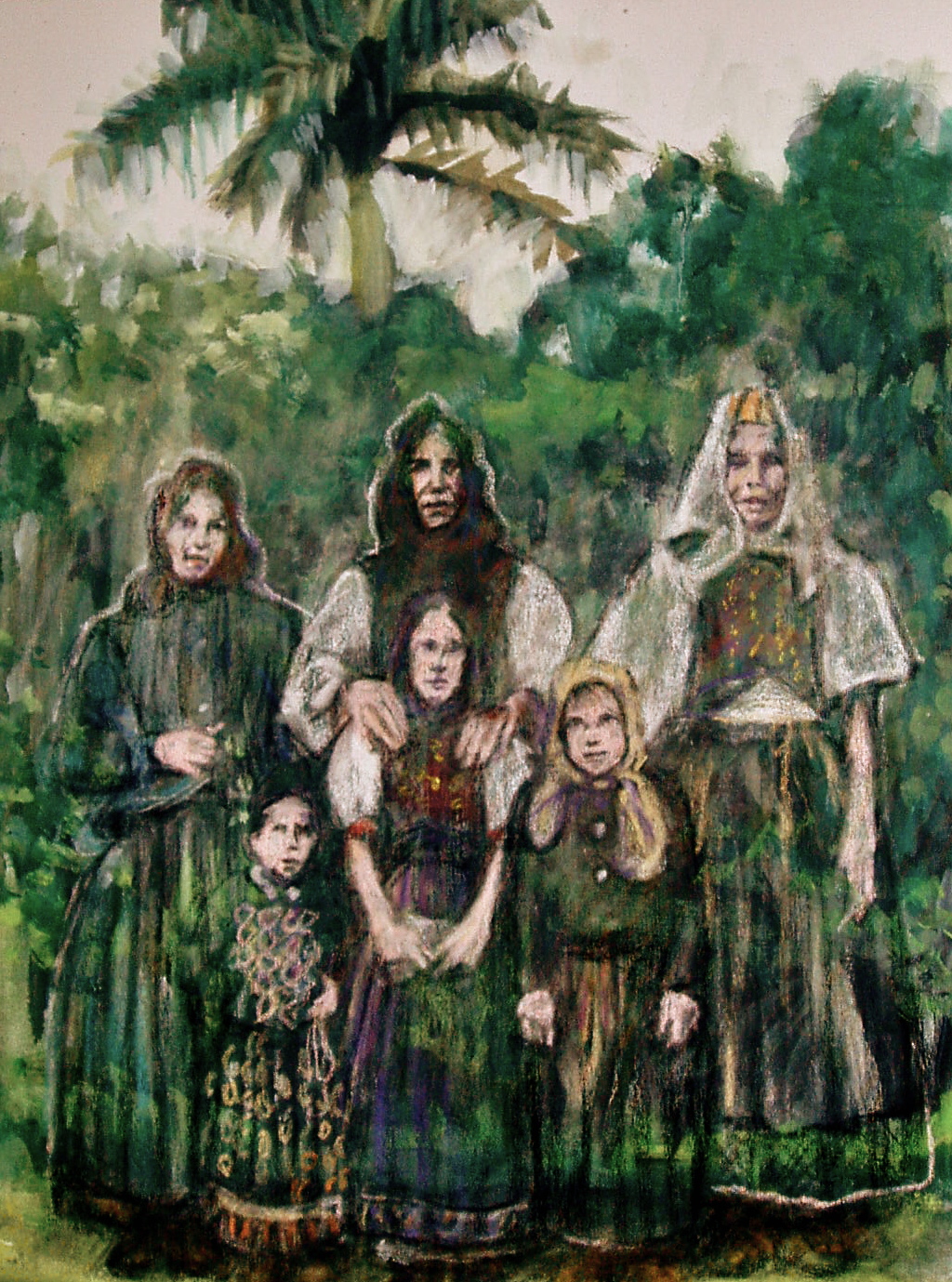 |
| Folk Music of Hungary cover (after a photograph by Béla Bartók) 24” x 18”, oil and pastel on canvas, 2011 |
Nostalgia - community - family - traditions - children - nature - home, these are some of the topics my paintings occupy lately. The same topics are present in the music I listen to (painting and music are parallel for me, always). Some of these topics had not entered my work before—children for example: I was never interested in their songs, their aesthetic, or their play, but something changed. I think it started with teaching children this summer, I had never done this before, and never thought I would like it, but I did—it gave me joy. In painting, in music, and in real life children provide an uncomplicated presence. There’s no idolatry, sexual charge, or psychological complexion—burdens I feel no use for, in these paintings anymore.
It has recently been discovered that some of the iconic ancient cave paintings have been done by small children. In the recently discovered Rouffignac caves in the Dordogne, the most prolific artist was a five year old girl. Learning about this fact had an enormous impact on my worldview and my attitude of how I view my position within the world of art.
The LP Hungarian Folk Music contains a really nice children’s song but the first track from this magnificent record to be included in the Top 100 is sung by an older woman. Jaj, Jaj énnekem bánatos anyának! is a lament from the north of Hungary, a true example of the world-wide practice of cry-singing I have been collecting for many years. There hasn’t been a top 100 in the 2000s without an example of such mode of singing.
The group of Hungarian women and girls was photographed by Béla Bartók and used for the cover of Folk Music of Hungary with recordings made by Bartók. Hungarian Folk Music (not to be confused with Bartók's) is an introduction to a series of records that was to be started in 1965 by the Folk Music Research Group of the Hungarian Academy of Sciences. I don’t know if the series ever materialized.
It has recently been discovered that some of the iconic ancient cave paintings have been done by small children. In the recently discovered Rouffignac caves in the Dordogne, the most prolific artist was a five year old girl. Learning about this fact had an enormous impact on my worldview and my attitude of how I view my position within the world of art.
The LP Hungarian Folk Music contains a really nice children’s song but the first track from this magnificent record to be included in the Top 100 is sung by an older woman. Jaj, Jaj énnekem bánatos anyának! is a lament from the north of Hungary, a true example of the world-wide practice of cry-singing I have been collecting for many years. There hasn’t been a top 100 in the 2000s without an example of such mode of singing.
The group of Hungarian women and girls was photographed by Béla Bartók and used for the cover of Folk Music of Hungary with recordings made by Bartók. Hungarian Folk Music (not to be confused with Bartók's) is an introduction to a series of records that was to be started in 1965 by the Folk Music Research Group of the Hungarian Academy of Sciences. I don’t know if the series ever materialized.
Subscribe to:
Posts (Atom)